인급동 (ingeupdong) — Three Syllables Born on a YouTube Screen, and How Koreans Actually Use Them
인급동
인급동 (ingeupdong) is a shortened form of 인기 급상승 동영상 (ingi geupsangseung dongyeongsang), “rapidly rising popular videos” — YouTube’s trending list. It refers to a video whose view count explodes in a short time and lands it on that list of the moment’s hottest clips. Talk about YouTube with a Korean friend and these three syllables are almost guaranteed to come up. A video uploaded at dawn that has hundreds of thousands of views by the time you open your eyes in the morning; a favorite idol’s new music video sitting at the top of the list half a day after release; a neighborhood noodle-shop vlog nobody had heard of suddenly going nationwide — Koreans don’t spell any of that out at length. 인급동 떴다 (ingeupdong tteotda) and that’s the whole sentence.
The emotional temperature of the word sits close to “congratulations” and “excitement.” It doesn’t simply mean “it has a lot of views” — it carries the nuance of “it blew up suddenly, unexpectedly, visibly.” That’s why people rarely use it about a channel that has been steadily popular; they use it when a video that was quiet yesterday shoots up today. The verbs that attach to it are fixed, too. 인급동 떴다 / 인급동 갔다 / 인급동 올라갔다 (ingeupdong tteotda / gatda / ollagatda) are the most common, and you can add a rank: 인급동 1위 (ingeupdong ilwi). For a video that hasn’t made the list yet but feels like it’s about to, there’s 인급동 각 (ingeupdong gak). 각 (gak), written with the Chinese character 角, is a word younger Koreans use widely to mean “the signs of / the right timing for something about to happen,” so when the two are joined the result is roughly “this one’s going to blow up, right?”
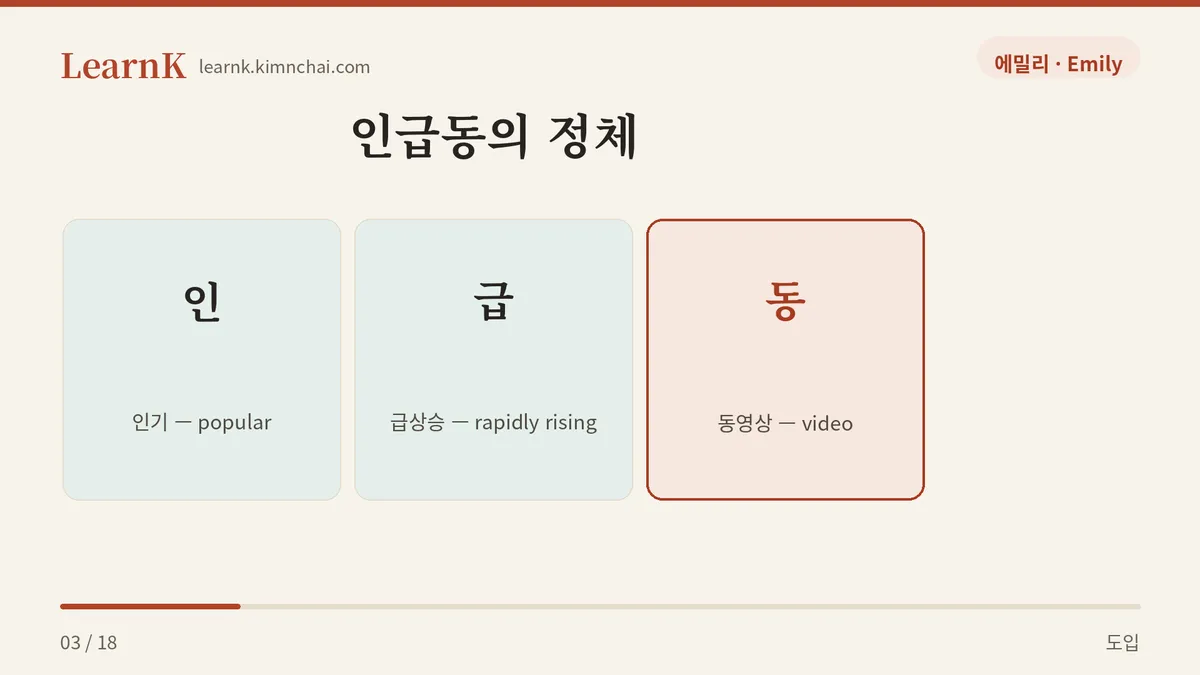
One thing to keep in mind: 인급동 (ingeupdong) began as the name of a menu on a screen. It isn’t a metaphor somebody invented — it’s the actual name of a list on YouTube’s Korean interface, which users kept shortening until the short form hardened into a word. So it is never attached to a person; it goes only with videos, channels, and content. The moment you cross that line it sounds off, which we’ll look at in detail below.
See It in a Real Conversation
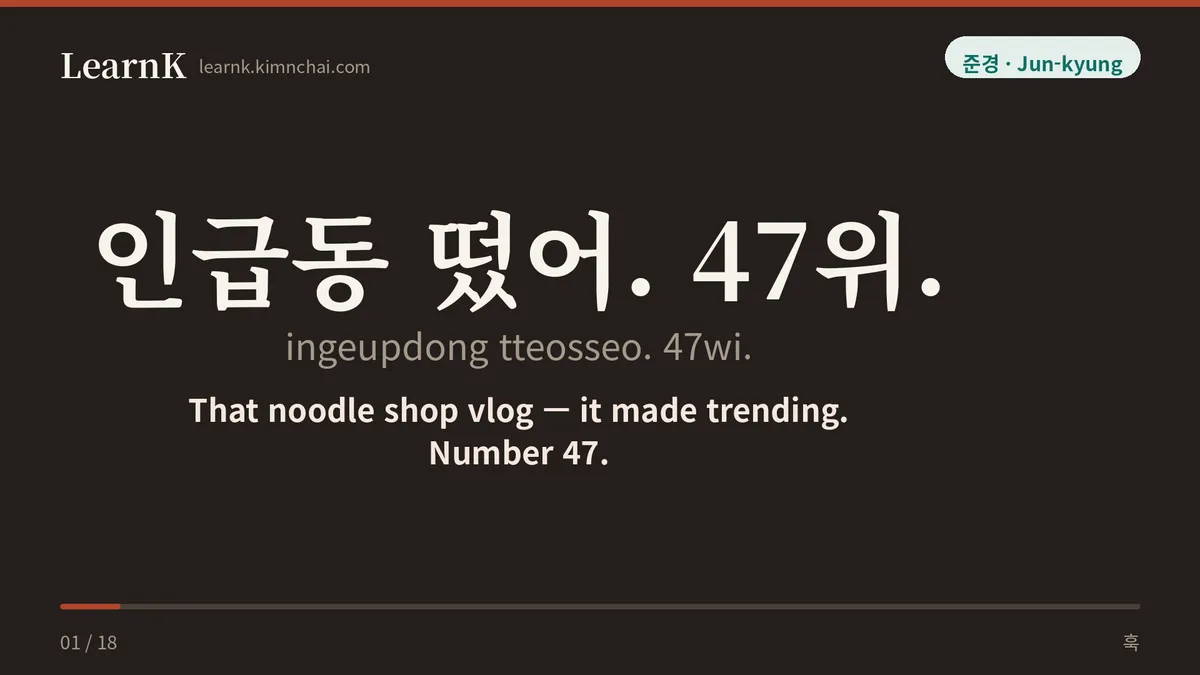
Setting: Friday evening, on the subway home from work. Two people sit side by side, each looking at their own phone.
Jun-kyung: 야, 에밀리. 폰 좀 켜 봐. 빨리. Hey, Emily. Pull up your phone. Quick.
Emily: 왜, 무슨 일인데 그래. 나 지금 배터리 3%야. What is it? My battery’s at 3 percent.
Jun-kyung: 너 어제 올린 그 국숫집 브이로그, 인급동 떴어. 47위. That noodle shop vlog you posted yesterday — it made trending. Number 47.
Emily: …뭐? 그거 조회수 200이었는데? 말도 안 돼. …What? That thing had 200 views. No way.
Jun-kyung: 내가 그랬잖아. 썸네일 바꾸면 인급동 각이라고. I told you. Change the thumbnail and it’s headed straight for trending.
Emily: 아 손 떨려. 나 이번 역에서 내려야 되는데 못 일어나겠어. My hands are shaking. This is my stop and I can’t even stand up.
Where It Sounds Off
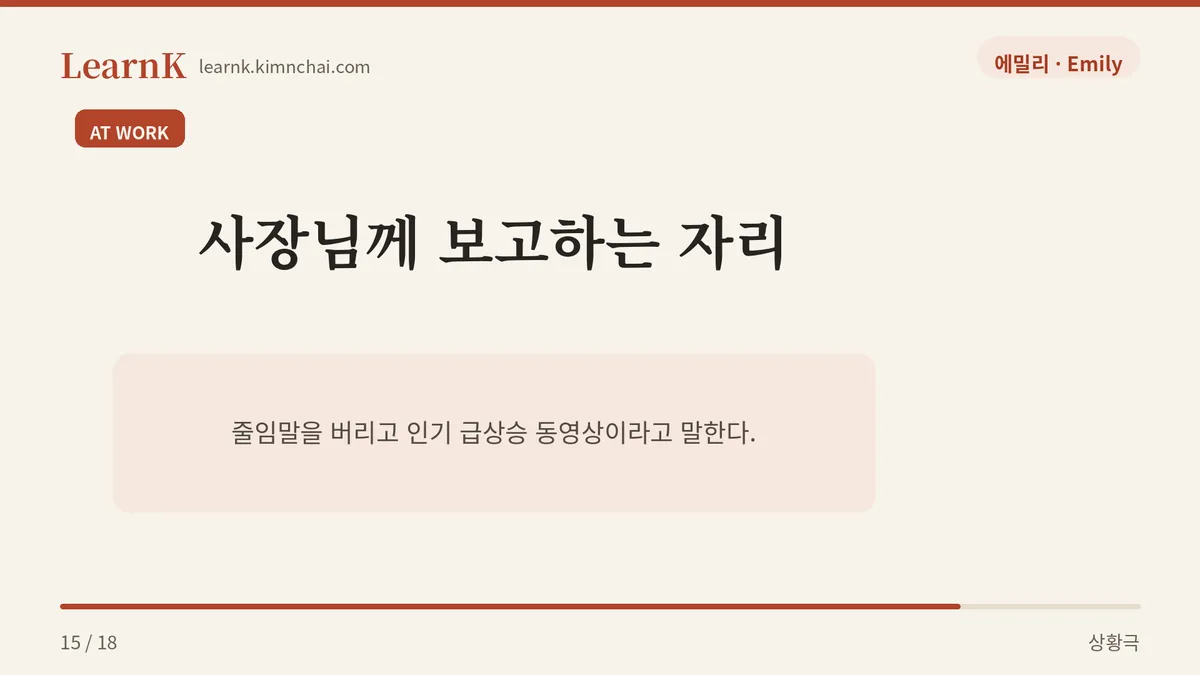
✗ (To your boss) 사장님, 저희 홍보 영상 인급동 갔습니다. — Sir, our promo video went trending. ✓ (To your boss) 사장님, 저희 홍보 영상이 인기 급상승 동영상 목록에 올랐습니다. — Sir, our promotional video has made the trending videos list. → 인급동 (ingeupdong) is slang shared among peers, so in an official report it comes across as flippant and giddy. Say exactly the same thing with the full original phrase and it turns straight back into a proper work update.
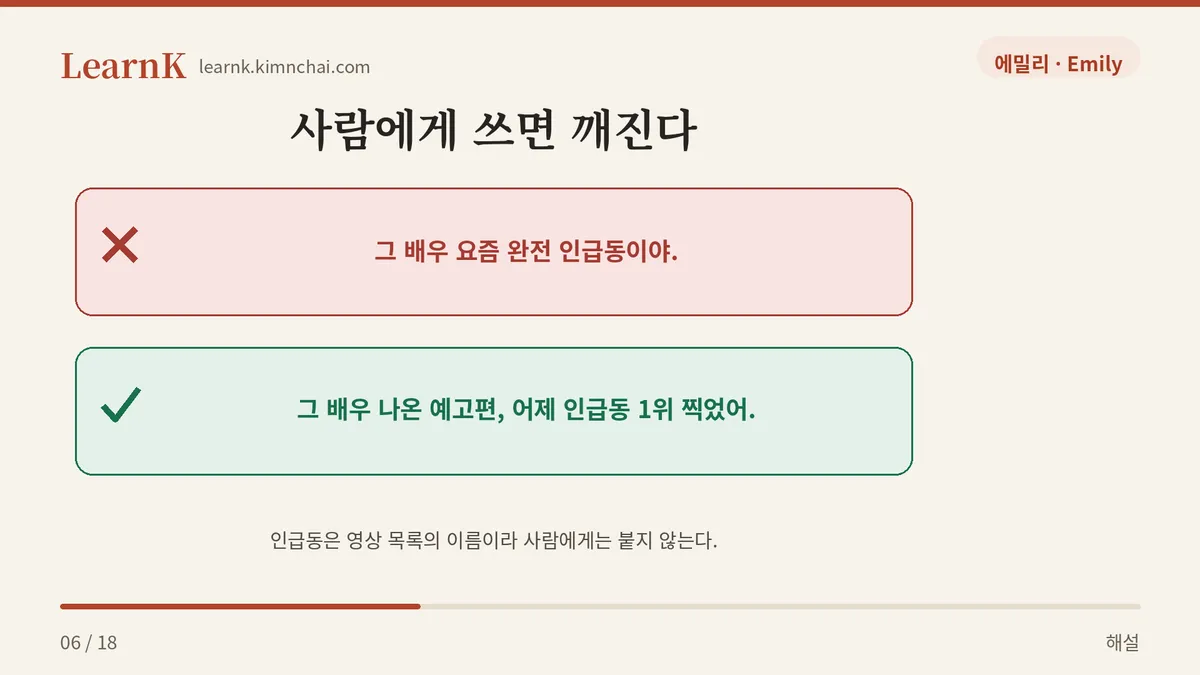
✗ 그 배우 요즘 완전 인급동이야. — That actor is totally trending-list these days. ✓ 그 배우 나온 드라마 예고편, 어제 인급동 1위 찍었어. — The trailer for the drama that actor is in hit number one on trending yesterday. → 인급동 (ingeupdong) is the name of a video list, not an adjective describing a degree of popularity. Attach it to a person and the sentence simply doesn’t work. If you mean that a person is the talk of the town, use 요즘 대세야 (yojeum daese-ya) or 완전 떴어 (wanjeon tteosseo).
Example Sentences by Situation
Situation 1 — A friend’s hobby video suddenly blows up
어? 네 영상 인급동 올라갔더라. 축하해! eo? ne yeongsang ingeupdong ollagatdeora. chukahae! → Huh? Your video made the trending list. Congrats!
Breakdown: More often than not, the people around you spot it before you do — notifications arrive late, or the creator simply isn’t checking. The ending -더라 (-deora) is used to report something you witnessed yourself, so it adds the freshness of “I just saw it with my own eyes.”
Situation 2 — It hasn’t taken off yet, but it looks like it will
이거 편집만 잘하면 인급동 각인데? igeo pyeonjipman jalhamyeon ingeupdong gakinde? → If we edit this right, this thing is going straight to trending.
Breakdown: This is something you say while watching the raw footage together. The sentence-final -ㄴ데? (-nde?) quietly fishes for the listener’s agreement, so it reads less like certainty and more like an excited hunch: “You think so too, right?”
Situation 3 — You have no idea why it took off
왜 인급동 갔는지 나도 모르겠어. 그냥 고양이가 하품하는 영상인데. wae ingeupdong gatneunji nado moreugesseo. geunyang goyangiga hapumhaneun yeongsanginde. → I have no idea why it went trending. It’s literally just a cat yawning.
Breakdown: This is the single most common joke format among Korean YouTube users. It holds a kind of cheerful resignation — the algorithm’s choices simply cannot be explained.
Politeness Levels and Related Expressions
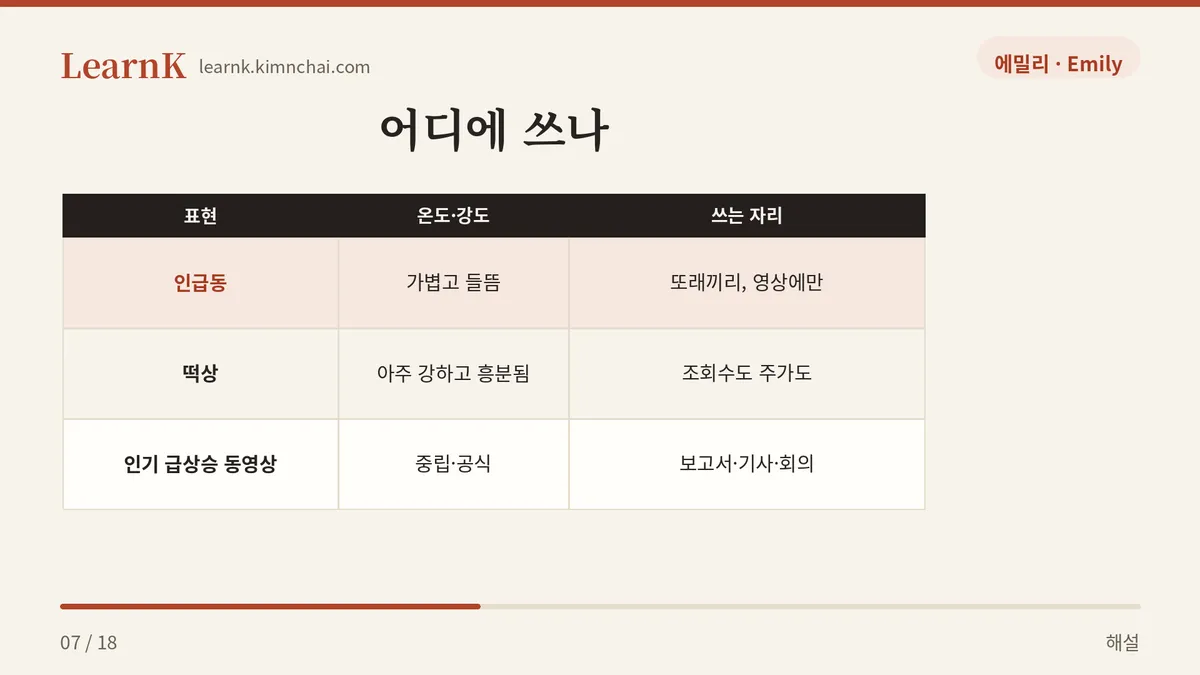
인급동 (ingeupdong) is a noun, so the word itself doesn’t change into an honorific form. Instead, you adjust the register through the verb that comes with it. With friends: 인급동 떴어 (ingeupdong tteosseo). With someone you owe a bit of politeness: 인급동 올라갔어요 (ingeupdong ollagasseoyo) — and that’s about as far up as it naturally stretches. For anyone senior to you, or in a formal setting, the safe move is to drop the slang entirely and use the full original phrase, 인기 급상승 동영상 (ingi geupsangseung dongyeongsang). Abbreviations aren’t a matter of grammar; they reveal the distance in a relationship.
| Expression | Tone & intensity | Where it’s used |
|---|---|---|
| 인급동 (ingeupdong) | Light and giddy | Among peers, in comments, in messenger chats. Not with seniors or in official documents |
| 인기 급상승 동영상 (ingi geupsangseung dongyeongsang) | Neutral, official | Reports, articles, meetings. Safe anywhere |
| 떡상 (tteoksang) | Very strong, excited | When views or stock prices shoot straight up. Peers only |
| 화제작 (hwajejak) | Composed and dignified | Articles, write-ups. Also used for films and dramas |
Learners especially tend to mix this up with 떡상 (tteoksang). 떡상 points at the motion of numbers skyrocketing itself, so it applies just as well to stocks or crypto; 인급동 points at a specific place — that list on YouTube. That’s why 주식 떡상 (jusik tteoksang), “the stock skyrocketed,” works, while 주식 인급동 (jusik ingeupdong) does not.
Cultural Background — Words That Keep Only the First Syllables
The way 인급동 was coined is dead simple: 인기 급상승 동영상 — keep the first syllable of each of the three words and throw away the rest. Korean churns out abbreviations like this endlessly. An iced americano even if you’re freezing to death (얼어 죽어도 아이스 아메리카노) becomes 얼죽아 (eoljuga); the moment the mood suddenly goes cold (갑자기 분위기가 싸해지는 순간) becomes 갑분싸 (gapbunssa). Because Hangul bundles consonants and vowels into a single syllable block, you can lop off the first block of each word, string them together, and still have something pronounceable — which is why this kind of clipping rolls so easily in Korean. It’s also the first wall foreign learners hit on the Korean internet: even if you know every underlying word, a combination made of nothing but first syllables is impossible to look up in a dictionary.
There’s a reason 인급동 in particular spread so far. Korea is regularly counted among the countries with the longest YouTube viewing time in the world, and plenty of people run their searches on YouTube rather than a portal site. So “어제 인급동 봤어? (eoje ingeupdong bwasseo?)” — “Did you see what was trending yesterday?” — occupies almost exactly the same slot that “Did you watch the 9 o’clock news last night?” did for an earlier generation. That list was the window through which you checked what the whole country was watching today.
For creators, the word is both a goal and a running joke. Because that list was the one and only route by which a small channel with a few thousand subscribers could wake up as a hundred-thousand-subscriber channel, the scene of a creator finishing an edit at dawn and muttering “이번엔 인급동 가자 (ibeoneun ingeupdong gaja)” — “let’s hit trending this time” — has become a stock vlog cliché. Over the past few years YouTube has reworked the list’s name and shape several times, so its position on the screen has changed, but the word has outlived the screen it came from. These days 인급동 works less like the name of a particular menu and more like a common noun meaning “a video the whole country suddenly watched.” Dramas and variety shows use it too: when a character becomes the center of attention, someone nearby shoves a phone in their face and says exactly this word.
Today’s Quiz
Which of the following uses 인급동 naturally?
① 우리 팀장님은 요즘 회사에서 인급동이야. — Our team leader is trending-list around the office these days. ② 그 아이돌 신곡 뮤직비디오, 어제 인급동 3위 찍었대. — That idol’s new music video hit number three on trending yesterday, apparently. ③ (To the boss) 사장님, 저희 신제품 광고가 인급동 갔습니다. — Sir, our new product ad went trending.
Answer: ②
① is wrong because it’s attached to a person. 인급동 is the name of a video list, so it can’t be used for people; here the right choice is 요즘 완전 대세야 (yojeum wanjeon daese-ya). ③ makes sense as a sentence, but the setting is off. In an official report to a superior, you drop the abbreviation and say 인기 급상승 동영상 목록에 올랐습니다 (ingi geupsangseung dongyeongsang mongnoge ollatseumnida). ② is the most textbook usage there is: among peers, about a video, together with a rank.
인급동 (ingeupdong) is a newly coined word, so it is not yet listed as a headword in the National Institute of Korean Language’s Basic Korean Dictionary (krdict.korean.go.kr). The definitions, example sentences, dialogue, and quiz in this post are therefore all original work written by us, and no dictionary material is quoted.