인사동 (Insadong) — The Traditional Culture Street Still Standing in the Middle of Seoul
인사동 (Insadong) is a dong — an administrative neighborhood — in Jongno-gu, Seoul, famous as a traditional culture street and visited by crowds of tourists. If you’re learning Korean, you’ll hear this name long before it shows up in your textbook. Ask a Korean friend “서울에서 어디 가면 좋아? (seoureseo eodi gamyeon joa?)” — “Where should I go in Seoul?” — and nine times out of ten, 인사동 (Insadong) is the first thing out of their mouth.
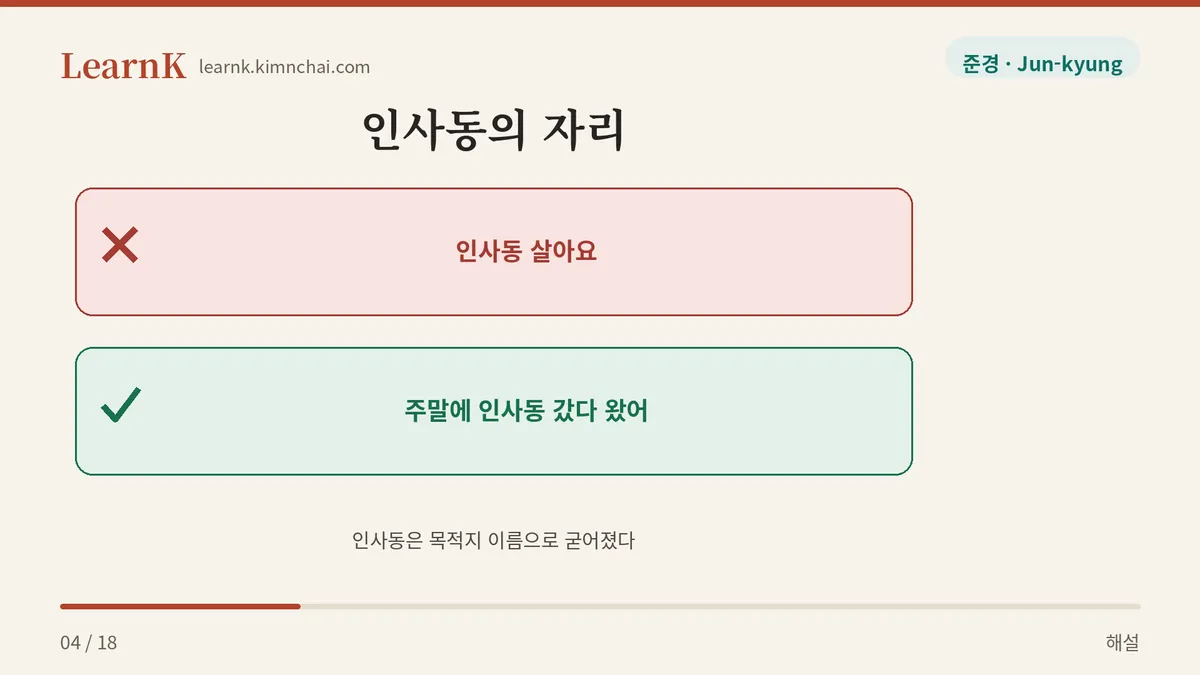
What’s interesting is how the word gets used. Insadong is clearly an administrative district name, the kind that goes into an address, and yet Koreans rarely use it that way. Almost nobody says “인사동 살아요 (insadong sarayo)” (“I live in Insadong”). Instead you hear it like this: “주말에 인사동 갔다 왔어. (jumare insadong gatda wasseo.)” (“I went to Insadong over the weekend.”) or “두 시에 인사동에서 봐. (du sie insadong-eseo bwa.)” (“See you at Insadong at two.”) In other words, Insadong is the name of a place you go to, not a place you live in. It’s one of the few place names that has hardened into a destination name, so learning this single word unlocks making plans, asking directions, and giving recommendations all at once.
인사동 (Insadong)
The picture the word 인사동 paints in a Korean person’s head is remarkably specific: 필방 (pilbang), the shops selling calligraphy brushes and inkstones; stores for 한지 (hanji, traditional paper) and carved seals; galleries handling antiques and paintings; framing shops; and traditional teahouses you can only reach by climbing a narrow staircase. One main road — 인사동길 (insadong-gil) — runs down the middle, with narrow alleys branching off it like ribs, and every one of those alleys is packed with these shops.
The temperature of the word is quiet and dignified. It has a different grain from 핫플 (hatpeul), the “hot place” word people use for whichever neighborhood is trending. Almost nobody names Insadong as the place where twenty-somethings go to party. Instead, this name comes up in moments like these — when you’re picking somewhere to take your parents or an elder, when you have to show a visitor from abroad one good day of Seoul, when you need to buy a distinctly Korean gift. That’s why Insadong carries the feeling of “a choice that can’t go wrong.”
At the same time, a mild dig follows it around among Koreans: “이제 관광객만 가는 데 아니야? (ije gwangwanggaengman ganeun de aniya?)” — “Isn’t that just a tourist place now?” Knowing both sides will help you understand why a Korean friend shrugs ever so slightly when Insadong comes up.
Checking the National Institute of Korean Language dictionary
인사동 (insadong) 「noun」 A dong in Jongno-gu, Seoul. Located in the southern part of Jongno-gu, it is famous for its traditional culture street, so many tourists visit. — National Institute of Korean Language, Basic Korean Dictionary (krdict.korean.go.kr)
The dictionary also glosses this word in five other languages.
[en] Insadong — A building in Jongno-gu, Seoul; it is located in the south of Jongno-gu and is famous for its traditional culture street, so many tourists visit. [ja] インサドン【仁寺洞】 — ソウル特別市鍾路区にある洞。鍾路区の南側にあり、伝統文化通りとして有名で、多くの観光客が訪れる。 [es] Insadong — Uno de los distritos en Jongno-gu, Seúl. Se encuentra en el sur de Jongno-gu y es famoso por su calle de la cultura tradicional, por lo que muchos turistas la visitan. [zh] 仁寺洞 — 首尔钟路区的一个街区。位于钟路区南部,以其传统文化而闻名,游客众多。 — National Institute of Korean Language, Basic Korean Dictionary (krdict.korean.go.kr)
One point worth flagging. The English definition opens with “A building,” but Insadong is not a building — it refers to a 동 (dong), an administrative district. Since this is the dictionary’s own text, we’ve reproduced it as-is without correcting it, so when you read it, treat the Japanese, Spanish, and Chinese glosses (洞 / distrito / 街区) as the reliable ones. Portuguese isn’t listed for this entry, so the line below is our own translation, not the dictionary’s.
- (our own translation) Insadong — Um bairro em Jongno-gu, Seul, famoso por sua rua de cultura tradicional e muito visitado por turistas.
The dictionary also includes sentences showing the word in real use. This entry has two registered, so here are both.
인사동에는 우리나라의 전통적인 차와 다기를 판매하는 가게들이 여럿 있어 외국인 관광객들이 많이 방문한다. (insadong-eneun urinaraui jeontongjeogin chawa dagireul panmaehaneun gagedeuri yeoreot isseo oegugin gwangwanggaekdeuri mani bangmunhanda.) “Insadong has a number of shops selling Korea’s traditional teas and tea sets, so many foreign tourists visit.” — National Institute of Korean Language, Basic Korean Dictionary (krdict.korean.go.kr)
This is the kind of descriptive sentence you’d expect when someone introduces Insadong. The word to watch here is 다기 (dagi), which means a full set of vessels used for drinking tea — cups, teapots, and the rest. The sentence shows exactly how what Insadong sells isn’t just “tea” but the whole apparatus of drinking tea.
시장은 인사동 거리가 새로운 문화의 중심지로 등장할 것이라고 말했다. (sijang-eun insadong georiga saeroun munhwaui jungsimjiro deungjanghal geosirago malhaetda.) “The mayor said that Insadong Street would emerge as a new center of culture.” — National Institute of Korean Language, Basic Korean Dictionary (krdict.korean.go.kr)
This one reads like a news article. Note that 시장 here is not 시장 (市場), a market where things are sold, but 시장 (市長) — a mayor, a person, like the mayor of Seoul. One more thing: the previous sentence said “인사동에는,” pointing at the area itself, while this one adds a word — “인사동 거리 (insadong geori),” Insadong Street. Attaching 거리 like this shifts the meaning from the administrative district to the actual street you walk down.
Seeing it in a real conversation
Setting: Saturday afternoon, in front of Exit 6 of Anguk Station. Next week, Emily’s parents are coming to Seoul from Canada for the first time.
Jun-kyung: 부모님 오시면 어디 모시고 갈 거야? Where are you going to take your parents when they come?
Emily: 몰라. 인사동 얘기가 나오긴 했는데, 거기 관광객만 가는 데 아니야? I don’t know. Insadong came up, but isn’t that place just for tourists?
Jun-kyung: 그건 편견이지. 나도 붓 사러 일 년에 두세 번은 가. That’s a prejudice. I go two or three times a year myself, to buy brushes.
Emily: 붓? 아, 맞다. 거기 필방이랑 화랑 많다고 했지. Brushes? Oh right, you said there are a lot of brush shops and galleries there.
Jun-kyung: 응. 어머님 차 좋아하시면 인사동만 한 데도 없어. 전통 찻집이 골목마다 있거든. Yeah. If your mom likes tea, there’s no place like Insadong. There’s a traditional teahouse in every alley.
Emily: 오케이. 그럼 오늘 미리 답사 가자. 네가 안내해. Okay. Then let’s go scout it out today. You lead the way.
These sound unnatural
✗ 인사동에 가면 조용한 주택가랑 오래된 집들을 볼 수 있겠네요. (insadong-e gamyeon joyonghan jutaekgarang oraedoen jipdeureul bol su itgennneyo.) — “If I go to Insadong, I guess I’ll see quiet residential streets and old houses.” ✓ 인사동에 가면 전통 찻집이랑 화랑, 기념품 가게가 이어진 거리를 볼 수 있겠네요. (insadong-e gamyeon jeontong chatjibirang hwarang, ginyeompum gagega ieojin georireul bol su itgennneyo.) — “If I go to Insadong, I guess I’ll see a street lined with traditional teahouses, galleries, and souvenir shops.” → The 동 (dong) at the end of the name makes it easy to imagine a neighborhood where people live, but what you actually see in Insadong is a street of shops, not housing. If you’re hoping for quiet hanok alleys, that’s the next neighborhood over — 북촌 (bukchon).
✗ 주말에 인사동 시장에서 만나요. (jumare insadong sijang-eseo mannayo.) — “Let’s meet at Insadong Market this weekend.” ✓ 주말에 인사동 거리에서 만나요. / 주말에 인사동에서 만나요. (jumare insadong georieseo mannayo. / jumare insadong-eseo mannayo.) — “Let’s meet on Insadong Street this weekend. / Let’s meet in Insadong this weekend.” → There is no market called “Insadong Market.” Even the dictionary definition calls it a “traditional culture street,” not a market. If you mean an actual market, you have to name a real one, like nearby 광장시장 (gwangjang sijang); Insadong itself gets bundled under the word 거리 (geori), “street.”
Example sentences by situation
1. Mapping out a day for a friend who’s visiting Seoul
경복궁 보고 나서 걸어서 인사동으로 넘어가면 딱이야. (gyeongbokgung bogo naseo georeoseo insadong-euro neomeogamyeon ttagiya.) “After you see Gyeongbokgung, walking over to Insadong is perfect.”
Gyeongbokgung, Anguk Station, and Insadong are all within walking distance of each other, so this is a combination that genuinely comes up all the time. Here, -으로 넘어가다 (-euro neomeogada) means to move naturally on to the next nearby place, and 딱이다 (ttagida) is colloquial for something close to “it’s perfect, that’s the answer.”
2. When you need to buy a gift
외국 친구 줄 선물은 인사동에서 사는 게 제일 무난해요. (oeguk chingu jul seonmureun insadong-eseo saneun ge jeil munanhaeyo.) “For a gift for a foreign friend, buying it in Insadong is the safest bet.”
무난하다 (munanhada) means “it may not be the very best, but it won’t fail” — a word that lines up exactly with Insadong’s image. It’s also the adjective Koreans most often attach when recommending the place.
3. When you’re setting a meeting spot
그럼 두 시에 인사동 입구에서 만날까요? (geureom du sie insadong ipgueseo mannalkkayo?) “Shall we meet at the entrance to Insadong at two, then?”
Insadong stretches out lengthwise along one main road, so “인사동에서 만나자 (insadong-eseo mannaja)” alone won’t be enough for you to find each other. That’s why people normally add one more reference point, like 입구 (ipgu) (the entrance), 초입 (choip) (the near end), or 쌈지길 앞 (ssamjigil ap) (in front of Ssamziegil).
Polite vs. casual speech, and related expressions
인사동 is a noun, so there’s no honorific level built into the word itself. The politeness level is decided by the verb that follows. To an elder it’s “인사동 가 보셨어요? (insadong ga bosyeosseoyo?)”, and to a friend it’s “인사동 가 봤어? (insadong ga bwasseo?)”. One thing worth knowing, though: when suggesting a place, “인사동 어떠세요? (insadong eotteoseyo?)” sounds gentler than “인사동 가시죠 (insadong gasijyo)”.
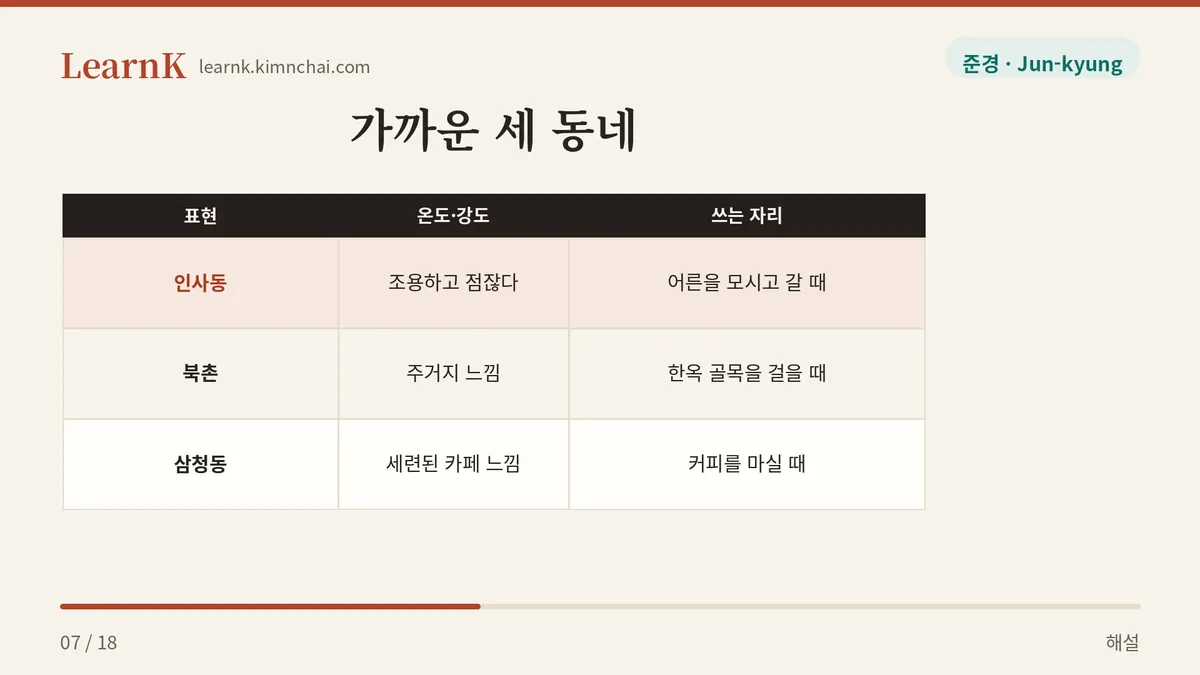
Comparing it with the other place names that come up in the same breath makes Insadong’s position clear.
| Expression | Temperature / intensity | Where it’s used |
|---|---|---|
| 인사동 (insadong) | Neutral. The default form referring to the whole area | Anywhere — making plans, recommending, introducing |
| 인사동길 (insadong-gil) | Concrete, administrative | When you mean the main road itself. Addresses or precise locations |
| 인사동 거리 (insadong geori) | Emphasizes the experience of walking it | Writing and introductions. The dictionary example uses this form too |
| 북촌 (bukchon) | Quiet, residential feel | Talk of strolling slowly through hanok alleys |
| 삼청동 (samcheong-dong) | Stylish, café feel | Talk of dates and café tours |
Insadong, Bukchon, and Samcheong-dong are close enough that you can walk between them, but in a Korean person’s head their temperatures are distinctly different. With elders, Insadong; to take photos, Bukchon; to drink coffee, Samcheong-dong — sort them roughly like that and you’ll almost never get it wrong in conversation.
Cultural background — the two syllables inside the name
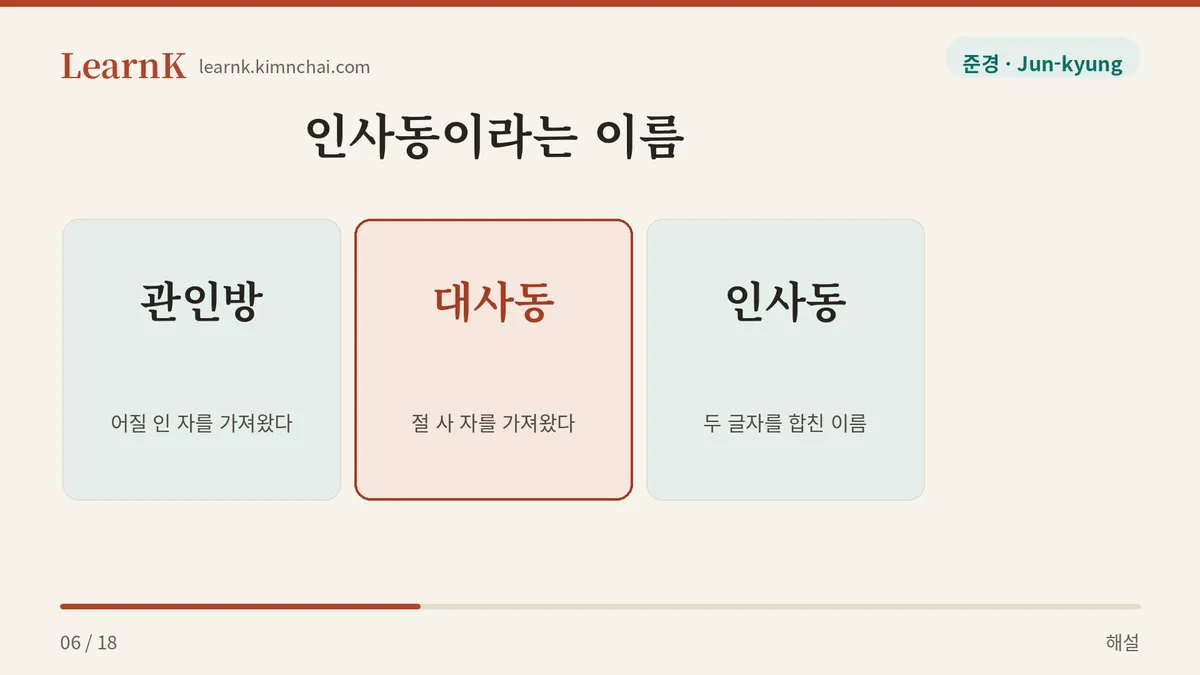
Here’s the misunderstanding Korean learners run into most: “Is the 인사 in 인사동 the 인사 that means greeting?” No. According to the widely cited explanation, the name was formed by taking one syllable each from 관인방 (寬仁坊, gwaninbang) and 대사동 (大寺洞, daesa-dong), two areas that existed here during the Joseon period. Written in hanja it’s 仁寺洞, from 어질 인 (仁, “benevolent”) and 절 사 (寺, “temple”). The “great temple” in 대사동 refers to Wongaksa, which stood on the site of today’s Tapgol Park. So what’s tucked inside this name isn’t a greeting — it’s a temple.
The Insadong we know today was built much later. Through the 1970s and ’80s, antique dealers and galleries gathered in these alleys, and as people came and went buying and selling paintings and calligraphy, brush shops and framing shops followed them in. Which is to say, before it was a tourist destination it was a street where people worked. Jun-kyung saying “I go to buy brushes” in the dialogue above is a direct continuation of that grain.
The story about the signs is famous too. In Insadong, a practice took hold where even foreign brands put their signage up in Hangul, and the story of a coffee chain hanging its Insadong storefront sign in Hangul is a fairly well-known case that gets retold in Korea. It’s the result of an entire street trying to keep a promise: “this is a place that shows tradition.”
Insadong shows up often in dramas and variety shows, too — but the way it appears is fixed. The main character brings a visitor from abroad and sits them down in a traditional teahouse, or an older character hovers around a gallery hoping to buy a painting. It’s almost never used as the backdrop for young characters partying late into the night. That usage pattern itself tells you the temperature of the word 인사동.
Today’s quiz
A Korean friend asks you, “이번 주말에 인사동 갈까? (ibeon jumare insadong galkka?)” — “Want to go to Insadong this weekend?” Which of these is most likely the day your friend is picturing?
- Dancing all night at a club
- Drinking tea at a traditional teahouse, then browsing brushes and souvenirs
- Exchanging greetings with the neighbors in a quiet residential area
Answer: 2.
Option 1 is the exact opposite of Insadong’s temperature. Option 3 comes from mistaking the 인사 in the name for 인사 (greeting) — but as we saw above, the 인사 in 인사동 comes from 관인방 and 대사동. Insadong isn’t a neighborhood you live in; it’s a street you walk through and look around, exactly as the dictionary puts it: a “traditional culture street.”
Definitions and example sentences are from the National Institute of Korean Language’s Basic Korean Dictionary (krdict.korean.go.kr); that portion of this post, including our translations, is licensed under CC BY-SA 2.0 KR.