Who's Your Ideal Type? — 이상형 (isanghyeong), the One Phrase Every K-pop Fan Should Know
이상형
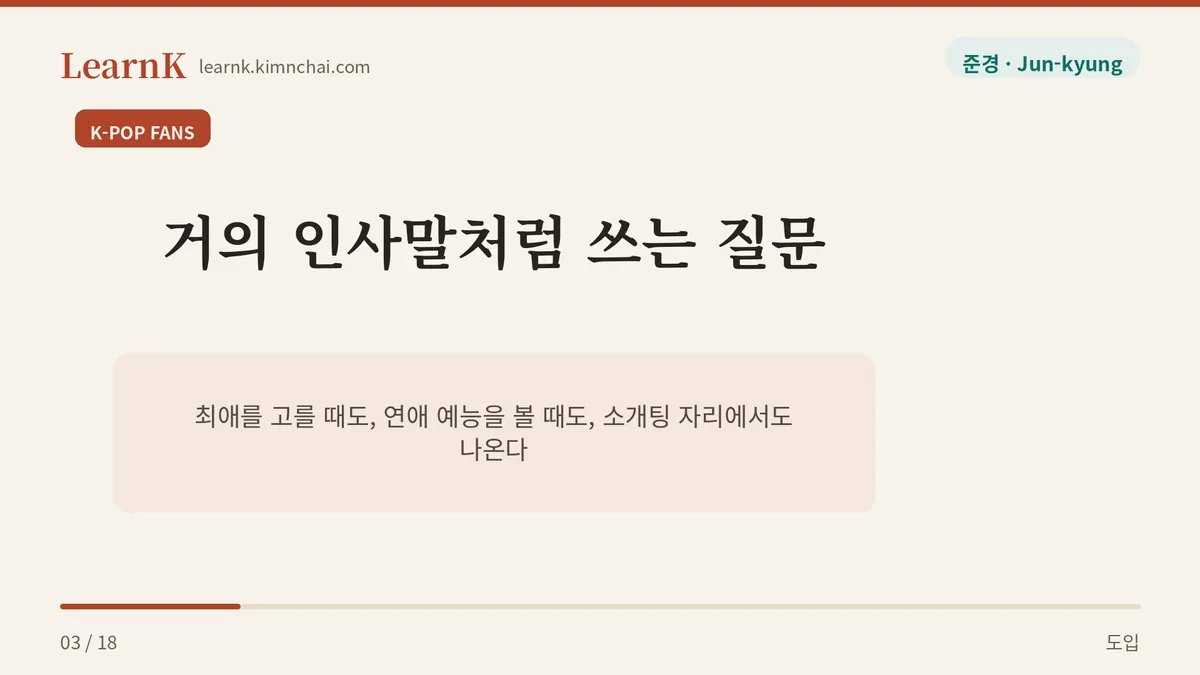
Whenever you get to talking about your favorite idols, there’s one question that’s guaranteed to come up. “Who’s your 이상형 (isanghyeong)?” Among K-pop fans, this phrase is used almost like a greeting. Whether you’re picking your bias, watching a dating variety show, or sitting through a blind date, this single word gets the conversation flowing. Today, let’s take a deep dive into an expression every fan of Korean culture should know: 이상형 (isanghyeong).
Meaning and Nuance
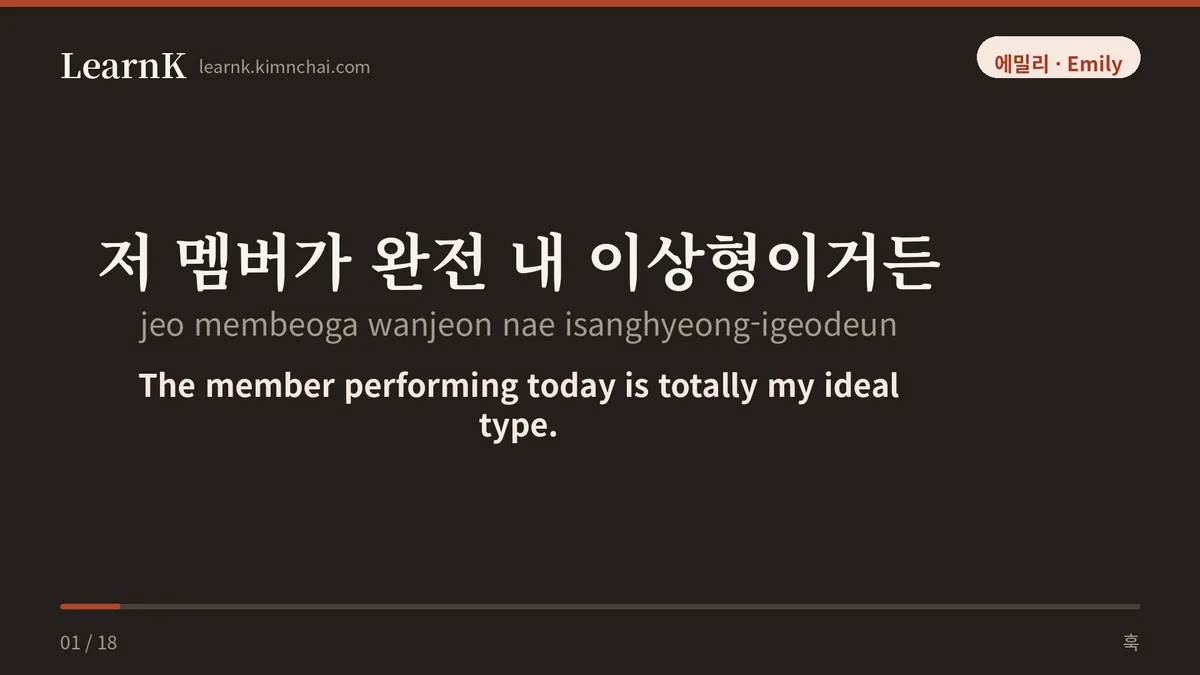
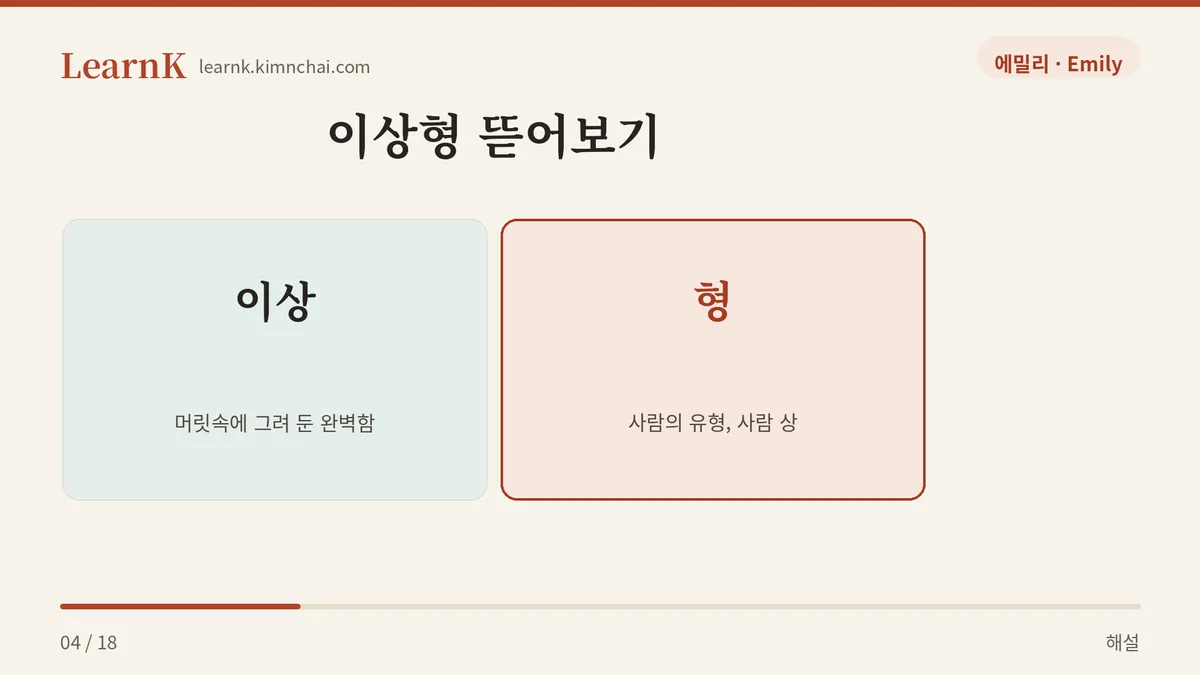
이상형 literally means “the type (型) of the most ideal (理想) person.” It doesn’t have to actually exist in real life. The picture of a “perfect partner” you’ve painted in your head — that’s your 이상형. That’s why the word carries a mix of excitement and longing. It doesn’t refer to looks alone, either. Personality, way of speaking, vibe, values — it means the whole “image (像) of a person” in which all the qualities you like come together. In K-pop fandom, saying “That member is totally my 이상형” is the highest compliment: it means that idol brought the perfect image you’d been dreaming of to life, right before your eyes.
Checking the National Institute of Korean Language Dictionary
First, let’s confirm the exact meaning in the dictionary of a national institution.
이상형 「noun」 The type of a person one thinks of as the most complete. [en] ideal type — The type of a person whom one considers to be perfect. [ja] りそう(理想) — 一番完璧だと思う人の類型。 [es] ideal — Tipo de persona que uno considera el más perfecto. [zh] 理想型 — 认为最完美的人的类型。 — National Institute of Korean Language, Basic Korean Dictionary (krdict.korean.go.kr)
The Portuguese translation wasn’t in the dictionary, so we translated it ourselves: [pt] tipo ideal — O tipo de pessoa que se considera perfeita.
Let’s also look at the real usage examples the dictionary provides.
- 네 이상형은 어떤 여자야?
- 너는 연애할 때 이상형이 뭐야?
- 아름다운 미소와 덕스러운 성품까지 갖춘 그녀는 내 이상형이다.
- 민준이랑 승규는 이상형이 똑같이 닮았어. — National Institute of Korean Language, Basic Korean Dictionary (krdict.korean.go.kr)
The first two sentences are casual (반말) conversations between friends asking about each other’s romantic tastes. They often show up in short question forms like “어떤 여자야?” (What kind of woman?) and “뭐야?” (What is it?). The third sentence is an admiring expression that firmly declares someone with both a beautiful smile and a virtuous character to be “my 이상형.” The last sentence, “이상형이 닮았다” (their ideal types resemble each other), means that two people’s “tastes in the opposite sex” are similar — a great illustration of how 이상형 can point not just to a specific person, but to a “taste” itself.
Seeing It in a Real Conversation
Situation: In line to enter an idol concert. While waiting their turn, they keep glancing toward the stage.
Jun-kyung: 에밀리, 너 오늘따라 유난히 들떠 보인다? Emily, you seem extra excited today.
Emily: 티 나? 오늘 무대 서는 저 멤버가 완전 내 이상형이거든. Does it show? The member performing today is totally my ideal type.
Jun-kyung: 아 진짜? 너 이상형이 대체 어떤 스타일인데? Oh really? What kind of style is your ideal type, anyway?
Emily: 음… 웃으면 눈 사라지고, 춤은 칼같이 추는 사람? 딱 저기 저 사람. Hmm… someone whose eyes disappear when he smiles and dances razor-sharp? Exactly that guy over there.
Jun-kyung: 야, 취향 확고하네. 근데 실물 영접하면 대부분 이상형 바뀌더라. Wow, you really know what you like. But once people meet them in person, their ideal type usually changes.
Emily: 그럴 리가. 나 3년째 한결같거든? No way. I’ve been consistent for three years, you know?
Example Sentences by Situation
Here are a few sentences you can put to use right away.
- On a blind date — “제 이상형은 대화가 잘 통하는 사람이에요. (je isanghyeong-eun daehwaga jal tonghaneun saram-ieyo.)” A polite expression for when you want to emphasize disposition over looks.
- A fan-signing recap — “실제로 보니까 완전 이상형이라 심장 터지는 줄. (siljero bonikka wanjeon isanghyeong-ira simjang teojineun jul.)” A casual (반말) recap capturing the thrill of a fan who saw their idol right in front of them.
- Asking a friend back — “그래서 네 이상형은 바뀐 거야, 그대로야? (geuraeseo ne isanghyeong-eun bakkwin geoya, geudaeroya?)” A question you toss out when you’re curious whether someone’s taste has changed.
Formal vs. Casual Speech and Similar Expressions
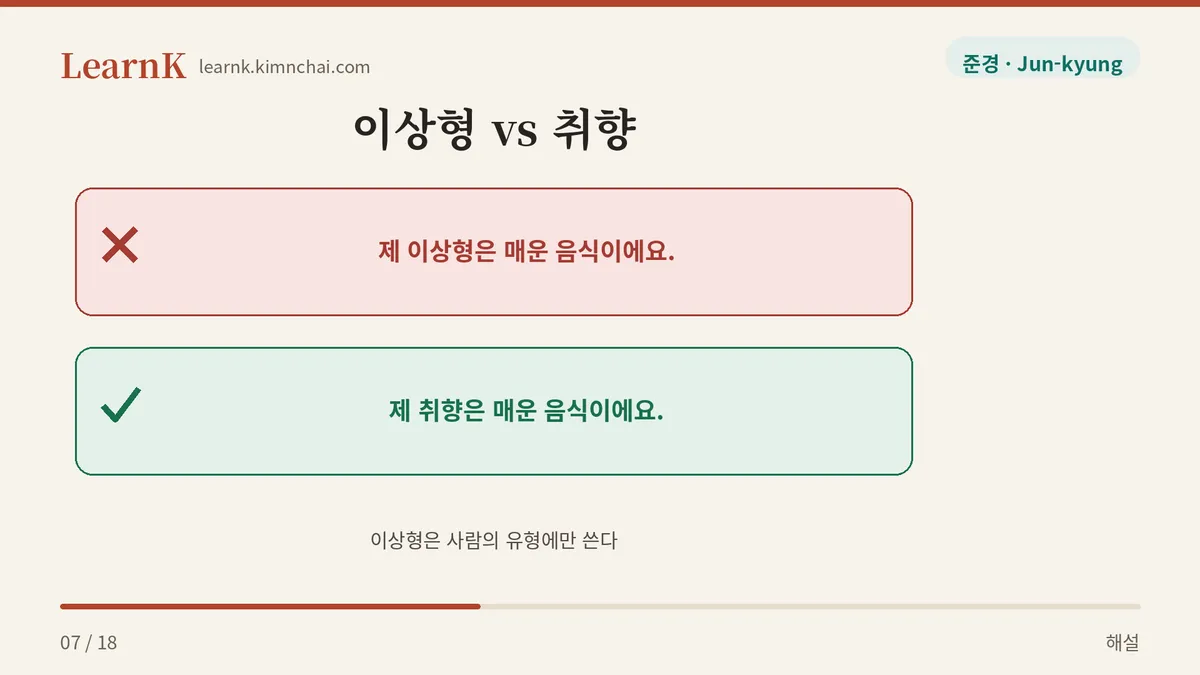
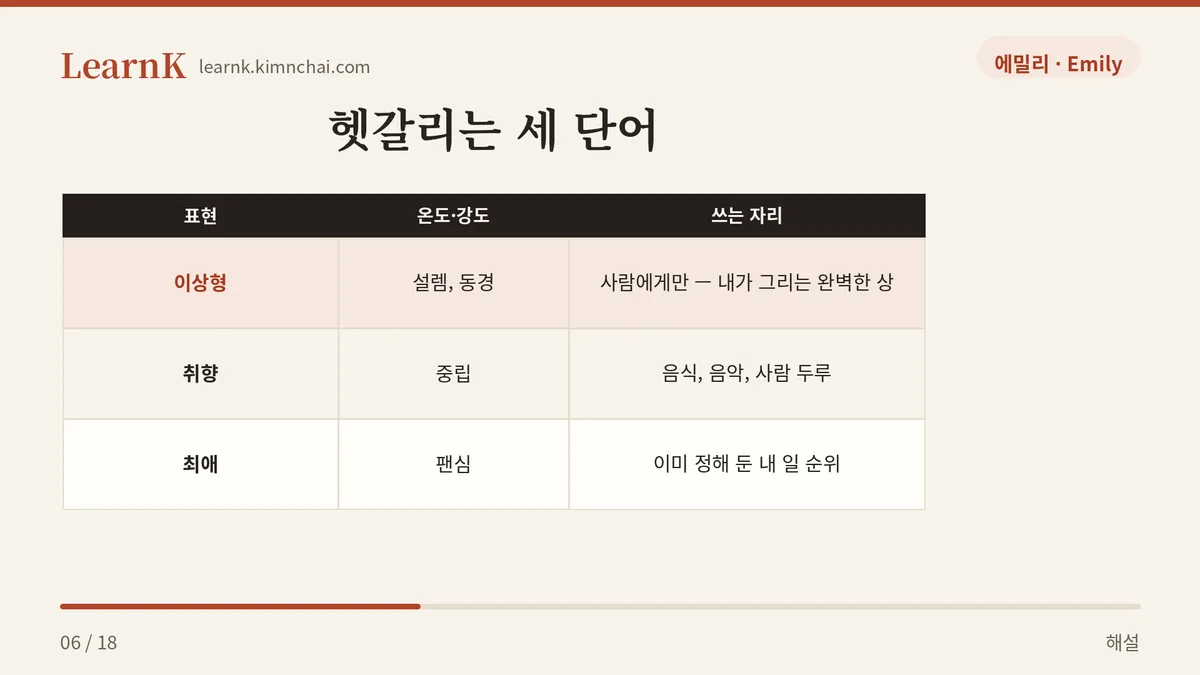
Because 이상형 is a noun, formal and casual speech split naturally just by changing the predicate at the end of the sentence. To a friend you’d say “네 이상형이 뭐야? (ne isanghyeong-i mwoya?)”, and to an elder or someone you’re meeting for the first time, “이상형이 어떻게 되세요? (isanghyeong-i eotteoke doeseyo?)”. A similar word is ‘취향 (chwihyang)’ (taste), but while 취향 is used broadly for food and music too, 이상형 is limited to “people” only. It’s also different from ‘최애 (choeae, the one you cherish most)’ that fans use these days. Your 최애 is your already-decided “number one,” while 이상형 is closer to a set of conditions — “I’d love it if they were like this.”
Cultural Background
In Korean variety shows, “이상형이 어떻게 되세요?” (What’s your ideal type?) is a go-to question thrown at guests. It never gets left out of dating reality shows, idol interviews, or even the after-chat of news interviews. That’s why idols play the “이상형 월드컵 (ideal-type world cup)” or reveal their ideal type to connect with fans from their very debut. It shows just how light and friendly this phrase is. Even between people meeting for the first time, asking “이상형이 뭐예요?” (What’s your ideal type?) instantly melts the awkward air. If you’re a K-pop fan, you can compress all your affection into a single line when introducing your bias: “얘가 내 이상형이야” (This one’s my ideal type).
Closing Quiz
A friend asks, “너 이상형이 뭐야?” (What’s your ideal type?) Which of the following is the most natural answer?
① 저는 이상형을 먹었어요. (I ate my ideal type.) ② 나는 다정하고 잘 웃는 사람이 이상형이야. (My ideal type is someone kind who smiles a lot.) ③ 이상형이 비가 와요. (My ideal type is raining.)
The answer is ②. Since 이상형 refers to a “type of person,” the natural way to answer is with the kind of personality or appearance you like.
Definitions and example sentences are from the National Institute of Korean Language’s Basic Korean Dictionary (krdict.korean.go.kr); that portion of this post, including our translations, is licensed under CC BY-SA 2.0 KR.