잘 자 vs 안녕히 주무세요 — The Temperature of Korean Honorifics Hidden in a Goodnight
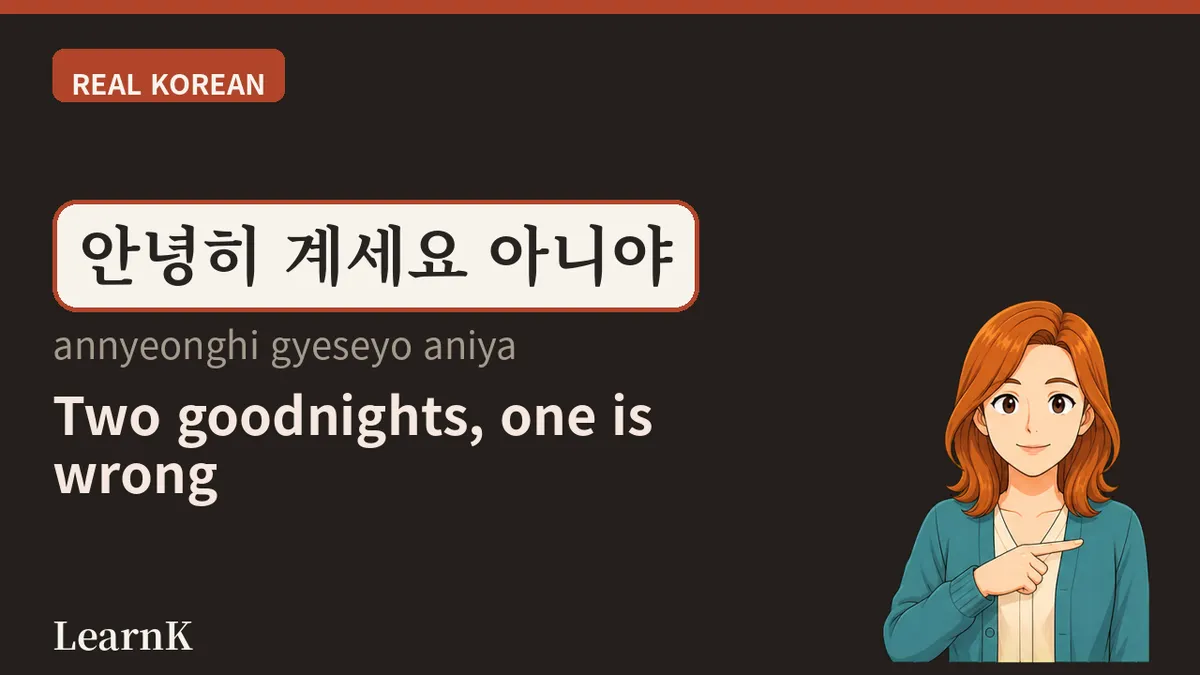
At the end of the day, right before heading to bed, Koreans don’t just part ways. They always say one little phrase — either “잘 자” or “안녕히 주무세요.” A greeting that English wraps up with a single Good night changes clothes completely in Korean, depending on who you’re talking to. Today, through this pair of nighttime greetings, let’s learn the delicate difference in “temperature” that Korean honorifics carry.
잘 자 / 안녕히 주무세요
The two expressions mean the same thing — a wish that says “Sleep comfortably tonight.” But their level of formality is different.
- 잘 자 (jal ja) — casual speech (반말). ‘잘’ is an adverb meaning ‘well, comfortably,’ and ‘자’ is the command form of the verb ‘자다 (jada, to sleep).’ Literally, “Sleep comfortably.” You use it with friends, sweethearts, and people younger than you.
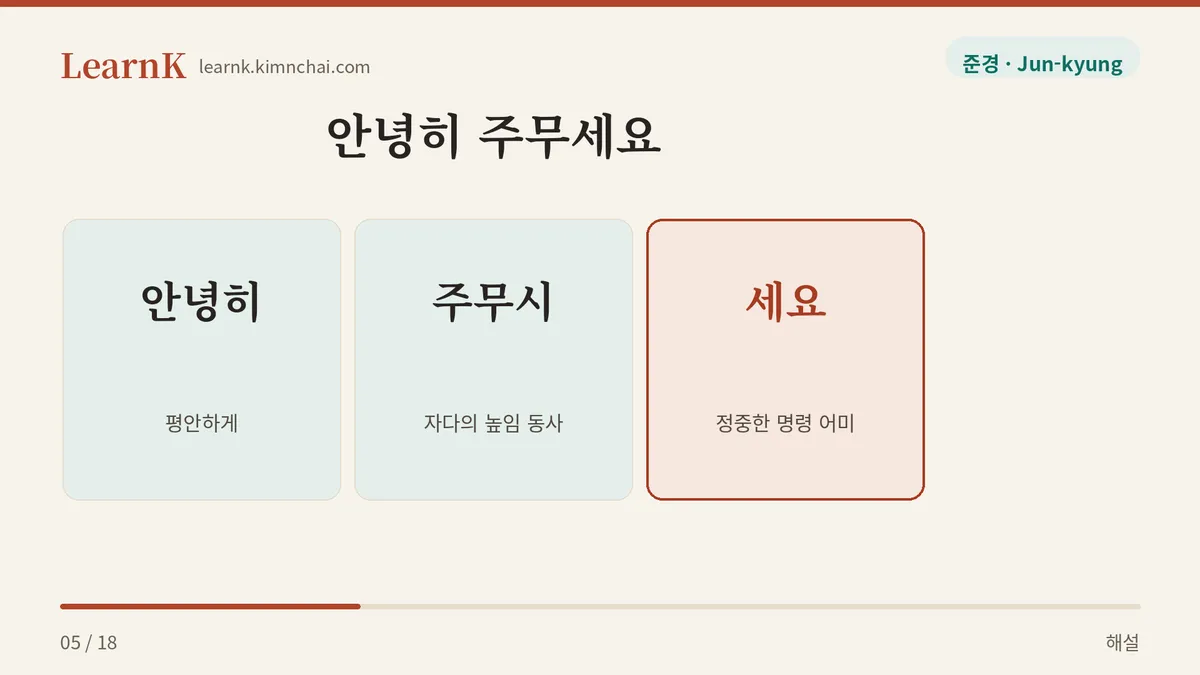
- 안녕히 주무세요 (annyeonghi jumuseyo) — polite speech (높임말). ‘안녕히’ means ‘peacefully,’ and ‘주무세요’ is the honorific verb ‘주무시다 (jumusida)’ — the respectful form of ‘자다’ — with a polite command ending attached. You use it with parents, teachers, and elders.
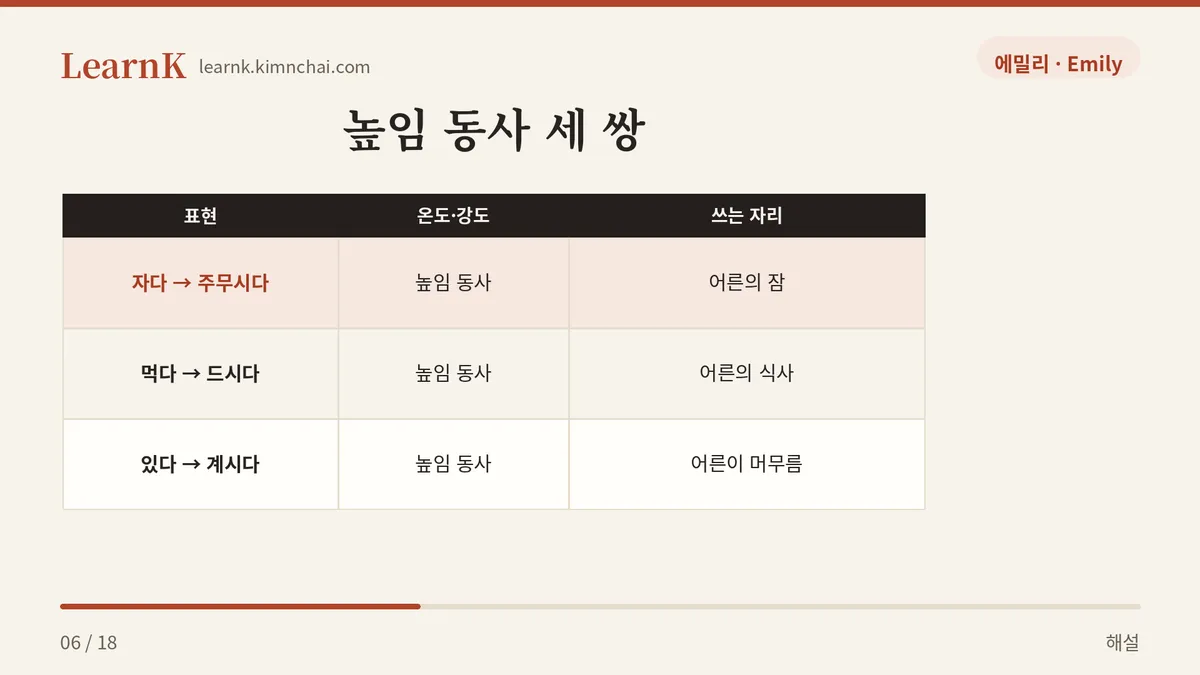
The key point here is that ‘자다’ and ‘주무시다’ are entirely different words. Korean has special verbs used only for the actions of people you respect (먹다→드시다, 있다→계시다), and ‘자다→주무시다’ is one of the most classic examples of this.
Why you won’t find it in the dictionary as-is
‘잘 자’ and ‘안녕히 주무세요’ aren’t single words — they’re idiomatic greetings made of an adverb and a verb combined. So today, instead of a dictionary headword definition, let’s look directly at how these expressions live and move in real conversation.
Example sentences by situation
Situation 1 — To your parents (child → elder)
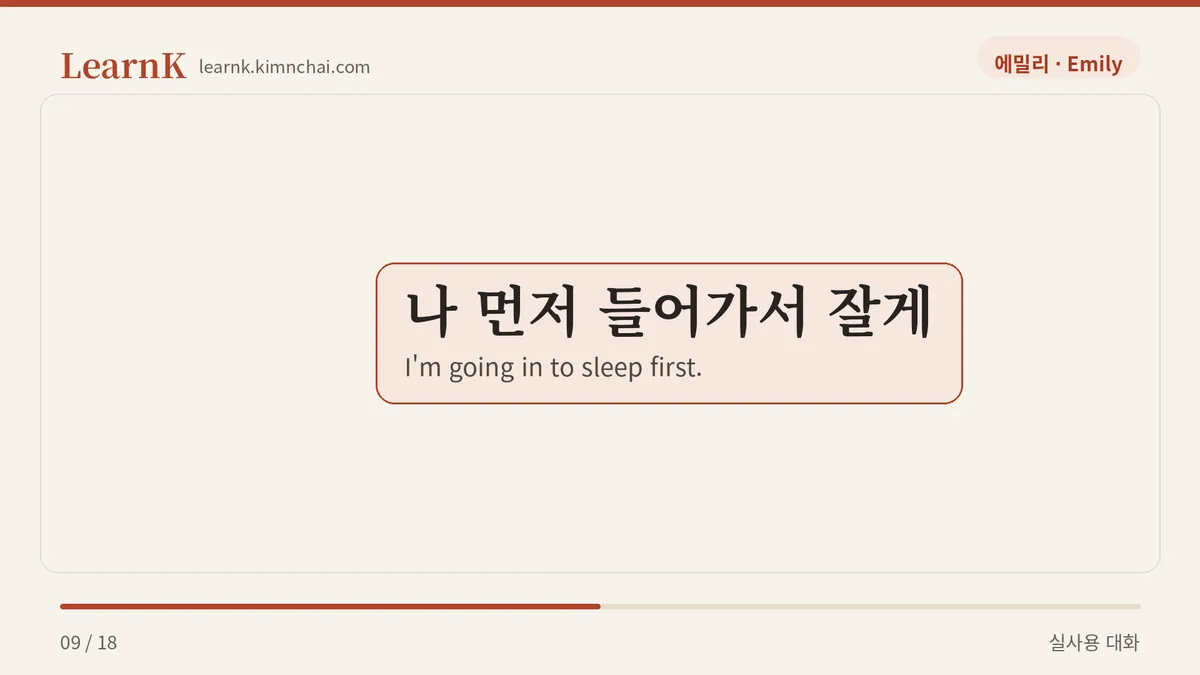
저 먼저 들어가서 잘게요. 아빠, 안녕히 주무세요. (appa, annyeonghi jumuseyo.) (I’m going in to sleep first. Good night, Dad.)
It’s eleven at night, and the child is saying goodnight to their father in the living room while heading into their own room. Since a younger child is speaking to an elder, polite speech is a must.
Situation 2 — Between sweethearts (hanging up a late-night call)
목소리 들으니까 좋다. 이제 진짜 끊자. 잘 자, 내 꿈 꿔. (jal ja, nae kkum kkwo.) (It’s so nice to hear your voice. Okay, we really have to hang up now. Sleep well, and dream of me.)
“잘 자, 내 꿈 꿔 (Sleep well and dream of me)” is a classic term of endearment among Korean couples. Since they’re close, the casual ‘잘 자’ feels natural.
Situation 3 — After a company dinner (seeing off your manager)
부장님, 오늘 감사했습니다. 조심히 들어가시고 안녕히 주무세요. (annyeonghi jumuseyo.) (Thank you for today, sir. Get home safely and good night.)
When you’re sending off a superior first, you show your respect by adding ‘조심히 들어가세요 (get home safely)’ to ‘안녕히 주무세요.‘
An easy-to-confuse pair — comparing with ‘안녕히 계세요’
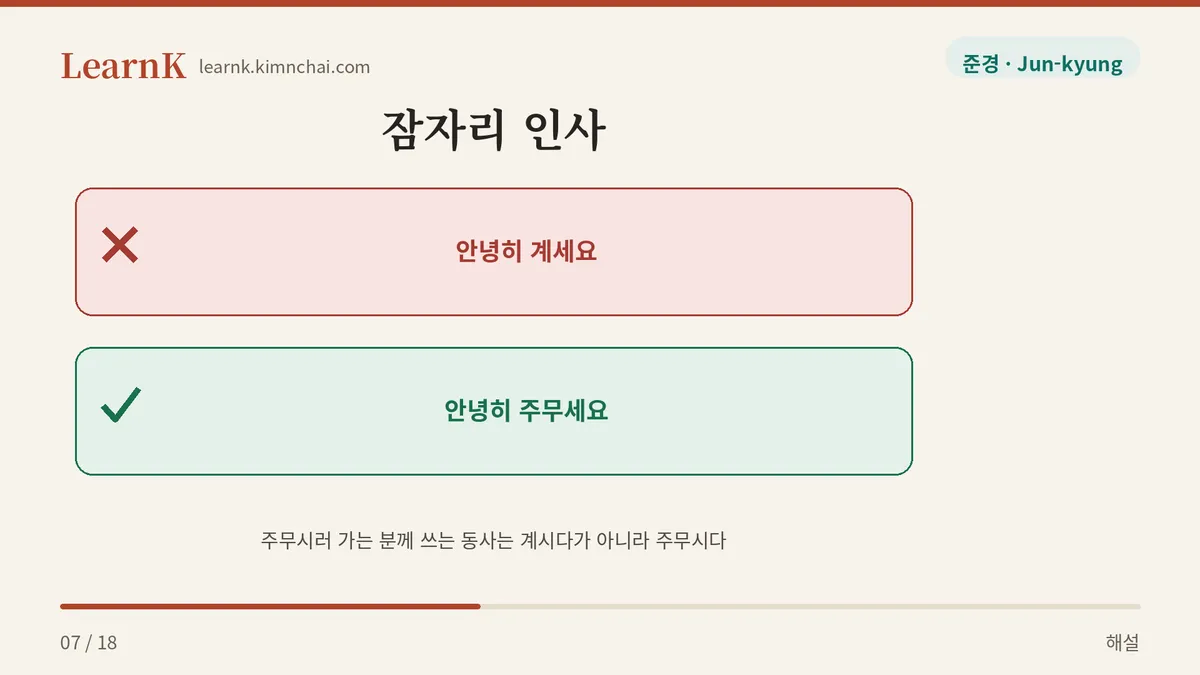
There’s a spot where beginners often slip up with nighttime greetings: for a bedtime greeting, you must use 주무세요.
| Situation | Casual (반말) | Polite (높임말) |
|---|---|---|
| Before sleeping | 잘 자 (jal ja) | 안녕히 주무세요 (annyeonghi jumuseyo) |
| Parting (you’re leaving) | 잘 있어 (jal isseo) | 안녕히 계세요 (annyeonghi gyeseyo) |
| Parting (the other person leaves) | 잘 가 (jal ga) | 안녕히 가세요 (annyeonghi gaseyo) |
They all start with the same ‘안녕히,’ but the verb that follows is different. For sleeping it’s ‘주무세요,’ for the person staying it’s ‘계세요,’ and for the person leaving it’s ‘가세요.’ Saying “안녕히 계세요” to an elder who’s going to sleep sounds off.
Cultural background — age is engraved into the greeting
Watch a Korean drama, and in a scene where a family says goodnight, the child bows their head slightly and says “안녕히 주무세요” to the parents, while the parents answer the child with “그래, 잘 자 (Yes, sleep well).” It’s the very same nighttime greeting, yet the honorific and casual forms split precisely depending on the direction. Just from this single exchange, the relationship and age gap between the two people become clear.
That’s why, in Korean, a nighttime greeting isn’t just politeness — it’s a signal of the relationship, revealing how much you respect the other person and how close you are. With an elder you’ve just met, it’s safe to always start with ‘안녕히 주무세요,’ and once they give you permission — “You can speak comfortably with me” — moving on to ‘잘 자’ is the natural next step.
Today’s quiz
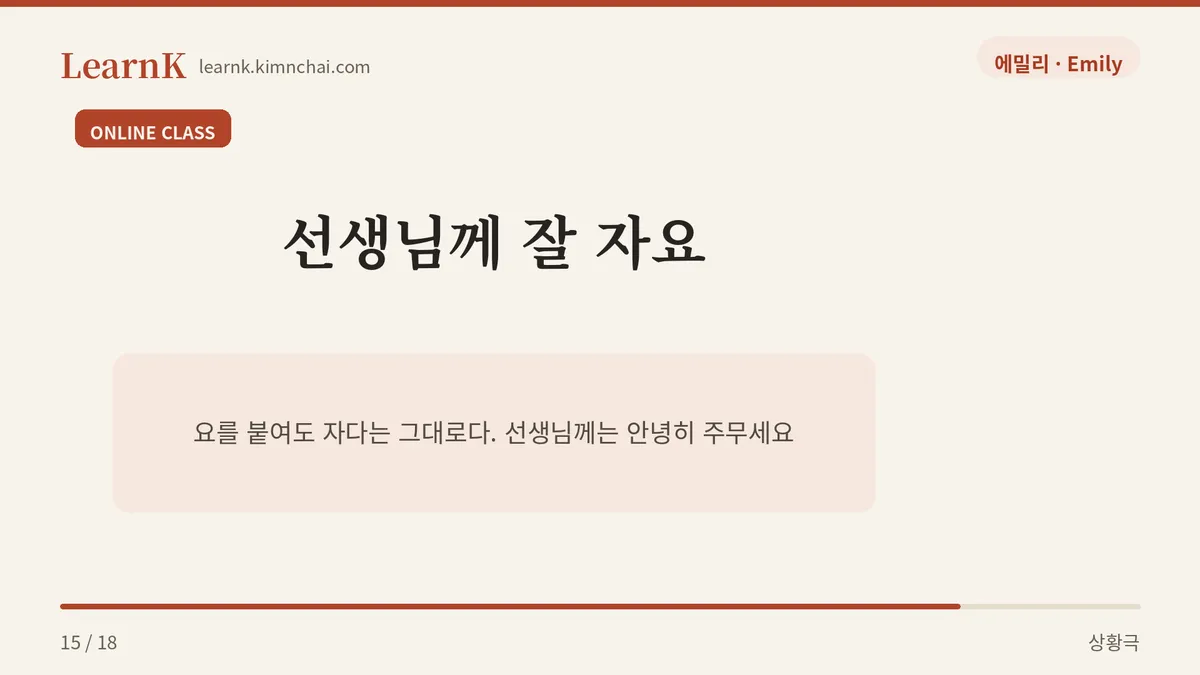
Your grandmother is up working late into the night, and you’re heading into your room to sleep first. What should you say to her?
① 잘 자 ② 안녕히 주무세요 ③ 안녕히 계세요
Show the answer
The answer is ② 안녕히 주무세요 (annyeonghi jumuseyo). Your grandmother is an elder, so you must use polite speech, and since the situation is about ‘주무시는 (sleeping),’ the correct word is ‘주무세요,’ not ‘계세요.’ ① is casual speech, so it’s rude, and ③ is what you say when parting, so it doesn’t fit the situation.
Tonight, why not say goodnight to someone you care about in Korean, too? To a close friend, “잘 자”; to someone you respect, “안녕히 주무세요.” If you can tell these small differences apart, your Korean has already grown one step deeper.