Just a Moment: The All-Purpose Phrase for Politely Stopping Someone
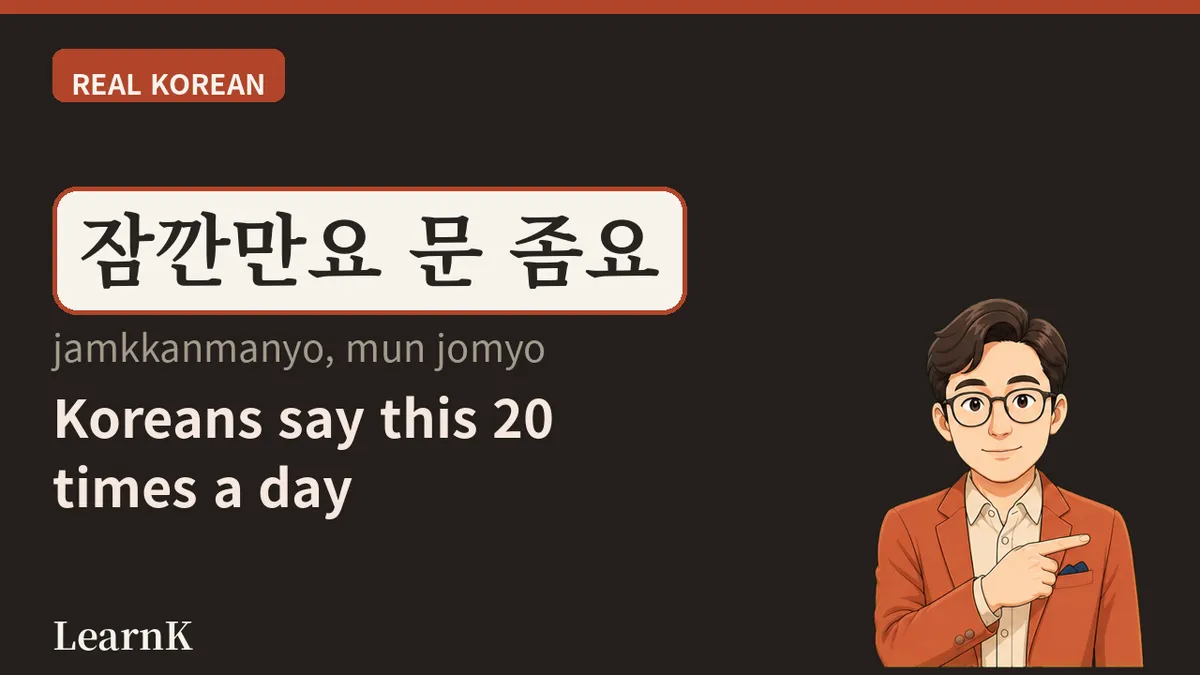
When you watch Korean dramas or variety shows, there’s a phrase that shows up without fail whenever someone is about to rush off, or when you want to pause what the other person is saying. That phrase is 잠깐만요 (jamkkanmanyo). Calling over a barista at a café, shouting it toward a closing elevator door, taking a beat to gather your thoughts mid-conversation — it’s an expression that flies back and forth dozens of times a day in a Korean person’s life. Today, let’s take a deep dive into this short but powerful little phrase.
잠깐만요
잠깐만요 (jamkkanmanyo) is made up of three pieces: 잠깐 (jamkkan, a very short moment) + 만 (man, the limiting sense of “only ~”) + 요 (yo, the polite ending that makes a sentence courteous). A literal translation would be something like “just a short moment, please,” but its real meaning is closer to “please wait a second” or “please hold on a moment.”
There are two key nuances. First, it’s a gentle signal to pause the other person’s action or speech. It isn’t forceful like “Stop right now!” — instead, it considerately asks for a brief moment of their time. Second, thanks to the 요 (yo) tacked on at the end, it becomes not a command but a polite request. That’s why this expression is a safe, courteous phrase you can use without a problem with someone you’ve just met, a shop clerk, or even your boss at work.
One more thing to remember: 잠깐만요 (jamkkanmanyo) doesn’t only mean “please wait.” It’s also used broadly to call someone (instead of “저기요”), to ask someone to make way, or to step away briefly during a phone call. In other words, it’s an all-purpose expression whose meaning flexibly stretches to fit the situation.
Example Sentences by Situation
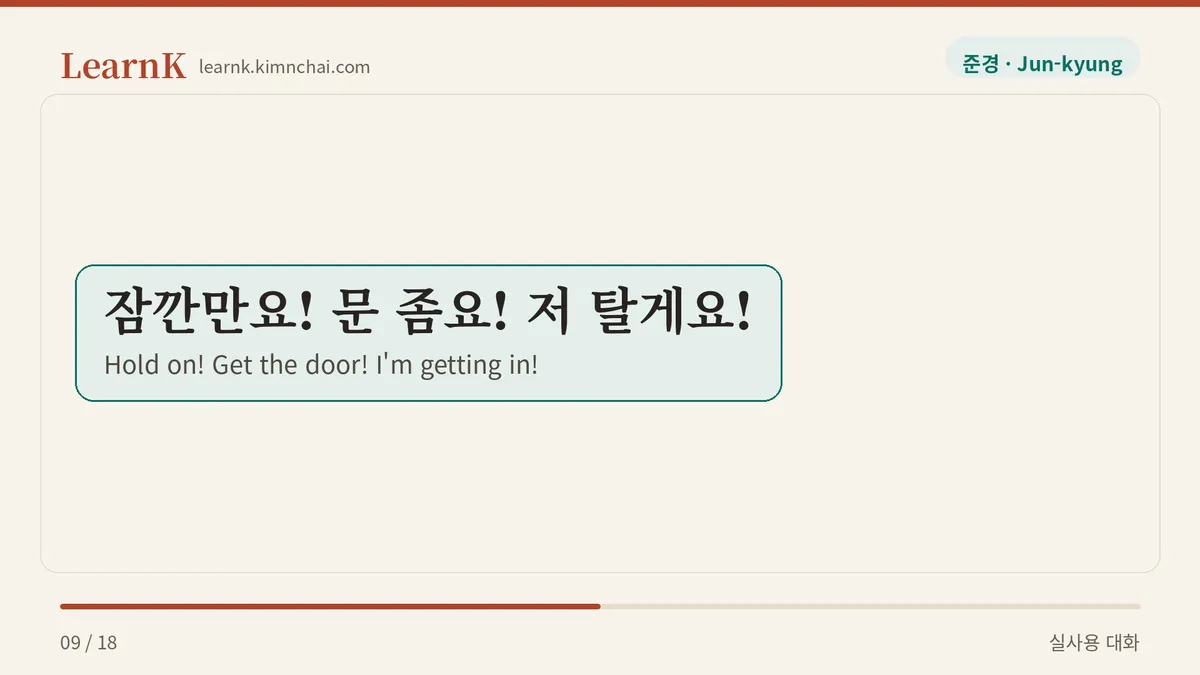
① Calling out to or stopping someone
On the subway, the person in front of you drops their wallet and keeps walking. At this moment, you call out like this:
잠깐만요! 이거 떨어뜨리셨어요. (jamkkanmanyo! igeo tteoreotteurisyeosseoyo.) — Excuse me! You dropped this.
Here, much like “저기요,” it’s used as a signal to stop a stranger.
② Asking someone to wait a moment
At a restaurant, when a staff member comes to take your order but you haven’t decided on your menu yet, you say:
잠깐만요, 조금만 더 볼게요. (jamkkanmanyo, jogeumman deo bolgeyo.) — Just a moment, I’ll look a little longer.
Without rushing the other person, it politely conveys “please give me a little time.”
③ Pausing during a phone call
If something comes up during a phone call, you naturally slip in a line like this:
잠깐만요, 문 좀 열고 올게요. (jamkkanmanyo, mun jom yeolgo olgeyo.) — Hold on a second, I’ll go open the door and be right back.
It acts as a cushion that gently interrupts the flow of conversation.
Comparing Polite Speech, Casual Speech, and Similar Expressions
With a friend or someone younger than you, if you drop the 요 (yo) and just say 잠깐만 (jamkkanman), it becomes casual speech. For example, to a friend you’d say something like “잠깐만, 나 이것만 하고! (jamkkanman, na igeotman hago!)” (“Hold on, let me just finish this!”).
Let’s also get to know some similar expressions.
- 잠시만요 (jamsimanyo): Nearly identical in meaning to 잠깐만요, but “잠시” sounds a bit more formal and soft. You’ll often hear it in official settings like banks or government offices.
- 저기요 (jeogiyo): An expression used only to call out to someone; it doesn’t carry the “please wait” meaning.
- 잠깐만 기다려 주세요 (jamkkanman gidaryeo juseyo): The full, spelled-out sentence — more polite and explicit.
In short, 잠깐만요 (jamkkanmanyo) is a remarkably efficient expression that compresses the calling function of “저기요” and the requesting function of “기다려 주세요” into a single word.
Cultural Background
In Korean, whether or not a single 요 (yo) is attached is an important signal that determines the distance in a relationship. Scenes in dramas where two characters move back and forth between casual and polite speech are a distinctly Korean bit of directing that shows a shift in the relationship in just one line of dialogue. The very moment someone drops the 요 from 잠깐만요 and calls out “잠깐만,” it can hint that the two people have suddenly grown much closer.
This expression is also steeped in a considerate attitude toward the other person. A situation where you’re making someone stop can easily come across as rude, but the emphasis on brevity in “잠깐” and the courtesy of “요” ease that burden. The sense of etiquette in Korean society is captured, whole and intact, in this one short phrase.
Closing Quiz
At a restaurant, you haven’t decided on your menu yet, but a staff member has come to take your order. To politely convey “please wait just a little” without rushing them, what should go in the blank?
”______, 조금만 더 볼게요.”
(Answer: 잠깐만요 (jamkkanmanyo))
This phrase you learned today — be sure to give it a try next time you’re at a Korean café or restaurant. The moment it comes out of your mouth naturally, your Korean will have grown one step stronger!