잖아요 — The Sentence Ending for Bringing Up Something You Both Already Know
잖아요
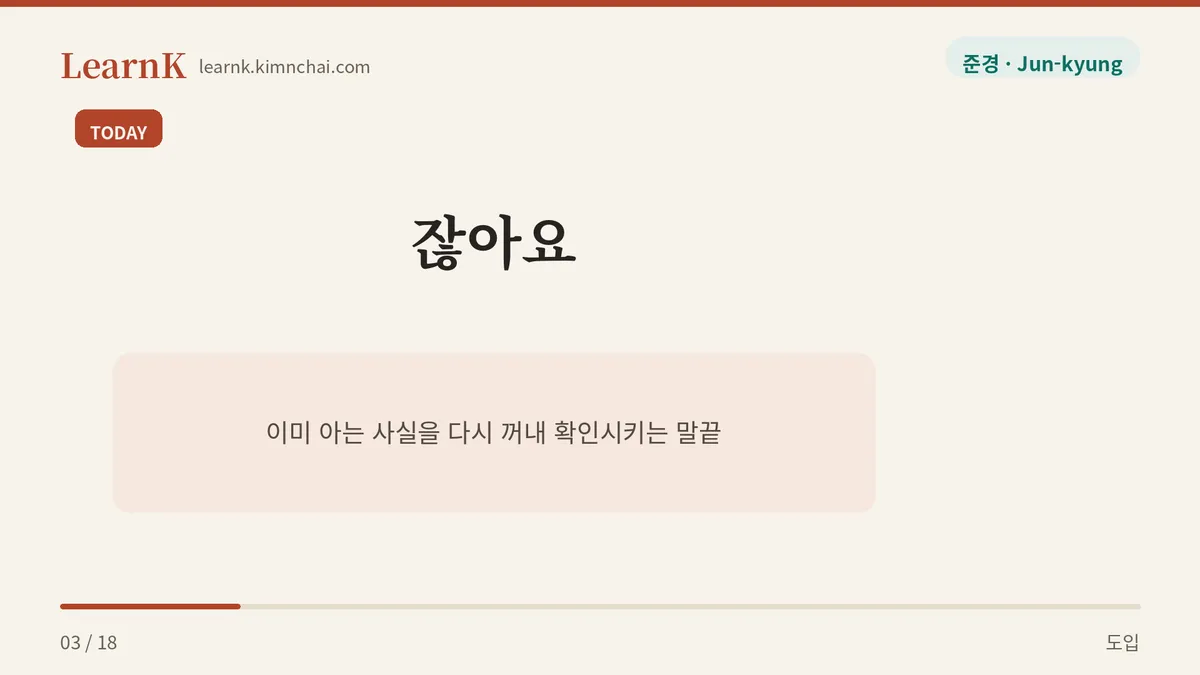
잖아요 (janayo) means “a sentence ending you attach when you bring up a fact the listener already knows, in order to confirm it with them.” It isn’t a way of delivering news. Think of it instead as pointing your finger at something that was already lying there between the two of you.
When a friend who’s late for a meetup comes rushing up out of breath, a Korean will say: 우리 여섯 시에 만나기로 했잖아 (uri yeoseot-si-e mannagiro haetjanha) — “We said we’d meet at six.” You could swap 했잖아 (haetjanha) for 했어요 (haesseoyo) and the sentence would still be perfectly fine. What vanishes is the temperature. 했어요 adds a new piece of information; 했잖아 adds a check — “you knew that too, right?” This is usually the point where a learner of a few years starts to sound like a native speaker. Not because they know more words, but because they’ve begun packing into the sentence ending what the two of you know together.
The nuance branches three ways. First, reminding: gently retracing a fact the other person has forgotten. Second, laying down grounds: when you make a suggestion, it puts the reason underneath it with the attitude of “this is something we both already know.” Third, a light scolding: when 그러게 (geureoge) comes in front of it, it turns into this meaning almost automatically. Same ending, but intonation separates them. Lift the end slightly and it’s a confirmation; press the end down and it’s a jab.
There’s one important precondition. 잖아요 only works if the listener actually knows the fact. Attach it to something they have no idea about and it becomes pressure — “how do you not know this?” Just remembering this one precondition eliminates half of all misuse.
Seeing it in real conversation
Situation: Saturday afternoon, the waiting room of an orthopedic clinic. Jun-kyung has come in with a sprained wrist from his early-morning soccer game, and Emily has tagged along and is sitting next to him.
에밀리: 그러게 내가 무리하지 말라고 했잖아. 지난달엔 발목이었고. See, I told you not to overdo it. Last month it was your ankle.
준경: 알아, 알아. 근데 그날따라 공이 딱 발밑으로 오는데 어떡해. I know, I know. But the ball rolled right to my feet that day — what was I supposed to do?
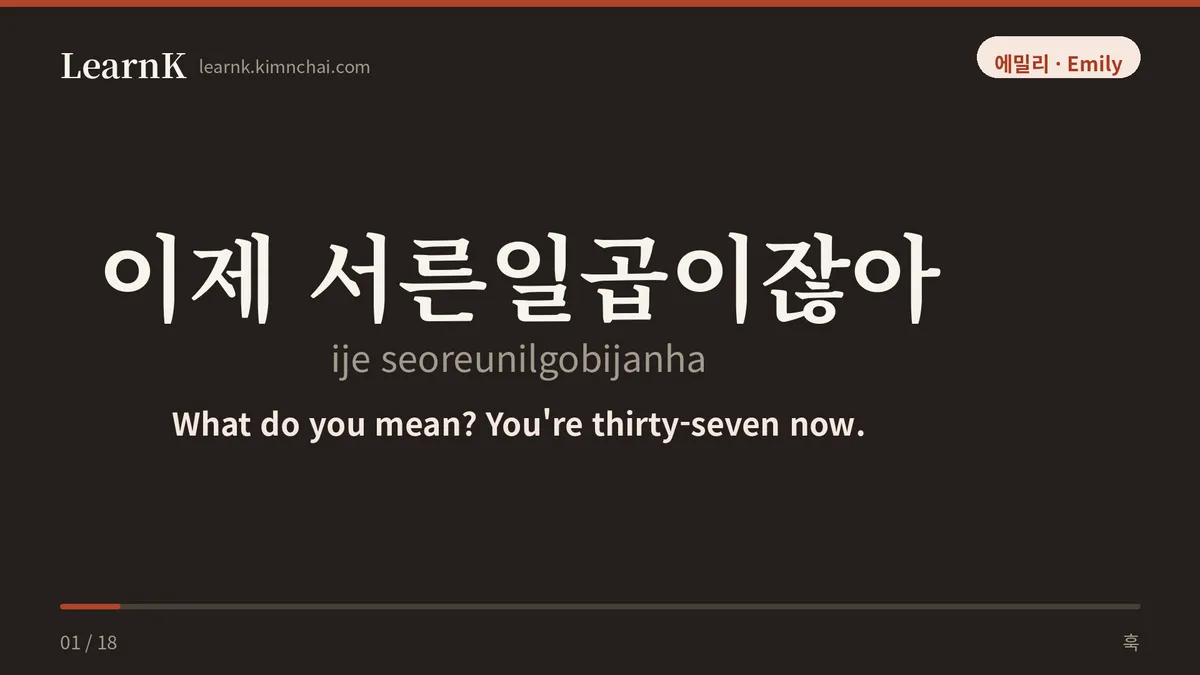
에밀리: 어떡하긴. 이제 서른일곱이잖아. What do you mean? You’re thirty-seven now.
준경: 야, 그 얘긴 하지 말자니까. …어? 접수증 어디 갔지? Hey, I said drop that. …Huh? Where’d my registration slip go?
에밀리: 아까 주머니에 넣으셨잖아요. 제가 옆에서 봤는데요. You put it in your pocket a minute ago. I watched you do it.
준경: …진짜네. 너 왜 갑자기 존댓말이야. …You’re right. And why the sudden polite talk?
Emily switching abruptly into polite speech at the end isn’t a slip. Between close friends, deliberately putting on formality becomes a teasing tone. 잖아요 sits nicely on top of that kind of joke, too.
Where it sounds off
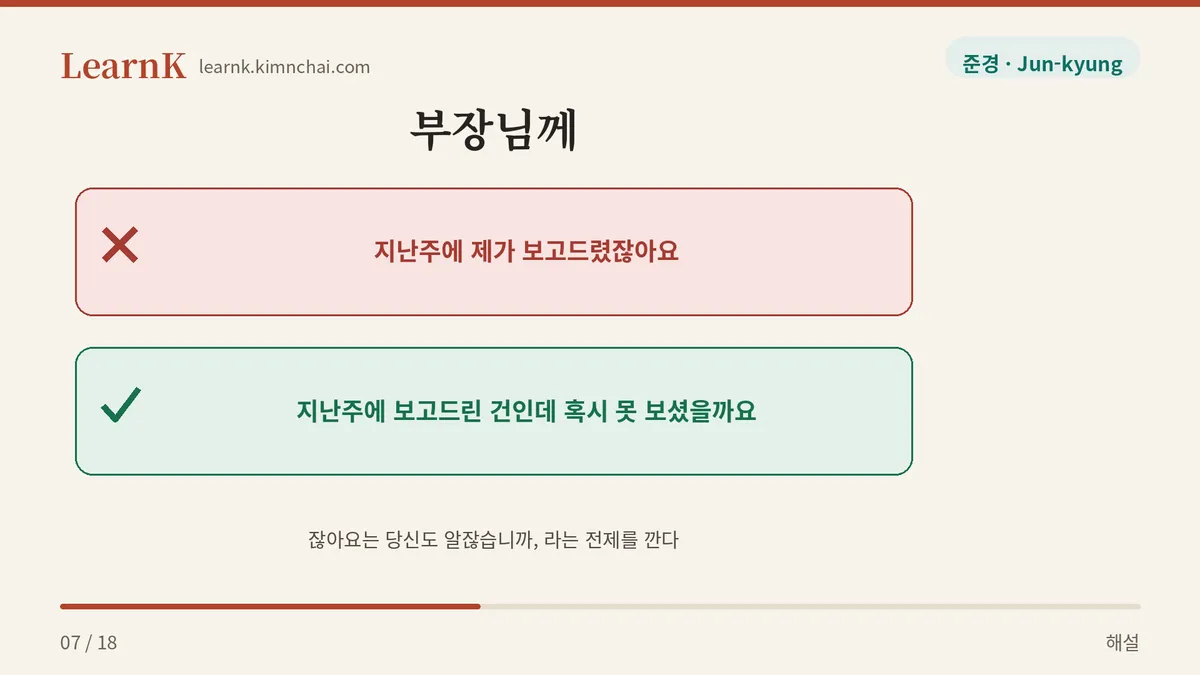
✗ (to your department head) 부장님, 그건 지난주에 제가 보고드렸잖아요. (bujangnim, geugeon jinanjue jega bogodeuryeotjanayo.) ✓ (to your department head) 부장님, 그건 지난주에 보고드린 건인데 혹시 못 보셨을까요? (bujangnim, geugeon jinanjue bogodeurin geoninde hoksi mot bosyeosseulkkayo?) → The grammar is flawless. The problem is that 잖아요 lays down the premise “surely you know this too.” Used toward someone senior to you, it turns into a remark pointing out that they failed to remember. With people above you, it’s safer to convert the confirmation into a question and let it slide by.
✗ (to someone you’ve just met) 아, 제가 홍대 쪽에 살잖아요. (a, jega Hongdae jjoge saljanayo.) ✓ (to someone you’ve just met) 아, 제가 홍대 쪽에 살아요. (a, jega Hongdae jjoge sarayo.) → Attach 잖아요 to a fact the other person couldn’t possibly know, and the listener freezes for a second: “was I supposed to know that?” On a first meeting, it can also come across as acting overly familiar.
Example sentences by situation
1. Gently retracing a forgotten commitment A colleague still hasn’t sent the meeting materials. Pushing feels awkward, but staying quiet means the meeting falls apart.
어제 메일 드렸잖아요. 확인만 한번 부탁드릴게요. (eoje meil deuryeotjanayo. hwaginman hanbeon butakdeurilgeyo.) I sent you the email yesterday. Could you just give it a look?
Say the same thing as 메일 드렸는데요 (meil deuryeonneundeyo) and the sense of picking a fight gets much stronger. 잖아요 adds a bit of ease — “this is something we both know, so there’s no need to make an issue of it now.”
2. Laying the grounds for a suggestion You’ve agreed to go to a restaurant with a friend this weekend, and you both know the place is always packed.
거기 주말엔 사람 많잖아요. 좀 일찍 나갈까요? (geogi jumaren saram manjanayo. jom iljjik nagalkkayo?) That place gets crowded on weekends, you know. Should we head out a little early?
The 잖아요 placed in front of the suggestion becomes the grounds for it: “I’m not deciding this on a whim — it’s because of something we both know.” It’s a device that keeps a request from sounding like an order.
3. Explaining your own circumstances At a company dinner, someone offers you spicy food. You have to decline, but you don’t want to kill the mood.
제가 매운 걸 잘 못 먹잖아요. 저는 저쪽 국물로 할게요. (jega maeun geol jal mot meokjanayo. jeoneun jeojjok gungmullo halgeyo.) I’m not great with spicy food, as you know. I’ll go with that soup over there.
This only sounds natural when it’s a circumstance the other person already knows. In front of someone you’re meeting for the first time, 제가 매운 걸 잘 못 먹어서요 (jega maeun geol jal mot meogeoseoyo) is the right choice.
Similar expressions in polite and casual speech
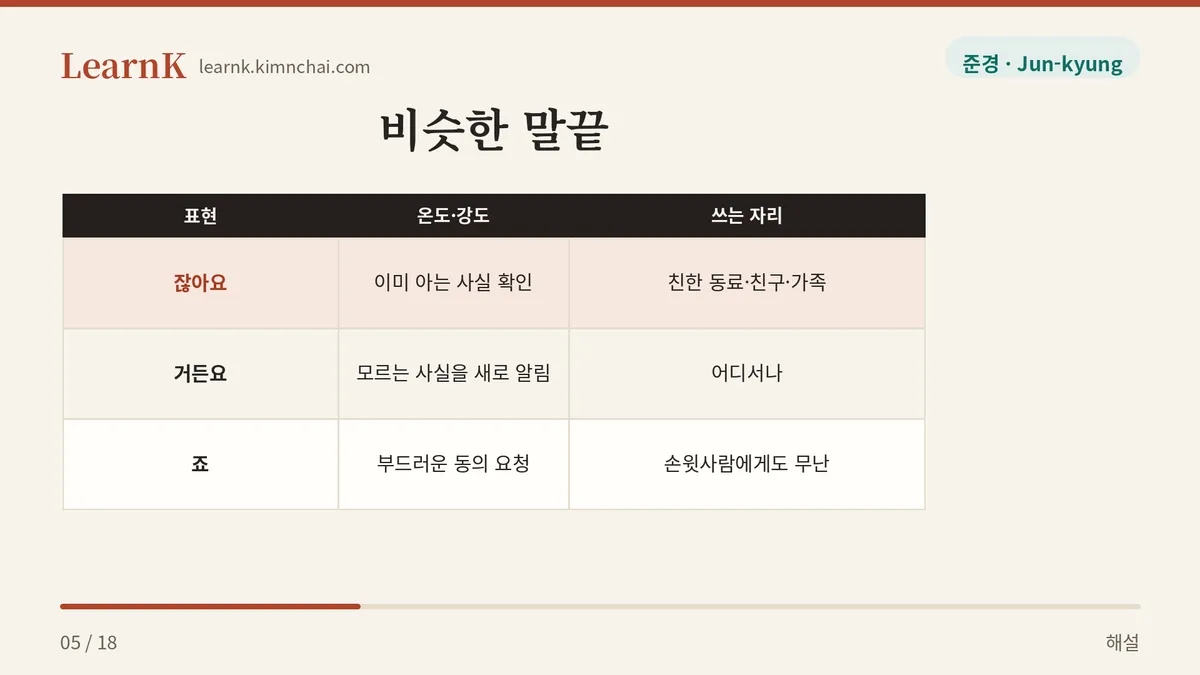
| Expression | Temperature / intensity | Where it’s used |
|---|---|---|
| 잖아요 (janayo) | Confirms a fact already known. Can be warm, can be a jab | Close colleagues, friends, family. Avoided with people senior to you |
| 잖아 (janha) | Same meaning in casual speech. More direct | Peers, friends, partners |
| 거든요 (geodeunyo) | Delivers a fact the listener doesn’t know | Anywhere. But used too often, it sounds like making excuses |
| 죠 / 지요 (jyo) | A soft request for agreement. The least pressure of all | Fine even with people senior to you |
| 니까요 (nikkayo) | Nails down a reason. Firm | Situations that call for explanation. Strong, so use with care |
The pair that confuses people most is 잖아요 and 거든요. They point in opposite directions. 잖아요 pulls out something already in the listener’s head; 거든요 puts something new in. You use 제가 부산 사람이잖아요 (jega Busan saramijanayo) when the other person already knows where you’re from, and 제가 부산 사람이거든요 (jega Busan saramigeodeunyo) when you’re revealing it for the first time. Swap the two and the sentence still stands, but the grain of the conversation runs the wrong way.
Cultural background — a sentence ending only for people who already know each other
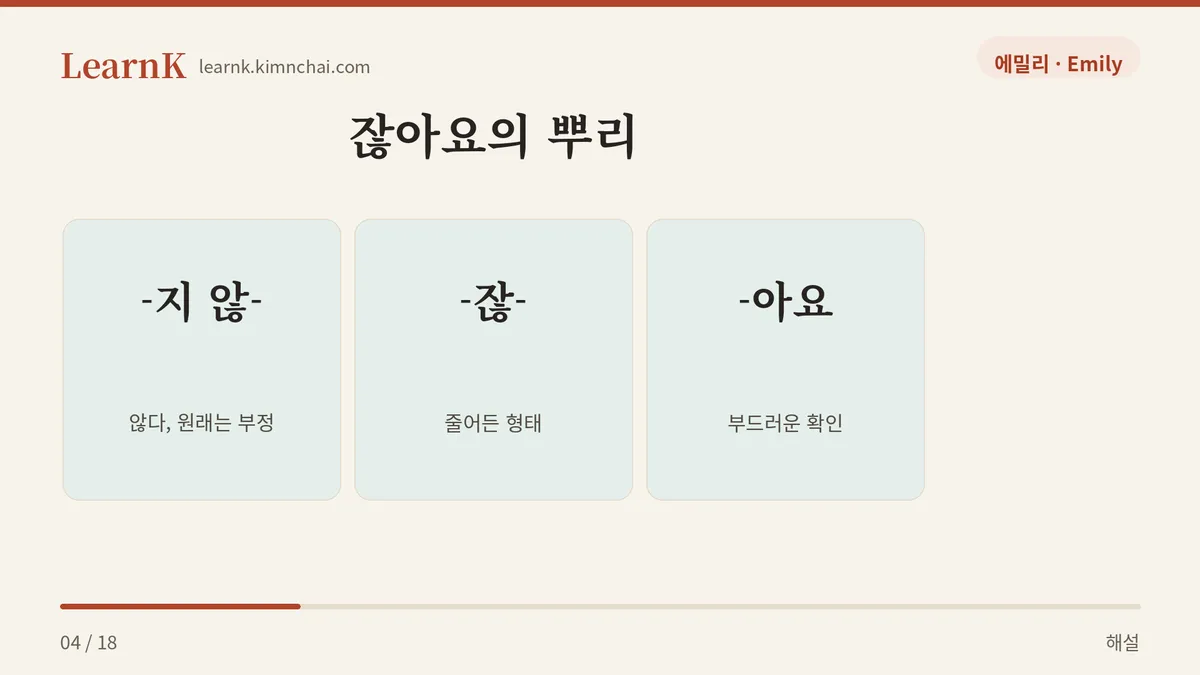
The root of 잖아요 isn’t complicated. -지 않- (-ji anh-) contracted into -잖- (-janh-). 그렇지 않아요 (geureochi anayo) became 그렇잖아요 (geureochanayo). What was originally a negative passed through the questioning form “isn’t that so?” and has now hardened into a confirming sentence ending with almost none of the negation left. That’s why 잖아요 still carries the posture of leaning toward the other person and asking, 안 그래? (an geurae?) — “right?”
The reason this ending shows up so often in Korean has less to do with grammar than with relationships. Korean conversation is constantly calculating what the speaker and the listener know in common. With someone you’ve just met, you lay information down one piece at a time with 요 (yo); as you grow closer, the territory of “you already know this, no need to spell it out” widens — and as that territory widens, 잖아요 multiplies. So 잖아요 carries information that disappears if you translate only the meaning: the information that we already know each other.
That’s the same reason this ending turns up so often in Korean dramas at the moment a relationship flips. When one of two people who had only ever used polite speech brings up the past with 그때 그랬잖아요 (geuttae geuraetjanayo), a single line of dialogue reveals that the two of them share a history. Subtitles usually handle it with something like “you know,” but on a Korean screen that sentence ending is a ruler for measuring the distance in a relationship.
Today’s quiz
You’re introducing yourself to a client contact you’re meeting for the very first time. They have no idea that you lived in Japan for years. What fits in the blank?
제가 도쿄에서 8년 살았 ______ . 그래서 일본어는 좀 합니다. (jega Dokyo-eseo 8-nyeon sarat ______ . geuraeseo ilboneoneun jom hamnida.) I lived in Tokyo for eight years ______ . So I speak a bit of Japanese.
- 잖아요
- 거든요
- 잖아
Answer: 2, 거든요
This is a situation where you’re bringing up a fact the listener doesn’t know for the first time. 잖아요 lays down the premise “you know this too,” so it sounds off here, and 잖아 is casual speech, which you can’t use with a client contact. Conversely, if you’d already met a few times and knew each other’s backgrounds, 제가 도쿄에서 8년 살았잖아요 (jega Dokyo-eseo 8-nyeon saratjanayo) would be far more natural. The same sentence splitting depending on the relationship — that’s the whole of this sentence ending.
Definitions and example sentences are from the National Institute of Korean Language’s Basic Korean Dictionary (krdict.korean.go.kr); that portion of this post, including our translations, is licensed under CC BY-SA 2.0 KR.