진지 드세요 (jinji deuseyo) — The Highest Honorific, Saved for Grandma's Table
진지 드세요
진지 드세요 (jinji deuseyo) is the most elevated way to say “please eat” — the top tier of Korean honorific speech, used when inviting an elder like a grandfather or grandmother to a meal. On the morning of the Lunar New Year holiday, once the table is fully set on the wooden floor of the main family house, someone goes and stands at the door of the inner room and says this. It’s also the phrase that carries clear across the yard when it’s mealtime at a grandmother’s house in the countryside, and the one a caregiver says while knocking on a resident’s door down a nursing home hallway.
It’s the line you see in Korean dramas — the daughter-in-law standing outside her father-in-law’s door with her hands folded in front of her. And yet it’s rarely taught in Korean textbooks. What textbooks teach is 식사하세요 (siksahaseyo). The two mean the same thing, but they sit in different seats. Miss that difference and you’ll say 진지 드세요 to your thirty-five-year-old team leader and turn the whole office upside down.
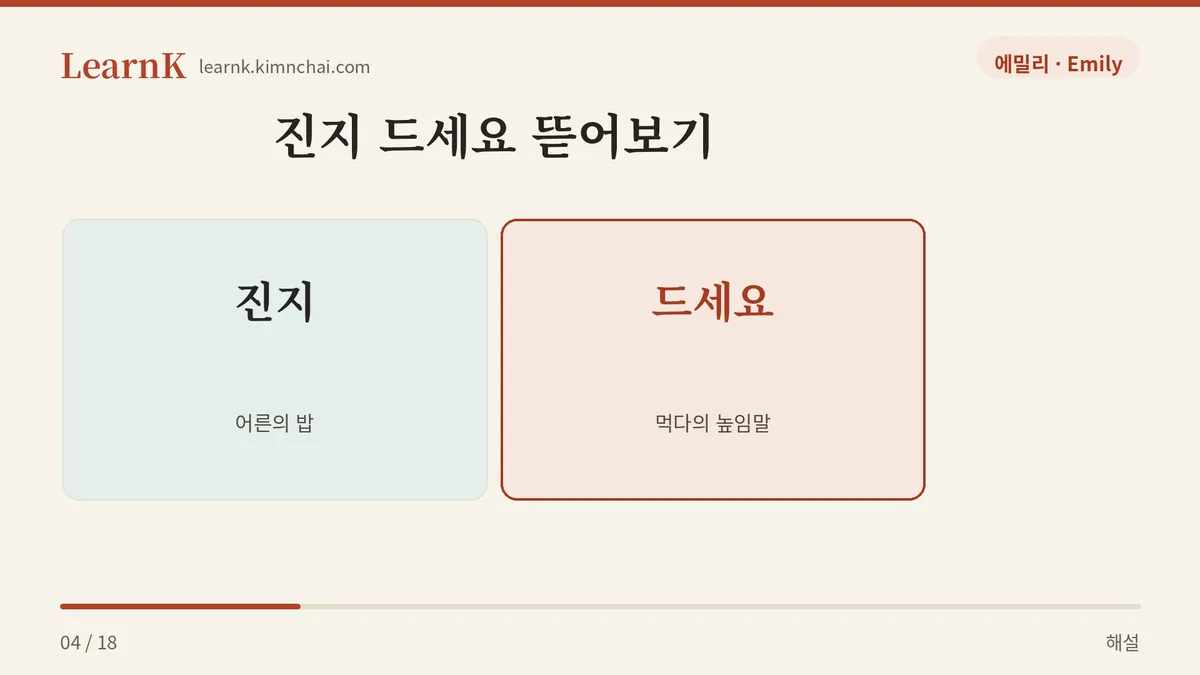
What makes this expression special is that the honorific runs two layers deep. Korean politeness is usually built by changing verb endings: 먹어 (meogeo) → 먹어요 (meogeoyo) → 드세요 (deuseyo) — you just swap out the tail of the word. But a handful of words don’t change their ending at all; the entire word is replaced with a different one. This is called lexical honorification.
- 밥 (bap, rice/meal) → 진지 (jinji)
- 나이 (nai, age) → 연세 (yeonse)
- 이름 (ireum, name) → 성함 (seongham)
- 집 (jip, house) → 댁 (daek)
- 말 (mal, words/speech) → 말씀 (malsseum)
- 먹다 (meokda, to eat) → 드시다 (deusida), or higher still, 잡수시다 (japsusida)
- 자다 (jada, to sleep) → 주무시다 (jumusida)
- 있다 (itda, to be/exist) → 계시다 (gyesida)
진지 드세요 elevates both the noun (진지) and the verb (드시다) from this list at the same time. That puts it a full step above 밥 드세요 (bap deuseyo), and half a step above 식사하세요 (siksahaseyo). If 식사하세요 is polite but neutral, office-appropriate speech, then 진지 드세요 is warm, old-fashioned, and already carries within it the meaning “I respect your years.”
Just one thing to remember. 진지 (jinji) is only ever used for someone else’s meal. No matter how formal you’re being, your own food is never 진지. Honorifics are a tool for raising the other person up, not yourself.
A Real Conversation
Scene: The first day of the Lunar New Year holiday, at Jun-kyung’s grandmother’s house. The table is set, and they’re about to go call Grandma, who is in the inner room.
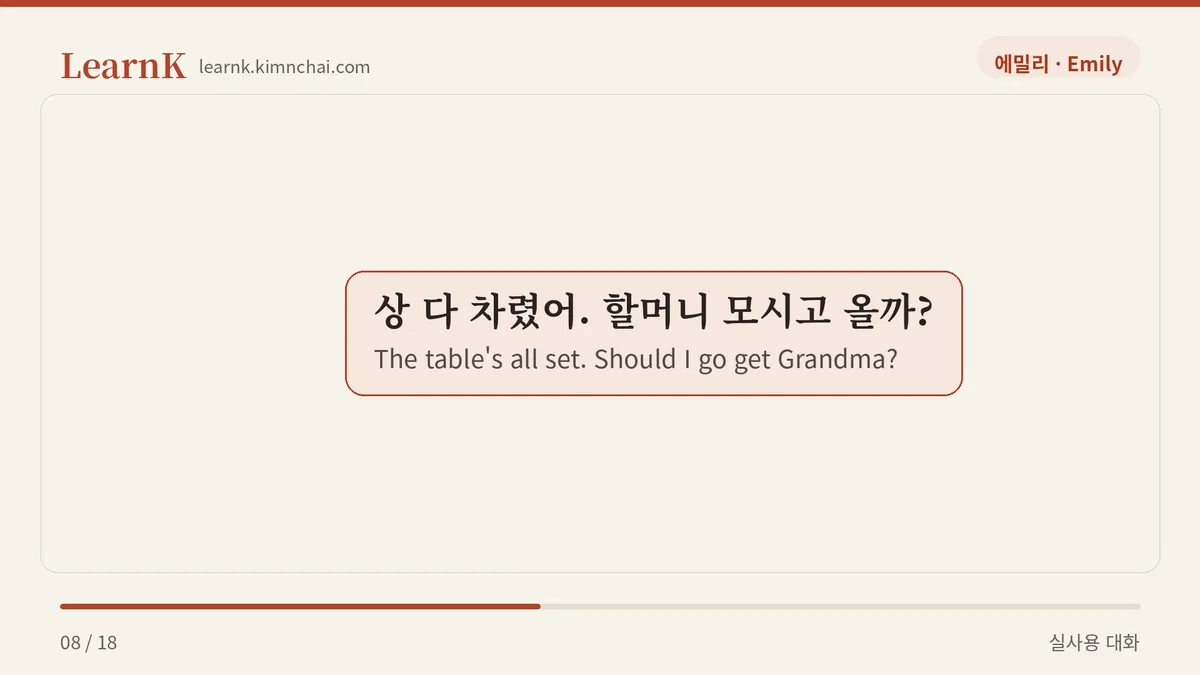
Emily: 상 다 차렸어. 내가 가서 할머니 모시고 올까? The table’s all set. Should I go get Grandma?
Jun-kyung: 어, 부탁해. 가서 진지 드세요 하고 말씀드리면 돼. Yeah, please. Just go and say ‘jinji deuseyo.’
Emily: 진지? 밥 드세요 아니고? Jinji? Not ‘bap deuseyo’?
Jun-kyung: 할머니한테는 밥을 진지라고 해. 훨씬 더 높이는 말이야. For Grandma, rice is called ‘jinji.’ It’s a much more respectful word.
Emily: 아, 연세랑 말씀 같은 거구나. 알겠어. 할머니, 진지 드세요! Ah, so it’s like ‘yeonse’ and ‘malsseum.’ Got it. Grandma, come and eat!
Jun-kyung: 야, 억양 좋다. 할머니 오늘 그 얘기만 하시겠는데. Whoa, nice intonation. Grandma’s gonna talk about that all day.
Where This Sounds Off
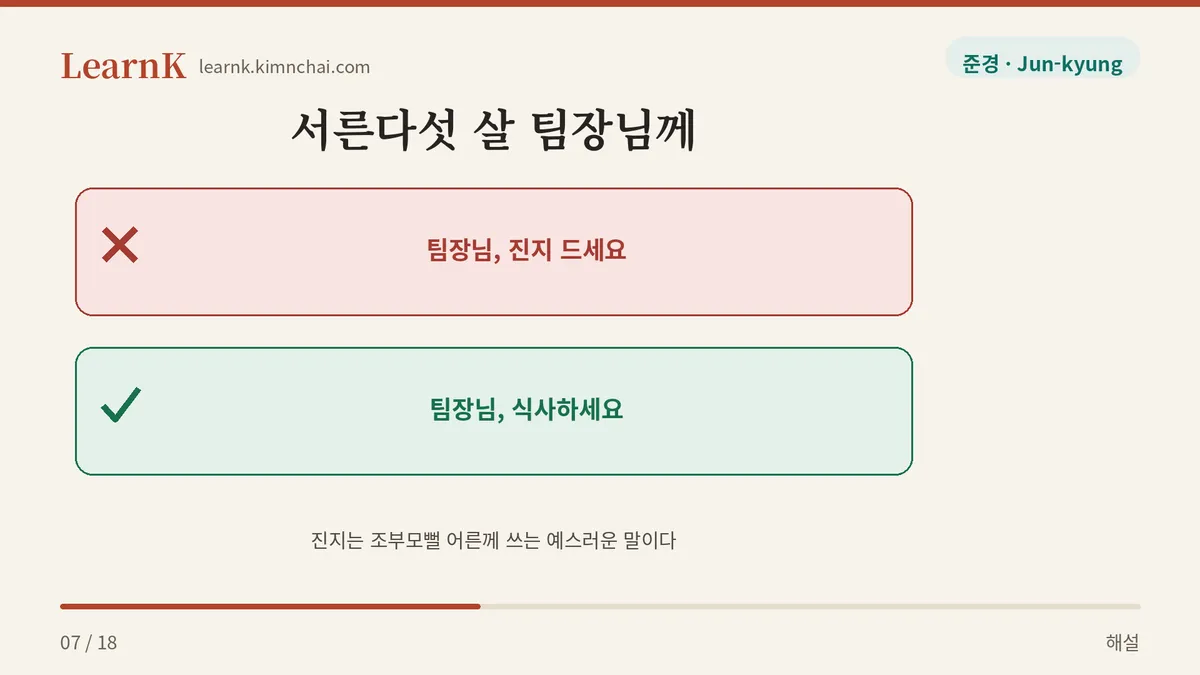
✗ (to a thirty-five-year-old team leader) 팀장님, 진지 드세요. ✓ (to a thirty-five-year-old team leader) 팀장님, 식사하세요. → 진지 is an old-fashioned word reserved for grandparent-aged elders, so using it with a boss who isn’t much older than you doesn’t read as respect — it reads as treating them like an old person. At work, 식사하세요 is the safe choice regardless of age.
✗ (to a coworker) 저 이제 진지 먹으러 갈게요. ✓ (to a coworker) 저 이제 점심 먹으러 갈게요. → 진지 elevates the other person’s meal. Use it for your own and you end up honoring yourself — reaching for politeness and landing on comedy instead.
Example Sentences by Situation
1. Grandma’s house in the countryside, seven in the morning
The table is set and Grandma is still in the inner room. You call to her from outside the door, raising your voice just a little.
할머니, 진지 드세요. 국 식어요. (halmeoni, jinji deuseyo. guk sigeoyo.) Grandma, come have your meal. The soup’s getting cold.
That tacked-on “국 식어요 (guk sigeoyo)” pulls the phrase down out of formality and into everyday household life. At an actual dinner table, 진지 드세요 almost never stands alone — there’s always some small nudge like this attached to it.
2. Holiday morning, in the living room at your uncle’s house
When several elders are present, you don’t call them one by one — you invite them all at once. This is also where people sometimes step it up another level by using 잡수시다 (japsusida).
어른들 먼저 진지 잡수세요. 저희는 이따 먹을게요. (eoreundeul meonjeo jinji japsuseyo. jeohuineun itta meogeulgeyo.) Elders, please eat first. We’ll eat later.
The first sentence goes as high as it can with 진지 and 잡수시다; the second, which is about the speakers themselves, drops right back down to plain 먹을게요 (meogeulgeyo). This rhythm — the layers of honorification shifting within a single breath — is the heart of Korean politeness.
3. A nursing home or hospital ward
Where people care for elders every day, the phrase shows up more often as a way of asking how someone is doing.
어르신, 오늘 진지는 드셨어요? (eoreusin, oneul jinjineun deusyeosseoyo?) Sir/Ma’am, have you eaten today?
On the surface it’s a question about food, but its real weight is closer to “Have you been all right today?” That’s exactly why this expression is still alive in caregiving settings.
Related Expressions, Polite and Casual
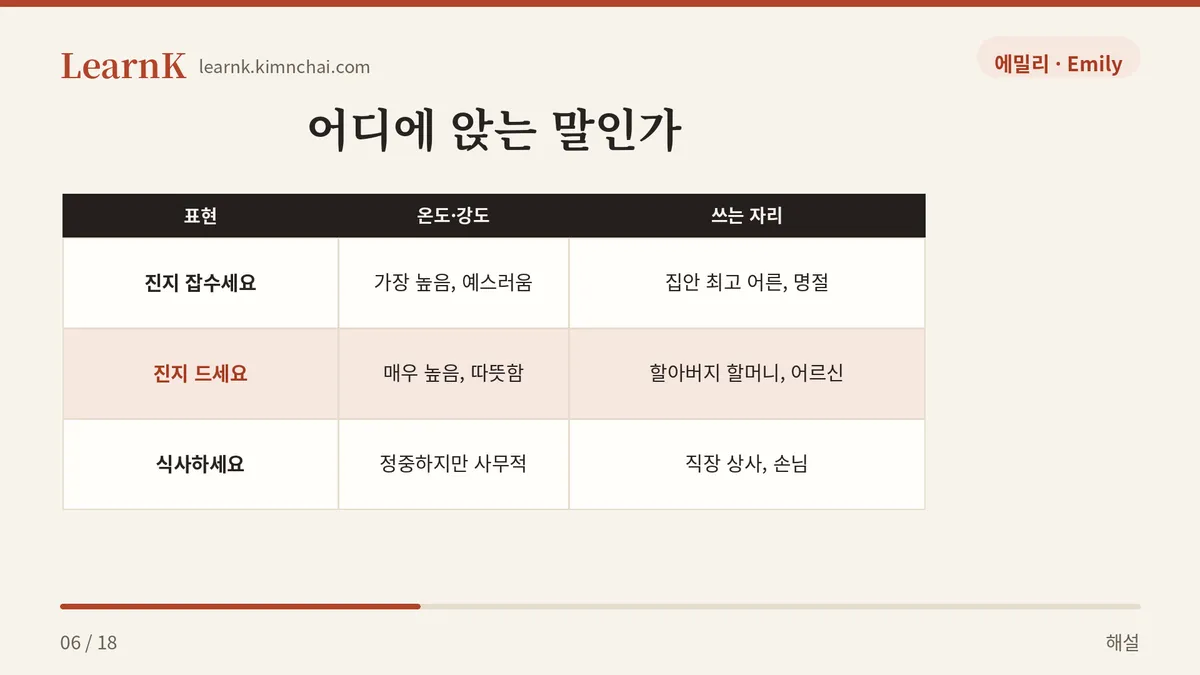
| Expression | Warmth & Intensity | Where it fits |
|---|---|---|
| 진지 잡수세요 (jinji japsuseyo) | Highest; distinctly old-fashioned | Grandparents, the most senior member of the family. Holidays and ancestral rites |
| 진지 드세요 (jinji deuseyo) | Very high; warm and old-fashioned | Grandfathers, grandmothers, elderly people. Country dinner tables, caregiving settings |
| 식사하세요 (siksahaseyo) | Polite but neutral and businesslike | Bosses, guests, elders you’re meeting for the first time. Safe at any age |
| 밥 드세요 (bap deuseyo) | Light politeness | Slightly older seniors, elders you’re comfortable with. A touch too casual for true elders |
| 밥 먹어 (bap meogeo) | Casual speech; relaxed | Friends, people younger than you, within the family |
Read the table from top to bottom and it doubles as a scale of age gap and social distance. When you’re unsure, there’s really only one test: is this person roughly my grandparents’ age? If yes, 진지 드세요. If not, 식사하세요.
Cultural Background — When a Meal Was the Same as “How Are You?”
In Korea, food has long served as a greeting. Even today, people ask 밥 먹었어? (bap meogeosseo?, “Have you eaten?”) when they meet, and say 밥 한번 먹자 (bap hanbeon meokja, “Let’s eat sometime”) when they part. Neither is really about food — they mean “How are you doing?” and “See you again.” 진지 드셨어요? (jinji deusyeosseoyo?) is the most elevated form of that greeting. Instead of asking an elder directly whether they’re in good health, you ask about their meals. Behind the phrase is an old piece of arithmetic: if they haven’t skipped a meal, nothing’s seriously wrong.
What you called the food depended on whose it was. A younger person’s meal was 밥 (bap), an elder’s meal was 진지 (jinji), and the king’s meal was 수라 (sura). That’s why the king’s table in a historical drama is called a 수라상 (surasang), and the individual table once set separately in front of a grandfather was called a 진짓상 (jinjitsang). These days the whole family sits around one table, so the word 진짓상 has all but disappeared — but 진지 is still with us.
The range of people who use it, though, has definitely narrowed. Two thirty-somethings in Seoul will almost never have occasion to say 진지, and there are really only about three places where the word is used daily: extended families gathered for the holidays, hospitals and care facilities looking after the elderly, and historical dramas. It’s also a perennial favorite on Korean proficiency exams whenever they test lexical honorifics. So this is less an expression to learn for daily use and more one to learn so that you’ll recognize its warmth when you hear it. And if you ever find yourself sitting down at the table in a Korean friend’s grandmother’s house, for that one day it will be the single most useful Korean phrase in the world.
Today’s Quiz
Which of the following is the most natural place to use 진지 드세요?
- Saying it to your thirty-five-year-old team leader at a company dinner
- Saying it to your grandmother in the inner room after setting out breakfast at her country house
- Saying it to a friend your own age sitting across from you at a café
- Pointing at your own food as you head out for lunch
Answer: 2
For 1, the age gap isn’t large enough, so it comes across as treating them like an old person — 식사하세요 is the right call. For 3, you’re among friends, so 밥 먹자 (bap meokja) will do. For 4, you’ve used an honorific for your own meal, which ends up elevating yourself. There is exactly one place where 진지 드세요 belongs: at the table of an elder of your grandparents’ generation.