집순이 · 집돌이 — What We Call People Who Love Being Home Most
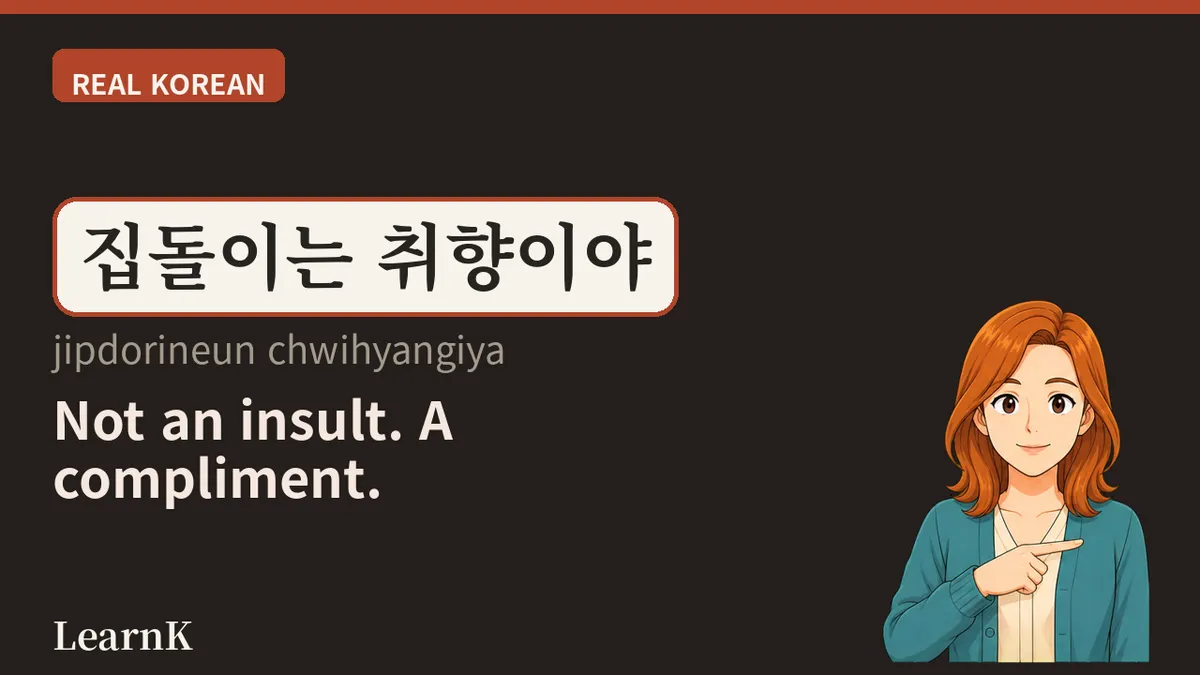
집순이 / 집돌이
Has a friend ever asked you on the weekend, “Should we go out?” — and a quiet voice inside you said, “Hmm… I kind of just want to stay home”? If so, you already understand the heart of a 집순이 (jipsuni) or a 집돌이 (jipdori). These two words are used constantly by Korea’s younger generation in everyday life, so you’ll run into them easily in dramas, variety shows, and on social media.
Meaning and Nuance
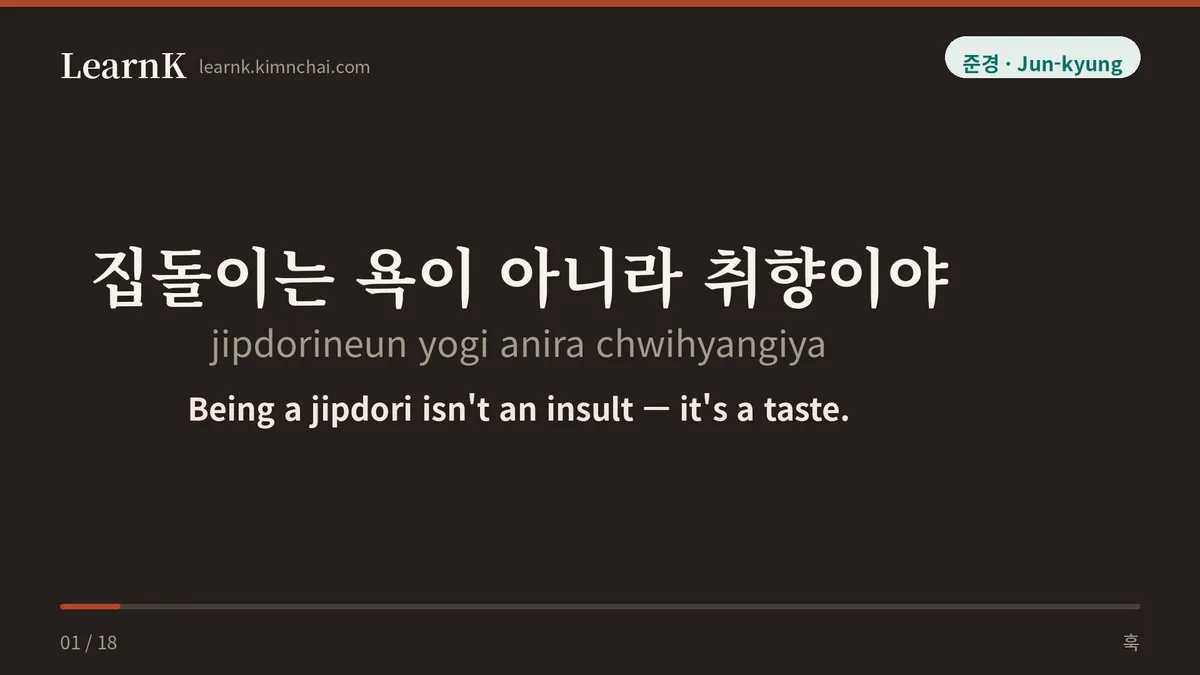
집 (jip) means ‘house/home,’ and here it’s joined with a friendly suffix that refers to a person. It combines with -순이 (-suni), used to casually refer to a girl, or -돌이 (-dori), used for a boy.
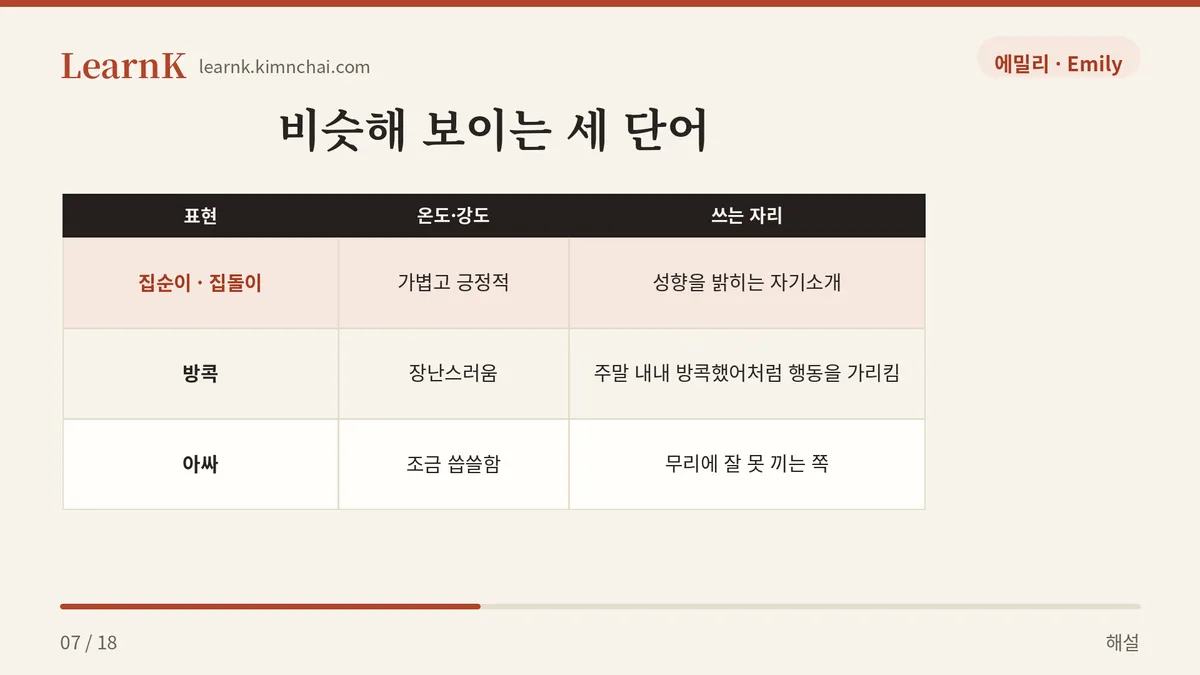
- 집순이 (jipsuni): a girl who loves being home most of all
- 집돌이 (jipdori): a boy who loves being home most of all
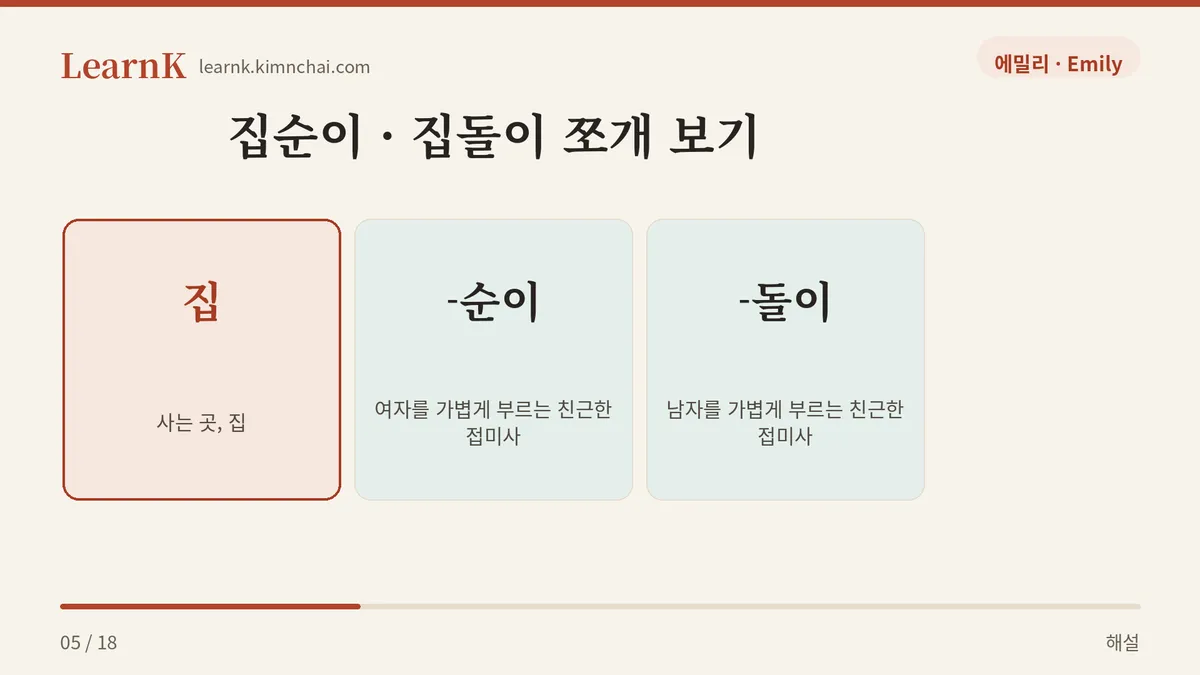
In other words, ‘someone who prefers relaxing at home over going out to have fun’ — very close to the English word homebody. The important thing is that these words carry almost no negative feeling. They’re not an accusation of laziness; they’re closer to a self-introduction, even a point of pride: “I’m the type who recharges at home.” That’s why people cheerfully introduce themselves by saying, “나 완전 집순이야 (na wanjeon jipsuniya)” — “I’m a total homebody.”
Example Sentences by Situation
① Introducing yourself
저는 주말마다 밖에 나가기보다 집에서 영화 보는 걸 좋아하는 집돌이 (jipdori) 예요. (I’m a 집돌이 (jipdori) — every weekend I’d rather watch movies at home than go out.)
This is a situation where you lightly and honestly reveal your personality to someone you’ve just met. It comes up very naturally when people ask about your hobbies.
② Turning down plans
미안, 오늘은 그냥 집에 있고 싶어. 나 집순이 (jipsuni) 잖아. (Sorry, today I just want to stay home. You know I’m a 집순이 (jipsuni).)
This is a way to gently decline a friend’s invitation without hurting the relationship. That little phrase “집순이잖아” (“you know I’m a homebody”) carries the nuance of “please understand.”
③ Using it as a post-pandemic trend
요즘은 다들 집돌이·집순이 (jipdori · jipsuni) 가 됐지, 배달 음식에 넷플릭스면 완벽하니까. (These days everyone’s become a 집돌이·집순이 (jipdori · jipsuni) — delivery food and Netflix and you’re all set.)
This describes today’s mood, in which time spent at home has become its own kind of culture.
Comparing Polite/Casual Speech and Similar Expressions
집순이·집돌이 are themselves casual, newly coined words, so they aren’t really used in very formal settings. If you want to say it politely instead, you spell it out with something like “저는 집에 있는 걸 좋아해요 (jeoneun jibe inneun geol joahaeyo)” (“I like staying home”).
It’s helpful to know some similar words too.
- 방콕 (bangkok): short for ‘방에 콕 박혀 있다’ (staying cooped up in your room). It refers to an action, as in “주말 내내 방콕했어” (“I stayed cooped up at home all weekend”).
- 인싸 (inssa) / 아싸 (assa): someone who mixes well with people (인싸) and the opposite (아싸). 집순이·집돌이 can overlap with ‘아싸,’ but it doesn’t necessarily mean a lonely person. It’s closer to someone who actively enjoys and chooses time alone.
Cultural Background — An Era When Home Became a Preference
There’s a reason this expression spread so widely in Korea. Thanks to a fast, tightly-knit delivery culture, well-developed online shopping, and streaming services like Netflix, you can now enjoy pretty much any pleasure right at home. On top of that, going through the COVID-19 era, ‘the ability to live well at home’ settled in as a lifestyle and a taste of its own. In dramas and variety shows, it’s common to see a character lying in bed on the weekend, rolled up in a blanket, declaring “나는 뼛속까지 집순이” (“I’m a homebody to the bone”) — and viewers laugh because they see themselves in that image.
So the next time someone asks you, “What did you do this weekend?”, try answering with confidence: “집에서 푹 쉬었어. 나 집순이거든!” (“I rested up at home. I’m a homebody, you know!”)
Today’s Quiz
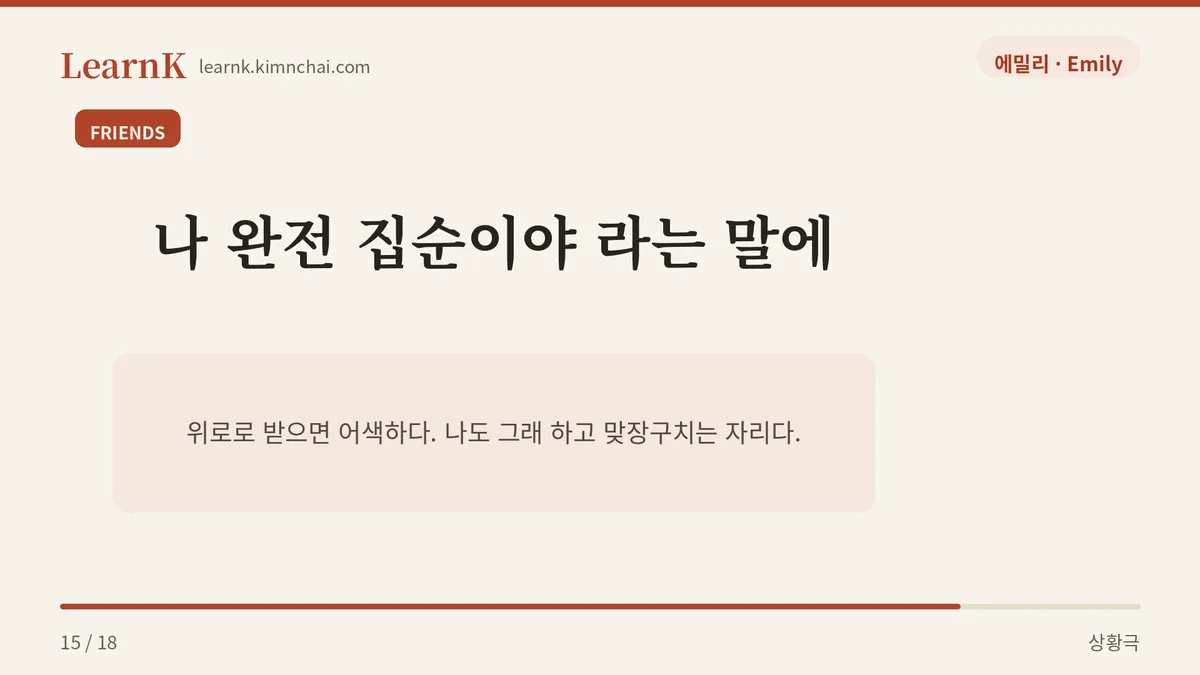
When a friend asks, “Want to go hiking this weekend?”, a guy who wants to rest at home wants to reveal his personality and gently decline. Which word would sound natural to work into his reply?
(Hint: it’s a newly coined word in the form of ‘집 + -돌이,’ which refers to a boy.)