Ta-da! The One Word Koreans Shout When Their Glasses Meet

짠 (건배)
Friday evening, at some bar in Korea. The glasses get filled, someone lifts theirs, and as if on cue everyone brings their glasses together toward the center. Then, the instant the glass rims clink, out bursts a single word — 짠 (jjan). It’s the sound you’re guaranteed to hear whenever a company-dinner scene comes up in a Korean drama. Today, let’s take a close look at this short, cheerful little expression.
What does 짠 mean?
‘짠’ is actually a word that imitates the sound of one glass striking another. It’s close to English “cheers” or “clink,” but in Korea the sound itself became the toast. In other words, when you knock glasses together and call out “짠!”, that alone carries the feeling of “let’s drink together — here’s to this wonderful moment.”
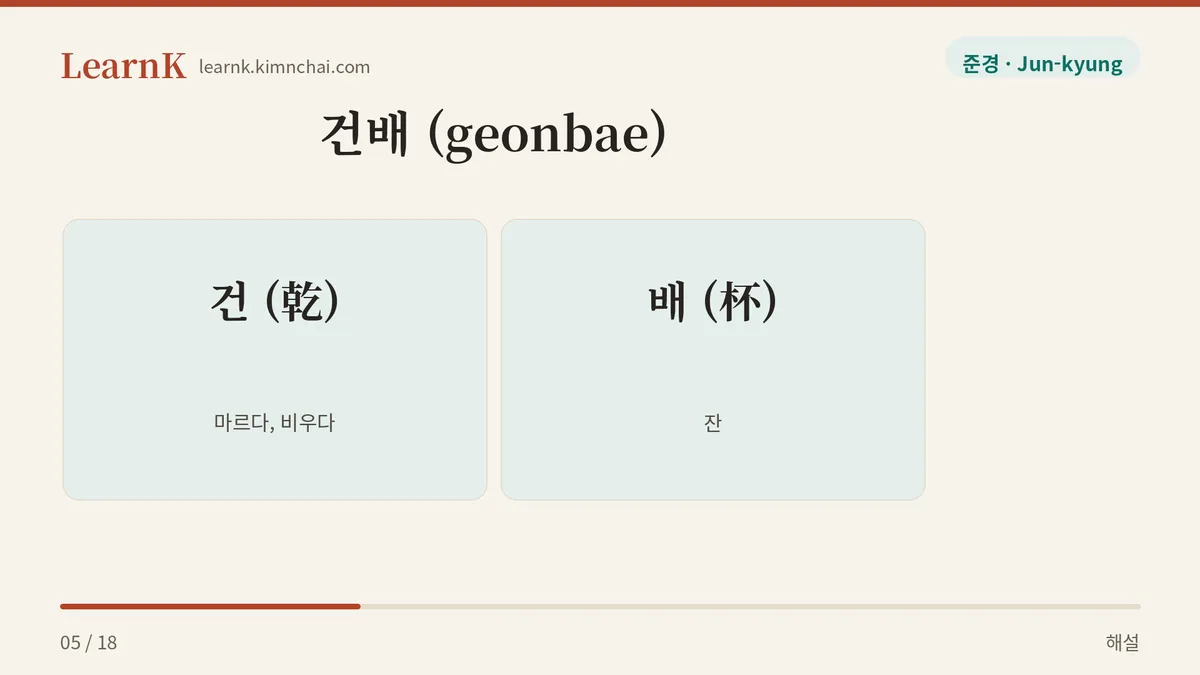
In slightly more formal settings, people say 건배 (geonbae). In Chinese characters, 건배 is written ‘마를 건(乾), 잔 배(杯)’ — literally, ‘to empty the glass.’ So “건배!” quietly carries the nuance of “let’s drink it all down.” Picture the scene where, at a company dinner or an official gathering, the boss raises a glass and calls out “자, 건배!” (“Alright, cheers!”). 짠, on the other hand, is a much more relaxed word used among friends, couples, and close relationships. Even though both are toasts, the temperature is different.
Seeing it in real conversation

Scene: Emily has finally moved into her new apartment. Jun-kyung has come over for the housewarming, and the two fill their first glasses.
Jun-kyung: 집 진짜 좋다. 자, 이사 축하하는 의미로 한잔해야지. 짠! This place is really nice. Come on, we’ve gotta drink to your move. Cheers!
Emily: 짠! 와줘서 고마워. 사실 오늘 아무도 안 오면 어쩌나 했어. Cheers! Thanks for coming. Honestly, I was worried nobody would show up.
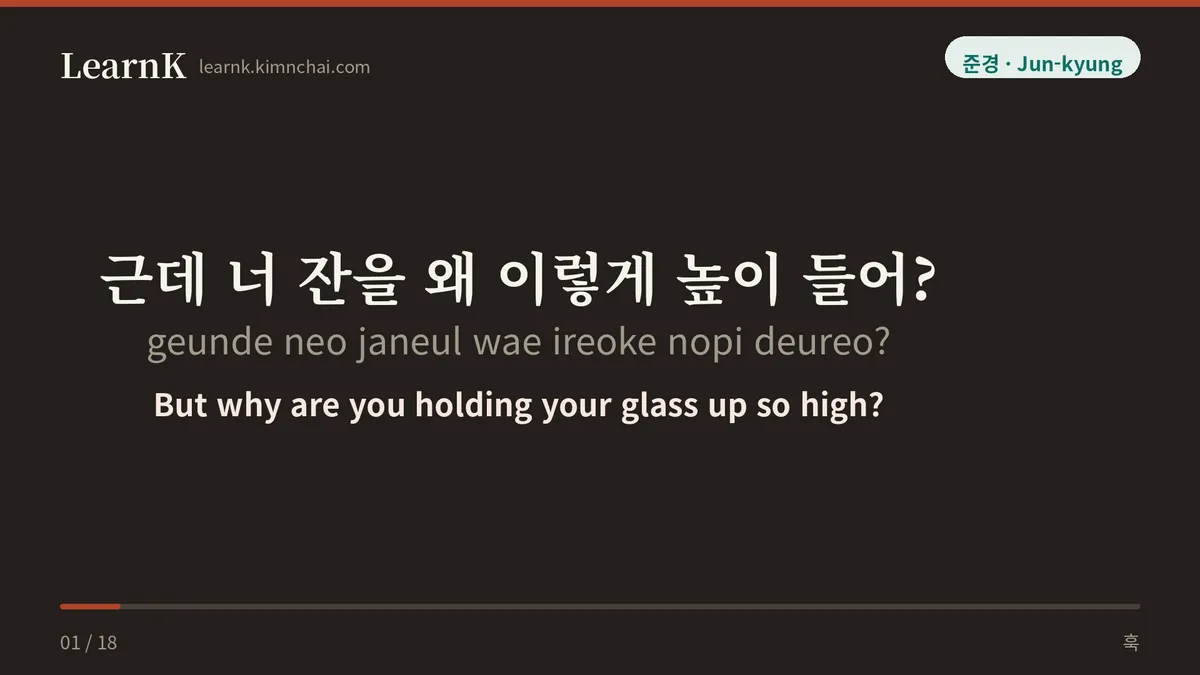
Jun-kyung: 무슨 소리야, 내가 집들이를 어떻게 빼먹어. 근데 너 잔을 왜 이렇게 높이 들어? What are you talking about, how could I skip a housewarming. But why are you holding your glass up so high?
Emily: 아, 나이 많은 사람이랑 마실 땐 잔을 좀 낮춰야 한다며. 너 나보다 형이잖아. Oh, I heard you’re supposed to lower your glass a bit with someone older. You’re older than me, right?
Jun-kyung: 오, 너 그런 것도 알아? 한국 15년차 무시 못 하네. 자, 다시. 짠! Oh, you even know that? Fifteen years in Korea really shows. Okay, again. Cheers!
Emily: 짠! 이제 여기가 우리 동네 아지트야. 자주 와. Cheers! This is our neighborhood hangout now. Come by often.
Example sentences by situation
① Friends reunited after a long time — Three friends who haven’t met in months lift their first glasses. “자, 우리 얼굴 본 게 얼마 만이야. 다 같이 짠 (jjan)!” (“Man, how long has it been since we’ve seen each other’s faces? All together — cheers!”) The joy and excitement ride right along on the sound of the clinking glasses. It’s the most natural expression among people who are close.
② Company year-end dinner — The department head stands up from his seat and raises his glass. “올 한 해 다들 고생 많았습니다. 내년에도 잘해봅시다. 건배 (geonbae)!” (“Everyone worked so hard this past year. Let’s do great next year too. Cheers!”) Since it’s a formal setting, ‘건배’ suits it better than ‘짠’, and everyone matches their voices and calls it out together.
③ A celebration for passing an exam or getting promoted — A special cheer is added for a friend’s news of landing a job. “우리 에밀리의 새 출발을 위하여 (wihayeo)!” (“To our Emily’s fresh start!”) ‘위하여’ is short for “~을 위하여” (“for the sake of ~”), and it’s a slightly more serious, more stylish expression used when raising your glass to wish for something.
Comparing polite vs. casual speech and similar expressions
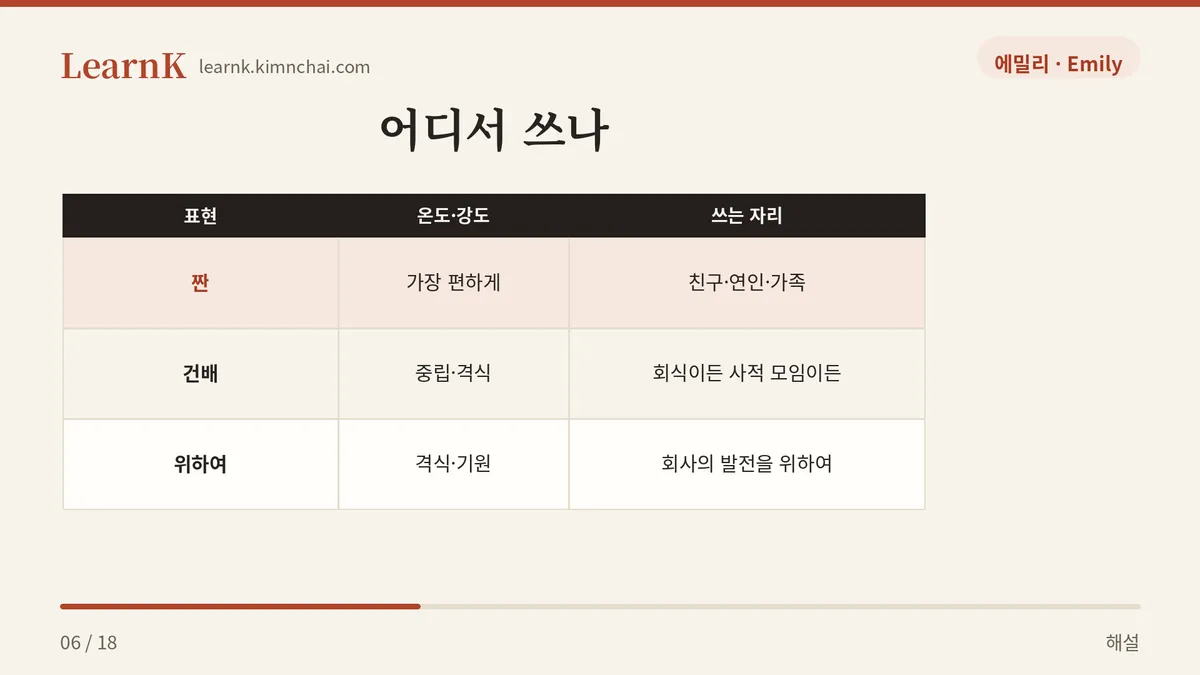
Since ‘짠’ is a word that mimics a sound, it has no built-in distinction between polite and casual speech. But the temperature of its use is clearly different.
- 짠 (jjan): The most casual. Used among comfortable relationships like friends, couples, and family. Loudly shouting “짠!” in front of a formal elder can come across as a bit too lighthearted.
- 건배 (geonbae): Neutral, yet it handles formal settings too. Whether at a company dinner or a private gathering, it works smoothly anywhere.
- 위하여 (wihayeo): Formality with a nuance of well-wishing added. Attaching an object, as in “회사의 발전을 위하여!” (“To the company’s growth!”), makes it feel more polished.
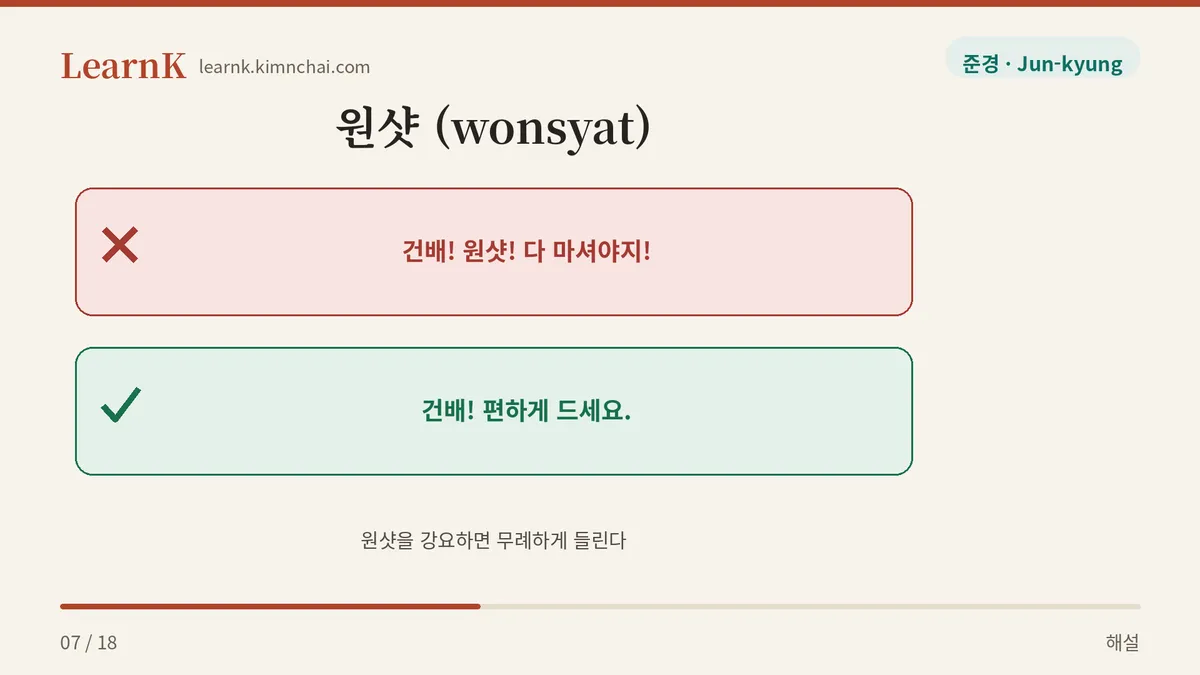
- 원샷 (wonsyat): It means to drain the glass all the way. People sometimes chain it as “건배! 원샷!”, but be careful — forcing it on someone is rude.
Cultural background
Korean drinking gatherings have etiquette just as important as the sound of clinking glasses. When you knock glasses with someone older than you or of higher standing, you touch your glass to theirs slightly lower than their glass. That’s exactly why Emily deliberately lowered her glass in the conversation above. Also, when an elder pours you a drink, it’s a long-standing custom to turn your head slightly to the side as you drink it.
This culture shows up often in company-dinner scenes in dramas, too. A nervous new employee receiving the glass with both hands while the senior staff call out “짠” to loosen the stiff mood — it’s a stock setup in Korean workplace dramas. In this way, the single word ‘짠’ holds more than a simple toast; it contains the relationships and the care shared among the people who are together. Next time you have the chance to raise a glass with a Korean friend, mind even the height of your glass as you call out “짠!”. You’ll surely hear them say, “Oh, you’ve become a real Korean.”
Today’s quiz
When you clink glasses with someone of higher standing, how should you hold your glass to follow proper etiquette?
① Hold it higher than the other person’s glass ② Lower it slightly below the other person’s glass ③ The height doesn’t matter
(Answer: ②)