존버 (jonbeo): The One Word for People Who Hang On to the Very End
존버
A friend whose stocks got cut in half but who still won’t sell and just closes the account; a streamer who survives near-death moments in a game until dawn and makes it to the end; a trainee who keeps showing up at the practice room even after years of failing auditions. To people like these, Koreans smile and say: “존버는 승리한다 (jonbeoneun seungnihanda)” — “those who hang on to the end win.” Today’s expression is a slang word that’s exploding in online and everyday conversation: 존버 (jonbeo).
Meaning and Nuance
존버 (jonbeo) is an abbreviation formed from two words. The front part, 존- (jon-), is an emphatic prefix that comes from a swear word and means “incredibly, terribly.” The back part, -버 (-beo), comes from 버티다 (beotida, to endure/hold out). So 존버 means “enduring terribly hard” — the attitude of not giving up and holding out to the very end, even while taking on loss and pain.
One thing to watch out for: because there’s a swear word mixed into its origin, 존버 is a casual word used only among friends or on the internet. You would never use it with a boss at work or with an adult you’re meeting for the first time. Among very close friends, though, it comes across as a warm word full of encouragement and humor. Think of it as a stronger, more playful version of “조금만 더 버텨 (hang on just a little longer).”
Originally, stock and crypto investors used it a lot to mean holding on to an asset — not selling even when the price drops, and waiting until it goes back up. Now it has broadened to cover any situation you have to grit your teeth and get through: job hunting, dieting, a rough time at work, and more.
Example Sentences by Situation
1. Talking about investing (a conversation with a friend)
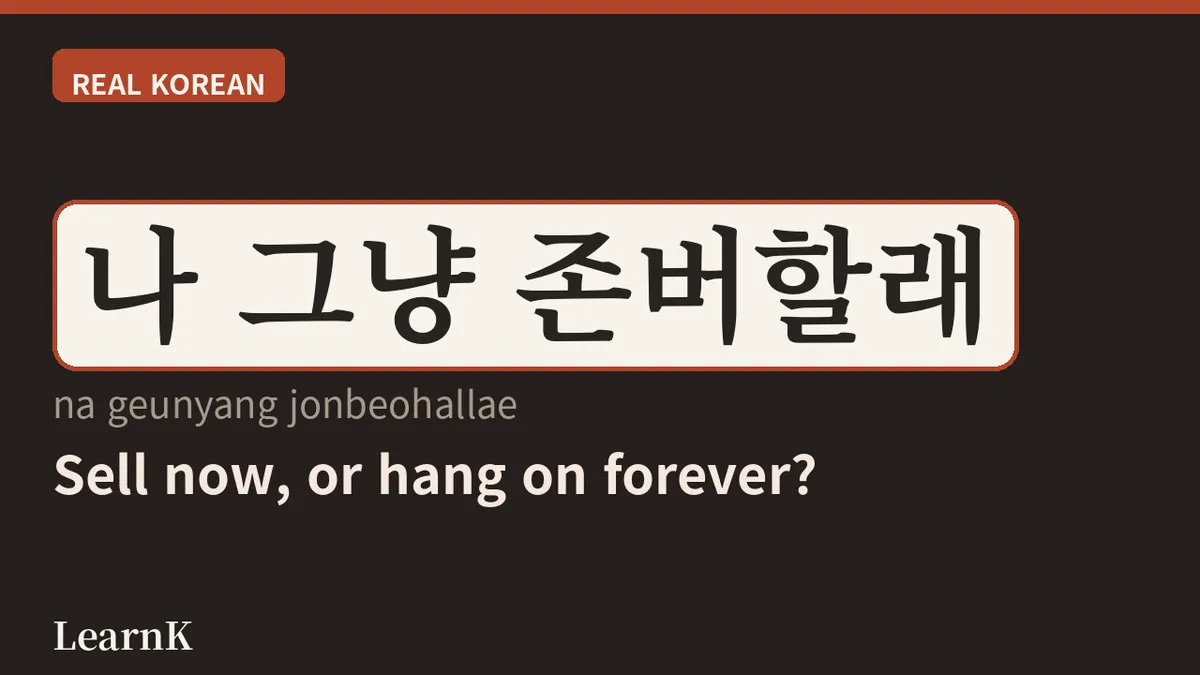
지금 팔면 손해잖아. 그냥 존버할래. 언젠간 오르겠지. (jigeum palmyeon sonhaejana. geunyang jonbeohallae. eonjengan oreugetji.) If I sell now I’ll take a loss. I’m just gonna hang on (jonbeo). It’ll go up someday.
This is someone declaring that even though the price has dropped, they’ll hold out instead of selling. Here 존버 is used like a verb, in the form “존버하다 (jonbeohada)”.
2. Cheering on someone job hunting
벌써 열 번 떨어졌어… 그래도 존버하면 붙는 날 오겠지? (beolsseo yeol beon tteoreojyeosseo… geuraedo jonbeohamyeon butneun nal ogetji?) I’ve already been rejected ten times… but if I just hang in there (jonbeo), the day I pass will come, right?
This expresses the feeling of being worn out and struggling, yet refusing to give up. It’s a very real-life use, carrying both sadness and determination at the same time.
3. Marveling at something in a game or everyday life
체력 1 남았는데 끝까지 존버 성공! 이게 바로 정신력이지. (chelyeok il namanneunde kkeutkkaji jonbeo seonggong! ige baro jeongsinlyeogiji.) Down to 1 HP but held out (jonbeo) to the end — success! This is what willpower looks like.
This captures the thrill of enduring a crisis and surviving in the end. As in “존버 성공 (jonbeo success),” the word is freely used as a noun too.
Polite vs. Casual Speech and Similar Expressions
Since 존버 itself doesn’t fit formal settings, when you need to speak politely you swap it out for a standard expression with the same meaning.
- Casual/slang: 존버해 (jonbeohae) — “Hang in there!” to a friend
- Polite standard: 끝까지 버티세요 (kkeutkkaji beotiseyo) or 포기하지 마세요 (pogihaji maseyo)
Similar expressions include 버티기 (beotigi, holding out/enduring) and 존버 정신 (jonbeo jeongsin, the willpower to endure to the very end). On the other hand, not being able to hold on and selling or quitting is called 손절 (sonjeol, cutting your losses and closing out). That’s why “존버냐 손절이냐 (hang on or cut your losses?)” is a dilemma you’ll often see expressed online.
Cultural Background
The reason 존버 is so beloved is that it touches on a distinctly Korean “spirit of enduring.” Amid fierce competition in exams, job hunting, and the real-estate and stock frenzies, many people have turned the very act of “getting through” a hard time into a kind of virtue — and a joke. So 존버 goes beyond being simple swear-laced slang; it’s also used almost like a word of solidarity: “Let’s cheer each other on and hang in there together.”
In dramas and variety shows, too, you’ll often see viewers root for a character who endures a tough situation, leaving comments like “저건 진짜 존버다 (now THAT is real jonbeo).” In a way, it compresses the whole arc of a character who succeeds after great hardship into a single word.
Closing Quiz
A friend’s stocks have dropped, but they say, “I’m not selling — I’m going to wait until it goes back up.” What single word captures this friend’s attitude?
① 손절 (sonjeol) ② 존버 (jonbeo) ③ 포기 (pogi)
The answer is ② 존버 (jonbeo)! Taking on the loss and holding out to the very end — that’s exactly 존버. How about you, too — shall we start some 존버 with your Korean studies, starting today?