조심히 가세요 (josimhi gaseyo) — The Send-Off Koreans Always Say When Parting
조심히 가세요
When a friend gets up to leave after eating dinner at your place, when you part late at night and each walk off toward your own subway station, when a driver calls out to a passenger stepping out of the taxi — there’s a phrase in Korea that comes out almost automatically whenever you send someone off. It’s 조심히 가세요 (josimhi gaseyo).
Word for word, it means “go carefully,” that is, “be careful on your way.” But this phrase isn’t simply a warning to drive safely or watch your step. It’s much closer to a warm send-off, carrying the feeling of “I hope you make it home safe and sound.” It’s affection directed at the person you’re parting from.
Meaning and Nuance
‘조심히 (josimhi)’ is an adverb that comes from the verb ‘조심하다 (josimhada),’ meaning “taking care so that nothing goes wrong and no accidents happen.” To this is added ‘가세요 (gaseyo),’ the polite command form of ‘가다 (gada, to go).’ So the whole thing means “go with care, go carefully.”
The most important point is that this phrase is said to the person who is leaving. It’s what the one staying behind calls out to the back of the one departing. So it carries the feeling of “I’ve looked after you this far, and now I hope the rest of your journey is safe too.” The sentiment is very close to the English “Take care” or “Get home safe.”
Seeing It in a Real Conversation
Scene: Eleven at night, after Jun-kyung’s housewarming party. Emily, the last guest, is putting on her shoes at the front door.
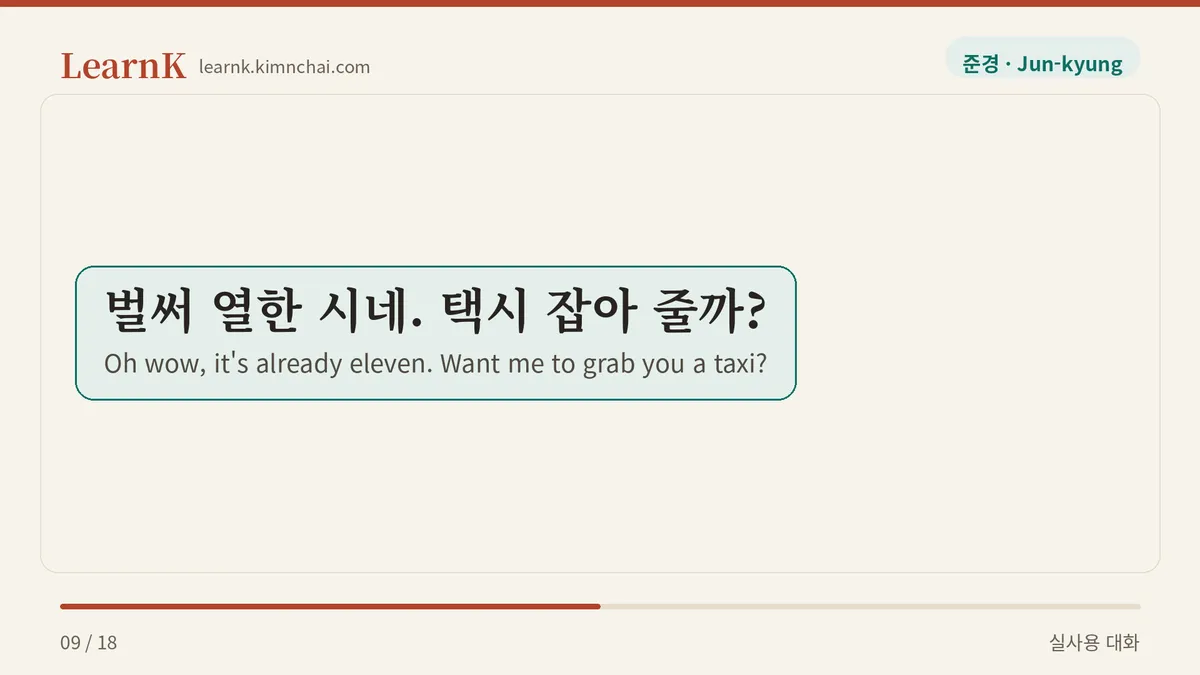
준경: 벌써 열한 시네. 택시 잡아 줄까? Oh wow, it’s already eleven. Want me to grab you a taxi?
에밀리: 아냐, 앱으로 불렀어. 3분 뒤 도착이래. 오늘 진짜 잘 먹었다. No, I booked one on the app. It says three minutes. I really ate well today.
준경: 뭘. 도착하면 톡 하나 남기고. 조심히 가. Don’t mention it. Text me when you get home. Get home safe.
에밀리: 응. 근데 너 설거지 산더미다. 그냥 두고 자. I will. By the way, you’ve got a mountain of dishes. Just leave them and sleep.
준경: 내일 할래. 아, 계단 어두우니까 난간 꼭 잡고 내려가. I’ll do them tomorrow. Oh, the stairs are dark, so hold the rail on your way down.
에밀리: 걱정 마. (문을 열며) 너도 얼른 씻고 자. 조심히 들어가세요, 집주인님. Don’t worry. (opening the door) You wash up and sleep too. Rest safe, Mr. Host.
준경: 하하, 갑자기 웬 존댓말이야. 담에 또 와! Haha, why the sudden formal talk? Come again next time!
Here, Jun-kyung’s 조심히 가 is a casual (반말) send-off, and the 조심히 들어가세요 that Emily tosses out playfully is the same sentiment switched into polite speech. It’s a phrase pitched at exactly that temperature — the one where your mind won’t rest easy until the other person has arrived.
How to Use It in Different Situations
1) Sending off an elder. As an uncle heads out from your parents’ house during the holidays, a younger family member says:
- 살펴 가세요. 도착하시면 꼭 전화 주세요. (salpyeo gaseyo. dochakhasimyeon kkok jeonhwa juseyo.) — ‘살펴 가세요’ is a slightly more old-fashioned and courteous send-off than ‘조심히 가세요.’
2) On a night road or in bad weather. Using it when parting after a rainy-day work dinner doubles the sincerity.
- 비 많이 오니까 조심히 가세요. (bi mani onikka josimhi gaseyo.) — Your concern for their safety comes across directly.
3) As a quick one-liner. As a customer leaves a convenience store or shop, a clerk might smile and offer:
- 조심히 가세요! (josimhi gaseyo!) — It’s a formulaic greeting, yet it’s mixed with the warmth of “come again.”
Similar Phrases — What’s the Difference?
- 안녕히 가세요 (annyeonghi gaseyo): The most basic and neutral farewell. ‘안녕히’ carries the meaning of “safely,” so it’s essentially the standard send-off.
- 조심히 가세요 (josimhi gaseyo): Feels like it looks after the other person’s safety one layer more than ‘안녕히 가세요.’ It fits especially well for a night road, a long trip, or bad weather.
- 조심히 들어가세요 (josimhi deureogaseyo): Using ‘들어가세요’ instead of ‘가세요’ makes it mean “get home safe,” which is even more affectionate.
- Casual version: With friends or people younger than you, you can say 조심히 가 (josimhi ga) or 조심히 들어가 (josimhi deureoga).
Cultural Background — The Korean ‘Send-Off (배웅)’
In Korea, it’s rare to send a guest off with just a “잘 가 (see you).” There’s a culture of walking them all the way to the door — sometimes to the elevator or out to the main road — seeing them off and watching until their retreating figure disappears. ‘조심히 가세요’ is the phrase that completes that very moment of the send-off. In Korean dramas, too, you often see a parent hold on to a child, or a lover to a lover, at the front gate and say “조심히 가” — because this short line compresses so much tenderness into itself. So knowing how to use this expression is, beyond knowing a single word, also a matter of understanding the temperature of Korean-style 정 (jeong, warm affection).
Closing Quiz
A friend has been hanging out at your place late into the night and is now about to head home. To send them off at the door with a heart full of concern, what would be a good thing to say — in casual speech (반말)? (Hint: using ‘들어가다’ instead of ‘가다’ is even more affectionate.)