중꺾마 (jung-kkeok-ma) — The Words You Reach For When You're Losing
중꺾마 (jung-kkeok-ma)
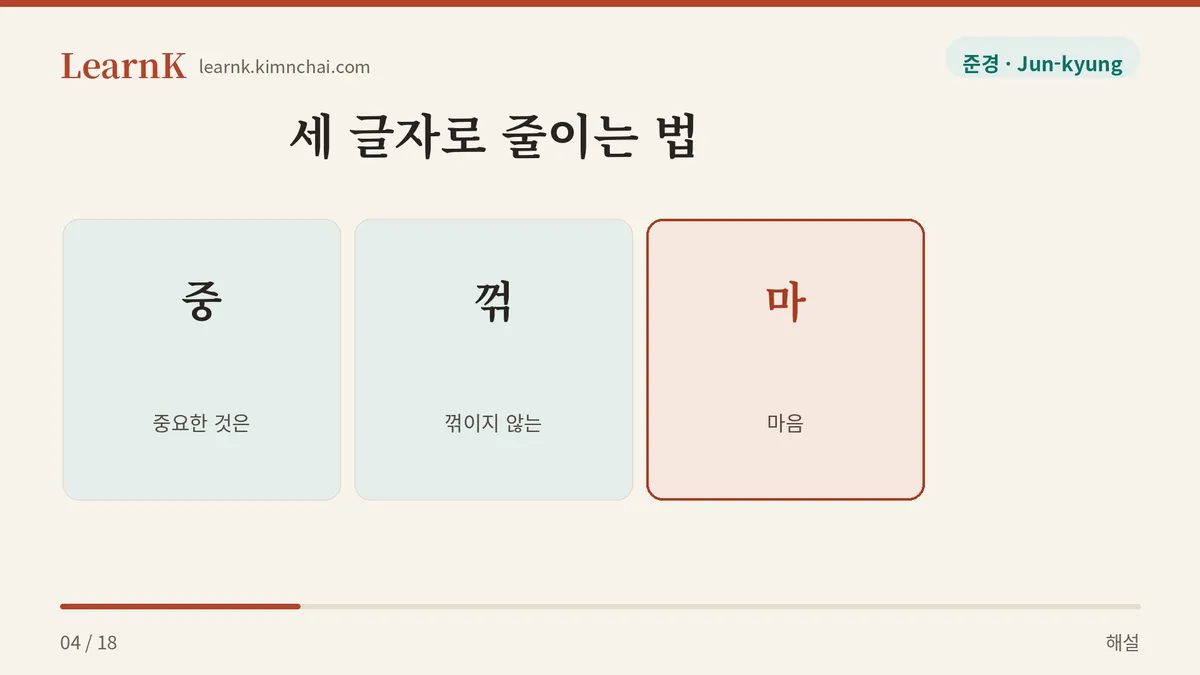
중꺾마 (jung-kkeok-ma) is a contraction of 중요한 것은 꺾이지 않는 마음 (jungyohan geoseun kkeokkiji anneun ma-eum) — “what matters is a heart that doesn’t break” — built from the first syllable of each chunk. It means that whatever the result turns out to be, the mindset of not giving up is what counts most. The places Koreans pull this phrase out are fairly predictable: the bottom of the 8th at a baseball stadium where the score gap has opened up and fans are trickling toward the exits; a group chat on the evening a third rejection email lands; an office with the lights still on at two in the morning before a deadline. It isn’t a phrase for when things are going well. It comes out after things have already been going badly for a while.
So learning this expression gets you more than one definition. You also pick up the tone Koreans use when they talk about losing.
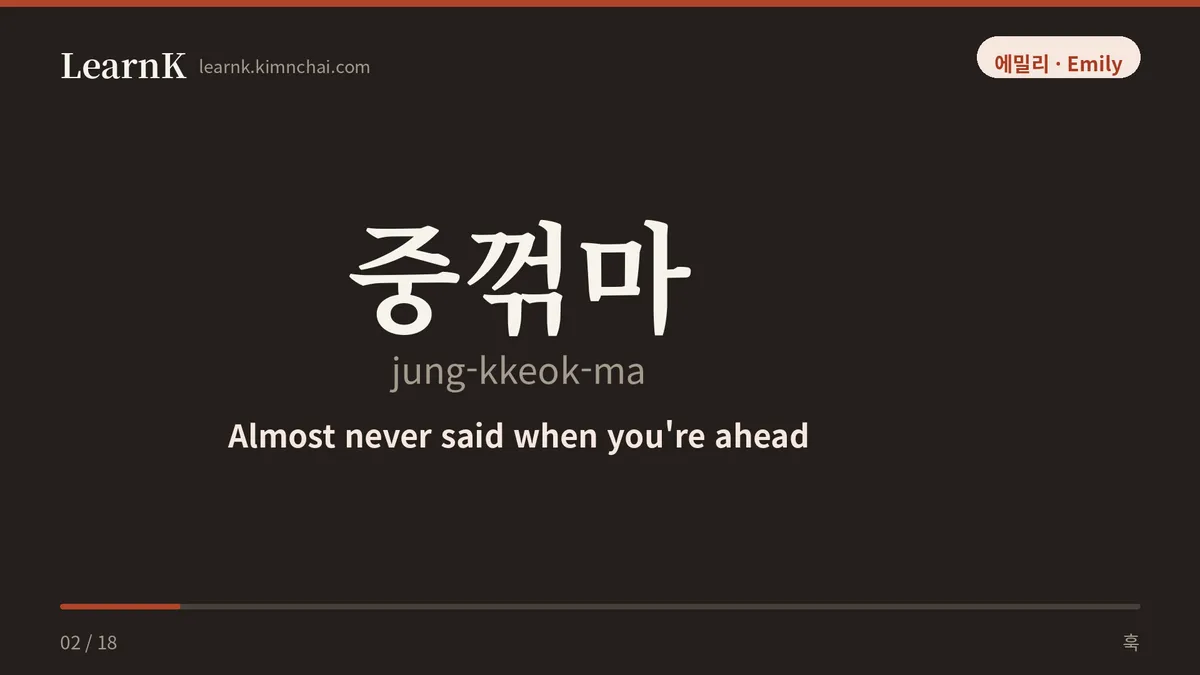
The center of gravity sits on “not breaking,” not on “winning.” It isn’t optimism that you’ll definitely win — it’s closer to holding your ground: even if I lose, my heart isn’t going to lose with me. That’s why you almost never use it when you’re ahead. You say it in the bottom of the 8th when you’re down 5–1, and not in the bottom of the 8th when you’re up 5–1.
The temperature is lower than you’d expect. It does get shouted as a fist-in-the-air rallying cry, but more often it comes out with a sigh and a bit of self-deprecation mixed in. When someone says 중꺾마지 뭐 (jung-kkeok-maji mwo), the feel is close to “well, what can you do — might as well keep going.” Being usable both red-hot and lukewarm is exactly what makes this short phrase so handy.
It looks like a noun, but in practice it works like a chant or an interjection: tossed onto the end of a sentence, or standing completely on its own.
- 중꺾마! (jung-kkeok-ma!) — a chant. Group chats, the cheering section, outside the exam hall
- 중꺾마다. (jung-kkeok-mada.) — a closing line, said as a promise to yourself
- 중꺾마지 뭐. (jung-kkeok-maji mwo.) — comfort with a half-shrug of resignation in it
- 중꺾마 정신 (jung-kkeok-ma jeongsin) — “the 중꺾마 spirit,” the most common way to attach it as a noun
What you don’t do is turn it into a verb like 중꺾마하다 (jung-kkeok-ma-hada). When you need a verb, you unfold the original phrase instead and say 꺾이지 않으면 된다 (kkeokkiji aneumyeon doenda) — “you just have to not break.”
See It in a Real Conversation
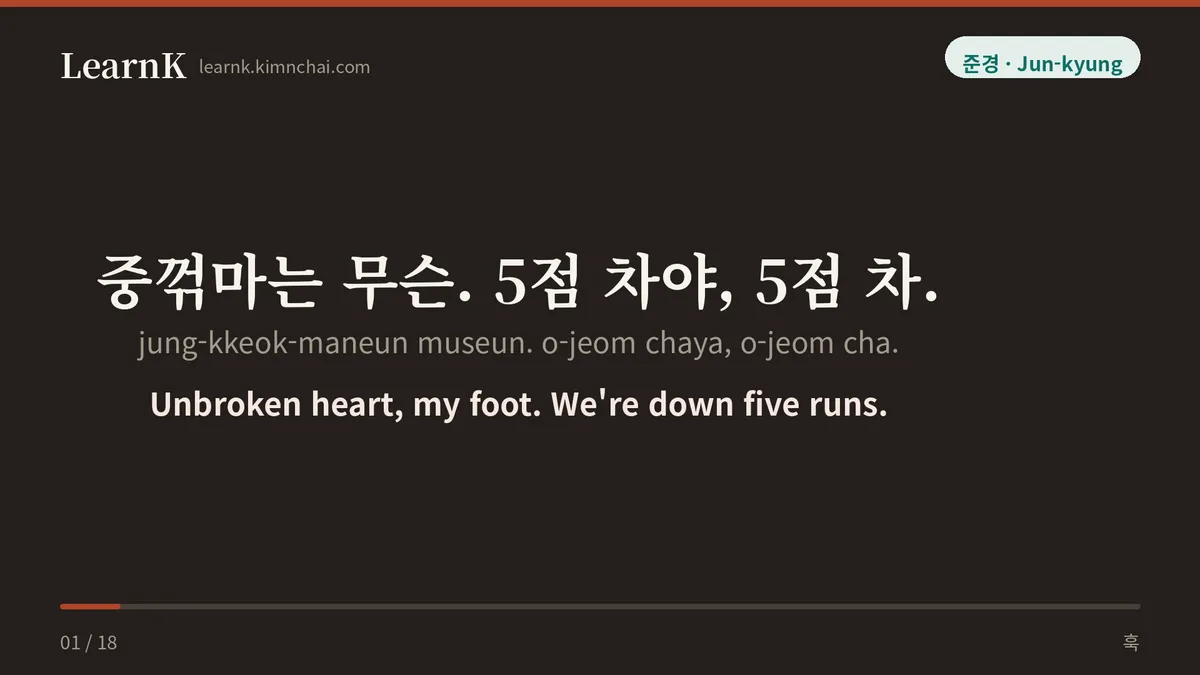
Situation: The third-base cheering section at Jamsil Baseball Stadium. It’s the bottom of the 8th, and the team they’re rooting for is down 5–1. People are drifting toward the exits.
Jun-kyung: 야, 사람들 벌써 나간다. 우리도 슬슬 일어날까? Hey, people are already leaving. Should we head out too?
Emily: 무슨 소리야, 아직 8회잖아. 중꺾마. What are you talking about, it’s only the 8th. Don’t let it break you.
Jun-kyung: 중꺾마는 무슨. 5점 차야, 5점 차. “Don’t let it break you,” my foot. We’re down five runs. Five.
Emily: 작년 가을에도 9회에 뒤집었잖아. 나 그날 목 다 쉬었어. We came back in the 9th last fall too. I lost my voice that day.
Jun-kyung: 아, 그건 그렇지… 알았어, 딱 한 이닝만 더 보자. Ah, that’s true… Fine, let’s stay one more inning.
Emily: 그래야 우리 팀 팬이지. 이럴 때 필요한 게 중꺾마야. That’s what being a fan is. This is exactly when you need that unbroken heart.
When It Sounds Off
✗ (To a friend whose dog died this morning) 너무 슬퍼하지 마. 중꺾마! Don’t be so sad. 중꺾마!
✓ (To a friend whose dog died this morning) 무슨 말을 해야 할지 모르겠다. 밥은 챙겨 먹어. I don’t know what to say. Make sure you eat something.
→ 중꺾마 is for things you can take another run at. In the face of a loss you can’t undo, it doesn’t land as comfort — it lands as a nudge to hurry up and get over it.
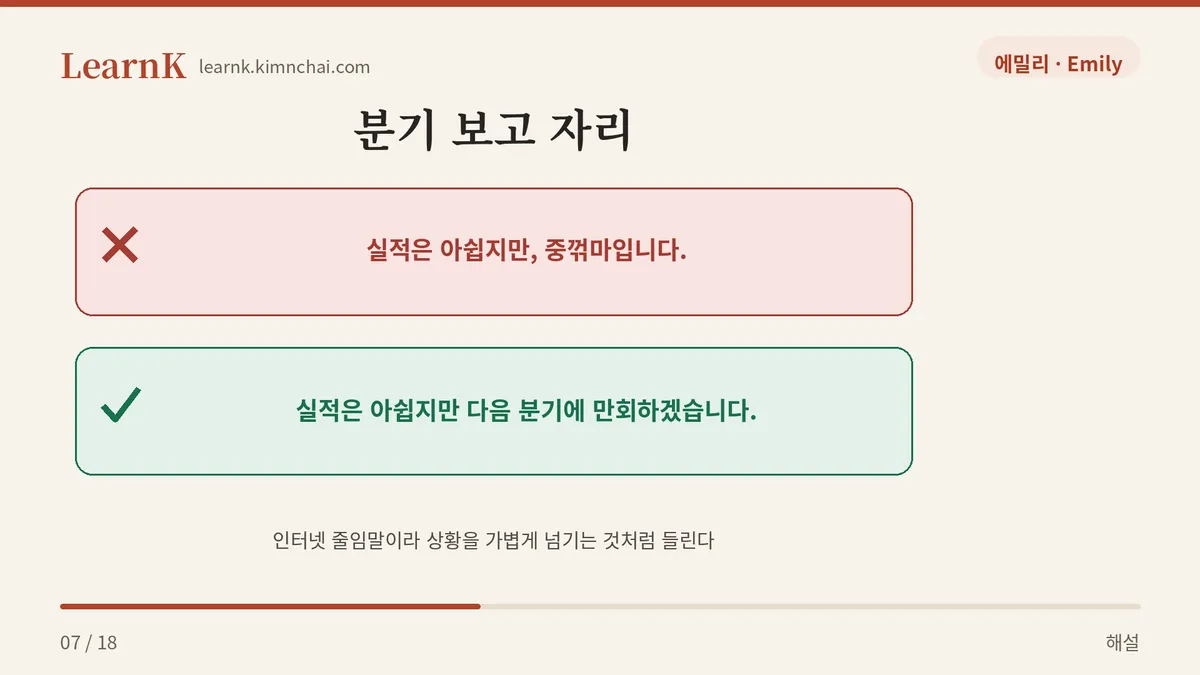
✗ (Presenting the quarterly report to your manager) 실적은 아쉽지만, 중꺾마입니다. The numbers are disappointing, but — 중꺾마.
✓ (Presenting the quarterly report to your manager) 실적은 아쉽지만 다음 분기에 만회하겠습니다. The numbers are disappointing, but we’ll make it up next quarter.
→ It’s an abbreviation born on the internet, so in an official report it sounds like you’re waving the situation off. To convey the same idea formally, don’t shorten it — unfold it into a full sentence, as in 중요한 것은 꺾이지 않는 마음이라고 생각합니다 (jungyohan geoseun kkeokkiji anneun ma-eumirago saenggakhamnida), “I believe what matters is a heart that doesn’t break.”
Example Sentences by Situation
1. The group chat of a friend who just got rejected from a third final-round interview
When the friend shared the news, nobody knew what to say and the chat went quiet for a moment. Here’s a line you can offer without making the mood any heavier.
아쉽다 진짜. 그래도 이번엔 최종까지 갔잖아. 중꺾마다. (aswipda jinjja. geuraedo ibeonen choejongkkaji gatjanha. jung-kkeok-mada.) That really stings. But you made it to the final round this time. Don’t let it break you.
2. A rainy early morning, day 40 of a running streak
Something said by a person who knows that a promise you make to yourself collapses the first day you break it. Using it on yourself, rather than as encouragement for someone else, is extremely common.
비 온다고 오늘 안 뛰면 내일도 안 뛰어. 중꺾마. (bi ondago oneul an ttwimyeon naeildo an ttwieo. jung-kkeok-ma.) If I skip today because of the rain, I’ll skip tomorrow too. Keep the heart unbroken.
3. To a teacher you’re close with, after just missing the mark on a Korean exam again
A situation that calls for polite speech, but with someone you’re comfortable around. Lifting the ending with “-죠” lets even a slang abbreviation sit there without sounding rude.
듣기에서 또 막혔어요. 그래도 중꺾마죠 뭐. (deutgieseo tto makhyeosseoyo. geuraedo jung-kkeok-majjyo mwo.) I got stuck on the listening section again. Well — you just don’t let it break you.
Politeness Levels and Similar Expressions
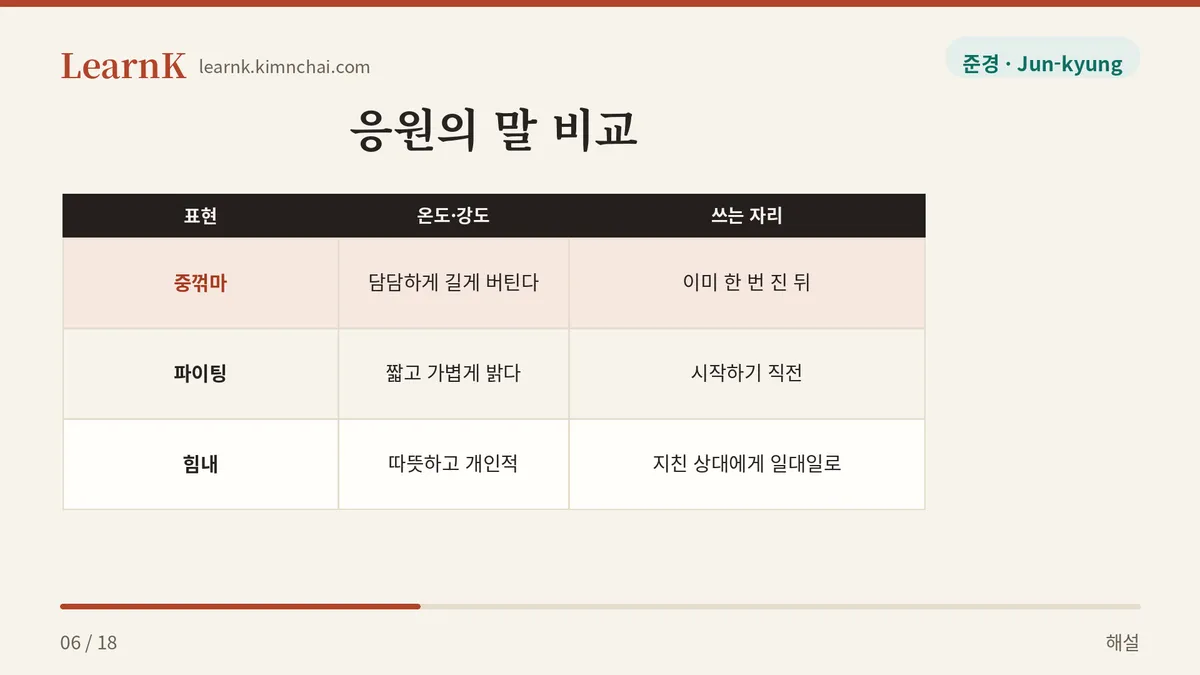
중꺾마 has no separate polite form. Lifting the ending to 중꺾마죠 (jung-kkeok-majyo), as in example 3 above, is about as far as it goes; in a setting that genuinely calls for deference, you skip the abbreviation and unfold the original into a sentence — 중요한 것은 꺾이지 않는 마음입니다 (jungyohan geoseun kkeokkiji anneun ma-eumimnida). Lining it up next to similar words of encouragement makes its place clear.
| Expression | Temperature / intensity | Where it’s used |
|---|---|---|
| 중꺾마 (jung-kkeok-ma) | Level-headed; built for holding out a long time | Among peers, in group chats, in the cheering section. After you’ve already lost once |
| 파이팅 (paiting) | Short, light, bright | Anywhere. Mostly right before something starts |
| 힘내 (himnae) | Warm and personal | One-on-one, to someone who’s worn out |
| 존버 (jonbeo) | Rough and blunt | Only among very close friends your own age |
| 끝까지 최선을 다하겠습니다 (kkeutkkaji choeseoneul dahagetseumnida) | Formal and earnest | Interviews, reports, official interviews |
존버 (jonbeo) is closest in meaning, but it comes from a vulgar word, so the range of places you can use it is far narrower. In the other direction, 파이팅 (paiting) is for someone who hasn’t even started yet, while 중꺾마 is for someone who has already come apart once. That difference in timing is the key thing separating the two.
Cultural Background — Winter 2022, the Teams That Were Losing
In the fall of 2022, a Korean team at an international League of Legends tournament was pushed to the very edge of elimination and survived. The gist of one player’s post-match interview ran in a headline as the sentence “중요한 것은 꺾이지 않는 마음” — “what matters is a heart that doesn’t break” — and a screenshot of it circulated through online communities until it shrank to three syllables. That December, at the Qatar World Cup, the Korean national team dramatically turned around its final group-stage match and advanced to the round of 16; afterward the players unfurled a Korean flag handed down from the stands, and the same phrase was written on it. That moment was broadcast live nationwide, and the expression became one of the most-used phrases in Korea that winter.
The way it’s formed is textbook Korean abbreviation: keep only the first syllable of each chunk — 중(요한 것은) + 꺾(이지 않는) + 마(음). It’s the same method behind 소확행 (sohwakhaeng, small but certain happiness) and 별다줄 (byeoldajul, “they abbreviate absolutely everything”). Squeezing a twelve-syllable sentence down to three made it easy to shout as a chant — and, in exchange, more people now use it without knowing the original. For a learner, that’s actually an opportunity. Use it while also knowing the full phrase behind it, and you’ll get a “wait, how do you know that?”
Looking at where the phrase actually shows up makes its usage even clearer: on banners outside CSAT exam halls, next to gym mirrors, in sports broadcast captions, in KakaoTalk status messages, and in the cheering section of a game that’s being lost. In TV dramas it flickers past as a line of dialogue or a caption at the point where the lead gets back up after falling down for the umpteenth time. They all have one thing in common. The places this phrase gets put are always places where the result isn’t in yet — or where it is in, and nobody likes it.
Today’s Quiz
In which of the following situations would 중꺾마 (jung-kkeok-ma) sound the most out of place?
- To a friend who just failed a certification exam for the second time
- In the group chat for a team project with three days left until the deadline
- To a friend whose cat died this morning
- In the cheering section during the second half of a game you’re losing 0–3
Answer: 3
중꺾마 is for when there’s still a round left to play. In the face of a goodbye that can’t be undone, encouragement doesn’t work as comfort — it sounds like you’re rushing the person to pack their feelings away. Options 1, 2, and 4 all have “a round left to play,” so the phrase fits naturally there.
Definitions and example sentences are from the National Institute of Korean Language’s Basic Korean Dictionary (krdict.korean.go.kr); that portion of this post, including our translations, is licensed under CC BY-SA 2.0 KR.