케바케 (kebake) — 'It Depends,' Squeezed into Three Syllables
케바케
케바케 (kebake) means “it varies from case to case” — the idea that you can’t give one clear-cut answer, because the outcome changes with the situation. Once you’ve been studying Korean for a while, there comes a point where these three syllables start turning up everywhere. Ask whether Korean companies make you work late: 케바케. Ask whether that restaurant delivers fast: 케바케. Ask whether the teacher at that academy is any good, and still: 케바케. It’s clearly an answer to your question, and yet it seems to tell you nothing — and it’s one of the most practical pieces of new slang Koreans reach for several times a day.
Let’s look a little closer at the nuance. 케바케 mixes three different temperatures. The first is honesty about information. Instead of pretending to know and declaring an answer, the speaker tells you that the variation itself is wide. The second is a small dose of resignation — a shrug attached to the words that says, “There’s nothing I can do about it either, it’s luck.” The third is lightness. Abbreviations carry their own quick rhythm, so using one in a serious setting can make you look like you’re not putting in the effort. That’s why the same meaning splits in two: 사안에 따라 다릅니다 (saan-e ttara dareumnida) in the meeting room, 케바케야 (kebake-ya) in a KakaoTalk chat with a friend.
Inside a sentence it behaves like a noun. 케바케야 (kebake-ya) — casual speech; 케바케예요 (kebake-yeyo) — the all-purpose polite form; 케바케지 (kebake-ji) — a nuance that invites agreement; 케바케라서 (kebake-raseo) — the form that leads into a reason. Put a criterion in front of it to narrow the range, and it becomes a far more useful thing to say — for example 회사마다 케바케 (hoesa-mada kebake) or 사람마다 케바케 (saram-mada kebake).
Seeing It in a Real Conversation
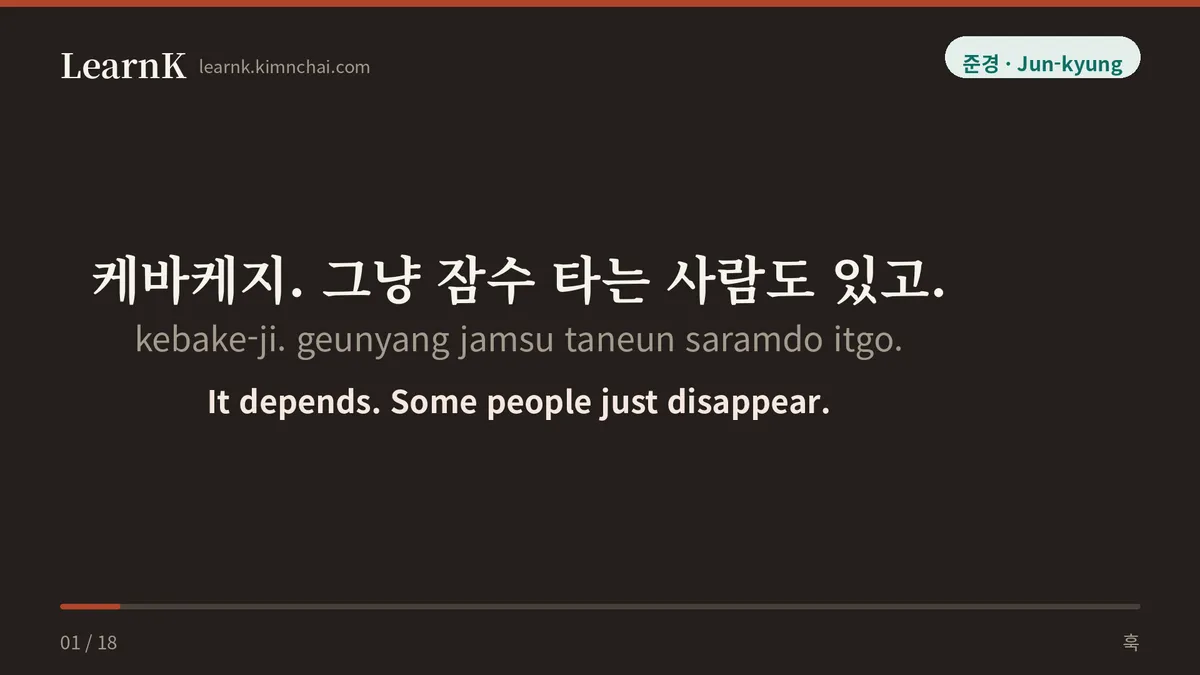
Situation: Saturday afternoon, in front of Exit 3 of the subway station. Emily has come out to pick up a bike she bought secondhand, and Jun-kyung tagged along.
Emily: 판매자가 십 분 늦는대. 원래 이래? The seller says he’ll be ten minutes late. Is this normal?
Jun-kyung: 케바케지. 시간 칼같이 지키는 사람도 있고, 그냥 잠수 타는 사람도 있고. It depends. Some people are right on time, some just disappear.
Emily: 잠수? 야, 무서운 소리 하지 마. 나 입금까지 했는데. Disappear? Hey, don’t scare me. I already sent the money.
Jun-kyung: 아, 그건 좀… 근데 후기 봤으면 괜찮을 거야. 나는 열 번 중에 여덟 번은 멀쩡했어. Ah, that part’s a bit… But if you checked his reviews it’ll be fine. Eight out of ten of mine went fine.
Emily: 결국 나머지 두 번이 문제인 거잖아. 진짜 케바케네. So the other two are the problem. It really is case by case.
Jun-kyung: 어, 저기 온다. 자전거도 깨끗하네. 오늘은 좋은 케이스인가 보다. Oh, here he comes. The bike looks clean too. Guess today’s a good case.
When It Sounds Off
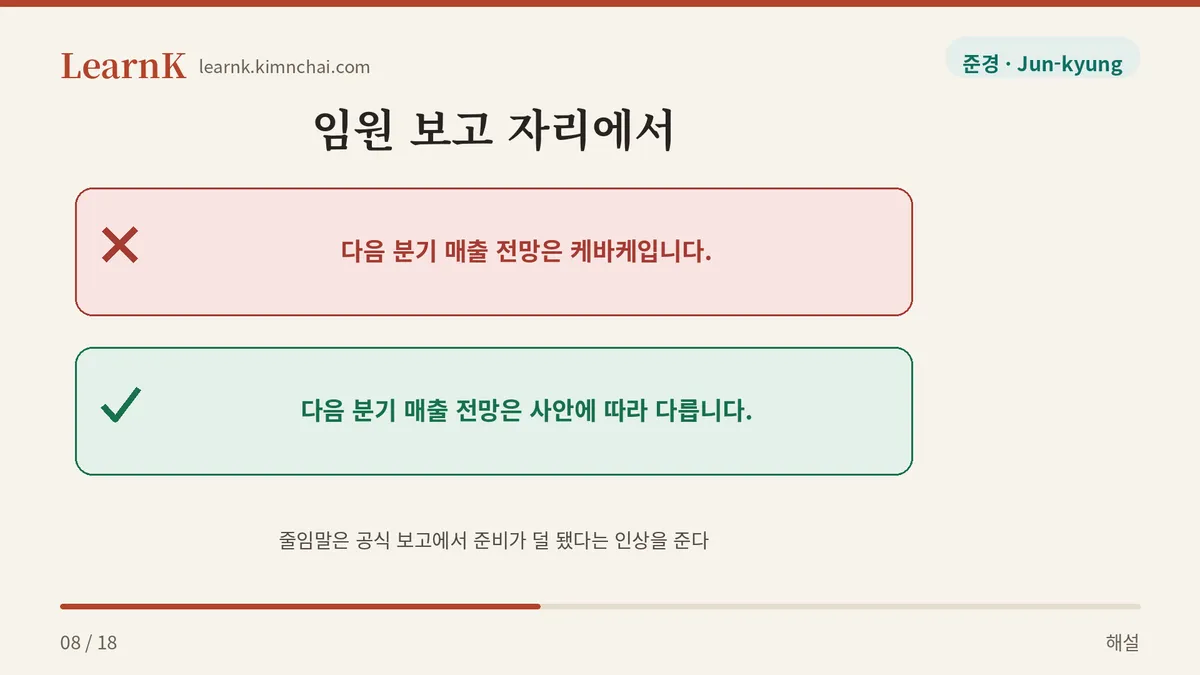
✗ (in a briefing to executives) 다음 분기 매출 전망은 **케바케 (kebake)**입니다. ✓ (in a briefing to executives) 다음 분기 매출 전망은 조건에 따라 달라집니다. The revenue outlook for next quarter varies depending on the conditions. → The grammar is perfectly fine, but the setting is wrong. In formal reports, presentations, and contract meetings, a slang abbreviation gives the impression that you came in underprepared. Swap the same content out for 사안에 따라 다릅니다 (saan-e ttara dareumnida) and it gains weight.
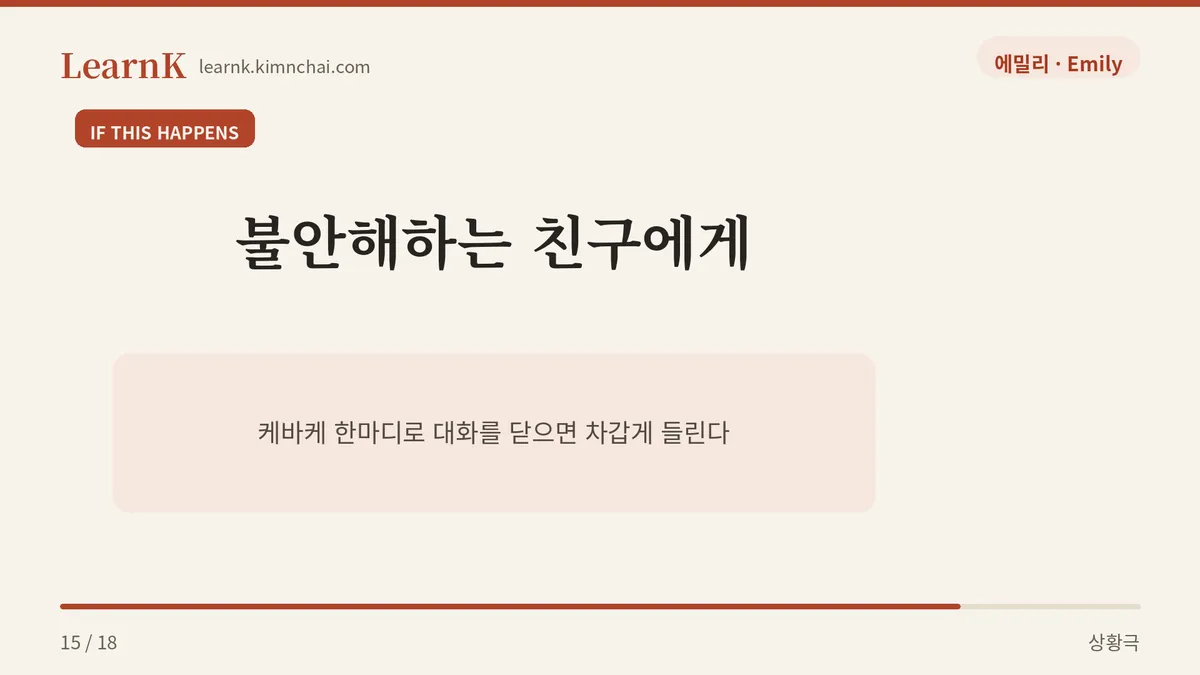
✗ (to a friend who’s anxious about an upcoming surgery) 그 수술 결과? 몰라, **케바케 (kebake)**야. ✓ (to the same friend) 케이스마다 다르다고는 하는데, 그 병원 후기는 좋더라. They say it varies from case to case, but the reviews for that hospital were good. → When the other person is genuinely worried and you close the conversation with a single 케바케, it lands as “I don’t really care.” 케바케 is useful when you’re giving information; in a moment that calls for comfort, it’s cold. If you’re going to use it anyway, add a line of your own experience or evidence right after it.
Example Sentences by Situation
1) An international student preparing to job-hunt in Korea asks what a company is like
한국 회사는 회식이 많냐고요? 그건 진짜 회사마다 케바케예요 (hoesa-mada kebake-yeyo). 저희 팀은 일 년에 두 번 정도 하는데, 친구네는 매달 한대요. You’re asking if Korean companies have a lot of team dinners? That one really is company by company. My team does it about twice a year, but my friend’s team apparently does it every month.
This is the most common reply to a question that treats “Korean companies” as one single block. Because 회사마다 (hoesa-mada, “company by company”) goes in front and defines what exactly is varying, the same 케바케 stops being a lazy answer and turns into information.
2) Sharing reviews of cosmetics or food
그 크림 나한테는 별로였는데, 이건 피부 케바케라서 (pibu kebake-raseo) 샘플 먼저 써 보는 게 나아. That cream didn’t work for me, but skin varies from person to person, so you’re better off trying a sample first.
In product reviews, 케바케 works as a safety device meaning “my experience isn’t automatically yours.” If you recommend something flatly and it fails for the other person, things get awkward for both of you — so this is a way of stepping back half a pace while still leaving the advice on the table.
3) Talking about the results of an exam or an interview
면접관 **케바케 (myeonjeopgwan kebake)**라 뭐라 말을 못 하겠어. 어제는 십 분 만에 끝났는데 오늘은 사십 분 붙잡혔거든. It depends on the interviewer, so I can’t really say. Yesterday it was over in ten minutes, but today they kept me for forty.
You use it when the procedure is the same but the outcomes swing widely. Two concrete cases follow right after, and suddenly you can see why it’s 케바케. This is when 케바케 is most convincing — when it travels with examples.
Polite vs. Casual Forms, and Similar Expressions
The casual form is 케바케야 (kebake-ya) and the polite form is 케바케예요 (kebake-yeyo); both attach naturally. That said, tacking on a polite ending doesn’t make the word usable in formal settings. You may have raised the register of the speech, but the word itself is still casual. Relaxed conversation with someone older than you is the safe limit — above that line, it’s better to switch to the expressions at the bottom of the table below.
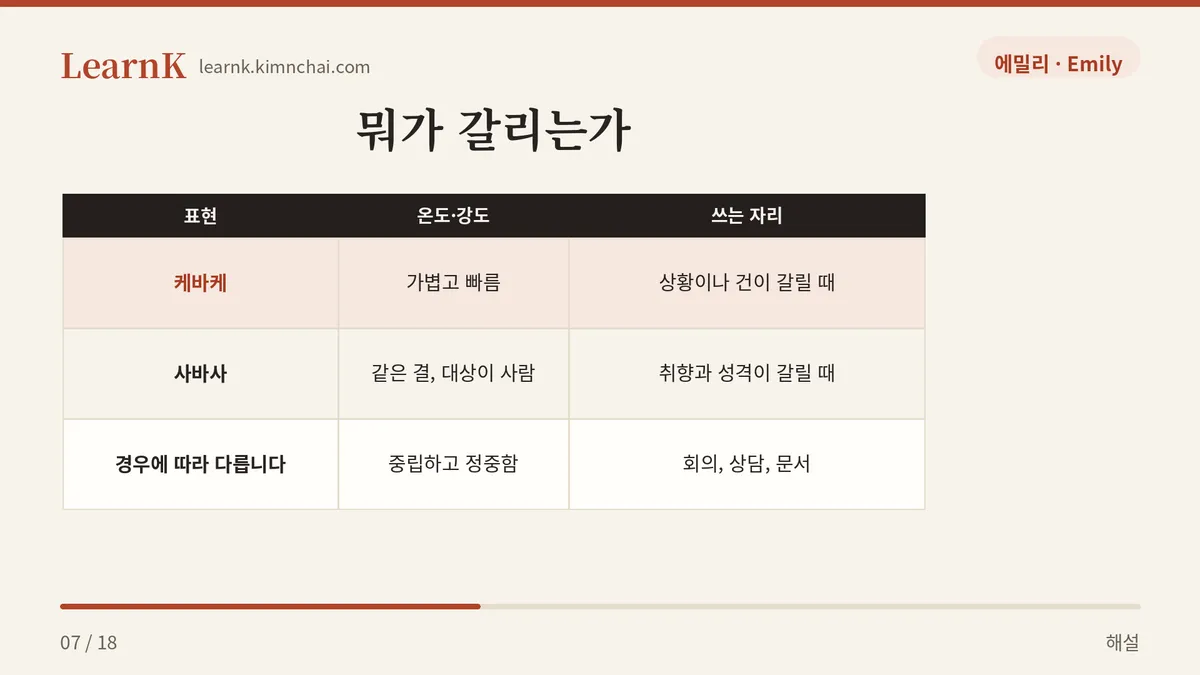
| Expression | Temperature & strength | Where it’s used |
|---|---|---|
| 케바케 (kebake) | Light and quick, with a faint trace of resignation | Peers, close friends, online reviews. Not used in reports or official documents |
| 사바사 (sabasa) | Same grain as 케바케, but what varies is the person | Talk about taste and personality. “그건 사바사지” |
| 그때그때 달라요 (geuttae-geuttae dallayo) | Soft and conversational | Fine even with customers or people older than you. Heard constantly in shops |
| 경우에 따라 다릅니다 (gyeong-u-e ttara dareumnida) | Neutral, polite | Meetings, consultations, documents. Safe anywhere |
The difference between 케바케 and 사바사 trips people up all the time in practice. If the thing causing the variation is a situation or a case, it’s 케바케; if it’s a person, it’s 사바사. Delivery times all over the place — 케바케. Whether someone can handle spicy food — 사바사.
Cultural Background — A Cushion Word Made by Review Culture
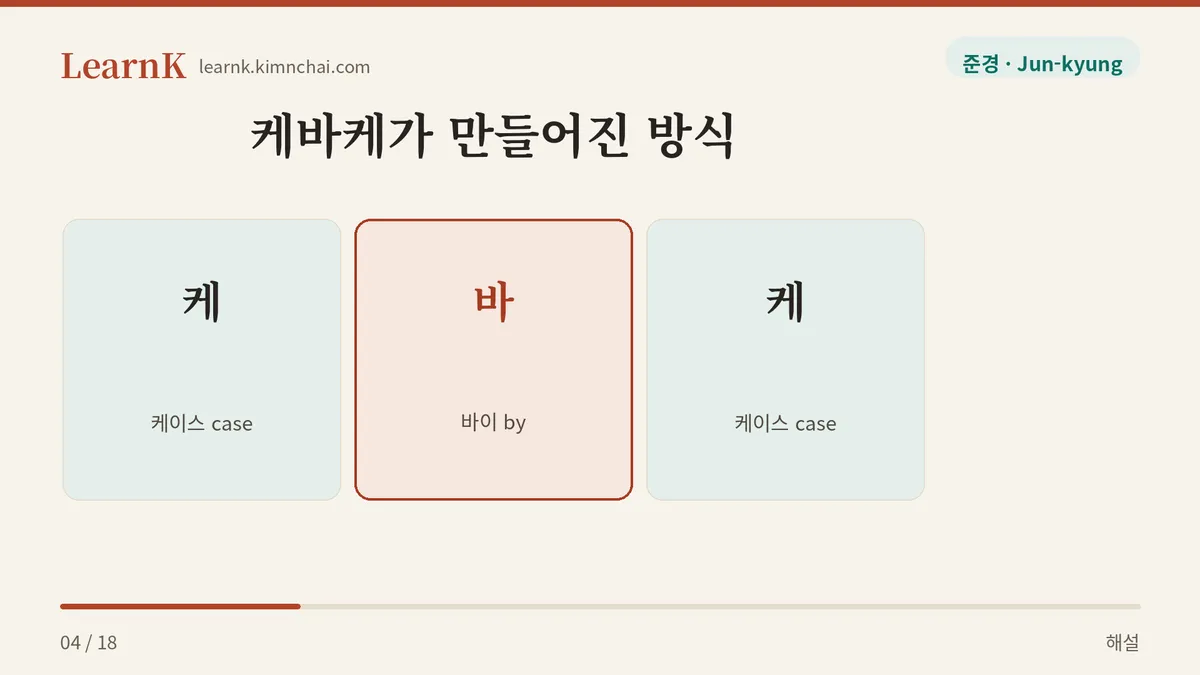
케바케 comes from the English phrase “case by case.” It entered Korean and was used in its long form as 케이스 바이 케이스 (keiseu bai keiseu), until only the first syllable of each word survived and it became 케바케. This “A바A” frame has settled into Korean slang almost like a formula — 사람 바이 사람 (saram bai saram, person by person) becomes 사바사 (sabasa), 팀 바이 팀 (tim bai tim) becomes 팀바팀 (timbatim), 부서 바이 부서 (buseo bai buseo, department by department) becomes 부바부 (bubabu). Once you know the principle, you can roughly guess the meaning of combinations you’ve never seen before.
Behind this word’s unusually wide spread is Korea’s dense review culture. Restaurants, hospitals, cram schools, companies, even the stranger you’re buying a used bike from — the habit of searching online first and deciding afterward has taken hold, which means someone will inevitably ask “So is it good or bad?” and someone will have to answer. But if you recommend something flatly and the other person has a bad time, the resentment comes back to you. 케바케 is the cushion placed in between. Three syllables that hand over information without taking on responsibility, and let you slip out without cooling the temperature of the conversation.
So for Koreans, 케바케 is closer to politeness than to evasion. Inside this short word sits an attitude that refuses to insist there’s only one right answer to anything in the world, and a carefulness about not stacking your own experience on top of someone else’s. When a learner starts using this word naturally, it’s also a signal that they’ve picked up not just Korean sentences but the rhythm of Korean conversation.
Today’s Quiz
Emily has applied to a Korean company and is in the final interview. The interviewer asks, “우리 회사 야근에 대해 어떻게 생각하세요?” (“How do you feel about working late at our company?”) Which of the following is the most fitting answer for this setting?
- 야근은 케바케죠.
- 야근은 프로젝트 일정에 따라 경우에 따라 다르다고 생각합니다.
- 야근은 사바사입니다.
Answer: 2. All three mean roughly the same thing, but an interview is a formal setting, so the slang abbreviations 케바케 and 사바사 sound flippant. On top of that, in number 3 the thing that varies isn’t a person but a situation, so the meaning is off too. Even the same thought has to be dressed for the occasion — and knowing that is what it means to really know 케바케.
Definitions and example sentences are from the National Institute of Korean Language’s Basic Korean Dictionary (krdict.korean.go.kr); that portion of this post, including our translations, is licensed under CC BY-SA 2.0 KR.