킬링파트 (killingpateu) — The Three Seconds You Remember from a Three-Minute Song
킬링파트
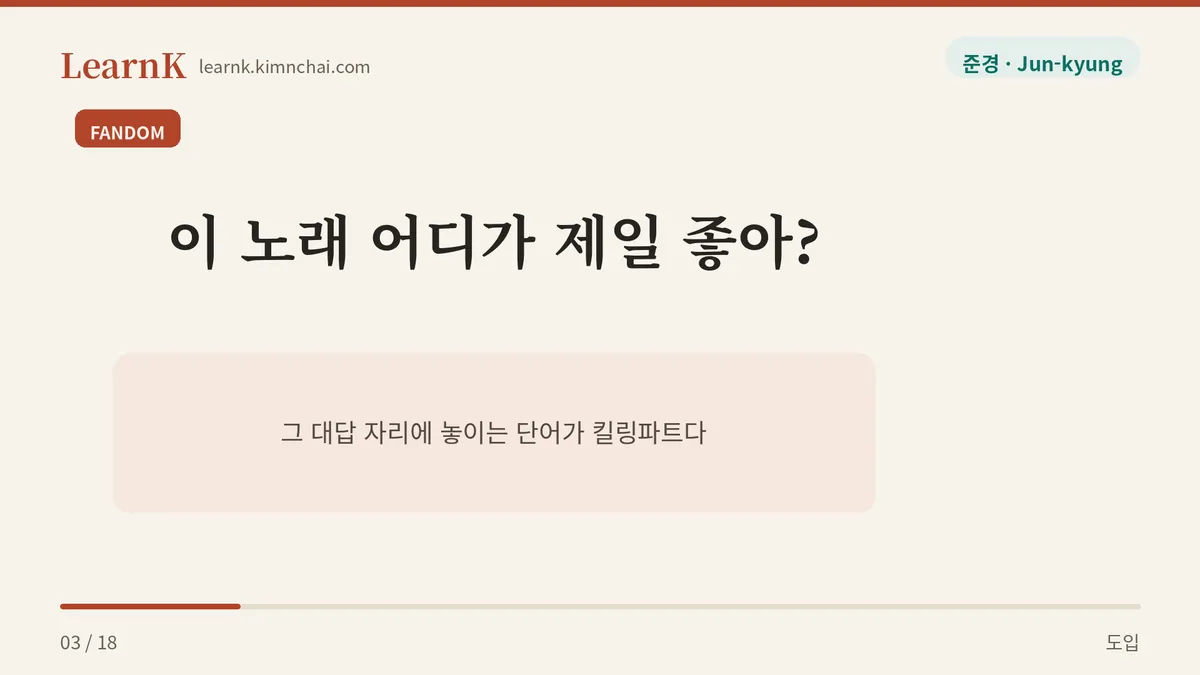
킬링파트 (killingpateu) — literally “killing part” — is the word for the short stretch of a song that hits your ear hardest and makes you remember the whole track. The song runs three minutes, but what stays in your head is three seconds — and Korean fans have a name for those three seconds. When a friend says 이 노래 좋아 (i norae joa), “I love this song,” the question that almost always follows is 어디가 제일 좋아? (eodiga jeil joa?), “which part do you like best?” — and this is the word that goes in the answer slot. Sharing a playlist, rehearsing a cover dance, passing the mic back and forth at a 노래방 (noraebang) — it’s one of the fandom words that Korean-learning fans of Korean culture actually run into most often.
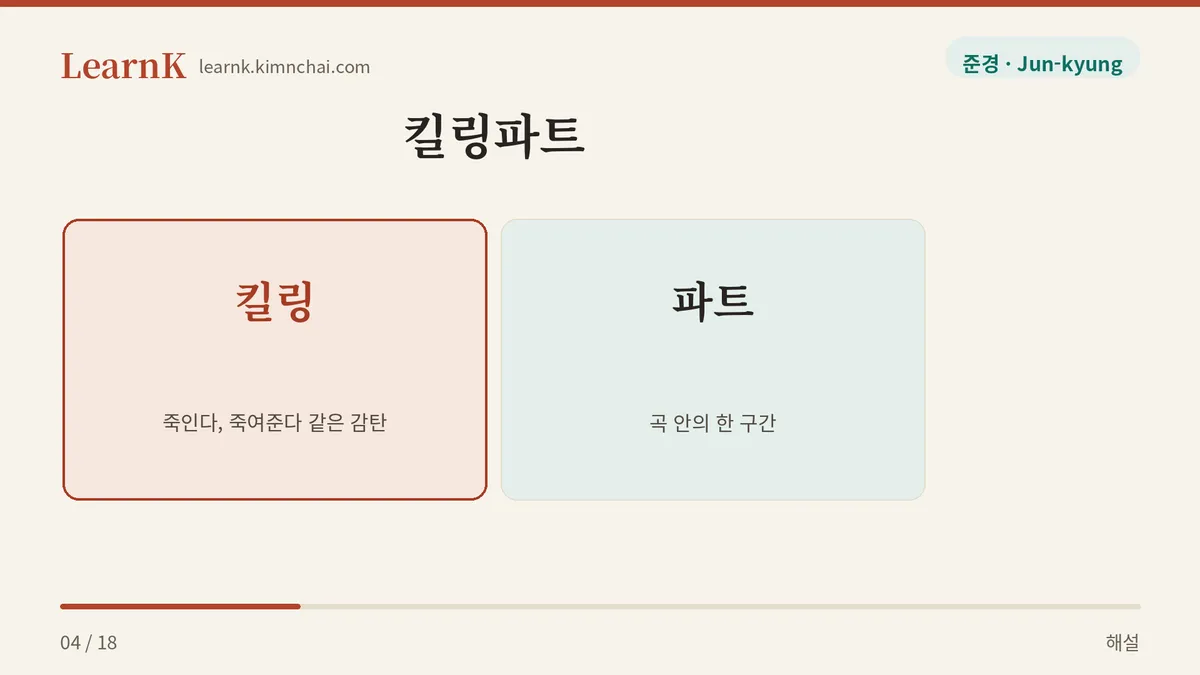
The “killing” here isn’t menacing. It’s the same instinct Korean already has in 죽인다 (juginda) and 죽여준다 (jugyeojunda), exclamations that mean something is fantastic. The exaggeration of “this is so good I can’t handle it” simply got loaded onto an English word.
A sense of length matters here. A 킬링파트 is usually a few seconds — a dozen or so at the very most. It might be one soaring high note, a single line of rap, an ad-lib with a sharp intake of breath, or even a single dance move rather than a lyric at all. That’s why, if you ask 이 노래 킬링파트 어디야? (i norae killingpateu eodiya?), the answer usually comes back as a time: “from 1:12.” The word points to a stretch of the track.
It’s also worth noting that it isn’t the same as the chorus. 후렴 (huryeom) is a neutral term for the repeating slot in a song’s structure, while 킬링파트 carries a judgment — “this is the best bit.” The chorus often is the killing part, but so can one suddenly hushed line right before the second verse begins. To put it simply: 후렴 tells you the position, 킬링파트 tells you the verdict.
These days the word travels outside music, too. The funniest 30 seconds of a variety show episode, the last five minutes of a drama, the most striking passage of a presentation — people jokingly call all of these the killing part. But that’s a light metaphor; the roots are still in songs.
See It in a Real Conversation
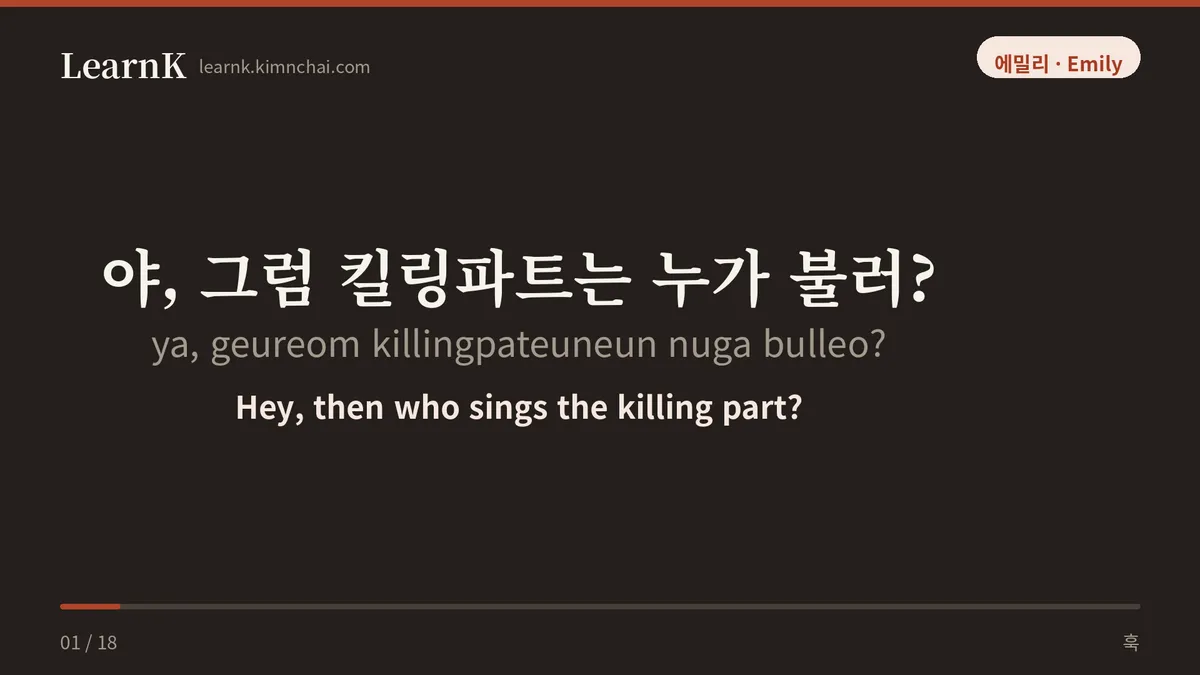
Setting: Friday night at a 노래방 (noraebang). The next song is queued up, and the two of them have just split the mics.
Jun-kyung: 이 노래 내가 1절 할 테니까 너 2절 해. I’ll take the first verse, you take the second.
Emily: 야, 그럼 킬링파트는 누가 불러? 나 그거 하려고 예약한 건데. Hey, then who sings the killing part? That’s the whole reason I queued this song.
Jun-kyung: 아 맞다, 마지막 고음. 그건 네가 해라. 나 목 나갔어. Oh right, the high note at the end. You take it — my voice is shot.
Emily: 진작 그렇게 나왔어야지. 대신 안무 킬링파트는 같이 하는 거다? That’s more like it. But we do the dance killing part together, deal?
Jun-kyung: 그건 좀… 나 팔이 거기까지 안 올라가. That one’s… my arms don’t go up that high.
Emily: 핑계 대지 마. 3초야, 3초. No excuses. It’s three seconds. Three.
When It Sounds Off
✗ (To your teacher after a recital) 선생님, 아까 3악장 킬링파트 진짜 좋았어요. — Teacher, the killing part in the third movement earlier was so good. ✓ (To your teacher after a recital) 선생님, 3악장 그 부분이 정말 인상 깊었습니다. — Teacher, that passage in the third movement really made an impression on me. → This is colloquial fandom slang, so in formal settings or in front of someone older than you it lands as too casual. You may be trying to pay a compliment and end up sounding rude instead, so in situations like this it’s safer to swap in words like 그 부분 (geu bubun), “that part,” or 대목 (daemok), “that passage.”
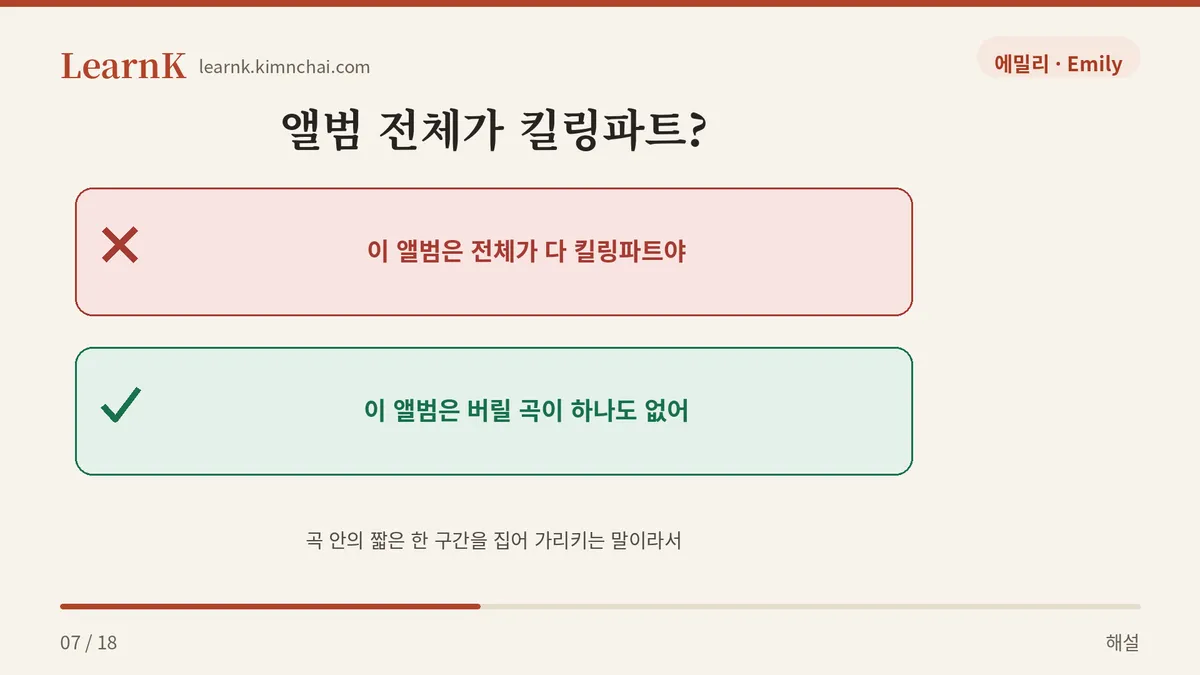
✗ 이 앨범은 전체가 다 킬링파트야. — This whole album is one big killing part. ✓ 이 앨범은 버릴 곡이 하나도 없어. — There isn’t a single throwaway track on this album. → 킬링파트 singles out one short stretch inside a song. Attach it to something big, like an entire album or a whole track, and the very meaning of “the best part” collapses on itself. This sense of scale is the mistake learners make most often.
Example Sentences by Situation
1) Recommending a song to a friend — you know that if you just send a link they won’t listen all the way through, so you point out exactly where to start.
이 곡은 2분 10초부터가 킬링파트예요. 거기만 들어도 돼요. (i gogeun i-bun sip-chobuteoga killingpateuyeyo. geogiman deureodo dwaeyo.) The killing part starts at 2:10. You can just listen to that part.
2) At cover dance practice — even if you haven’t memorized the whole routine, that one stretch has to be perfect. You hear this constantly in practice rooms.
오늘은 킬링파트만 따로 연습할게요. (oneureun killingpateuman ttaro yeonseuphalgeyo.) Today we’ll practice just the killing part separately.
3) Using it for something that isn’t a song — swapping reactions with a friend who watched the show with you. The tone is light and joking.
어제 방송 킬링파트는 마지막 5분이었어. (eoje bangsong killingpateuneun majimak o-bunieosseo.) The best bit of yesterday’s episode was the last five minutes.
Formal Speech, Casual Speech, and Similar Expressions
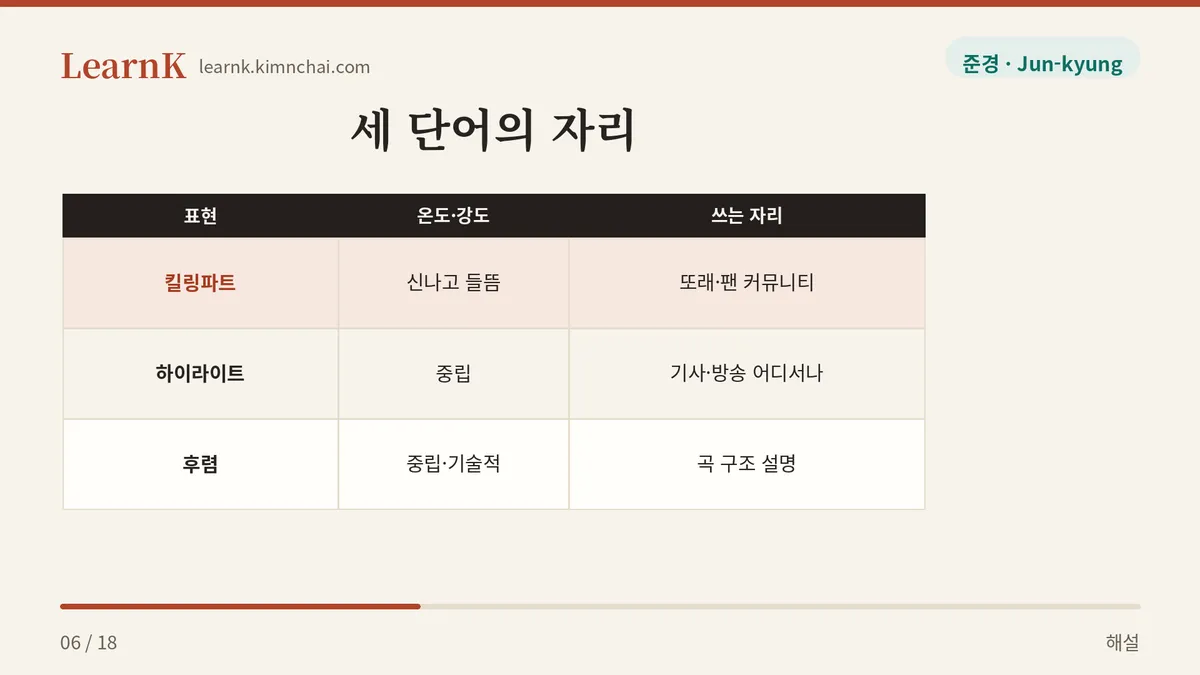
Because it’s a noun, the politeness level is decided by whatever predicate follows it. Casual is 킬링파트야 (killingpateuya), polite is 킬링파트예요 (killingpateuyeyo). The formal 킬링파트입니다 (killingpateuimnida) is grammatically possible, but in practice you’ll only see it in broadcast subtitles or promo copy — the speech level is formal while the word itself is slang, so the pairing feels mismatched.
| Expression | Warmth & intensity | Where it’s used |
|---|---|---|
| 킬링파트 (killingpateu) | Excited and buzzing, with affection mixed in | Among peers, on social media, in fan communities. Not used in formal settings |
| 하이라이트 (hairaiteu) | Neutral | Anywhere. Fine in news articles and broadcasts |
| 후렴 (huryeom) | Neutral, technical | When explaining a song’s structure. Carries no admiration |
| 포인트 안무 (pointeu anmu) | Light and fun | When pointing to one specific move in a dance |
For the very same stretch of a song, a music teacher says 후렴, a journalist says 하이라이트, and a fan says 킬링파트. What separates the three words isn’t their meaning — it’s where the speaker is standing.
Cultural Background — Songs Made for Three Seconds
The word is Konglish: English killing and part stuck together in Korea. Both words exist in English, of course, but there was never an idiom that joined them this way — if anything, English speakers learned the combination backwards, through K-pop. English-speaking fans usually say “the best part” or “the hook.”
It’s also worth knowing that the second half, 파트 (pateu), is unusually everyday vocabulary in Korea. Idol groups divide a single song among their members, so who got how many seconds is a permanent topic of conversation. Among fans, whether the parts were distributed fairly is a serious debate, and who was handed the very best stretch — that is, who got the 킬링파트 — is read as a signal of where the group’s center of gravity lies. In a single word, you get the structure of the idol industry.
As short-form video became the way songs spread, this stretch grew even more important. You have to win the listener over within 30 seconds, so people now say that today’s songs are written from the start with “the spot that will get clipped” in mind. The order has flipped: instead of a song producing its killing part, the killing part pulls the song along behind it.
Go to a 노래방 and you’ll see exactly where this word lives. When two people split one song, they’ll politely take turns on the first and second verses — and then neither of them will let go of the mic for that last high note. Just like Jun-kyung and Emily above, this little tug-of-war is a very familiar Friday-night scene in Korea.
Today’s Quiz
A friend plays you a newly released song and asks, “이 노래 킬링파트가 어디야?” Which reply sounds the most natural?
- 응, 이 노래 전체가 다 킬링파트야. — Yeah, this whole song is one big killing part.
- 1분 40초쯤, 갑자기 조용해지는 그 한 소절. — Around 1:40, that one line where it suddenly goes quiet.
- 킬링파트는 아직 안 나왔어, 다음 앨범에 나와. — The killing part isn’t out yet; it’s coming on the next album.
Answer: 2. 킬링파트 is a word for pinpointing one short stretch inside a song by its timestamp, so this reply is the most natural. Option 1 is off for the reason we saw earlier — the scale doesn’t match — and option 3 mistakes 킬링파트 for the name of a song or track. And notice that the correct answer isn’t the chorus but a single quiet line: that’s exactly where you can see that 킬링파트 is a verdict, not a position.