"깎아 주세요" — The Magic Phrase for Haggling Down Prices at a Korean Market
깎아 주세요
깎아 주세요 (kkakka juseyo) is the phrase you use when you want to ask for a small discount on something. Word for word, it means “(take some off the price and) give it to me,” and in English it’s close to “Please give me a discount.” If you’re a fan of Korean culture traveling in Korea, this is a real-world survival phrase you’re guaranteed to use at least once — at Namdaemun Market, Gwangjang Market, the Dongdaemun wholesale-retail shops, or a Jeju five-day market.
When do you use it?
You’ve spotted a leather wallet you love. It’s a market stall, not a fixed-price shop, so there’s no price tag — or if there is one, haggling is perfectly natural here. Ask the owner the price, put on a thoughtful face for a moment, then smile and say this:
사장님, 조금만 깎아 주세요! (sajangnim, jogeumman kkakka juseyo!) Boss, could you knock the price down just a little!
The moment the owner sighs “Aigo, there’s nothing left in it for me” but quietly lowers the price anyway — you’re already standing right in the middle of Korean market culture.
Meaning and nuance
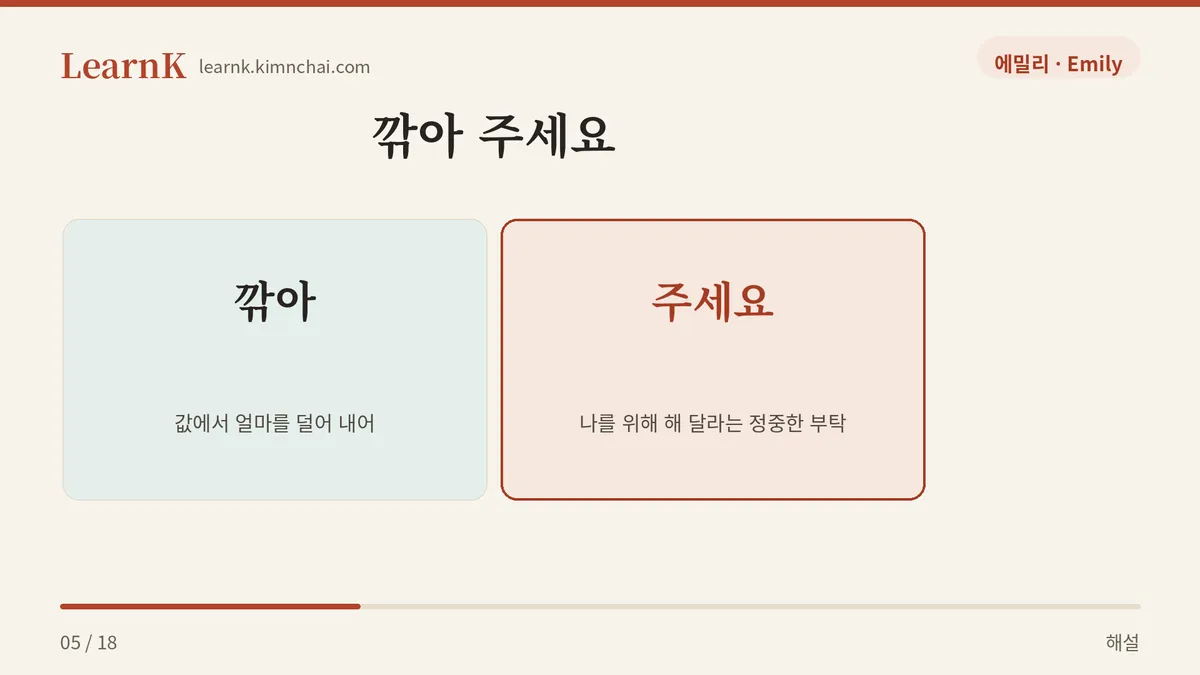
깎다 (kkakkda) originally refers to the action of shaving a thin layer off a surface — like “sharpening a pencil (연필을 깎다)” or “peeling an apple (사과 껍질을 깎다).” That image of “taking a bit off” got transferred to prices, so 가격을 깎다 (gagyeogeul kkakkda) came to mean “to take some amount off a set price.”
Then -아/어 주세요 (-a/eo juseyo) is attached. This is the polite request pattern meaning “please do ~ (for me).” That’s why 깎아 주세요 sounds not like a command but like a gentle request. It carries no sense of forceful demand at all, so it’s perfectly polite even when said to an owner you’ve never met.
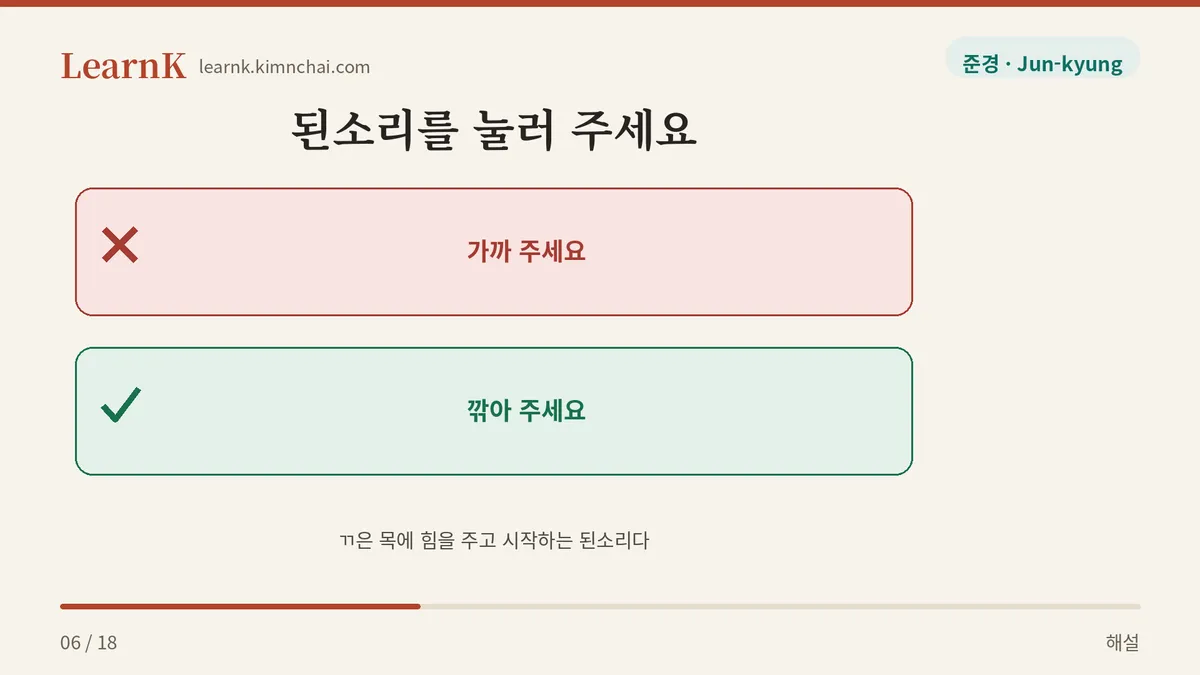
Pronunciation tip: press down firmly on the tense consonant (ㄲ) in ‘깎.’ It’s not 가까 주세요 (gakka juseyo) but 깎아 주세요 (kkakka juseyo). Just imagine putting a little tension in your throat and starting the “kka” hard.
Example sentences by situation
① When you first make an offer
이거 얼마예요? 조금만 깎아 주세요. (igeo eolmayeyo? jogeumman kkakka juseyo.) How much is this? Could you take just a little off?
This is the natural flow of asking the price and immediately laying a request on top of it. 조금만 (jogeumman) — adding “just a little” makes you look modest, which raises your success rate.
② When you buy several items (your most powerful weapon)
두 개 살게요. 그럼 좀 깎아 주세요. (du gae salgeyo. geureom jom kkakka juseyo.) I’ll take two. So could you take a bit off?
Signaling “I’ll buy a lot” works best of all in haggling. 그럼 (geureom) is a shortened form of “그러면 (geureomyeon),” and it quietly adds the logic of “since that’s the deal.”
③ When you’re paying in cash
현금으로 낼게요. 만 원만 깎아 주세요. (hyeongeumeuro naelgeyo. man wonman kkakka juseyo.) I’ll pay in cash. Could you take just 10,000 won off?
Pinpointing a specific amount (만 원 = 10,000 won) speeds up the haggling. Cash is more favorable to the owner than a card, so cash makes a good bargaining chip.
④ When you push one last time
그럼 이걸로 살게요. 마지막으로 조금만 더 깎아 주세요. (geureom igeollo salgeyo. majimageuro jogeumman deo kkakka juseyo.) Okay, I’ll take this one. As a final thing, could you take off just a little more?
Showing your decision to buy first while asking for one last concession — this is a polite yet effective closing move.
Comparing polite/casual forms and similar expressions
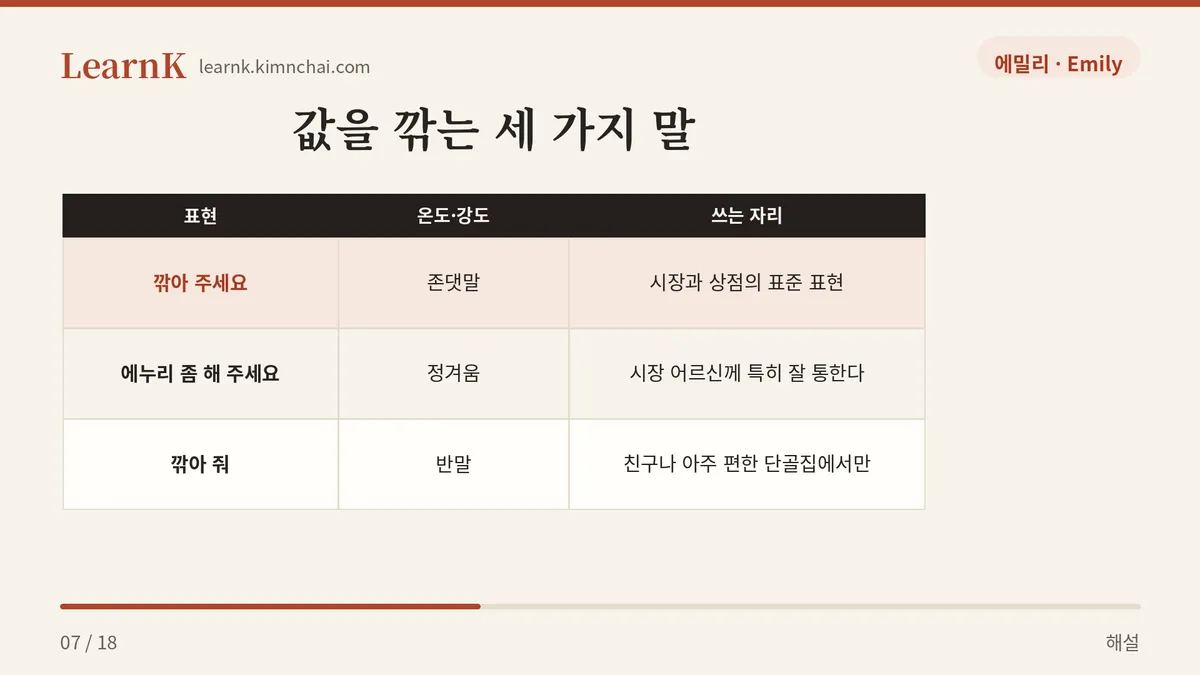
- 깎아 주세요 (kkakka juseyo) — polite. The standard phrase used at markets and shops.
- 깎아 주실 수 있어요? (kkakka jusil su isseoyo?) — even more courteous. Because it asks whether it’s possible (“Could you take some off?”), the politeness goes up a notch.
- 깎아 줘 (kkakka jwo) — casual (반말). Only between friends or at a very comfortable regular spot. Used with an owner you’ve just met, it’s rude.
Let’s also learn some expressions that are similar but have a different feel.
- 싸게 해 주세요 (ssage hae juseyo) — “please make it cheap,” i.e. “please make the price low.” It means almost the same as 깎아 주세요 and can be used interchangeably.
- 에누리 좀 해 주세요 (enuri jom hae juseyo) — 에누리 (enuri) is a native Korean word meaning “a reduction in price.” It’s a warm, old-fashioned expression that market elders love, so using it might make the owner say “Oh, your Korean is good!” and knock off even more.
- 덤으로 주세요 (deomeuro juseyo) — instead of cutting the price, this asks for a 덤 (deom) — something extra thrown in for free. Like buying a bag of tangerines and saying “throw in a few more as a 덤.”
Cultural background
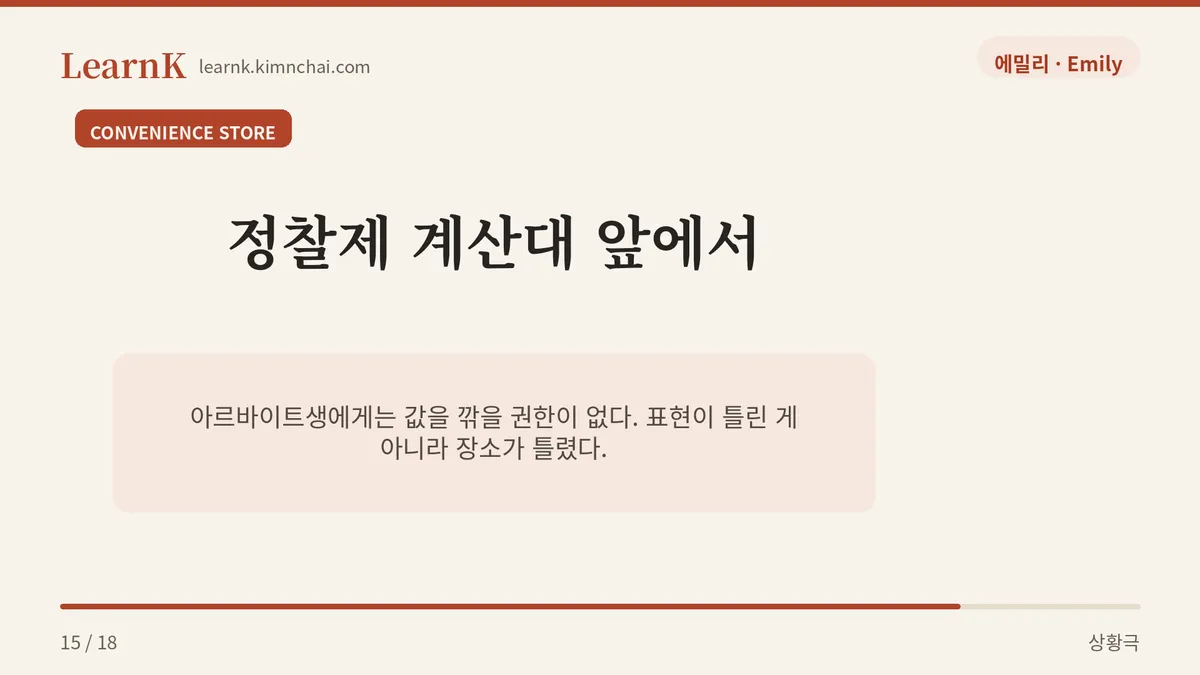
At Korea’s fixed-price (정찰제, jeongchalje) stores — department stores, big-box marts, franchises, convenience stores — haggling doesn’t work. Say “깎아 주세요” here and you’ll just put the clerk in an awkward spot. The places where haggling is alive are traditional markets, street stalls, some tourist-area shops, and wholesale-retail arcades.
The heart of haggling is a smile and a relaxed attitude. Bargaining down a price isn’t a fight — it’s closer to a short bit of playful push-and-pull you share with the owner. Even in the market scenes of K-dramas, you often see that heartwarming moment where the seller and customer bicker back and forth, then finally laugh and the seller says “Aish, fine, take this one too.” More than the result of shaving a bit off the price, it’s the 정 (jeong) — the warm human affection — that passes between you in the process that’s the real charm of a Korean market.
One point of etiquette: if the owner finally says “This one really can’t go any lower,” don’t keep pestering — just smile and back off. Even if you couldn’t get a discount, if you say “Got it, I’ll take it as is” and buy it, next time you visit you might become a regular whom the owner tosses a 덤 to first.
Today’s quiz
Saying “깎아 주세요” at the checkout of a fixed-price big-box mart is awkward. So then, where is a place this phrase works naturally? Pick from the three below.
- A convenience store
- A Namdaemun Market street stall
- A franchise café
Leave the answer and your own haggling experiences in the comments. Next time, we’ll take a deep dive into “덤으로 주세요 (deomeuro juseyo)” — the perfect phrase to use right after this one at the market!