Mastering ‘꼰대’ — Korea's Buzzword for the Nagging Elder
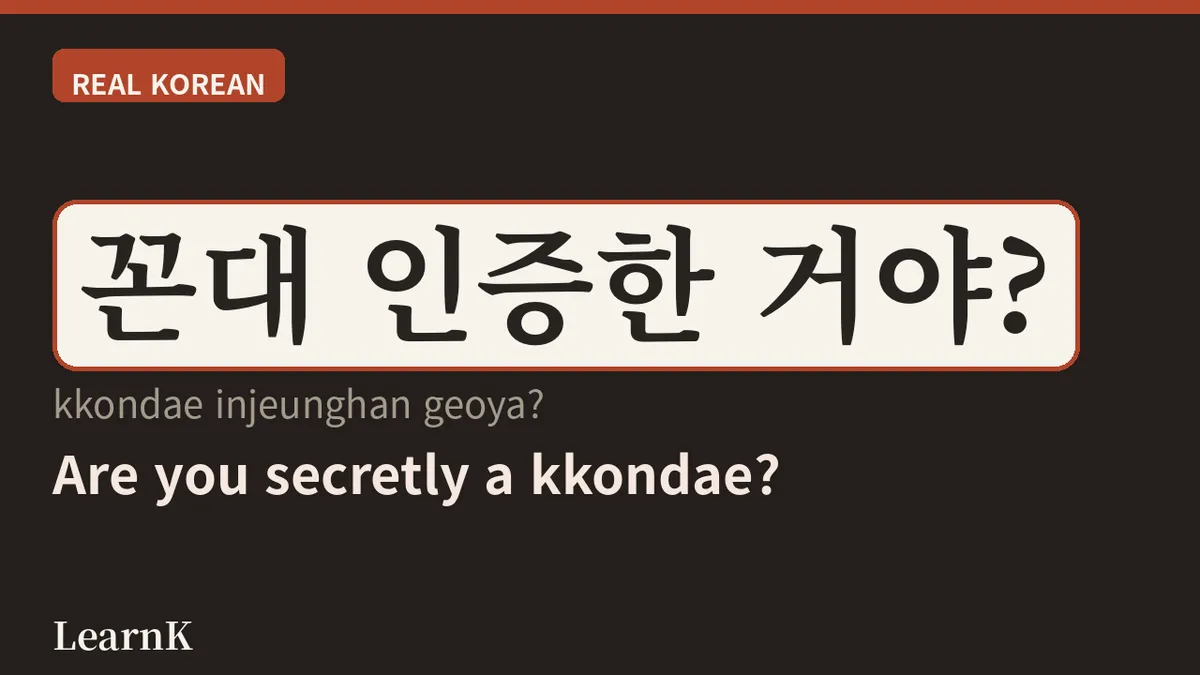
When you watch Korean dramas, you’ll often see a scene where a boss at work or an older relative launches into a lecture: “Kids these days, I tell you…” In that moment, the word the main character sighs and thinks to themselves is exactly today’s expression, 꼰대 (kkondae). Rather than a tidy standard word neatly defined in a dictionary, it’s a piece of slang that lives and breathes in everyday life and online — so just knowing its meaning gives you a clear window into Korea’s generational culture.
꼰대
꼰대 (kkondae) refers to someone who believes only their own experience and way of thinking is right, and who hands out advice, lectures, and orders one-sidedly without considering the other person’s situation. Originally it was slang that students used to secretly refer to an older teacher or their father, but now it has broadened into an expression that mocks any attitude of pulling rank by age or position and forcing others to “do as I say, because I’m right.”
The important thing is that 꼰대 doesn’t necessarily mean only older people. If someone in their twenties tells a junior, “Back in my day, this much was the bare minimum,” they become a ‘젊은 꼰대’ (young kkondae) in that instant. In other words, it’s not age but attitude that makes a kkondae. The nuance is clearly negative and can be somewhat rude, so saying “꼰대세요? (Are you a kkondae?)” directly to someone’s face is a serious insult.
The nuance at a glance
- Core attitude: one-way advice, ignoring the other person’s opinion
- A common tag-along phrase: “나 때는 말이야” (na ttaeneun malaya) — “Back in my day…” This is the original source of the joke made famous in the English-speaking meme world as “Latte is horse” (a pun on 나 때는…).
- Emotional color: frustration, a subtle smirk
Example sentences by situation
Let’s look at how it’s actually used in conversation through three situations. All of these are our own original example sentences.
Situation 1 — Complaining about your boss to a friend
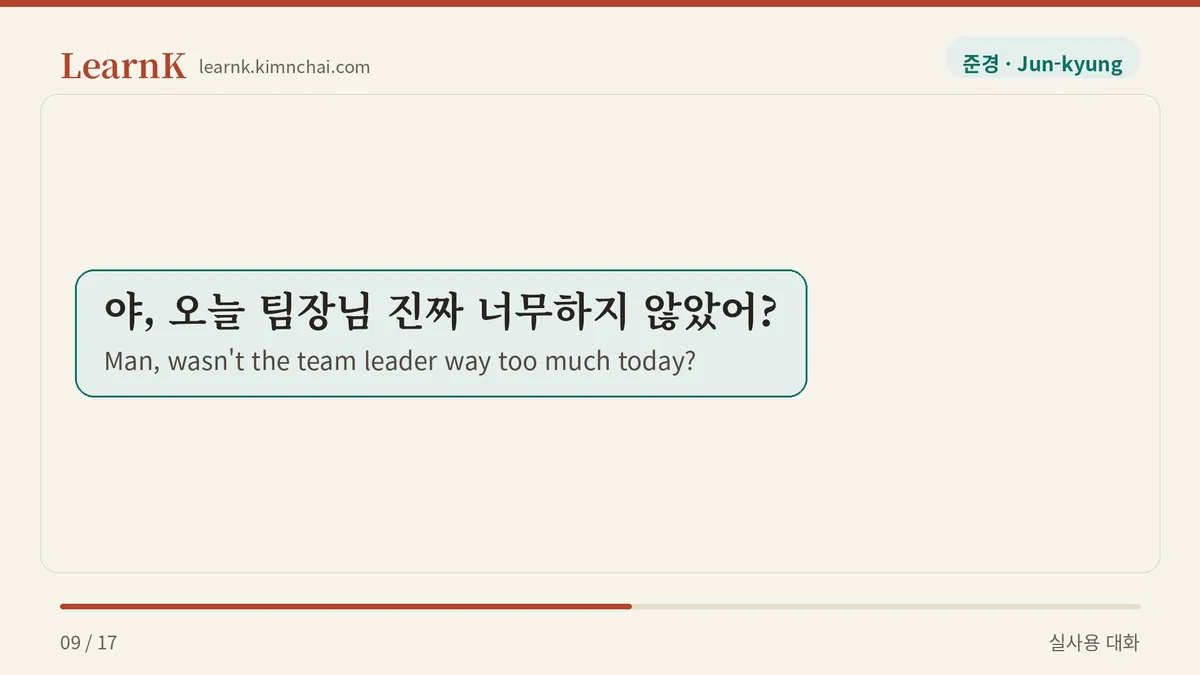
우리 팀장님은 진짜 꼰대야. 회의 때 아무도 반박을 못 해.
(uri timjangnimeun jinjja kkondaeya. hoeui ttae amudo banbageul mot hae.)
Our team leader is such a kkondae. Nobody can push back during meetings.
This is a complaint that the boss insists only his own words are right, so the meeting atmosphere gets tense. Talking about someone in the third person behind their back is the most common usage.
Situation 2 — Reflecting on yourself (self-reflection)
내가 꼰대처럼 굴었나? 그냥 조언한 건데.
(naega kkondaecheoreom gureotna? geunyang joeonhan geonde.)
Did I act like a kkondae? I was just giving advice.
This is a scene where someone worries that advice they gave with good intentions came across as nagging. ‘꼰대처럼 굴다 (kkondaecheoreom gulda)’, meaning “to behave like a kkondae,” is very commonly used.
Situation 3 — Making a light joke
라떼는 말이야~ 하면 완전 꼰대 인증이지.
(latteneun malaya~ hamyeon wanjeon kkondae injeungiji.)
If you say “Back in my latte days~,” that’s totally certifying yourself as a kkondae.
This is a situation where friends laugh and say, “If you talk like that, you’re admitting you’re a kkondae too.” ‘꼰대 인증 (kkondae injeung)’ is a trendy phrase meaning to prove yourself a kkondae.
Comparing formal/casual speech and similar expressions
꼰대 is slang, so you don’t use it in formal settings or toward people above you. To convey the same meaning politely, you use standard vocabulary like 고압적이다 (goapjeogida, to press down in an overbearing way) or 권위적이다 (gwonwijeogida, authoritarian).
- To a friend (casual): 완전 꼰대야. (wanjeon kkondaeya.) — “He’s a total kkondae.”
- Politely: 그분은 조금 권위적이신 것 같아요. (geubuneun jogeum gwonwijeogisin geot gatayo.) — “I think he’s a little authoritarian.”
There are also words that are similar but different. 잔소리꾼 (jansorikkun) is someone who keeps nitpicking small things, so it’s lighter than ‘꼰대,’ and 틀딱 (teulttak) is a harsh slur that demeans elderly people, so never use it. On the flip side, an adult who communicates across generational gaps is praised as being ‘어른스럽다 (eoreunseureopda)’ — mature — which these days is treated almost like the opposite of ‘꼰대.’
Cultural background — why is this word so hot?
Korea has a language culture (honorifics) that places great importance on age and hierarchy. Because of this, an elder’s advice easily turns into pressure, and the younger generation’s fatigue with this structure burst out in the word 꼰대. It’s a keyword you’ll never miss when office dramas or family dramas depict generational conflict.
The workplace drama Misaeng (미생) (tvN, 2014) realistically portrayed the hierarchy and communication problems between bosses and new employees, and it became the moment when the image of the “kkondae boss” was etched into the public mind. Rather than quoting its lines directly, let’s introduce it by situation: the scenes where a new hire, faced with an unreasonable order, can say nothing and just swallows it — those very scenes represent the frustration of “kkondae culture.”
Recently, this word has also come to be used as a tool for self-reflection. The resolution “I won’t become a kkondae myself” can also signify an older generation’s effort to respect the younger one. So if you understand 꼰대, you can even read how Korean society is trying to reshape its up-and-down relationships.
Wrap-up quiz
Which of the following sentences uses ‘꼰대’ most naturally?
- 저 어른은 정말 꼰대세요, 감사합니다.
- 나 때는 말이야, 하고 훈계하면 딱 꼰대야.
- 오늘 날씨가 참 꼰대네요.
The answer is number 2. That’s because the one-sided lecturing of “나 때는 말이야 (Back in my day)” is exactly the core attitude of a kkondae. Number 1 awkwardly mixes it in as if it were a compliment, and number 3 uses it for the weather, where it just doesn’t work. From today, when you see a frustrating boss in a drama, try shouting inside your head, “Ah, that person is a total kkondae!” Your Korean skills and your cultural instincts will grow at the same time.