최애 (choe-ae): The Word for the 'One Person' You Love Most in the World
At a K-pop concert, fans shout until their throats are raw. “Where’s my 최애?!” In that moment — waving a light stick, searching for the one person on stage — you’ll hear the single word most often used in Korean fandom culture, and it’s today’s expression. It pops up in social media bios, on merch boxes, and in chats with friends. If you’re an idol fan — or really, anyone who genuinely loves something — this is a must-know word. Let’s dig into it together.
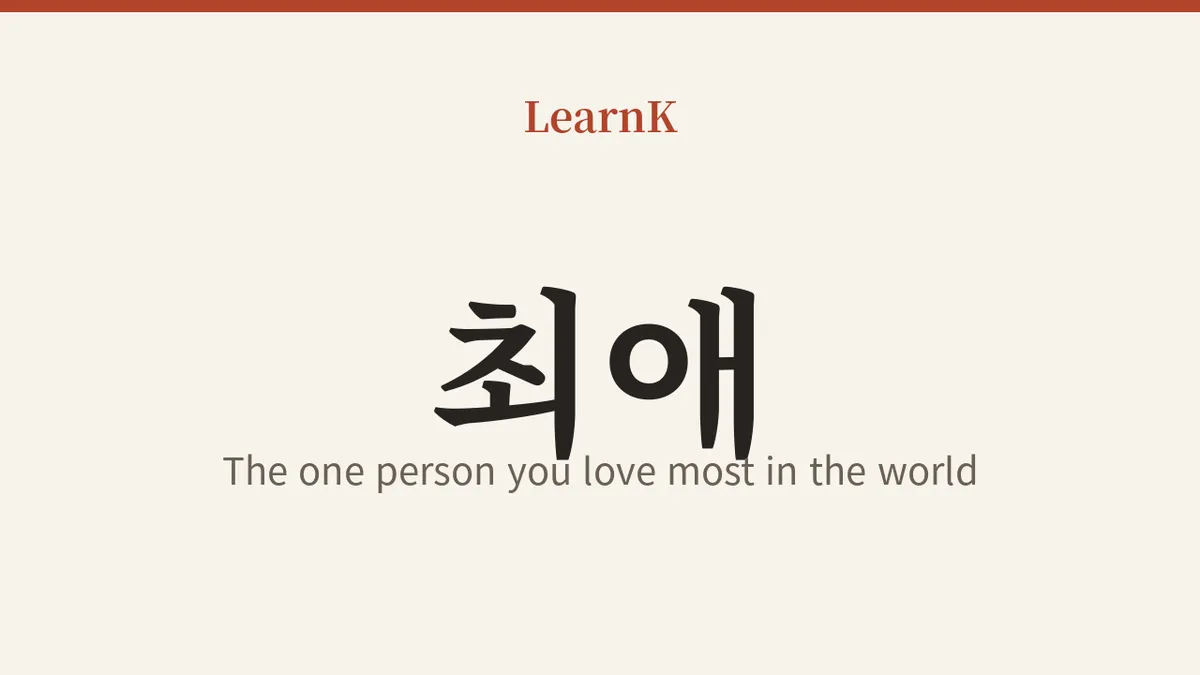
최애
최애 (choe-ae) means ‘the thing you love (애, 愛) the most (최, 最).’ Built from two Chinese characters, it started out as fan slang, but today it’s a full-fledged standard noun — officially listed in the National Institute of Korean Language’s dictionary.
The key nuance is ‘the one and only, out of many.’ It’s not just something you like — it’s the person or thing that would rank number one if you put them all in order. So within a group, if you say “내 최애는 저 멤버야 (nae choe-ae-neun jeo membeo-ya)” — “That member is my 최애” — it means the other members are great too, but that one holds the top spot in your heart. And it isn’t limited to people. A movie character, a song, even a food — anything that’s ‘the thing I love most’ can be your 최애.
Checking it in the National Institute of Korean Language dictionary
The National Institute of Korean Language’s Basic Korean Dictionary defines the word like this:
최애 (noun)
- Loving most; or something that is so loved. [en] one’s favorite — The most loved; or something like that. [es] favorito, ta — Lo más querido. O Lo que quiere más. [zh] 最爱, 最喜欢的 — 最爱慕;或指那样的人。 — National Institute of Korean Language, Basic Korean Dictionary (krdict.korean.go.kr)
(A Portuguese translation isn’t included in the dictionary, so we’ve provided one ourselves for reference — [pt] favorito, o mais amado; ou aquilo/aquele que se ama mais. Please note that this Portuguese gloss is our own translation, not from the original dictionary.)
Shall we also look at the actual example sentences the dictionary provides?
민준아. 너는 이 영화의 최애 캐릭터가 누구야? — National Institute of Korean Language, Basic Korean Dictionary (krdict.korean.go.kr)
This is a casual (반말) situation where you’re chatting with a friend about a movie and asking, “Who’s your favorite character?” It shows that 최애 attaches naturally to a ‘character,’ not just a person.
지수는 최애 가수의 노래를 직접 듣고 싶어서 콘서트에 갔다. — National Institute of Korean Language, Basic Korean Dictionary (krdict.korean.go.kr)
A descriptive sentence about going to a concert to hear ‘the singer you love most’ — an example that captures the heart of a K-pop fan exactly.
이 가수가 이 그룹에서 나의 최애이다. — National Institute of Korean Language, Basic Korean Dictionary (krdict.korean.go.kr)
Here you’re pointing out your ‘number one’ among several members. It’s a textbook example of 최애 used as a noun in the predicate position of a sentence.
나의 최애 음식은 김치찌개이다. — National Institute of Korean Language, Basic Korean Dictionary (krdict.korean.go.kr)
A case where a ‘food,’ not an idol, is the 최애. As you can see, 최애 can be used anywhere in everyday life.
Example sentences by situation (originally written)
Situation 1 — To a friend at a concert (casual)
봐 봐, 저기 센터에 선 사람이 내 최애야! (bwa bwa, jeogi senteo-e seon sarami nae choe-ae-ya!)
A scene where you’re excitedly shouting and pointing at the member you’re cheering for on stage.
Situation 2 — Choosing from a menu at a café (polite)
여기 크림 라테가 제 최애 메뉴예요. 꼭 드셔 보세요. (yeogi keurim rate-ga je choe-ae menyu-yeyo. kkok deusyeo boseyo.)
A situation where you attach 최애 even to a drink, politely recommending your ‘favorite menu item.’
Situation 3 — Posting on social media
오늘 드디어 최애 실물 영접… 심장이 아직도 뛴다. (oneul deudieo choe-ae silmul yeongjeop… simjang-i ajikdo ttwinda.)
A post recording, in that signature fandom voice, the thrill of finally seeing your favorite star in person.
Polite vs. casual speech, and comparing similar expressions
Because 최애 is a noun, you can switch freely between polite and casual speech just by changing what comes after it.
- Casual: 얘가 내 최애야. (yaega nae choe-ae-ya.) — “This one is my 최애.”
- Polite: 이분이 제 최애예요. (ibuni je choe-ae-yeyo.) — “This person is my 최애.”
It’s also good to know some similar words. 원픽 (won-pik) comes from the English ‘one pick’ and means almost exactly the same as 최애. The person or thing you love second or third best is called 차애 (cha-ae — the second-most-loved**)**. When you just want to convey ‘the best,’ you can use 최고 (choe-go), but 최고 is closer to an objective judgment of ‘top-tier skill or quality,’ whereas 최애 carries a strong subjective, affectionate nuance of ‘the number-one my heart is drawn to.‘
Cultural background
최애 is a key to understanding Korean fandom culture. Fans collect photocards featuring their 최애, and on their 최애’s birthday they might even rent out a café to hold a ‘생일 카페 (birthday café)’ event. Lately, dramas often feature a character who loves an idol, shouting “내 최애” and filling their room with merch (we’re describing the situation rather than quoting any specific line). In this way, the single word 최애 compresses an entire ‘culture of cheering for someone with your whole heart.‘
Closing quiz
A friend asks, “이 그룹에서 네가 제일 좋아하는 멤버가 누구야?” (“Who’s your favorite member in this group?”). Using 최애, try answering naturally in casual speech to mean “This member is my number one.” (Sample answer: 이 멤버가 내 최애야. (i membeo-ga nae choe-ae-ya.))
Definitions and example sentences are from the National Institute of Korean Language’s Basic Korean Dictionary (krdict.korean.go.kr); that portion of this post, including our translations, is licensed under CC BY-SA 2.0 KR.