센터 (senteo) — Center Stage, and the Community Center Down the Street
센터 (senteo)
센터 (senteo) means the middle of the field in a sport like soccer, volleyball, or basketball — or the player standing in that middle spot. That’s the meaning the dictionary leads with, but the place a K-pop fan first meets this word is usually on stage. Eight members stand shoulder to shoulder; the moment the chorus drops, one of them steps forward and the camera catches her head-on. Fans call that spot the 센터 (senteo).
The fun part is how far this short loanword has spread inside Korean. The place you go to work out in the morning is a 스포츠 센터 (seupocheu senteo). The place you go to report a change of address is the 주민 센터 (jumin senteo). The place you call when your internet is down is the 고객 센터 (gogaek senteo). The first is a position — “the middle.” The rest are institutions — “a place in charge of something.” One single word can be both a location and a building.
In nuance, these two faces are opposites. The 센터 that points to a position carries a mix of envy and recognition, because it isn’t just the middle — it’s the most visible middle. So 네가 센터 서 (nega senteo seo), “you take center,” is a seating arrangement and a compliment at the same time. The 센터 that points to an institution, on the other hand, is a flat, businesslike word with no feeling in it at all. No Korean hears “I stopped by the 주민 센터” and pictures a stage. Learn both faces together and you’ll be able to tell instantly which one is in play, just from the word attached in front.
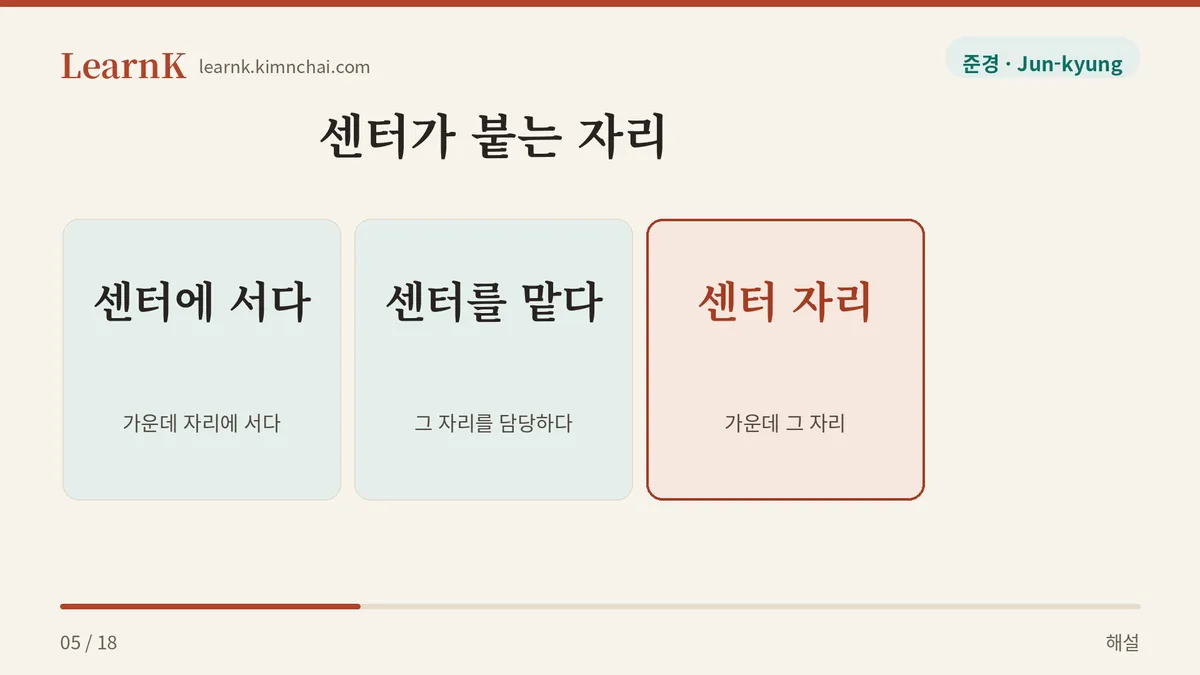
The grammar is easy. 센터 is a noun, so it pairs freely with particles. 센터에 서다 (senteoe seoda) is to stand in the middle spot, 센터를 맡다 (senteoreul matda) is to take charge of that spot, and it can attach straight onto another noun, as in 센터 자리 (senteo jari), “the center position.”
Checking It in the National Institute of Korean Language Dictionary
센터 「명사」 (noun)
- 축구, 배구, 농구 등에서, 경기장의 가운데. 또는 가운데에 선 선수. [en] center — The center of an arena or field in soccer, volleyball, basketball, etc., or a player positioned in the center. [ja] センター — サッカー・バレーボール・バスケットボールなどで、競技場の中央。また、中央のポジションに立つ選手。 [es] pívot, centro — En fútbol, baloncesto o voleibol, jugador que juega en la posición central o en el centro del campo. [zh] 中场,中锋,场地中心 — 在足球、排球、篮球等赛场的中间;或指处于中间的选手。
- 무엇을 파는 곳. [en] center — A place for selling something. [ja] センター — 物を販売する所。 [es] centro mercantil — Lugar en el que se venden las cosas. [zh] 中心 — 售卖东西的地方。
- 어떤 일을 담당하는 곳. [en] center — An organization in charge of doing a certain task. [ja] センター — その分野の仕事を担当する所。 [es] centro — Lugar en el que se desarrolla una actividad concreta. [zh] 中心 — 承担某事的地方。 — National Institute of Korean Language, Basic Korean Dictionary (krdict.korean.go.kr)
The dictionary carries no Portuguese definition. What follows is not a dictionary quotation but our own rendering. 1) centro — no futebol, vôlei ou basquete, o meio da quadra; ou o jogador que ocupa a posição central. 2) centro comercial — lugar onde se vendem coisas. 3) centro — lugar ou órgão encarregado de determinada tarefa.
One thing worth flagging: the K-pop sense of 센터 isn’t listed separately in the dictionary yet. But take meaning 1 — the middle, and the person standing in the middle — and move it onto a stage, and you get exactly the word fans use. The center of the field simply moved to the center of the stage; the picture the word paints is identical.
Below are the real example sentences the dictionary provides.
스포츠 센터에 등록을 하려고 왔어요. I came to sign up at the sports center. — National Institute of Korean Language, Basic Korean Dictionary (krdict.korean.go.kr)
This is a sentence you can use at a gym’s front desk as-is. In Korea, 헬스장 (helseujang) and 스포츠 센터 (seupocheu senteo) are used almost interchangeably, but the official name on the sign is usually the 스포츠 센터 version. 등록을 하다 (deungnogeul hada) means to sign up as a member.
운동하기로 결심했어? 스포츠 센터 회원권을 끊었네? So you’ve decided to start working out? You went and got a sports center membership? — National Institute of Korean Language, Basic Korean Dictionary (krdict.korean.go.kr)
Same place as the previous sentence, but a completely different temperature. This is casual speech between friends, with a light teasing edge. 회원권을 끊다 (hoewongwoneul kkeunta) is the colloquial way to say you bought a membership — you’ll hear it far more often than 사다 (sada), “to buy.”
주민 센터에서는 선거 안내 책자를 각 가호마다 한 부씩 배부했다. The community service center distributed one copy of the election information booklet to each household. — National Institute of Korean Language, Basic Korean Dictionary (krdict.korean.go.kr)
A stiff sentence, the kind you’d find in an administrative document. The 센터 here is not a position but an institution — meaning 3 in the dictionary. If you live in Korea as a foreigner, this is also a place you’re guaranteed to visit at least once, to update the address on your residence card.
노인, 주부, 청소년들을 위한 복지 센터를 건립하겠습니다. We will build a welfare center for seniors, homemakers, and young people. — National Institute of Korean Language, Basic Korean Dictionary (krdict.korean.go.kr)
This is the register of a campaign speech or a local government announcement. It shows nicely how putting a field of responsibility in front of ○○ 센터 instantly produces an institution’s name. 복지 센터 (welfare center), 문화 센터 (culture center), 상담 센터 (counseling center) — the list can go on forever.
지금 관제 센터와 교신하고 있으니 잠시 대기해 주십시오. We are currently in communication with the control center, so please stand by for a moment. — National Institute of Korean Language, Basic Korean Dictionary (krdict.korean.go.kr)
This is the most formal usage of all — the kind you’d hear in an airport or an emergency broadcast. Set it side by side with the casual example above and you can see at a glance that 센터 itself has no politeness level; the sentence ending sets the temperature.
A Real Conversation
Setting: a K-pop dance class at the neighborhood culture center. Class is over, and they’re deciding the formation for next month’s showcase.
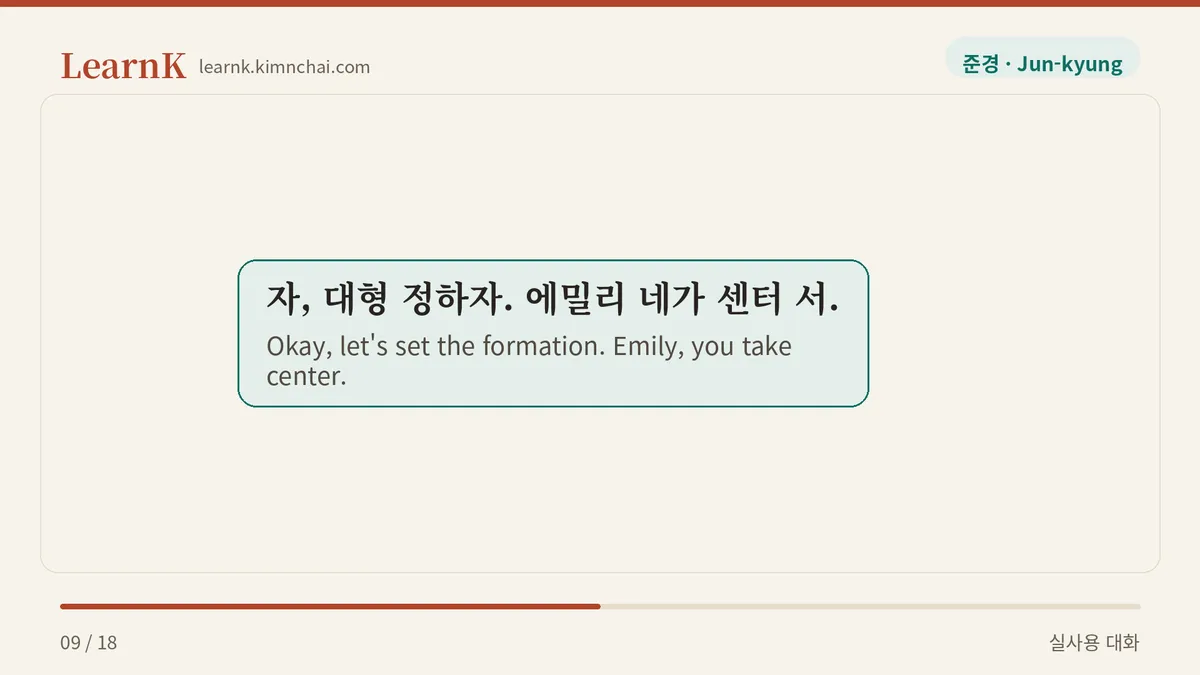
Jun-kyung: 자, 대형 정하자. 에밀리 네가 센터 서. Okay, let’s set the formation. Emily, you take center.
Emily: 나? 야, 나 후렴 안무 아직 반박자 늦어. Me? Come on, I’m still half a beat behind on the chorus.
Jun-kyung: 그게 뭐 어때. 카메라 앞에서 제일 크게 웃는 사람이 센터야. So what? Whoever smiles the biggest in front of the camera is the center.
Emily: 말은 쉽지… 그럼 1절만. 2절은 네가 센터 해. Easy for you to say… Fine, just the first verse. You take center for the second.
Jun-kyung: 콜. 근데 우리 이거 어디서 찍냐? Deal. But where are we filming this?
Emily: 3층 연습실. 아까 센터 사무실에서 예약해 뒀어. The practice room on the third floor. I booked it at the center’s office earlier.
Take a close look at that last line. Within a single conversation, 센터 switched from “the middle of the stage” to “the culture center as an institution,” and both speakers follow along without blinking. A Korean ear splits the two meanings apart in an instant, using the word in front and the situation.
This Sounds Off
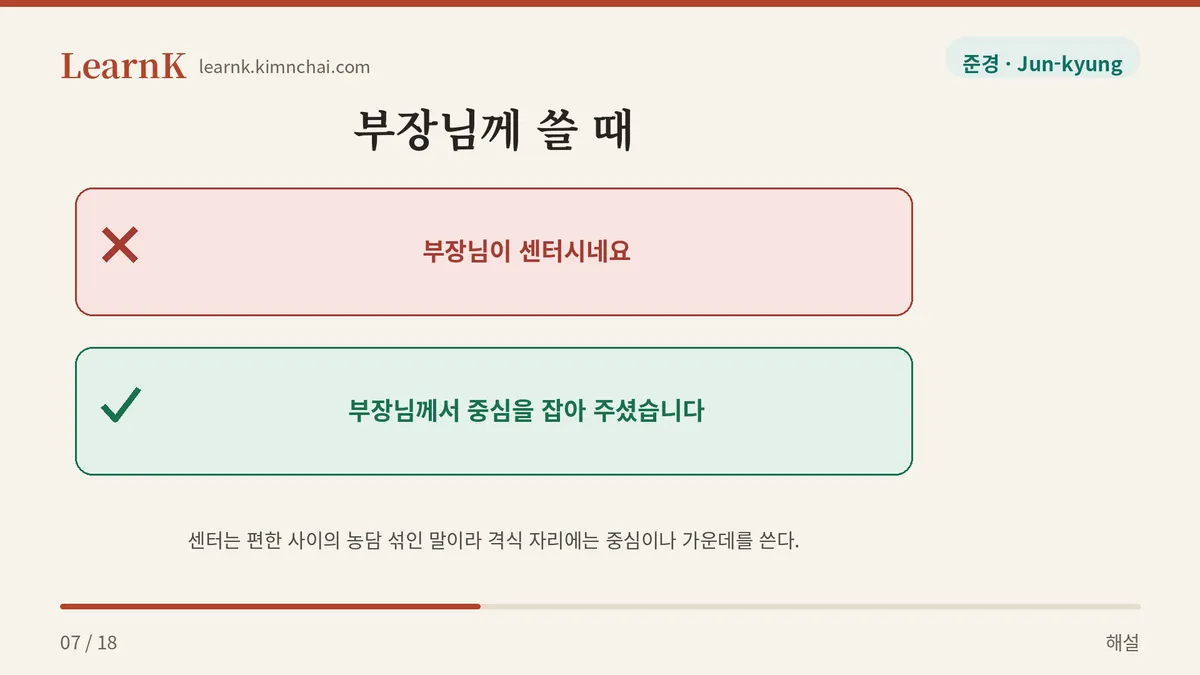
✗ (To your department head in a meeting) 부장님, 오늘 발표는 부장님이 센터시네요. ✓ (To a coworker) 야, 오늘 발표 네가 센터다. → It’s a light word that came over from fandom, so putting someone senior to you in that spot sounds less like praise and more like joking around. With a superior, something like 오늘 발표는 부장님께서 중심을 잡아 주셨습니다 (oneul balpyoneun bujangnimkkeseo jungsimeul jaba jusyeotseumnida) — “you anchored today’s presentation, sir” — is the safe choice.
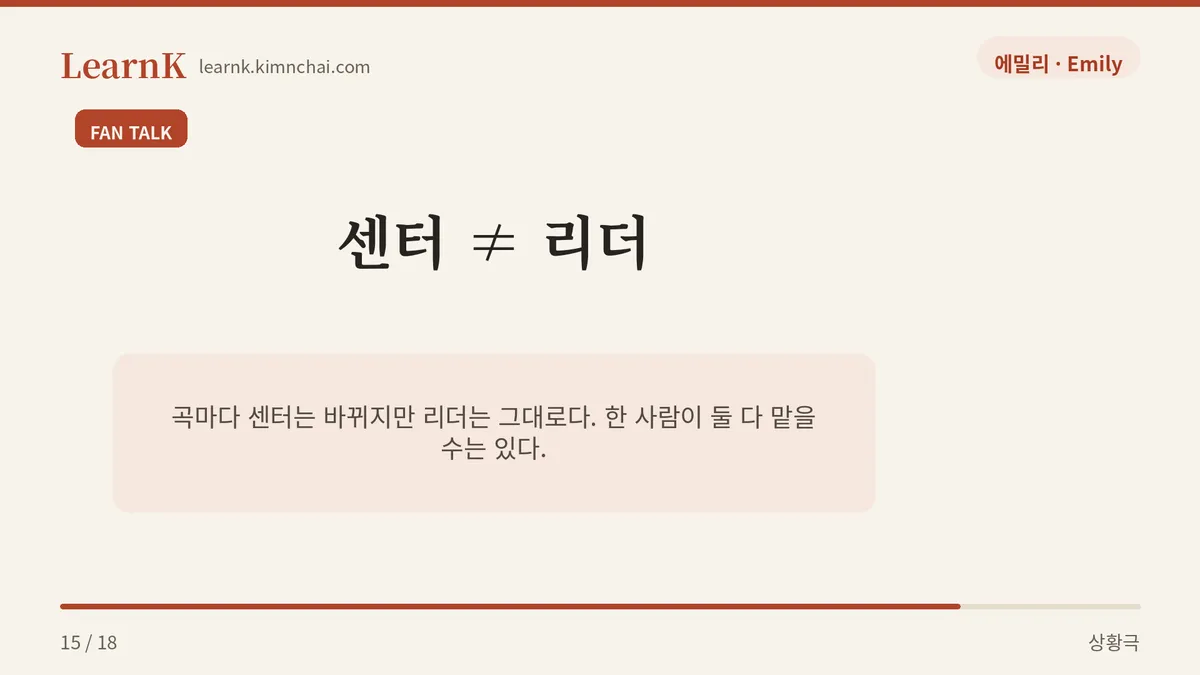
✗ 그 그룹 센터가 누구야? 팀 이끄는 사람 말이야. ✓ 그 그룹 리더가 누구야? 아, 센터는 다른 멤버구나. → 센터 is the spot at the middle of the formation, not the position of representing and leading the team (that’s the 리더 (rideo), the leader). One person can hold both, but they aren’t the same thing. Plenty of groups even change centers from song to song.
Example Sentences by Situation
Situation 1 — A birthday party. Everyone is standing awkwardly around the cake, about to take a group photo.
오늘 주인공은 센터로 오세요! (oneul juingongeun senteoro oseyo!) Today’s star, come to the center!
This is the usage you’ll hear most often when photos are being taken. 가운데 서세요 (gaunde seoseyo), “please stand in the middle,” means the same thing, but using 센터 turns it from a positioning instruction into a way of hyping up the guest of honor. This is one of the few situations where the word sits comfortably next to a polite ending.
Situation 2 — The internet has been slow for three days. Your roommate asks:
고객 센터에 전화해 봤어? 연결되는 데 삼십 분 걸린대. (gogaek senteoe jeonhwahae bwasseo? yeongyeoldoeneun de samsip bun geollindae.) Did you call customer service? I heard it takes thirty minutes to get through.
Here there’s no envy and no compliment — it’s purely the name of an institution. Of all the 센터s, this customer service one is probably the one you’ll end up saying out loud most often in daily life in Korea.
Situation 3 — Watching a comeback stage together.
이번 앨범 센터는 막내라던데? 대형 한가운데 계속 서 있잖아. (ibeon aelbeom senteoneun maknaeradeonde? daehyeong hangaunde gyesok seo itjana.) I heard the youngest is the center for this album — she keeps standing in the middle of the formation.
This is a sentence fans genuinely trade with each other. -라던데? (-radeonde?) is an ending you use to float something you’ve heard and check it, softly — it doesn’t assert, it passes the ball to the other person.
Polite vs. Casual, and Similar Expressions
센터 is a noun, so it carries no honorific level of its own. What comes after it decides the register. With a friend, 네가 센터야 (nega senteoya) is plenty. In a setting that calls for courtesy, 선배님이 가운데 서시면 좋겠어요 (seonbaenimi gaunde seosimyeon jokesseoyo) — “it’d be great if you stood in the middle, sunbae” — sounds far more natural than 선배님이 센터세요 (seonbaenimi senteoseyo). The moment you call a person a 센터, the whole tone of your speech turns casual.
| Expression | Tone & intensity | Where it’s used |
|---|---|---|
| 센터 (senteo) | Light and excited, fandom speech | Peers, social media, fan talk. Never in official documents |
| 가운데 (gaunde) | Neutral, purely positional | Anywhere. For people and objects alike |
| 중앙 (jungang) | Stiff and official | Announcements, official documents, institution names |
| 주인공 (juingong) | Warmly celebratory | Congratulatory occasions, the center of a story |
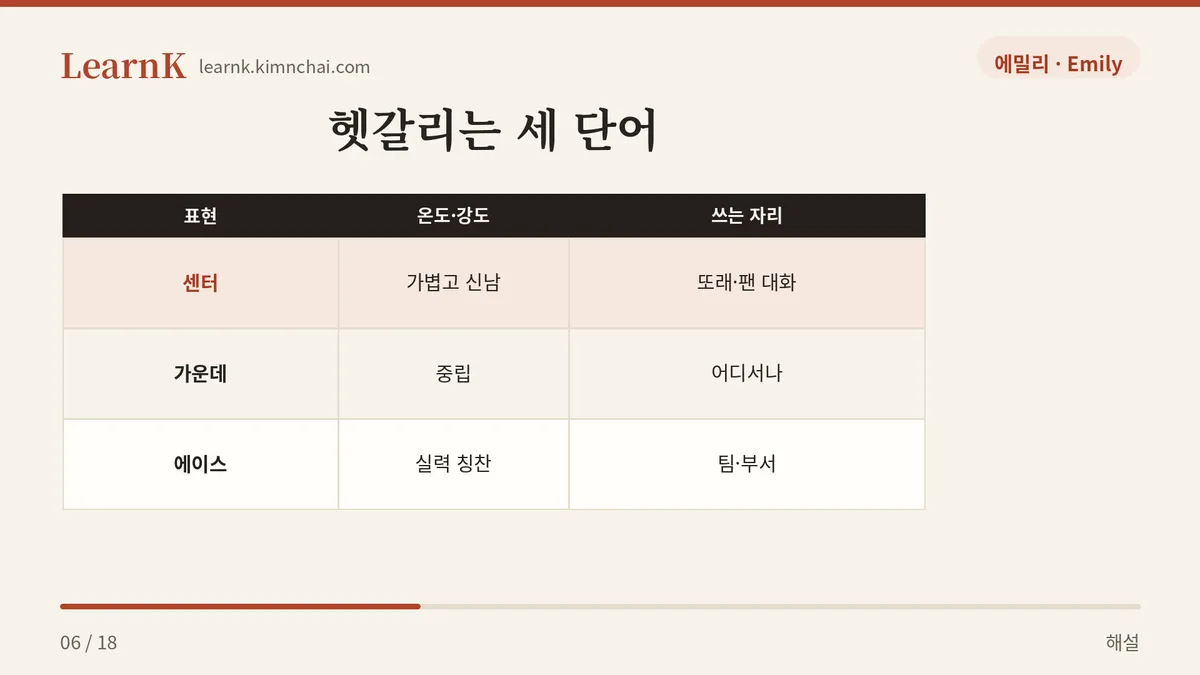
| 에이스 (eiseu) | Praise for skill | Teams and departments. About ability, not position |
As the table shows, 센터 and 에이스 are a pair people often mix up. 센터 is about where you stand; 에이스 is about how good you are. It’s quite common for the most skilled member not to be the one standing in the center.
Cultural Background — The Spot Where the Camera Lingers Longest
센터 is a loanword taken straight from English “center.” But the seat it settled into in Korean is a little different from the English one. In Korea, the word grew in two big directions. One is signage. What used to be called a 동사무소 (dongsamuso), a district office, now wears the name 주민센터 or 행정복지센터, and just tacking 센터 onto a field of responsibility — 스포츠 센터, 문화 센터, 복지 센터, 고객 센터, 관제 센터 — completes an institution’s name. Meaning 3 in the dictionary is, in effect, posted all over the Korean urban landscape.
The other direction is the stage. K-pop group choreography keeps shifting formations, and fans call the spot at the very front and middle during the chorus the 센터. The reason that spot is special is simple: the camera lingers there longest. Fold the stage in half vertically, and whoever stands on the crease becomes the face of that song. That’s why “이번 센터 누구야?” — “who’s the center this time?” — is the first question fans ask each other every comeback, and why audition shows that assemble debut lineups even hold votes over the center position.
This instinct leaks off the stage, too. In a group photo at a company dinner, someone shoves the birthday person into the middle with “너 오늘 센터” (“you’re the center today”), and while prepping a presentation, the person who took on the most work gets a “네가 센터네” (“you’re the center, then”). A name for a position quietly became a name for a role. That said, this extended usage is strictly joking talk among people who are comfortable with each other, so in formal settings you’re better off swapping in 중심 (jungsim) or 가운데 (gaunde).
Today’s Quiz
You’re taking a group photo with friends at a café. You want to put Ji-su, whose birthday is today, in the middle. Which is the most natural thing to say?
- 지수야, 너 오늘 관제 센터야!
- 지수야, 오늘 주인공은 센터지! 이리 와.
- 지수야, 네가 오늘 우리 팀 리더야. 가운데 서.
The answer is number 2. The 관제 센터 in number 1 is the name of an institution, so it can’t be applied to a person. The 리더 in number 3 is a leading role, not a place to stand, so it clashes with a situation about arranging a photo. Pairing 센터 (senteo) with 주인공 (juingong) the way number 2 does packs both the request to come to the middle and the compliment of being today’s star into one sentence.
Definitions and example sentences are from the National Institute of Korean Language’s Basic Korean Dictionary (krdict.korean.go.kr); that portion of this post, including our translations, is licensed under CC BY-SA 2.0 KR.