Everything About '역시' — From 'I Knew It' to 'That's So You' in a Single Word
When you watch K-dramas, you’ll often catch a character nodding and muttering a short “역시…” A friend checking their exam results might exclaim “역시 넌 달라!” (“I knew you were different!”), or someone coming home after a long trip might sigh with relief, “역시 집이 최고야” (“Home really is the best”). It’s just two syllables, yet depending on the situation it can express admiration, conviction, or even resignation. Today we’re taking a deep dive into this all-purpose adverb that Koreans use several times a day: 역시 (yeoksi).
역시
역시 (yeoksi) is an adverb derived from the Sino-Korean characters ‘亦是’, and its core feeling is “the nod you give when a result matches your expectation.” It has four broad uses: ① just like something else (also), ② as you expected (as expected), ③ just as before (as always), and ④ after all is said and done (after all). It may look like several separate meanings, but really it’s closer to a single emotional thread — “yep, just as I thought” — wearing a different outfit for each situation. So rather than forcing yourself to memorize all four, just picture “the moment my expectation is confirmed” and the feel of it will come naturally.
Checking with the National Institute of Korean Language Dictionary
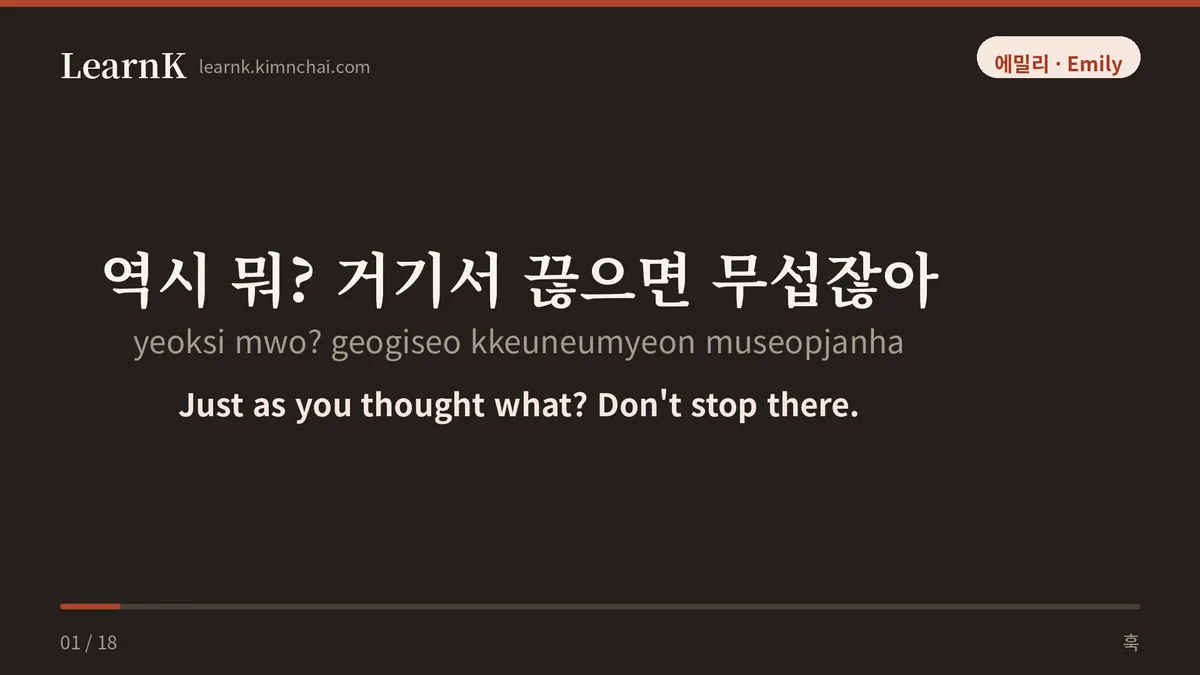
The National Institute of Korean Language’s Basic Korean Dictionary defines ‘역시’ with four meanings.
역시 「adverb」
- Just like something else. (also; as well)
- As one expected. (as one expected; as expected)
- Just as before. (as always)
- After all is said and done. (after all) — National Institute of Korean Language, Basic Korean Dictionary (krdict.korean.go.kr)
Let’s also look at the actual usage examples the dictionary provides.
역시 씨름은 체격보다 기술이 더 중요하다니까. — National Institute of Korean Language, Basic Korean Dictionary (krdict.korean.go.kr)
This is a situation where, after watching a ssireum (Korean wrestling) match, the speaker emphasizes the conviction that “역시, I was right all along.” It’s a textbook example of meaning ② (as expected).
여행도 좋았지만 역시나 집이 제일 편안하네요. — National Institute of Korean Language, Basic Korean Dictionary (krdict.korean.go.kr)
Here the form 역시나 (yeoksina) is used, with ‘-나’ attached to ‘역시’. It carries the nuance of reconfirming an unchanging truth — that even after a fun trip, home is the most comfortable place after all.
역시 문화에 대해 개방적인 곳이군요. — National Institute of Korean Language, Basic Korean Dictionary (krdict.korean.go.kr)
This is a scene where someone experiences a place firsthand and marvels, “So it really is just as I’d heard.”
국민들의 관심이 집중된 선거였던 만큼 개표소 분위기 역시 뜨겁습니다. — National Institute of Korean Language, Basic Korean Dictionary (krdict.korean.go.kr)
The ‘역시’ in this example corresponds to meaning ① (just like something else). It’s a connective usage meaning that the vote-counting station is heated “just like” the intense public interest mentioned earlier.
최근 큰 인기를 얻고 있는 배우들의 가세 역시 영화에 대한 관심을 가열하고 있다. — National Institute of Korean Language, Basic Korean Dictionary (krdict.korean.go.kr)
Similarly, this carries the meaning of ”~ as well; ~ too,” an objective statement that adds one more element to what came before.
On a side note, this dictionary provides definitions in English, Japanese, Spanish, and Chinese, but not Portuguese. For our Brazilian fans, let me add that for meaning ②, ‘역시’ is best rendered in Portuguese as roughly como esperado (as expected). (This Portuguese rendering is not in the dictionary; the author translated it directly.)
Example Sentences by Situation (written by the author)
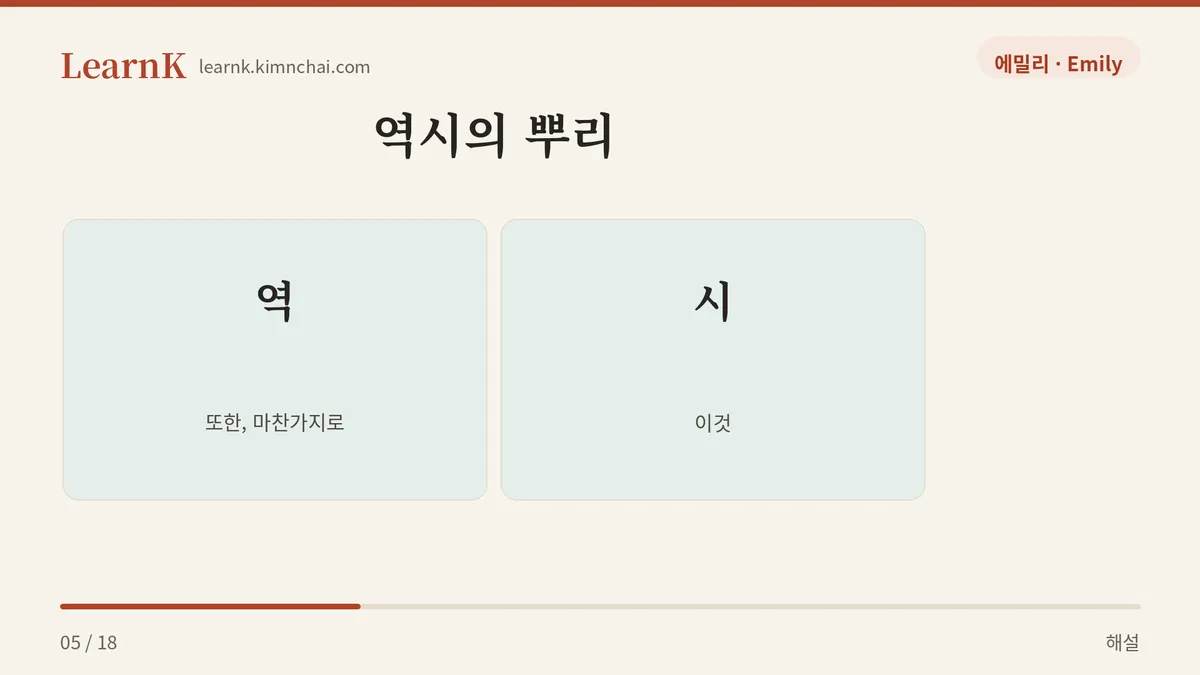
Situation 1 — Acknowledging someone’s skill A colleague nailed a difficult presentation flawlessly.
역시 김 대리님이네요. 믿고 있었어요. (yeoksi Kim daerinim-ineyo.)
This is admiration meaning “just as I thought, you’re great after all,” the most common way to use it to compliment someone.
Situation 2 — When a bad feeling turns out to be right While waiting for a friend who’s running late.
역시 또 늦네. 이럴 줄 알았어. (yeoksi tto neunne.)
Even though it’s the same ‘역시’, here it carries not delight but the resignation of “I knew this would happen.” The intonation dips down slightly.
Situation 3 — Back to square one after much deliberation After agonizing over the menu for a while.
이것저것 봐도 역시 김치찌개가 최고야. (yeoksi kimchijjigae-ga choegoya.)
This is meaning ④ (after all is said and done) — the feeling of circling through several options and ultimately coming back to the familiar conclusion.
Comparing Formal/Informal Speech and Similar Expressions
Since ‘역시’ is an adverb, it has nothing to do with honorifics on its own; the level of formality is set by the predicate that follows. Politely you’d say 역시 그렇군요 (yeoksi geureokunyo), and among friends 역시 그렇네 (yeoksi geureone).
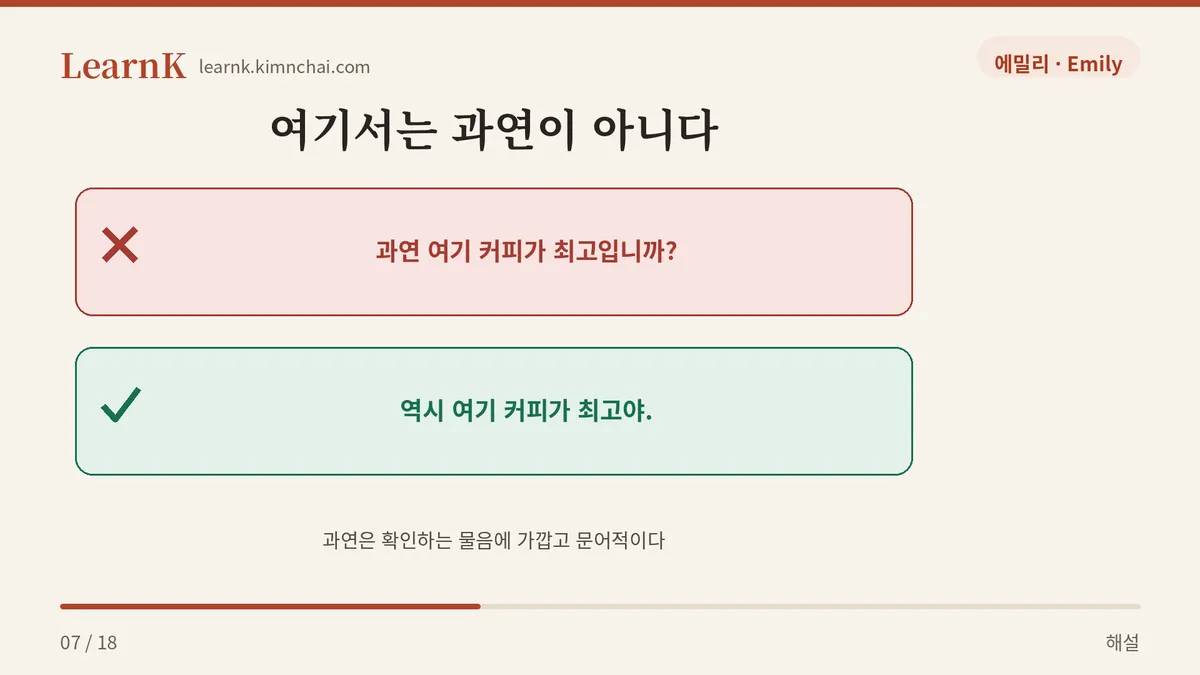
A similar word is 과연 (gwayeon). ‘과연’ puts more weight on the admiration of “truly, just as I’d heard,” and is somewhat literary. ‘역시’, on the other hand, is used far more freely in everyday conversation, and its range is wider — covering not just admiration but also resignation and connection. Also, in casual speech people sometimes playfully stretch it out as 역쉬, giving it the flavor of a shortened, jokey version of 역시나 (yeoksina) or 역시 (yeoksi).
Cultural Background — Between Admiration and Resignation
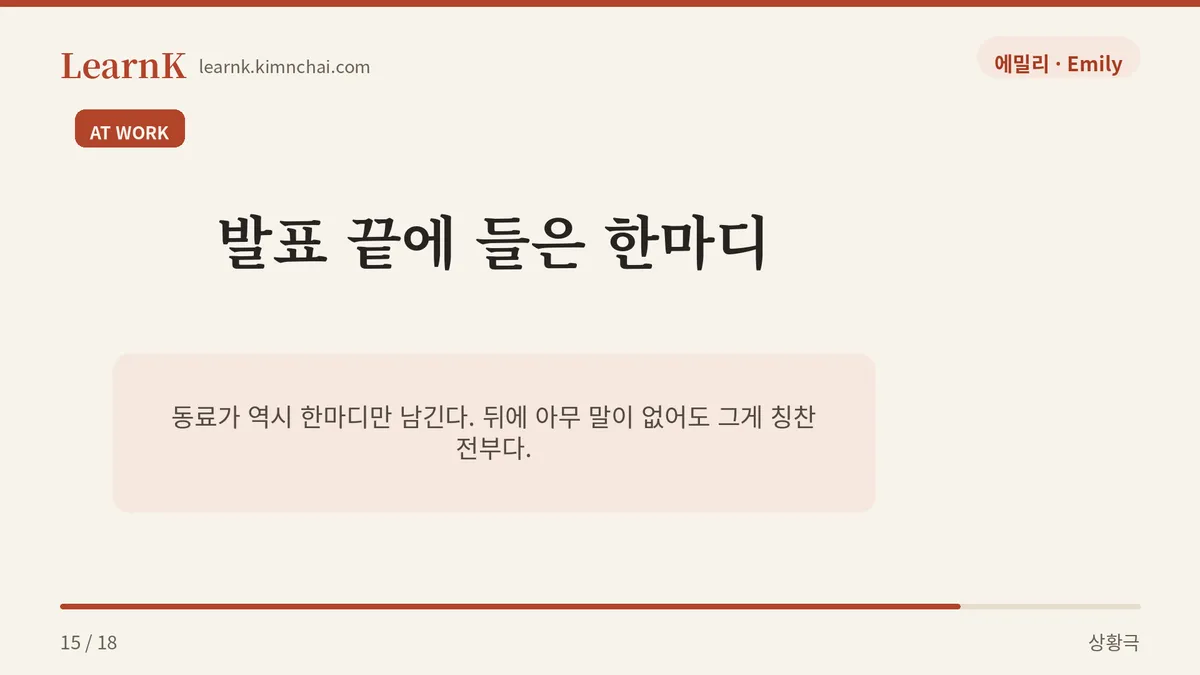
In Korean dramas, ‘역시’ often appears as a device that compresses a character’s inner thoughts into a single word. When a gifted protagonist solves a case, the people around them marvel, “역시…”, and conversely, when a detestable character causes trouble, the line “역시 저럴 줄 알았어” (“I knew they’d do something like that”) speaks for the viewers’ hearts. What’s fascinating is that both scenes start from the same shared emotion: “I was right.” In daily life too, Koreans say “역시” while eating food at a great restaurant, and “역시 너다” (“That’s so you”) when a friend they haven’t seen in a while is just as they’ve always been. In other words, ‘역시’ is a very Korean exclamation that captures the small satisfaction and relief we feel when the world turns out just as we expected.
Closing Quiz
A friend went to the trouble of hopping around several cafés, but in the end felt that the coffee at their usual neighborhood café was the tastiest. What would be the most natural sentence here?
ⓐ 역시 여기 커피가 최고야. ⓑ 과연 여기 커피가 최고입니까?
The answer is ⓐ. ‘역시’ is a perfect fit for the “after all is said and done (meaning ④)” feeling of circling through several options and returning to the familiar conclusion. The ‘과연’ in ⓑ carries more of a questioning, confirming tone than admiration, so it feels awkward in this situation.
Definitions and example sentences are from the National Institute of Korean Language’s Basic Korean Dictionary (krdict.korean.go.kr); that portion of this post, including our translations, is licensed under CC BY-SA 2.0 KR.