Learn Korean Greetings with One Phrase — "잘 지냈어?" and the Temperature Difference Between Casual and Polite Speech
잘 지냈어? / 잘 지내셨어요?
When you run into a friend you haven’t seen in ages, reconnect with someone after a few months, or gather with relatives during the holidays, the very first words exchanged are almost always 잘 지냈어? (jal jinaesseo?) and 잘 지내셨어요? (jal jinaesyeosseoyo?). These correspond to the English “How have you been?” — they’re like a key that opens the moment of reunion. If you watch Korean dramas, you’ll often see a scene where two people who had drifted apart meet again, and the whole atmosphere shifts with just this one line.
Meaning and Nuance
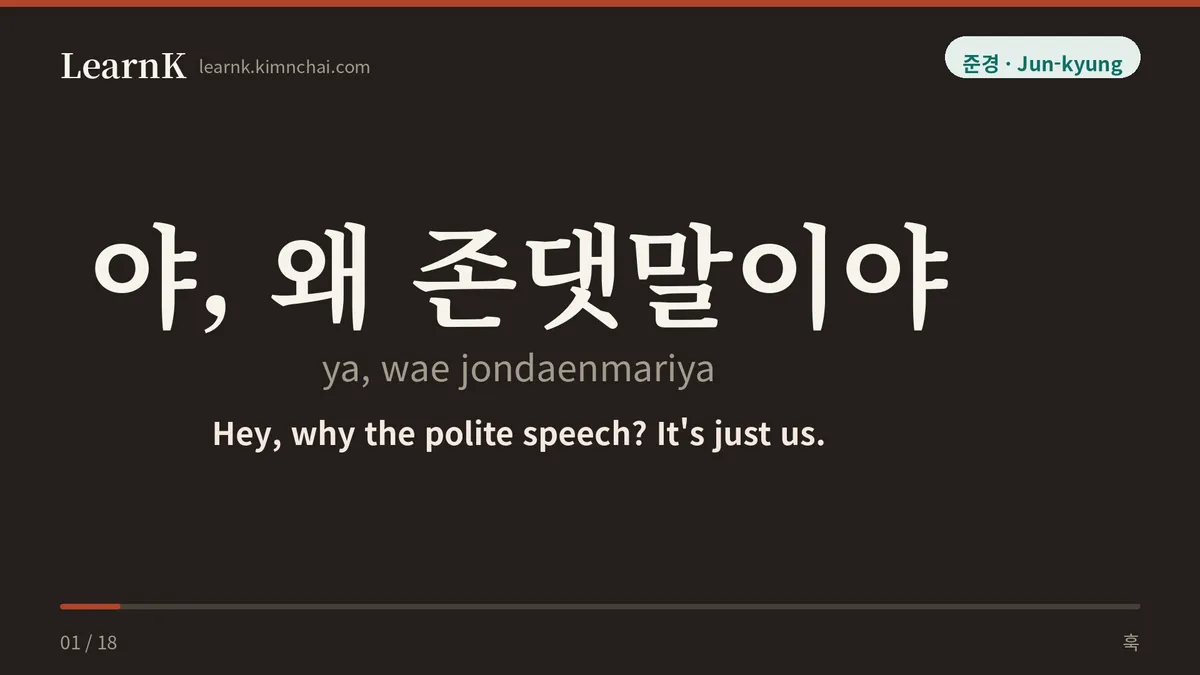
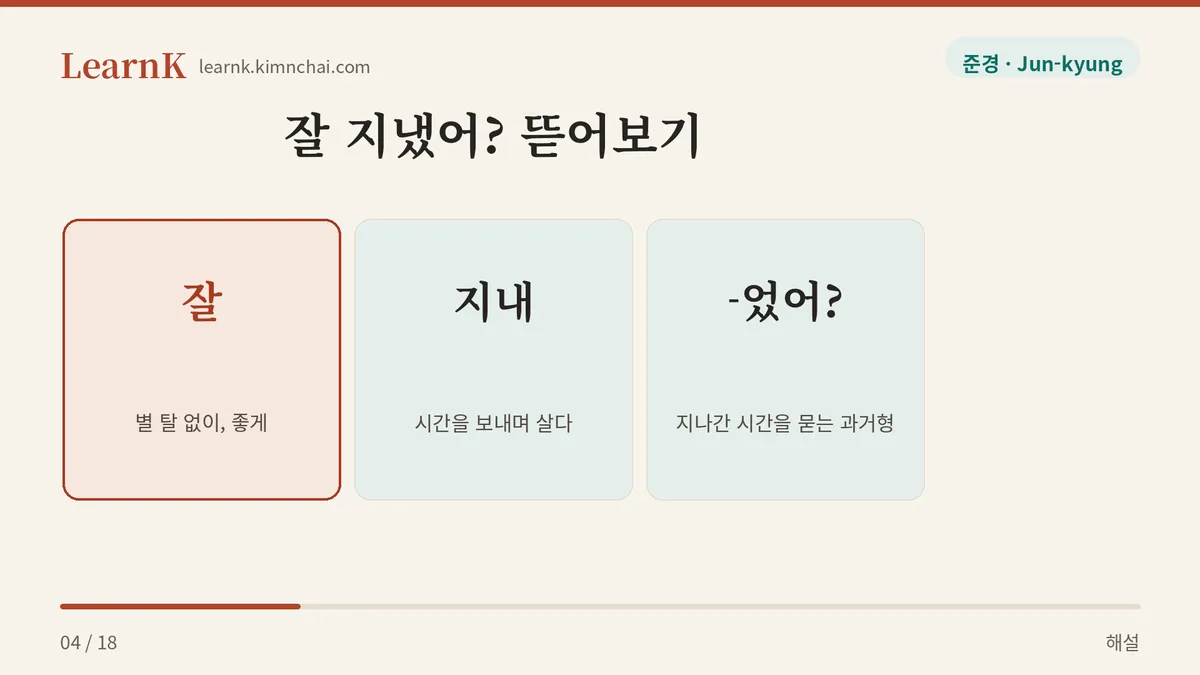
We can break this expression into two parts. 지내다 (jinaeda) is a verb meaning “to live while spending a period of time,” and the 잘 (jal) in front of it is an adverb meaning “well, without any trouble.” So a literal translation would be “Did you spend your time without any trouble?”, and in natural English it’s something like “Have you been doing okay all this time?”
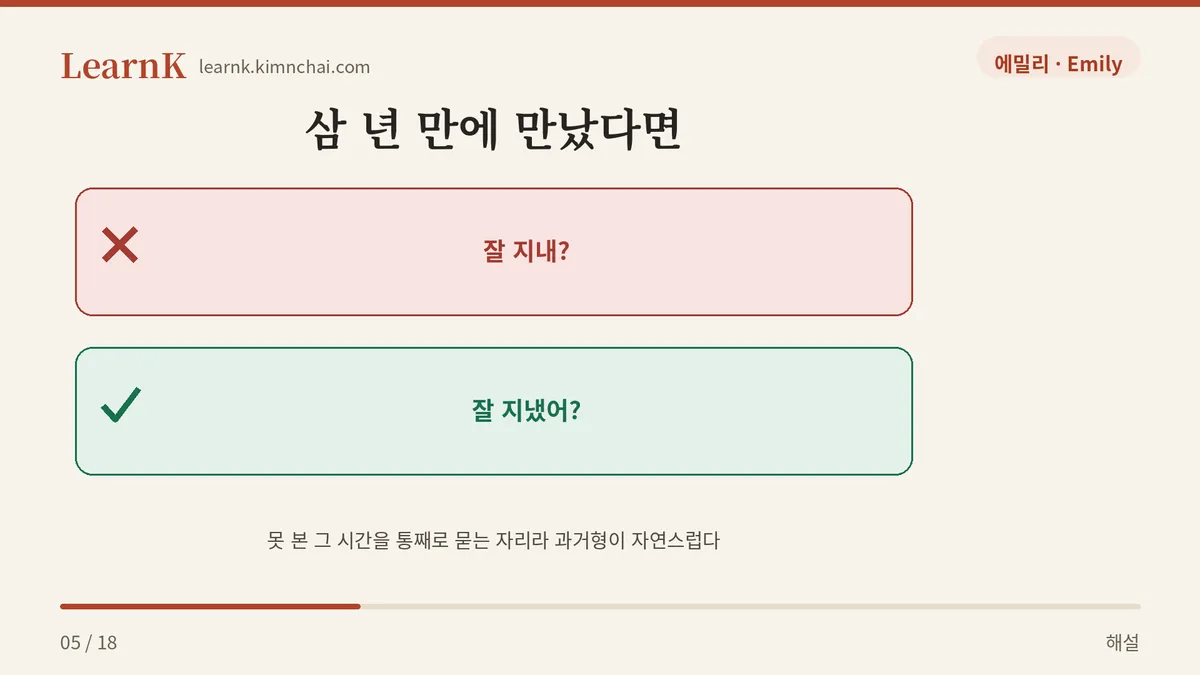
The key point is that it’s in the past tense. While 잘 지내? (jal jinae?) asks about how you’re doing right now — “How are you these days?” — 잘 지냈어? (jal jinaesseo?) specifically points to “all that time we didn’t see each other.” That’s why this phrase carries a subtle sense of longing and warm concern for the other person.
Example Sentences by Situation
Situation 1 — To a college classmate you’re meeting after a year (casual speech)
Hey, it’s been forever! 잘 지냈어? (jal jinaesseo?) You haven’t changed a bit.
Between close friends, the casual 잘 지냈어? feels natural. Tacking on a light compliment afterward doubles the warmth of the reunion.
Situation 2 — To a former teacher you’re seeing after a long time (polite speech)
Professor, have you 잘 지내셨어요? (jal jinaesyeosseoyo?) all this time? I’m sorry I haven’t kept in touch more often.
With someone senior to you, you use 잘 지내셨어요?, which includes the honorific pre-final ending -시- (-si-). Raising up the other person while adding an apology that lowers yourself makes it all the more courteous.
Situation 3 — On a call with a client contact after a while (formal speech)
Team leader, it’s been a while. Have you 잘 지내셨습니까? (jal jinaesyeotseumnikka?) in the meantime?
In business or official settings, you use the more formal ending -습니까 (-seumnikka) to emphasize politeness.
Comparing Casual, Polite, and Similar Expressions
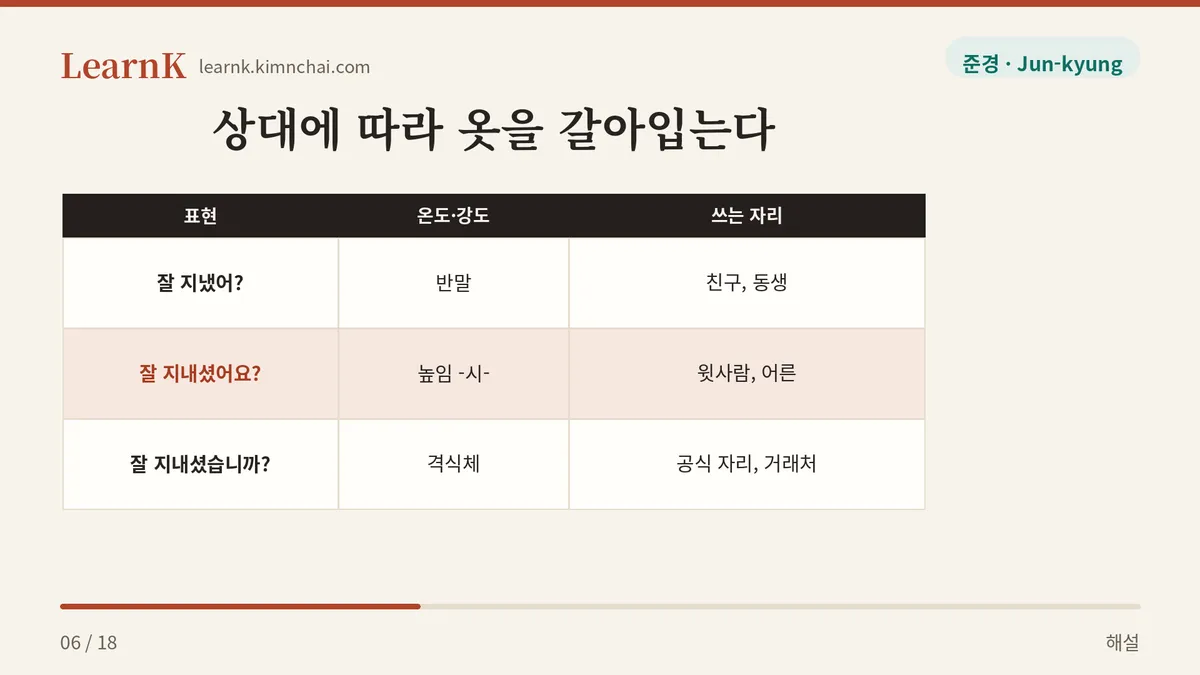
Even the same greeting changes its clothes depending on your relationship with the other person.
- 잘 지냈어? (jal jinaesseo?) — Casual speech. For friends, younger siblings, and very close relationships.
- 잘 지냈어요? (jal jinaesseoyo?) — General polite speech. For acquaintances not much different in age, or peers you want to show respect to.
- 잘 지내셨어요? (jal jinaesyeosseoyo?) — Includes the honorific -시- (-si-) that raises up the other person. For seniors, elders, and relationships that call for formality.
- 잘 지내셨습니까? (jal jinaesyeotseumnikka?) — The most formal form. For official occasions and business.
A similar greeting is 어떻게 지냈어? (eotteoke jinaesseo?), but this one carries the nuance of expecting a more detailed story about how — in what way — you’ve been. And 별일 없었어? (byeoril eopseosseo?) means “Nothing bad happened, right?”, asking with a note of worry, so it has a slightly different feel.
Cultural Background — The Language of Reunion
In Korean dramas, this expression is often used as an emotional trigger. Picture the scene where former lovers cross paths by chance, and one asks in a trembling voice, “잘 지냈어?” It’s just a short line, but hidden inside it is the unspoken feeling of “I thought about you the whole time you were gone.” That’s why actors put especially careful effort into their gaze and breathing when delivering this line.
It’s the same in everyday life. In Korea, rather than getting straight to business with someone you’re meeting after a long time, people first check the warmth of the relationship with a single 잘 지냈어? If you can offer this greeting naturally, you’ve already stepped right into the heart of Korea’s culture of jeong (정) — deep, heartfelt affection.
Closing Quiz
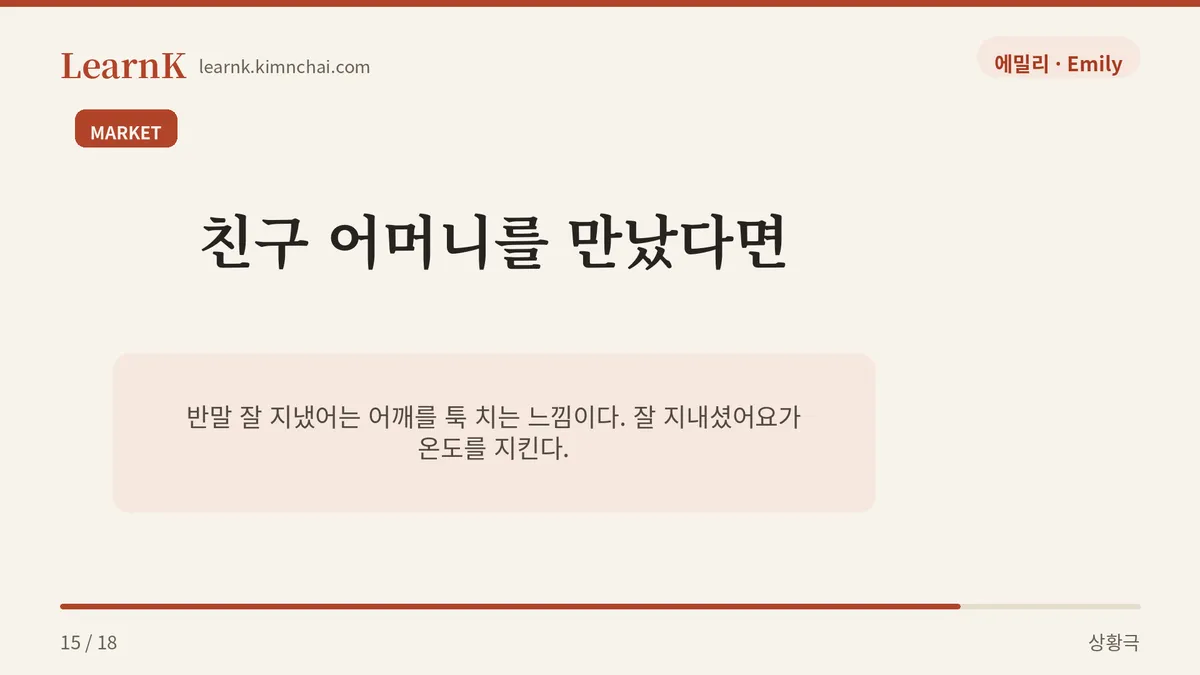
You want to ask after the well-being of your company’s department head, whom you’re meeting after a long time. Which of the following is the most appropriate expression?
- 잘 지냈어? (jal jinaesseo?)
- 잘 지내셨어요? (jal jinaesyeosseoyo?)
- 잘 지내? (jal jinae?)
The answer is number 2, 잘 지내셨어요? With someone senior to you, you have to use the form that includes the honorific -시- (-si-), and since you’re asking about the time you haven’t seen each other, the past tense is correct. Numbers 1 and 3 are casual speech suited only to friends, so they’d be rude to use with your department head.
The 잘 지냈어? / 잘 지내셨어요? you learned today — be sure to be the first to offer it the next time you meet a Korean friend after a long while!