앉으세요 (anjeuseyo) — The Warmest Bit of Polite Speech You Can Offer a Guest
If you watch enough Korean dramas, there’s one phrase that almost never fails to appear in a scene where a guest arrives at someone’s home. It’s 앉으세요 (anjeuseyo). Opening the front door to welcome a guest, then extending a hand toward the sofa or a floor cushion, this is the phrase you offer — an invitation and a signal of hospitality that says, ‘Please, sit comfortably here.’ For anyone learning Korean, it’s one of the very first pieces of polite speech you memorize, and at the same time it’s an expression that packs in Korean jeong (情, warm affection) and courtesy. Today, let’s really dig into this short but warm little phrase.
앉으세요
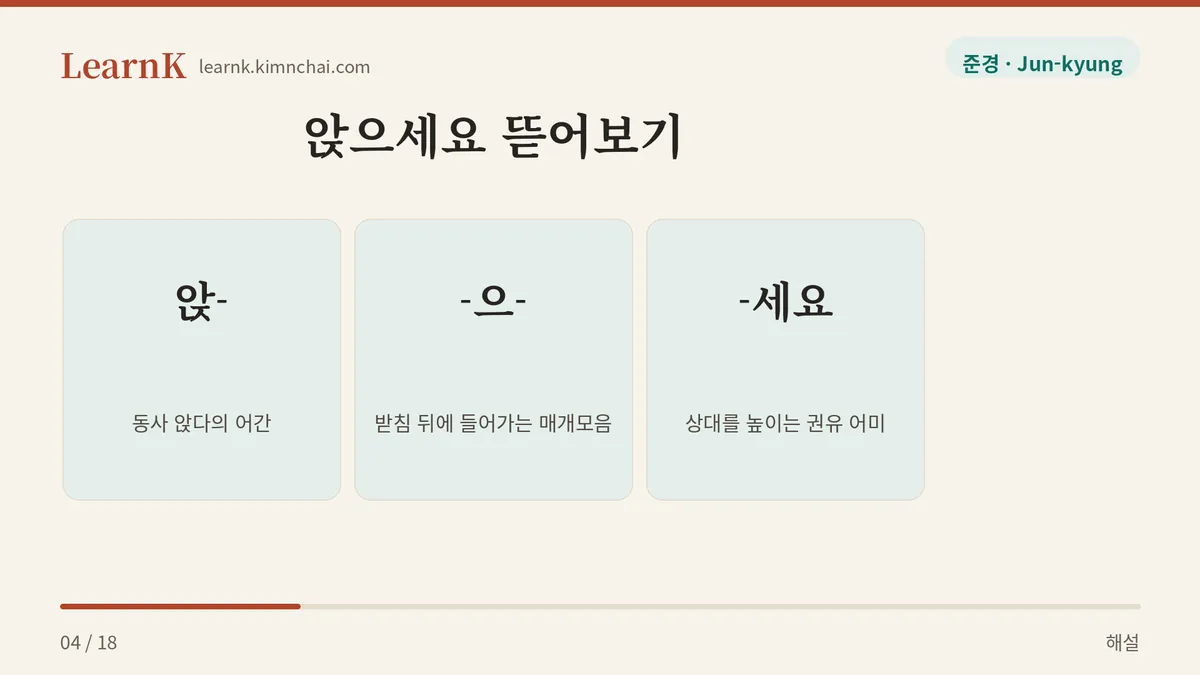
앉으세요 (anjeuseyo) is formed from the verb 앉다 (anda, to lower one’s body onto a seat) with the honorific ending -(으)세요 attached to elevate the listener. In English it lands close to ‘Please sit down / Please have a seat,’ but it isn’t a simple command — it carries the nuance of a gentle invitation.
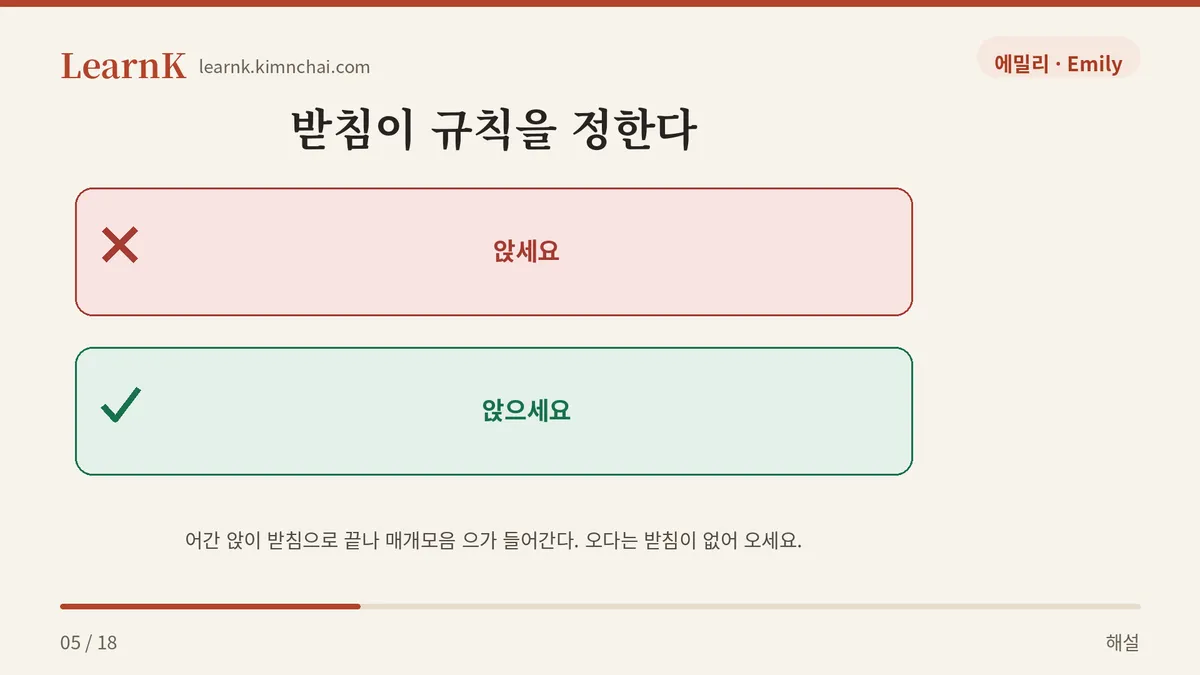
Shall we pick apart the grammar a little? The stem of the verb ‘앉다,’ which is ‘앉-,’ ends in a final consonant (batchim), so the linking vowel ‘으’ is inserted, giving us 앉으세요. Verbs without a final consonant, on the other hand, take the ending directly without ‘으’ — 오다 → 오세요 (oseyo), 하다 → 하세요 (haseyo). That’s why the correct form is not ‘앉세요’ but ‘앉으세요.’ This is a spot where many learners get confused, so be sure to keep it in mind.
‘앉으세요’ wears two faces depending on the situation. One is the ‘hospitality’ of welcoming a guest — the feeling of ‘please make yourself comfortable.’ The other is the gentle guidance you hear at a hospital, a photo studio, or an interview room: ‘All right, you can have a seat now.’ The form is identical in both cases, but the charm of this expression is that, depending on tone and facial expression, it comes across warmly, without a trace of stiffness.
Seeing It in a Real Conversation
Situation: Emily’s place. In thirty minutes, her boyfriend’s parents are coming over to meet her for the first time. Emily’s Korean is fluent, but she’s anxious about ‘etiquette in front of elders,’ so she hurriedly calls Jun-kyung for help.
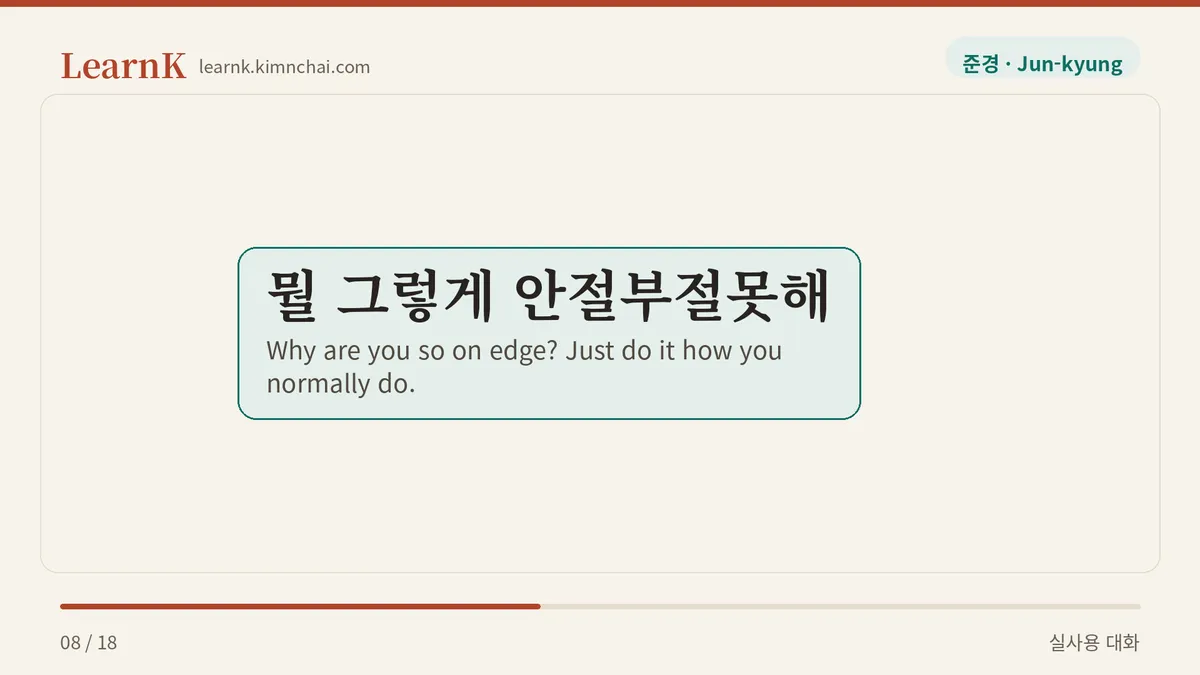
준경: 야, 뭘 그렇게 안절부절못해. 평소 하던 대로만 하면 돼. Hey, why are you so on edge? Just do it the way you normally do.
에밀리: 평소가 안 되니까 그러지. 문 열자마자 뭐부터 해야 돼? Because ‘normally’ isn’t working right now. What do I do the second I open the door?
준경: 어른들 들어오시면 소파로 모시고 가서 앉으세요 하고 자리부터 권해. 그럼 반은 먹고 들어가. When they come in, guide them to the sofa and say ‘please have a seat’ first — that’s already half the battle.
에밀리: 그냥 ‘앉아’라고 하면 안 되고? I can’t just say ‘sit’?
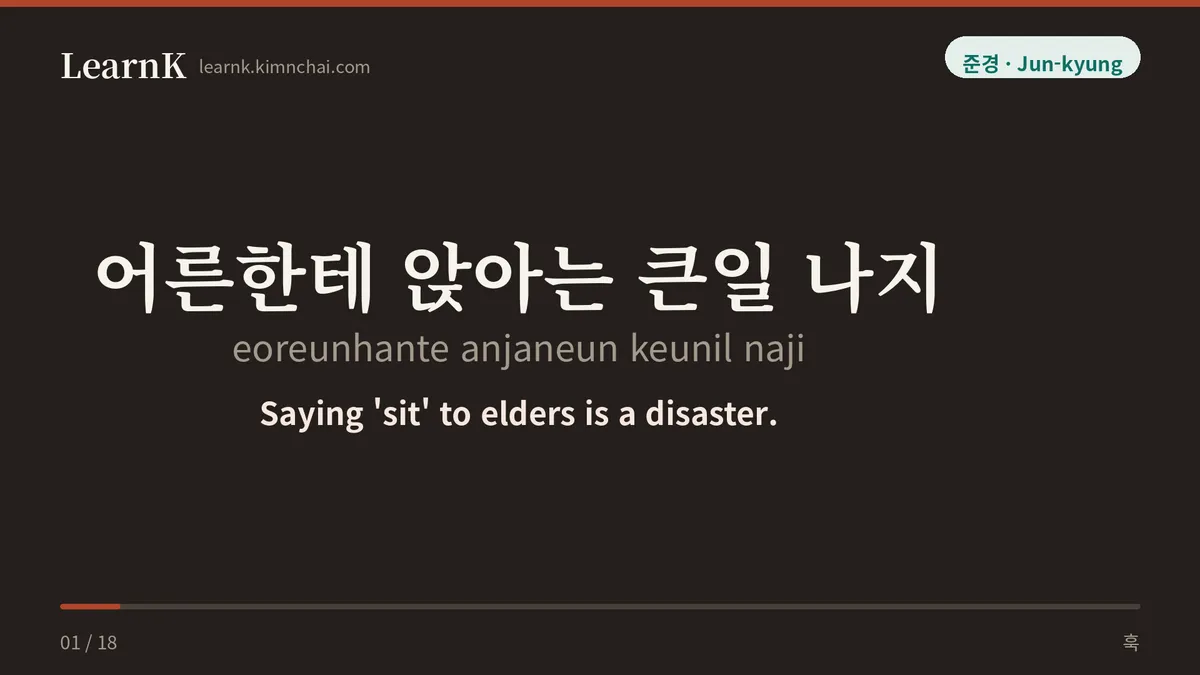
준경: 야, 어른한테 ‘앉아’는 큰일 나지. 꼭 앉으세요라고 높여서, 손으로 자리 가리키면서. Whoa, saying ‘sit’ to elders is a disaster. You’ve gotta raise it to ‘please have a seat,’ pointing at the seat with your hand.
에밀리: 아… 어머니, 아버지, 여기 앉으세요. 이렇게? Ah… Mother, Father, please sit here. Like this?
준경: 오, 눈빛까지 완벽해. 그럼 무조건 통과야. Oh, even your expression is perfect — you’ll pass for sure.
Example Uses by Situation
1. At a hair salon — The stylist points to the chair in front of the mirror: 이쪽으로 앉으세요 (ijjogeuro anjeuseyo). This is the most basic, polite way to welcome a customer in a service setting. Adding ‘이쪽으로’ means you’re pointing out the exact seat as well.
2. Walking into a restaurant — A staff member gestures toward the open seats: 편한 자리에 앉으세요 (pyeonhan jarie anjeuseyo). It’s a considerate way of saying, ‘Feel free to sit wherever you like.’
3. To an elder on the subway — Giving up your seat: 여기 앉으세요 (yeogi anjeuseyo). It’s short, but that single ‘-세요’ that elevates the listener completes a warm gesture of consideration. In fact, this is the very phrase that tends to make elders happiest when a foreign learner offers it.
Comparing Polite and Casual Speech
Even the same verb ‘앉다’ changes its clothes depending on who you’re addressing.
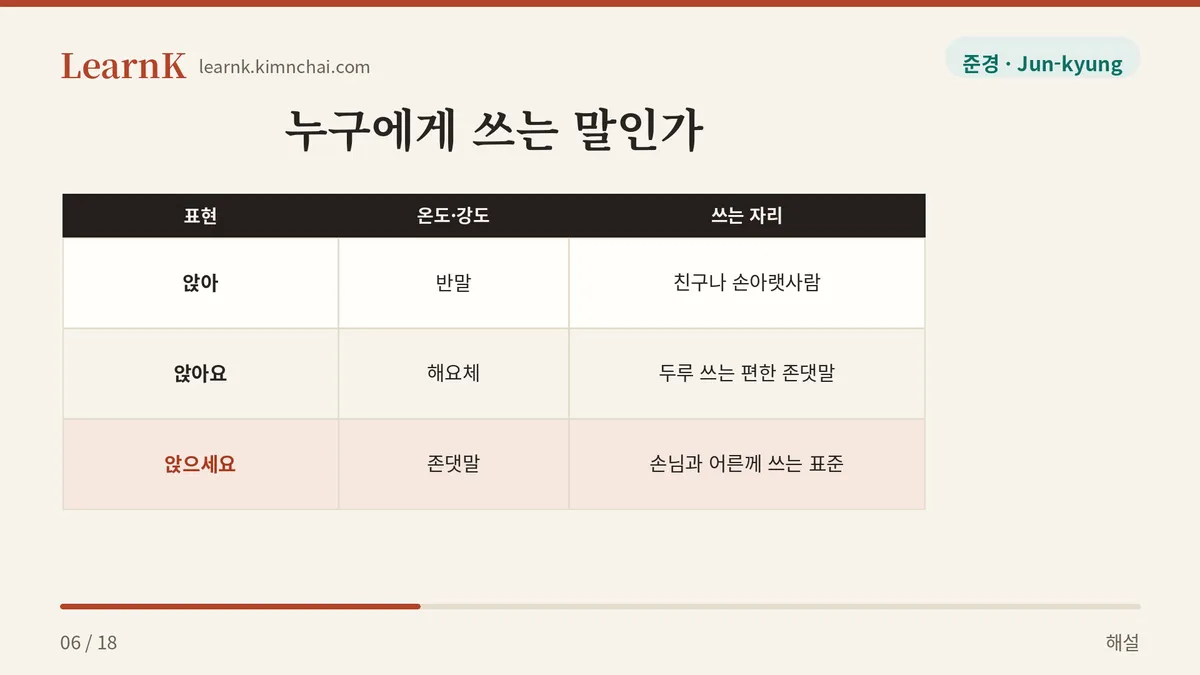
- 앉아 (anja) — Casual speech (banmal). For friends or those younger than you. ‘야, 여기 앉아.’
- 앉아요 (anjayo) — The haeyo style. An easygoing, all-purpose polite form.
- 앉으세요 (anjeuseyo) — Polite speech containing the honorific pre-final ending ‘-시-.’ The standard form used for guests and elders.
- 앉으십시오 (anjeusipsio) — The hasipsio style. Used in announcements or formal settings (‘승객 여러분, 자리에 앉으십시오’ — ‘Passengers, please take your seats’).
- Among similar expressions, 앉으시죠 (anjeusijyo) is for offering a seat a touch more gently, while 착석해 주세요 (chakseokhae juseyo) is used in official settings like meetings or events.
Cultural Background
In Korea, ‘offering someone a seat’ isn’t just guidance — it’s the first button of hospitality. For a junior to sit down first while an elder is still standing, or to use the casual ‘앉아’ with an elder, is considered a serious breach of manners. That’s why, at gatherings where elders are hosted — housewarmings, holidays, the sanggyeonrye (the formal first meeting of both families before a wedding) — 앉으세요 shows up almost as a matter of obligation. Especially at the sanggyeonrye, where the parents of both families meet for the first time, even the question of who offers a seat first and who sits first is fussed over — the ‘order of sitting’ is treated as part of etiquette. The basic rule is that a junior sits only after the elder has sat down first, so the invitation ‘앉으세요’ becomes the language of consideration that says, ‘Allow me to seat you first.’ In dramas too, a scene where the in-laws come to greet the family for the first time regularly features the host laying out a floor cushion and offering a seat — and in that short little phrase is the feeling of ‘I am hosting you with great honor.‘
Closing Quiz
You want to give up your seat to an elderly woman standing on the subway. Which expression is appropriate?
① 앉아 ② 앉으세요 ③ 앉는다
The answer is ② 앉으세요. With an elder you must always add ‘-세요’ to elevate them, and ③ ‘앉는다’ is a plain declarative sentence, so it doesn’t work as an invitation. The 앉으세요 (anjeuseyo) you learned today — next time you’re invited to a Korean friend’s home, you’ll get to hear this warm little phrase offered your way the moment the door opens. 😊