극혐 (geukyeom): 'Extremely Disgusting' in a Single Word — Mastering Korean Internet Slang
Spend even a little time in online communities, YouTube comments, or a KakaoTalk chat with friends, and there’s one expression you’ll run into almost immediately. It’s 극혐 (geukyeom). You’ll see it in a comment under a food photo — “이건 진짜 극혐” (“this is seriously disgusting”) — and it pops up in big letters on variety-show subtitles too. You’ll never find it in a textbook, but it’s one of the slang words that most honestly reveals how Koreans feel these days. Today, let’s take a deep dive into this short but powerful little word.
극혐
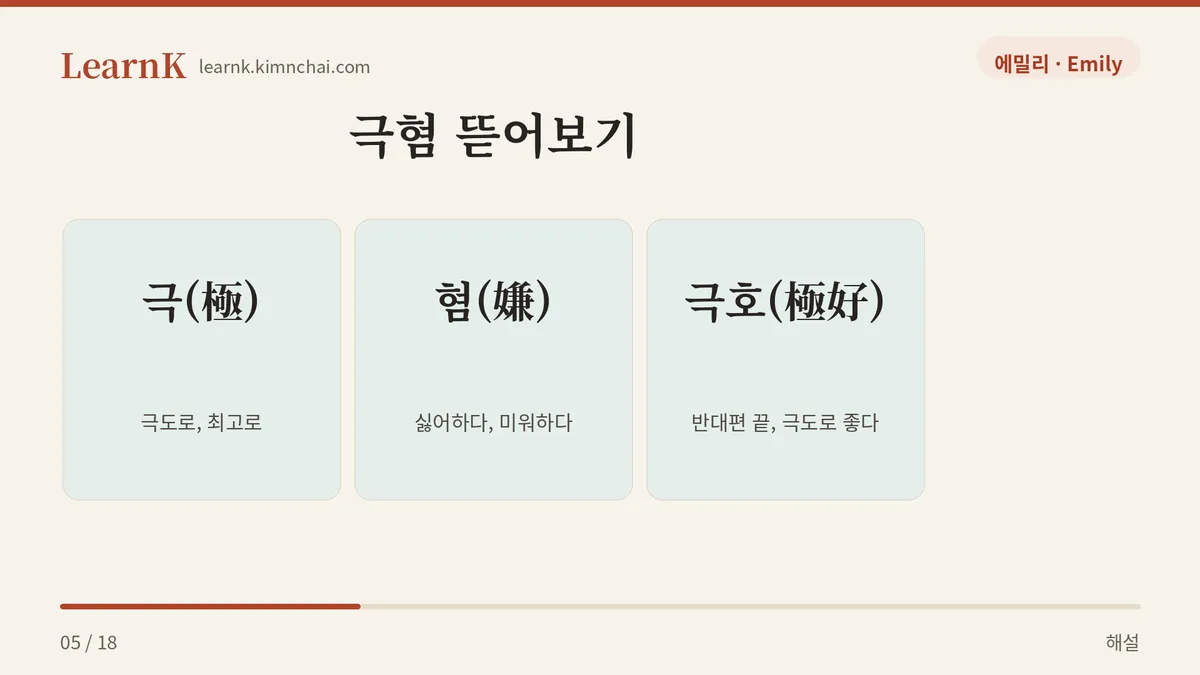
극혐 (geukyeom) is a coined word that shortens 극도로 혐오스럽다 (geukdoro hyeomoseureopda) — meaning “utterly hateful and revolting” — into just two syllables. ‘극(極)’ is a Chinese character meaning “extremely / to the highest degree,” and ‘혐(嫌)’ is a Chinese character meaning “to dislike / to detest.” Stick the two together and you get an expression of the strongest possible revulsion — “it couldn’t get any more repulsive than this.”
A companion word made the same way is 극호 (geukho), which means “to like something extremely.” So on the emotional spectrum, 극혐 sits at the most negative end, and 극호 sits at the most positive end.
Meaning and Nuance
The heart of 극혐 (geukyeom) is its intensity. It’s not simply “I don’t like it” — it’s closer to “just looking at it gives me the chills and makes me unbearably sick.” Because of that, it tends to be used less for genuinely serious matters and more for things that trigger an instinctive gut revulsion — bugs, spoiled food, a stomach-turning scene. At the same time, these days it’s often used as an exaggerated joke. If a friend cracks a dad joke and you laugh and say “극혐 ㅋㅋㅋ,” it’s not real disgust — it’s a light reaction more like “ugh, so cringey.”
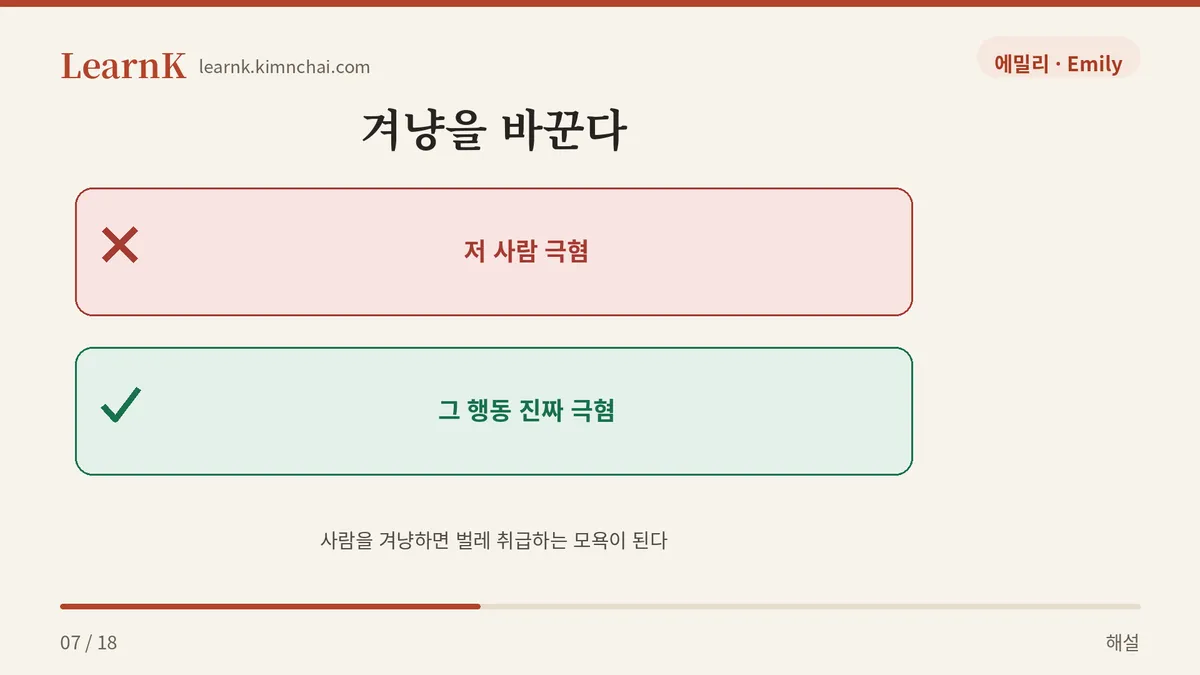
That said, because it’s such a strong word, aiming it directly at a person becomes a serious insult. Saying “저 사람 극혐” (“that person is disgusting”) is on the level of treating someone like a bug, so in practice it’s safest to use it for objects, situations, or actions.
Example Sentences by Situation
Situation 1 — When you see stomach-turning food
민트초코 파인애플 피자라니… 이건 극혐이다. (Mint choco pineapple pizza-rani… ige geukyeomida.) Mint-choco pineapple pizza?! This is straight-up disgusting.
This is a scene where you look at a food that splits opinion to the extreme and strongly express the revulsion of “there’s no way I could eat that.”
Situation 2 — When reacting lightly to a friend’s teasing
야, 그 개그 진짜 극혐이야 ㅋㅋㅋ 다시는 하지 마. (Ya, geu gaegeu jinjja geukyeomiya kkk dasineun haji ma.) Dude, that joke is seriously the worst ㅋㅋㅋ never do that again.
Here it doesn’t mean you genuinely hate it — it’s an affectionate jab you toss out while laughing at a cringey joke. Add some laughter (ㅋㅋㅋ) and the intensity drops way down.
Situation 3 — When criticizing bad manners
지하철에서 큰 소리로 영상 트는 거 진짜 극혐. (Jihacheoreseo keun sorillo yeongsang teuneun geo jinjja geukyeom.) Playing videos out loud on the subway is honestly disgusting.
This is a case of targeting an action rather than a specific person to express strong displeasure. It’s a classic usage that gets a lot of agreement online.
Polite vs. Casual Speech, and a Comparison of Similar Expressions
Since 극혐 was born as internet slang, it’s basically used in casual, informal settings. It’s best not to use it in formal situations or in front of someone senior to you. If you need to speak politely, you should switch to standard phrasing like 정말 싫습니다 (jeongmal sireumnida) (“I really dislike it”) or 너무 불쾌합니다 (neomu bulkwaehamnida) (“I find it very unpleasant”).
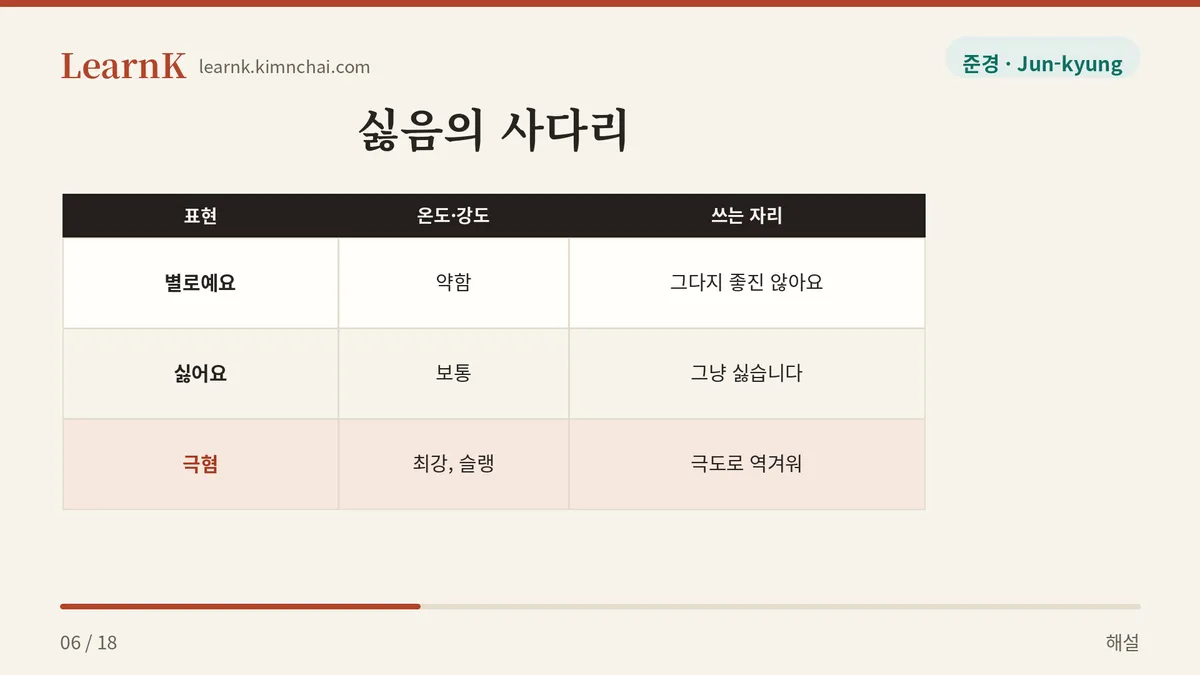
Here are some similar expressions arranged by intensity:
- 별로예요 (byeollo-yeyo) — “It’s not really that great” (weak)
- 싫어요 (sireoyo) — “I don’t like it” (moderate)
- 혐오스러워요 (hyeomoseureowoyo) — “It’s revolting” (strong, standard Korean)
- 극혐 (geukyeom) — “It’s extremely revolting” (strongest, slang)
As for opposites, if you learn the previously mentioned 극호 (geukho) along with 역대급 (yeokdaegeup) — meaning “absolutely the best ever” — you’ll broaden your range of emotional expression.
Cultural Background — The Internet Generation That Loves Abbreviations
극혐 spread through online communities in the early-to-mid 2010s and has now made its way even onto broadcast subtitles — a prime example of so-called “abbreviation culture.” Korean has always been good at compressing Sino-Korean words into two syllables (for example, 강추 = 강력 추천, “강추” meaning “strong recommendation”), and when you add the sensibility of an internet generation that loves to type fast, coined words like 극혐 have exploded in number.
Picture a young character in a drama finding spoiled side dishes in the fridge, pinching their nose, and spitting out “극혐…”. Without a single extra line of dialogue, that facial expression plus those two syllables convey the emotion perfectly. That’s just how short yet high-powered 극혐 is. But as a foreign learner, if you’re going to use this word, be sure to remember: use it for situations and objects rather than people, and only among close friends.
Closing Quiz
You take a bite of the pineapple fried rice your friend made, and with a grin you want to tease them playfully by saying “이거 완전 ○○ㅋㅋㅋ.” What’s the two-syllable slang for “extremely revolting” that goes in the blank?
(Answer: 극혐 (geukyeom) — with the laughter ㅋㅋㅋ attached, it’s being used as a light joke rather than genuine disgust.)