편의점 (pyeonuijeom): The Second Refrigerator That Keeps Koreans' Lights On 24 Hours a Day
편의점
When you travel around Korea, you’ll come across shops with blue light spilling out of them even at three in the morning. They’re on every alley, at every subway station exit, and even at the top of tourist spots. That place is exactly the 편의점 (pyeonuijeom). When you’re hungry, when you need an umbrella, when your phone urgently needs charging—it’s the first place Koreans think of. Today, let’s dig deep into this word that every traveler absolutely needs to know.
Meaning and Nuance
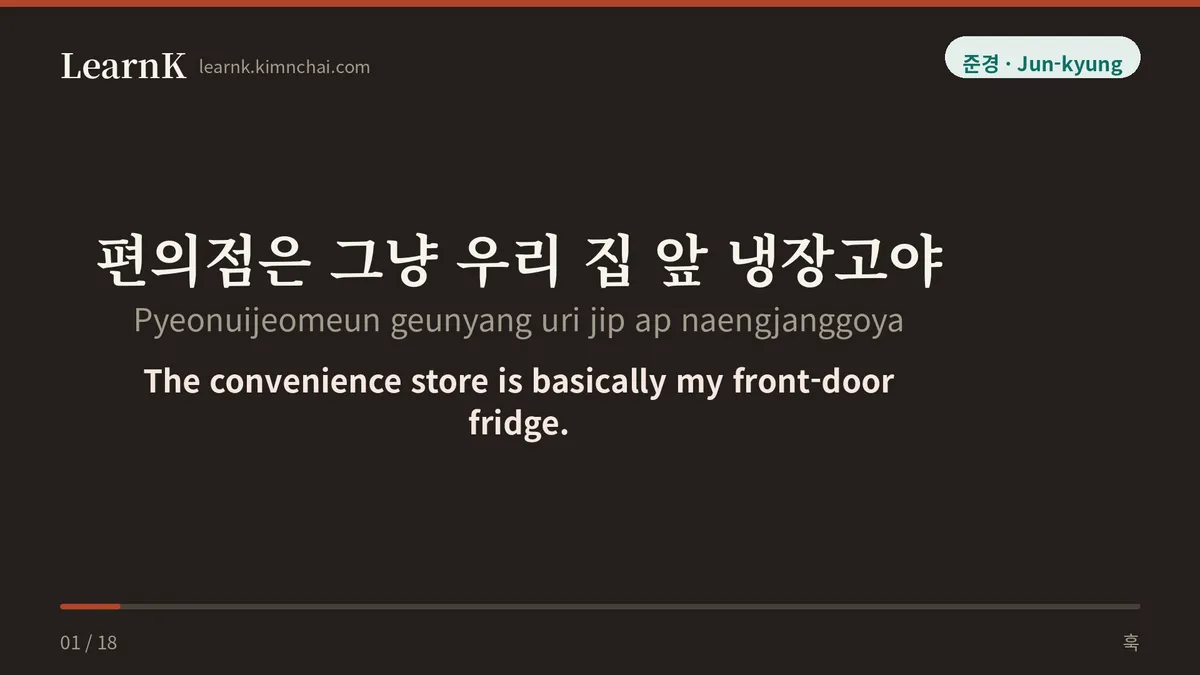
편의점 (pyeonuijeom) is written with the Chinese characters ‘편할 편(便)’ (convenient), ‘편할 의(宜)’ (suitable), and ‘가게 점(店)’ (shop). Literally, it means ‘a shop that sells convenience.’ It corresponds exactly to the English “convenience store,” but a Korean 편의점 is not just a place to buy things. It’s a hub of daily life where you can pour hot water into a cup of instant noodles on the spot, heat up a triangle rice ball (samgak-gimbap), send off a parcel, and even pay your utility bills. That’s why Koreans half-jokingly call the 편의점 the ‘refrigerator right outside my front door.‘
Checking with the National Institute of Korean Language’s Dictionary
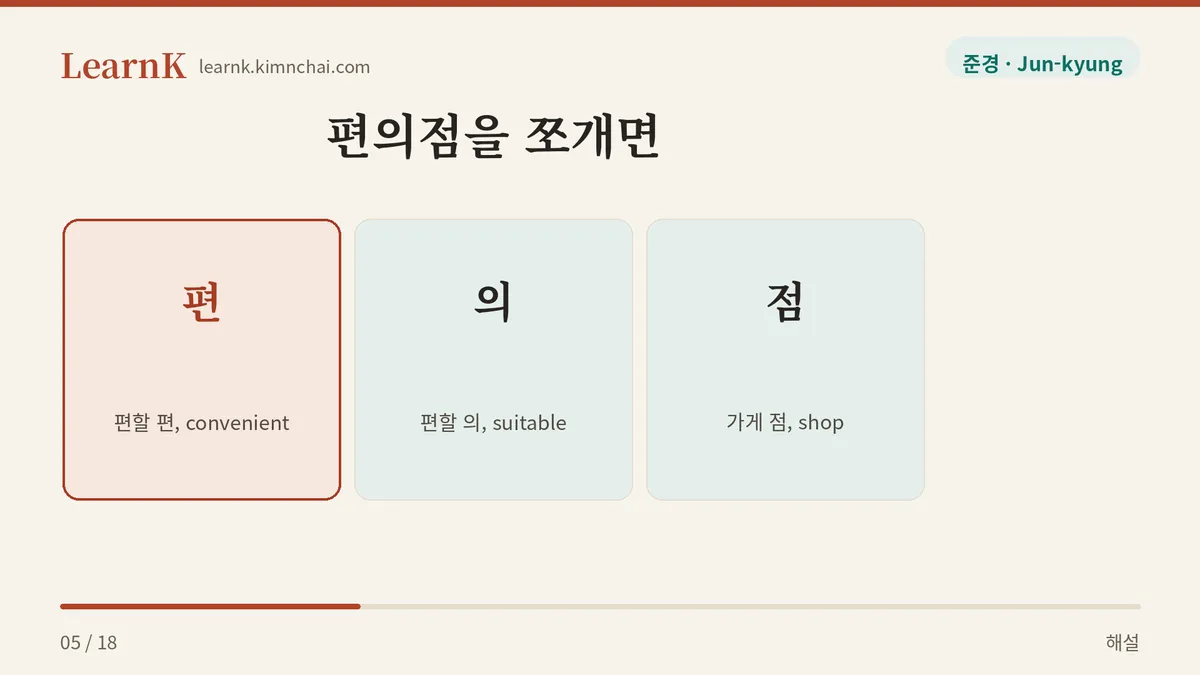
The Basic Korean Dictionary, published by the National Institute of Korean Language (a government body), defines the word like this.
편의점 (noun): A store that is open for long hours or all day and sells simple daily necessities, groceries, instant food, etc. [en] convenience store — A store that is open for long hours or all day and sells simple daily necessities, groceries, instant food, etc. [ja] コンビニエンスストア。コンビニ [es] tienda de conveniencia [zh] 便利店,超市 — National Institute of Korean Language, Basic Korean Dictionary (krdict.korean.go.kr)
As a side note, the Portuguese translation isn’t included in the dictionary, so the definition below is one we translated ourselves: loja de conveniência — loja aberta por longas horas que vende produtos básicos e comida instantânea.
Let’s also look at the actual usage examples listed in the dictionary.
갑자기 단것이 먹고 싶어서 집에 가는 길에 편의점에 들러 초콜릿과 과자를 잔뜩 샀다. (I suddenly wanted something sweet, so on my way home I stopped by the convenience store and bought a whole bunch of chocolate and snacks.) — National Institute of Korean Language, Basic Korean Dictionary (krdict.korean.go.kr)
Impulsively buying snacks on the way home from work or school—it’s a situation everyone has experienced. ‘들르다 (deulleuda)’ means ‘to drop by for a moment,’ and it’s a go-to verb that pairs naturally with the 편의점.
지수는 차를 도로변에 잠깐 세우고는 편의점에 들렀다. (Jisu pulled the car over to the side of the road for a moment and stopped by a convenience store.) — National Institute of Korean Language, Basic Korean Dictionary (krdict.korean.go.kr)
This is a scene of pulling the car over briefly while driving to buy a drink or a snack. It shows that 편의점 are everywhere along the roadside.
우리 집 앞에 있는 편의점에서는 낱개 포장된 닭다리를 판다. (The convenience store in front of my house sells individually wrapped chicken drumsticks.) — National Institute of Korean Language, Basic Korean Dictionary (krdict.korean.go.kr)
This nicely reveals a distinctive feature of the 편의점—it even sells simple ready-to-eat food.
주말마다 편의점에서 아르바이트를 하려면 힘들겠어요. (Working a part-time job at a convenience store every weekend must be tough.) — National Institute of Korean Language, Basic Korean Dictionary (krdict.korean.go.kr)
The 편의점 is also a classic place for young Koreans to work a part-time job (areubaiteu, part-time work).
Example Sentences by Situation
Let’s get a feel for real-life use with some sentences we made ourselves.
① Asking for directions
저기요, 이 근처에 편의점 있어요? (Jeogiyo, i geuncheoe pyeonuijeom isseoyo?) 저기, 이 근처에 편의점 있나요?
This means “Excuse me, is there a convenience store around here?”—one of the most useful sentences you’ll use while traveling.
② Buying something
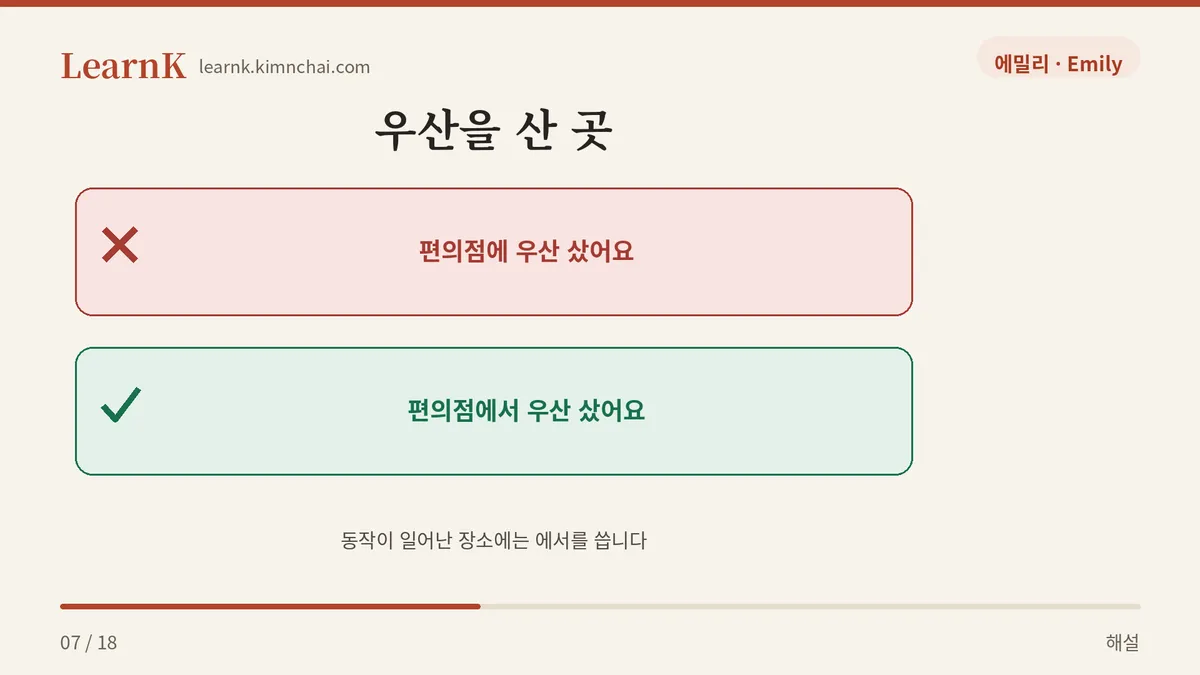
편의점에서 우산 하나 샀어요. (Pyeonuijeomeseo usan hana sasseoyo.)
This is the situation of buying a plastic umbrella at the convenience store when it suddenly rains. The particle ‘-에서 (-eseo)’ indicates ‘~at (a location).’
③ Deciding on a place to meet
편의점 앞에서 만나요. (Pyeonuijeom apeseo mannayo.)
In Korea, people often pick the front of a convenience store as a meeting spot. It’s easy to spot and it’s everywhere.
Polite and Casual Speech, and Similar Expressions
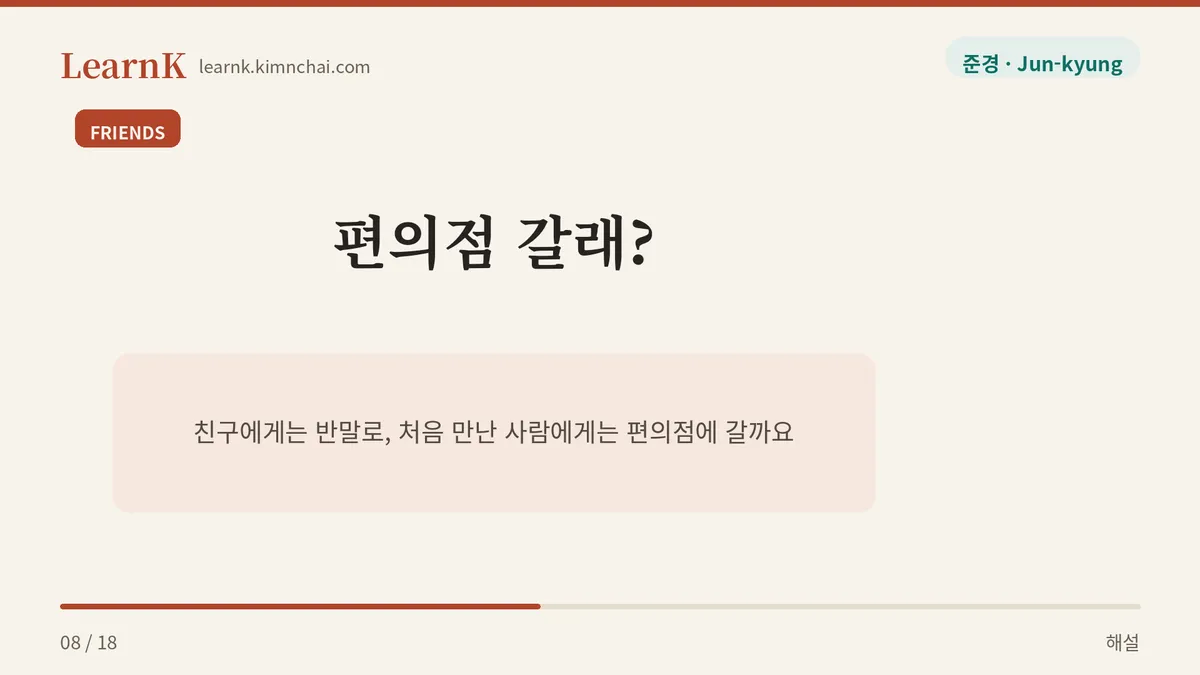
‘편의점’ itself is a noun, so it has nothing to do with honorifics, but the sentences you use it in change depending on who you’re talking to.
- Polite speech: 편의점에 갈까요? (Pyeonuijeome galkkayo?) — to someone you’ve just met, or to a customer
- Casual speech: 편의점 갈래? (Pyeonuijeom gallae?) — to a friend or family
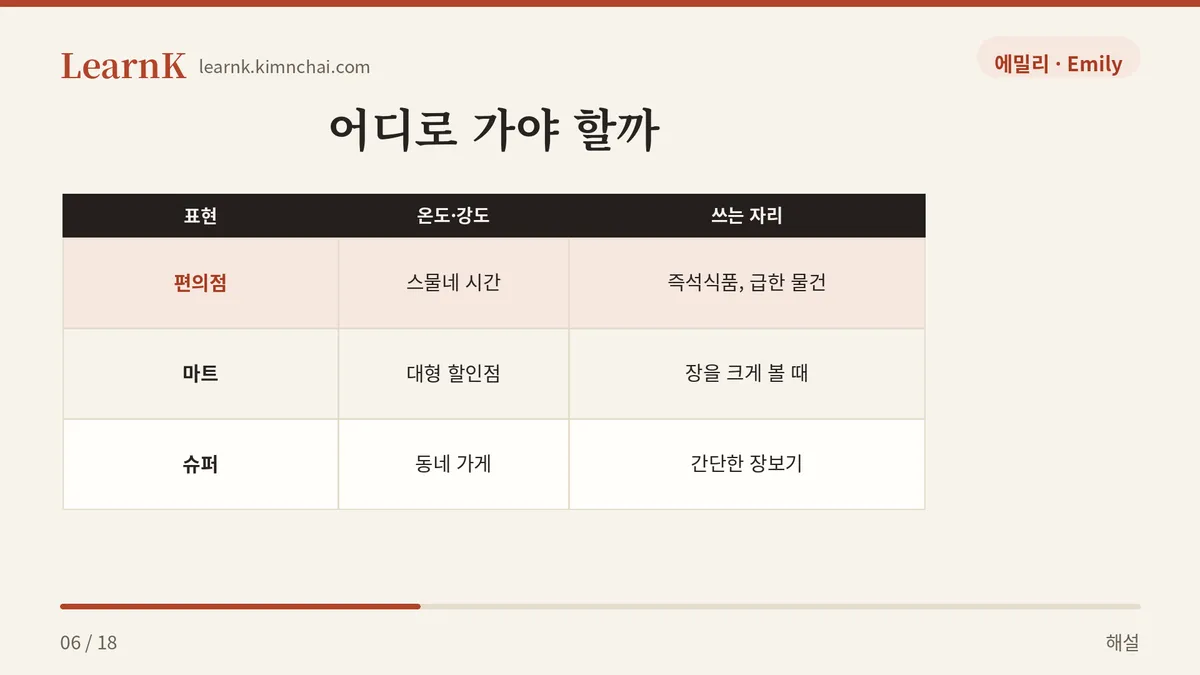
Similar shops include the larger 마트 (mateu, a big discount store) and the small neighborhood 슈퍼 (syupeo, supermarket). You can tell them apart like this: a place whose core features are 24-hour operation and ready-to-eat food is a ‘편의점,’ while a place for doing big grocery runs is a ‘마트.‘
Cultural Background
In Korean dramas, the 편의점 is an indispensable setting. Scenes of people sitting under a parasol late at night, sharing cup noodles and beer while pouring out their true feelings, or stories where the main character—a 편의점 part-timer—gets tangled up with customers, appear all the time. In fact, just like the comedy drama Backstreet Rookie (편의점 샛별이) (SBS, 2020), which is set in a convenience store, the 편의점 is portrayed as a symbolic space where the lives of ordinary people intersect. For travelers, too, the 편의점 becomes a window for experiencing everyday Korean life up close.
Closing Quiz
What word fits in the blank below?
비가 와서 ( )에서 우산을 하나 샀어요. (It was raining, so I bought an umbrella at the ( ).)
① 마트 ② 편의점 ③ 학교
If you got it right, you too can now confidently seek out that blue light on the streets of Korea at night! (Answer: ②)
Definitions and example sentences are from the National Institute of Korean Language’s Basic Korean Dictionary (krdict.korean.go.kr); that portion of this post, including our translations, is licensed under CC BY-SA 2.0 KR.