막장 (makjang): The Word Every K-Drama Fan Needs to Know for 'Rock Bottom'
If you love watching Korean dramas, you’ve probably run into the word 막장 (makjang) countless times in online communities and reviews. Things like “This drama is total 막장 (makjang),” or “the ultimate king of 막장 (makjang) plots.” At first it’s hard to tell whether it’s a compliment or an insult, but once you understand it, it becomes a key to understanding an entire genre of Korean drama. Today, let’s dig deep into this powerful word.
막장
막장 (makjang) was originally a mining term. In a coal mine, it referred to the deepest end of a tunnel — the dead-end point where you can’t dig any farther. It’s like a combination of the ‘막’ from ‘막다르다 (to hit a dead end)’ and ‘장 (場),’ meaning a yard or place. From there, the meaning broadened, and now it’s used as a metaphor for the worst possible state, a situation that has gone as far as it can go and can’t get any worse.
The nuance is definitely negative. Saying “인생이 막장으로 치닫는다 (life is racing toward 막장)” means a situation is heading toward an irreversible catastrophe, and saying “저 사람 막장이야 (that person is 막장)” carries a strong reproach — that they’ve thrown away all morals and dignity. Be careful, because using it carelessly about a person can be very rude.
Checking the National Institute of Korean Language Dictionary
The National Institute of Korean Language’s Basic Korean Dictionary defines this word very concisely, yet in a way that cuts right to the core.
막장 (noun)
- → 끝장 (kkeutjang) — National Institute of Korean Language, Basic Korean Dictionary (krdict.korean.go.kr)
In other words, the dictionary points to 막장 as being the same as 끝장 (kkeutjang) — that is, ‘the final state beyond which you can’t go any further, the end.’ It’s a very short definition, but a national institution’s dictionary clearly confirms that the essence of this word lies in ‘the end, catastrophe, a dead end.’
For reference, this dictionary does not include a Portuguese translation of 막장. So, to help learners understand, if I were to translate it myself, something like “beco sem saída” or “o fundo do poço” (a dead-end alley, the very bottom) would fit well. Please note that this translation is not from the dictionary but is a reference translation added by the author.
Example Sentences by Situation
I’ve put together three situations to show how it’s actually used in real conversation.
Situation 1 — Talking to a friend after watching a drama
어제 그 드라마 봤어? 출생의 비밀에 불륜에, 완전 막장이더라. (Eoje geu deurama bwasseo? Chulsaengui bimire bullyune, wanjeon makjang-ideora.) (Did you watch that drama yesterday? Secret birth stories, affairs — it was total 막장.)
Here, 막장 is less of an insult and closer to an affectionate exclamation of “it’s ridiculous, but fun.” This is the usage Korean drama fans use most often.
Situation 2 — When a company’s situation is racing toward the worst
이번 프로젝트, 예산도 끊기고 팀도 다 나갔어. 아주 막장이야. (Ibeon peurojekteu, yesando kkeungigo timdo da nagasseo. Aju makjang-iya.) (This project — the budget got cut and the whole team left. It’s a total 막장.)
It’s an expression lamenting a situation that has collapsed beyond repair.
Situation 3 — Using 막장 like a verb
둘이 싸우다가 결국 막장으로 치달았어. (Duri ssaudaga gyeolguk makjang-euro chidarasseo.) (The two of them fought and eventually spiraled into 막장.)
‘막장으로 치닫다 (makjang-euro chidatda)’ is an idiomatic expression meaning a situation is heading toward catastrophe, and it comes up very frequently.
Comparing Polite/Casual Speech and Similar Expressions
막장 itself is a noun, so it’s used regardless of politeness level, but the sentence ending changes the tone.
- Casual: 완전 막장이야. (wanjeon makjang-iya.)
- Polite: 정말 막장이네요. (jeongmal makjang-ineyo.)
Let’s also sort out some similar words. 끝장 (kkeutjang), which the dictionary pointed to, is a bit more neutral, meaning ‘the end, a final settling,’ and is used like “오늘 끝장을 보자 (let’s settle this once and for all today).” 엉망 (eongmang) means ‘a jumbled, tangled-up state’ and is a bit weaker in intensity. 막장, on the other hand, carries the most extreme nuance — ‘having hit rock bottom both morally and situationally.‘
Cultural Background — The Genre of ‘막장 Drama’
막장 became world-famous thanks to ‘막장 드라마 (makjang deurama)’. It refers to dramas that cram in provocative setups like secret birth stories, amnesia, affairs, power struggles among wealthy families, and “turns out they’re siblings.” Even while people criticize them as unrealistic, their strange addictiveness makes you wait for the next episode — so they’ve now firmly established themselves as a genre in their own right.
In fact, Korean dramas often feature scenes where a character driven to the extreme declares catastrophe, saying something like “여기서 다 끝내자 (let’s end it all right here).” The emotion of these gone-as-far-as-it-can-go moments is exactly what’s compressed into the word 막장.
Closing Quiz
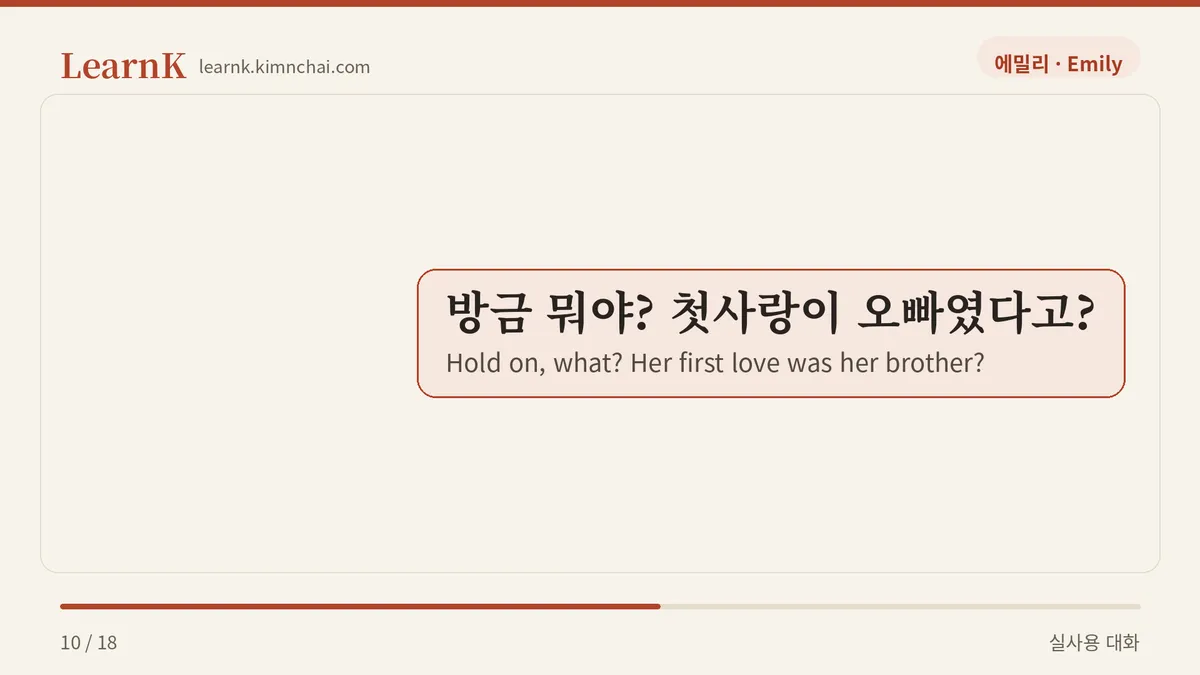
A friend who just watched a new drama excitedly says, “주인공이 알고 보니 재벌 회장의 숨겨진 딸이고, 첫사랑은 이복 오빠였어! (Turns out the main character is the secret daughter of a chaebol chairman, and her first love was her half-brother!)” What would be a natural thing to say back?
- 우와, 정말 막장이네요! (Uwa, jeongmal makjang-ineyo!) — Wow, that’s really 막장!
- 우와, 정말 안녕하세요! (Uwa, jeongmal annyeonghaseyo!) — Wow, really hello!
The answer is number 1! The expression that perfectly pinpoints a provocative, catastrophic plot is exactly 막장.
Definitions and example sentences are from the National Institute of Korean Language’s Basic Korean Dictionary (krdict.korean.go.kr); that portion of this post, including our translations, is licensed under CC BY-SA 2.0 KR.