만 나이 (man nai) — The Korean Math That Makes You a Year Younger Overnight
만 나이
만 나이 (man nai) means the age-counting system used by most of the world: you are 0 on the day you are born, and you add one year each time a birthday goes by. For foreigners living in Korea, this is the single box on a form that trips people up most often. Standing in front of the age field on a community-center application, at the hospital reception window, halfway through the personal-details section of a résumé — the pen just stops. Because sooner or later a moment comes when your friends all call you thirty-three, but the paperwork wants you to write thirty-two.
Korea has had three different ways of counting age for a long time. There is 세는나이 (seneun-nai), where you are one year old the moment you are born and everyone gains a year together on New Year’s Day; 연 나이 (yeon nai), which is simply the current year minus your birth year; and 만 나이, which goes by your birthday. The same person could be thirty-two in one setting, thirty-three in another, and thirty-four in a third. When the so-called “만 나이 통일법 (man nai tongilbeop)” — the Age Unification Act — took effect on June 28, 2023, the principle became clear: in law and administration, age means 만 나이 unless a specific regulation says otherwise. From that day on, Koreans all got a year or two younger — on paper, at least.
The temperature of the word is neutral, a little clerical. 만 나이 is the language of hospitals, government offices, and contracts, not the word you reach for over drinks when you are sorting out who is the older sibling and who is the younger. Since the unification act, though, it has worked its way into everyday conversation too. Lines like ‘나 만 나이로는 아직 스물아홉이거든 (na man naironeun ajik seumurahopigeodeun)’ — “I’m still twenty-nine in man-nai, you know” — now get tossed around as a joke.
See It in a Real Conversation
Setting: Saturday morning, the public service room at a community center. Emily has pulled a number ticket and sat down, and now she has stopped mid-form, pen in the air.
에밀리: 준경아, 여기 나이 칸에 만 나이로 쓰라는데, 나 서른둘이야 서른셋이야? Jun-kyung, this form says to write my age in man-nai — am I thirty-two or thirty-three?
준경: 생일 지났어? Has your birthday passed?
에밀리: 아니, 다음 달. 9월. No, next month. September.
준경: 그럼 아직 서른둘이지. 만 나이는 생일이 와야 한 살 먹는 거니까. Then you’re still thirty-two. With man-nai you only gain a year once your birthday comes.
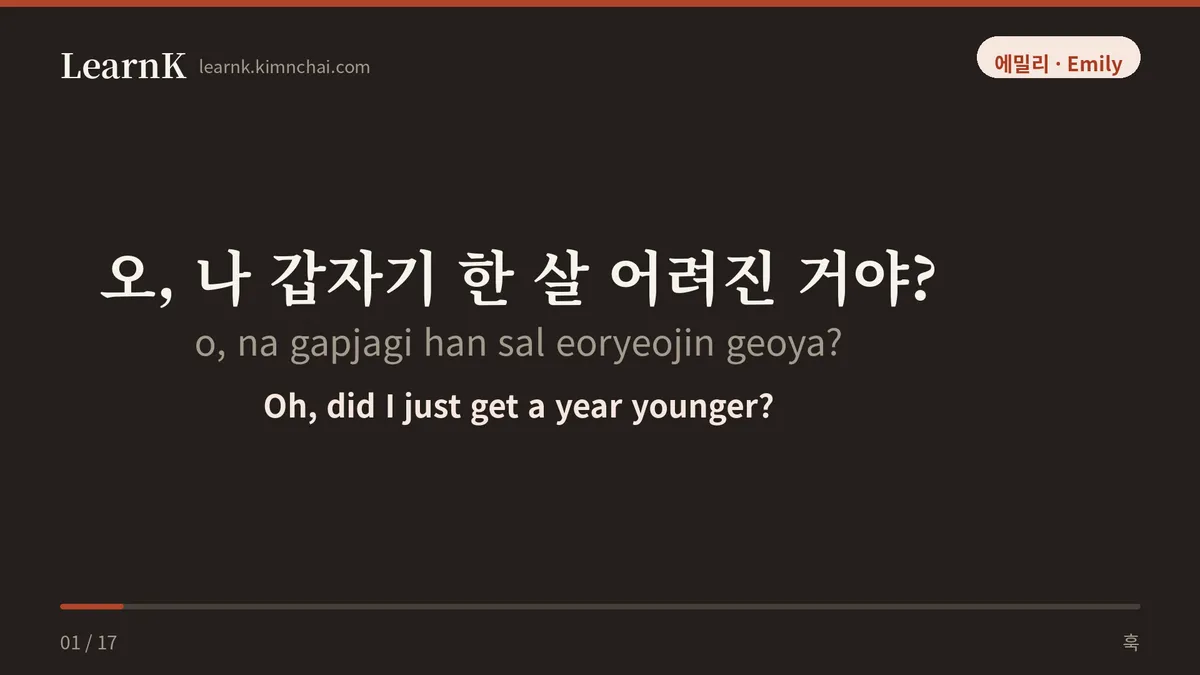
에밀리: 오, 나 갑자기 한 살 어려진 거야? 개꿀. Oh, did I just get a year younger? Sweet.
준경: 야, 그게 원래 네 나이야. 그동안 한 살 얹어서 살았던 거고. Hey, that’s your real age. You’ve just been walking around with an extra year on top.
When It Sounds Off
✗ (meeting someone for the first time) 실례지만 만 나이로 몇 살이세요? (sillyejiman man nairo myeot sariseyo?) — “Excuse me, how old are you in man-nai?” ✓ (meeting someone for the first time) 실례지만 몇 년생이세요? (sillyejiman myeot nyeonsaengiseyo?) — “Excuse me, what year were you born?” → In daily life, asking someone’s age is less about checking a number and more of a greeting — a way of finding where each of you stands. Slip 만 나이 into that moment and it starts to sound like hospital intake or an ID check, and the other person flinches. With someone you’ve just met, ‘몇 년생이세요?’ is the softest way in.
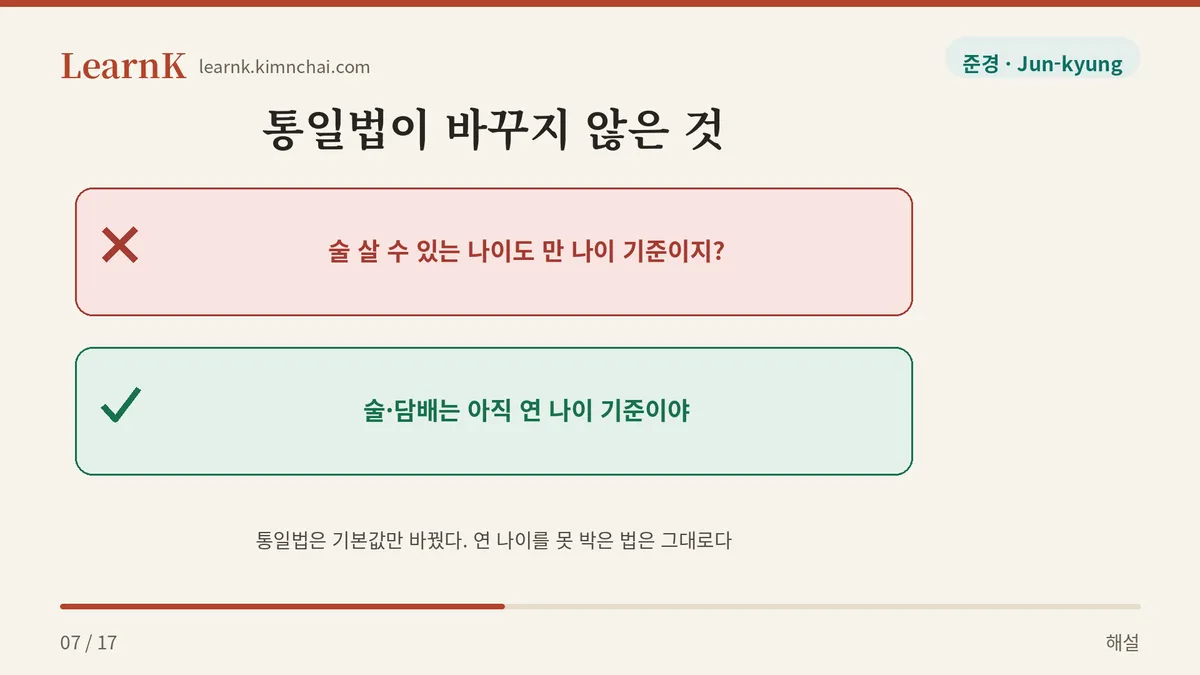
✗ 이제 법이 바뀌었으니까 술 살 수 있는 나이도 만 나이 기준이지? (ije beobi bakkwieosseunikka sul sal su inneun naido man nai gijuniji?) — “The law changed, so the drinking age goes by man-nai now, right?” ✓ 술·담배는 아직 연 나이 기준이야. 그해에 만 19세가 되는 사람부터. (sul·dambaeneun ajik yeon nai gijuniya. geuhaee man sipgusega doeneun sarambuteo.) — “Alcohol and cigarettes still go by yeon nai. Anyone who turns 19 that year.” → This is the most common misunderstanding. What the unification act changed was the default — what age means when no separate rule has been set. Places that explicitly nail down 연 나이, like the Youth Protection Act or the Military Service Act, stayed exactly as they were. That’s why someone with a December birthday can buy alcohol starting January 1 of that year.
Example Sentences by Situation
1. At the hospital reception window. Medical intake almost always asks for 만 나이, because medication dosages and insurance coverage criteria are set by it. In polite speech, the question goes like this.
환자분 만 나이로 어떻게 되세요? (hwanjabun man nairo eotteoke doeseyo?) May I have your age in international age?
2. Filling out a résumé or a contract. This is the line HR adds when they hand your paperwork back. Leave the age field blank and the documents may get returned.
나이는 만 나이로 적으시면 됩니다. (naineun man nairo jeogeusimyeon doemnida.) Please write your age using international age.
3. Joking around with friends. This is the defense someone facing their thirtieth birthday reaches for most often. Tacking on the casual ending ‘-거든’ gives it that playfully stubborn feel.
나 만 나이로 아직 스물아홉이거든? (na man nairo ajik seumurahobigeodeun?) Hey, I’m still twenty-nine in international age, okay?
Polite Speech, Casual Speech, and Related Expressions
Even the question itself changes depending on who you’re asking. With peers or someone younger, you say 몇 살이야? (myeot sariya?); in polite speech, 나이가 어떻게 되세요? (naiga eotteoke doeseyo?); and with an elder, 연세가 어떻게 되세요? (yeonsega eotteoke doeseyo?). 연세 (yeonse) is the honorific word for age, so asking a gray-haired elder ‘나이가 몇이세요?’ will drop the temperature of the room.
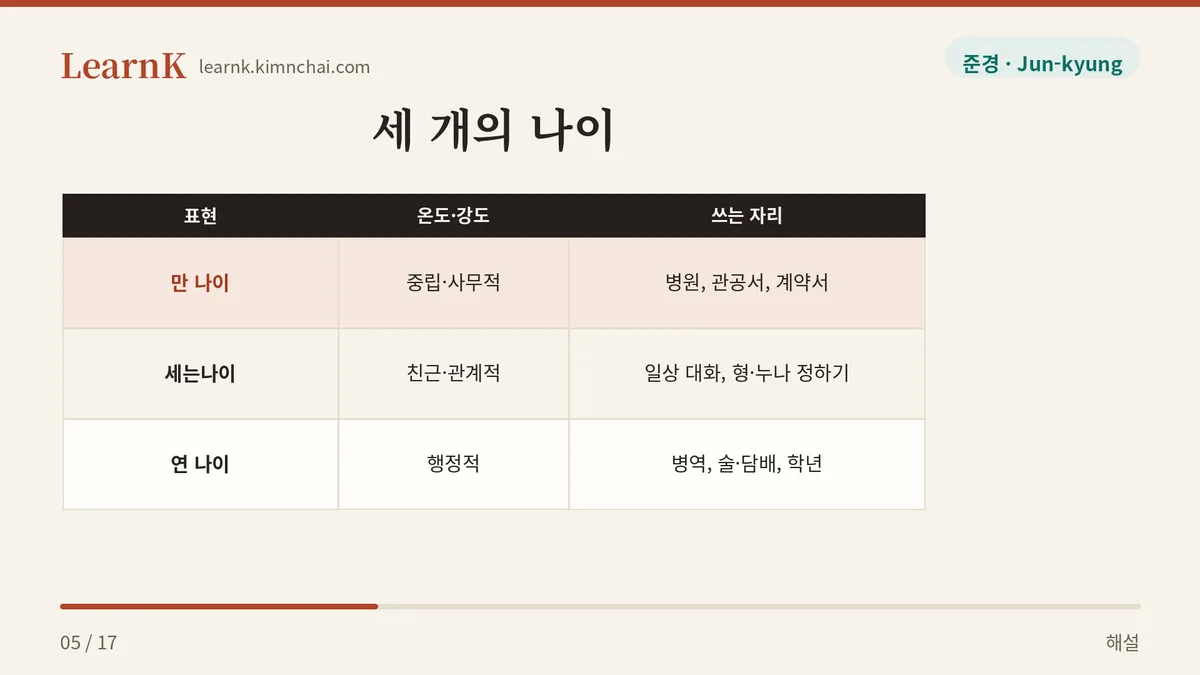
The counting systems themselves also coexist, all three of them. Which one you pull out, and where, says a great deal about what kind of setting you’re in.
| Expression | Tone / Intensity | Where It’s Used |
|---|---|---|
| 만 나이 (man nai) | neutral, clerical | hospitals, government offices, contracts, law |
| 세는나이 (seneun-nai) | warm, relational | everyday conversation, drinks with friends, sorting out who’s the 형 or 누나 |
| 연 나이 (yeon nai) | administrative, mechanical | military service, alcohol and tobacco, school years |
| 몇 년생 (myeot nyeonsaeng) | light and natural | sizing up someone’s age when you first meet |
Cultural Background — The Age You’ve Filled and the Age Laid on Top
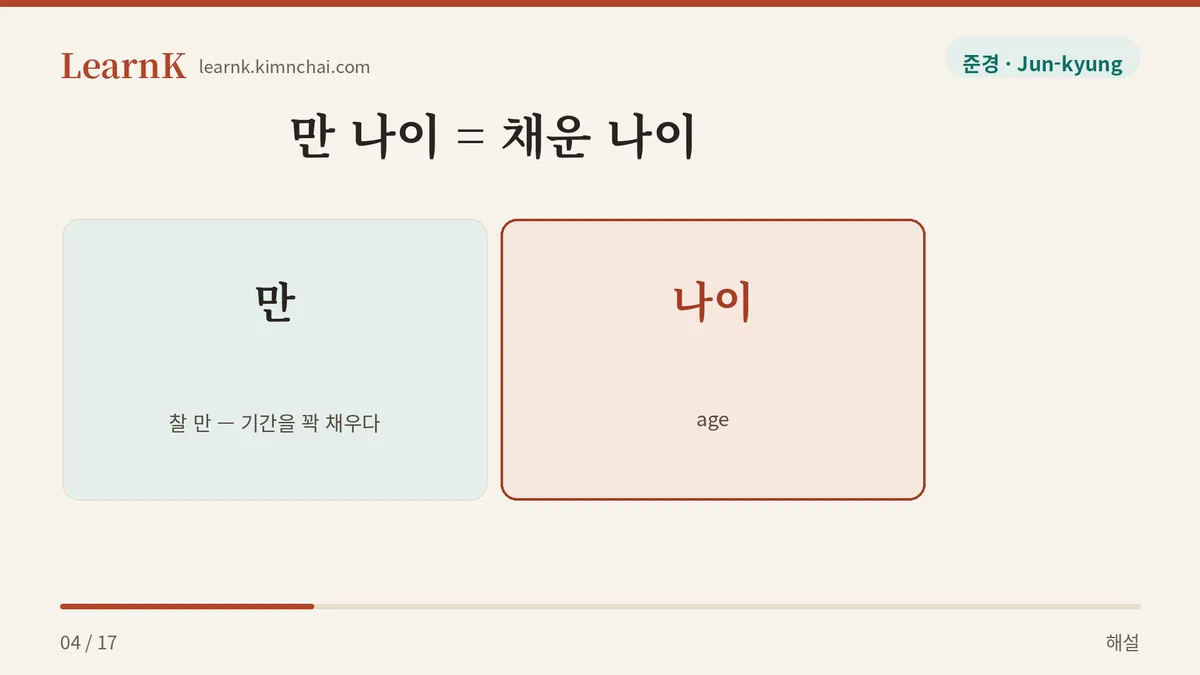
The 만 in 만 나이 is the hanja 滿 (찰 만, “to fill”). It’s used the way it is in 만 5년 (man o-nyeon, “a full five years”) or 만 하루 (man haru, “a full day”) — to say that the span has been filled all the way up. So 만 나이 is, literally, “the age you’ve filled.” Only when your birthday comes back around and you’ve lived a whole year through does another year get attached. 세는나이 works the opposite way: you start with a year already laid on top of you the moment you’re born, so a baby born on December 31 can be two years old two days later.
세는나이 was originally shared across several East Asian countries, but Korea is where it survived in daily life to the very end. The reason lies in the structure of the Korean language. In Korea, age isn’t a number — it’s a coordinate in a relationship. One year of difference decides whether someone is your 형, 누나, 오빠, or 언니, and your entire speech style shifts along with it. That’s why, when you meet someone, ‘몇 년생이세요?’ comes right after the name. It’s a culture where you grow up grouped by school year, so if you were born in the same year, you’re friends from that moment on. On this coordinate system, 세는나이 — where everyone turns a year older together on New Year’s Day — was far more convenient than 만 나이, where ages tick up on scattered individual birthdays.
In Korean dramas, the scene where two characters meet, confirm each other’s ages, and decide on the spot to drop the formal speech repeats almost like a ritual. A few lines of dialogue settle the pecking order, and from the next scene on, the titles and sentence endings have changed. If you’ve ever wondered why age comes up in conversation so often, those scenes are the answer.
This is also where the saying about eating 떡국 (tteokguk, rice cake soup) on New Year’s Day and gaining a year comes from. ‘떡국 한 그릇 더 먹었네 (tteokguk han geureut deo meogeonne)’ — “you’ve had one more bowl of tteokguk” — means you’ve gotten a year older. Even after the unification act took effect, this expression didn’t disappear. The age on your documents changed, but the age that passes around the dinner table is still 세는나이. So these days Koreans switch between two ages depending on the situation. Thirty-two at the hospital, thirty-four at the housewarming party — both at once.
Today’s Quiz
Jun-kyung was born on November 3, 1989. If today is August 12, 2026, what is Jun-kyung’s 만 나이?
① 서른여섯 살 (seoreun-yeoseot sal, thirty-six) ② 서른일곱 살 (seoreun-ilgop sal, thirty-seven) ③ 서른여덟 살 (seoreun-yeodeol sal, thirty-eight)
The answer is ① 서른여섯 살. His birthday hasn’t come around yet, so 2026 − 1989 − 1 = 36. For reference, on that very same day Jun-kyung is thirty-seven in 연 나이 and thirty-eight in 세는나이. One person holding three ages at one moment on one day — that single line explains why the unification act was needed.
Definitions and example sentences are from the National Institute of Korean Language’s Basic Korean Dictionary (krdict.korean.go.kr); that portion of this post, including our translations, is licensed under CC BY-SA 2.0 KR.