마라샹궈 (marasyanggwo) — The Tongue-Numbing Stir-Fry You Pick with Tongs and Pay for by the Scale
마라샹궈
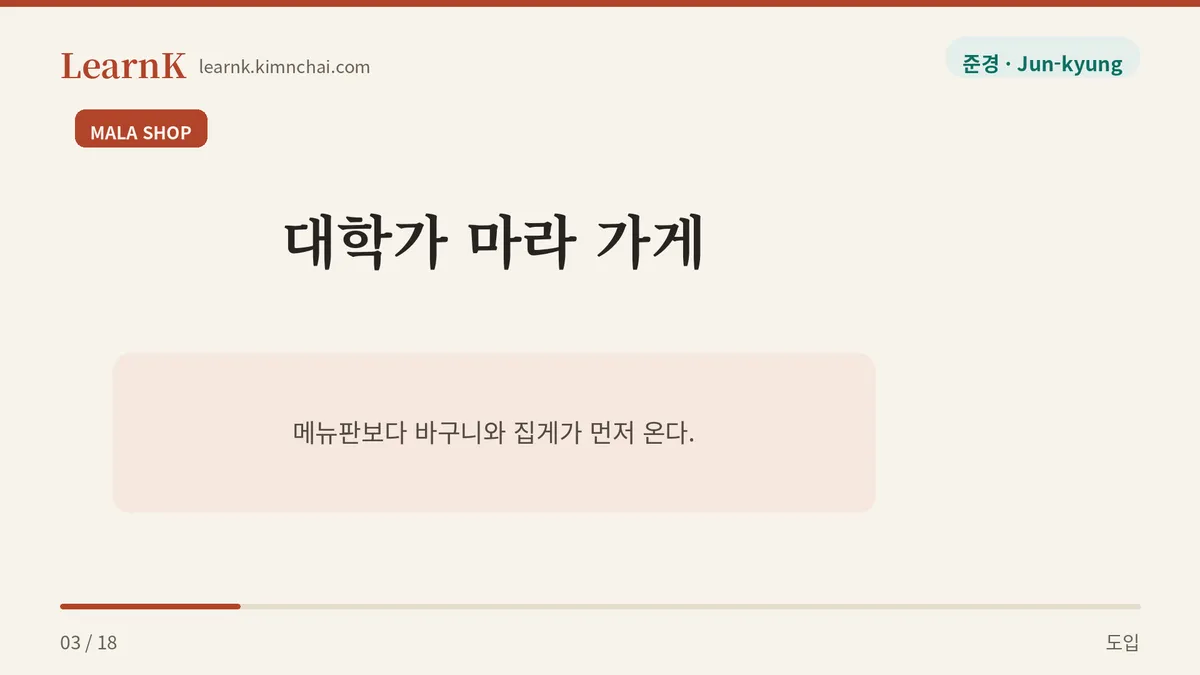
마라샹궈 (marasyanggwo) means “a Chinese-style stir-fry made with ingredients you choose yourself, tossed in a numbingly spicy mala seasoning and cooked without any broth.” Walk into a mala shop in Korea and the staff will hand you a stainless steel basket and a pair of tongs before they hand you a menu. You work your way down the refrigerated display, loading up on as much bok choy, wood ear mushroom, wide glass noodles (넓적당면, neopjeokdangmyeon), konjac pearl noodles (분모자, bunmoja), sausage, king oyster mushroom, and napa cabbage as you want. At the end you set the basket on a scale, the price is calculated at so-much per 100 grams, you pick a spice level, and the kitchen stir-fries it over high heat. So this word is the name of a dish and the name of an ordering procedure at the same time.
For someone learning Korean, the hard part of 마라샹궈 isn’t the pronunciation — it’s the procedure. If you only say 「마라샹궈 하나 주세요 (marasyanggwo hana juseyo)」, the person at the shop will pause for a beat. What goes in the basket and how much of it is the customer’s job to decide. Knowing this word is less about knowing what it means and more about knowing where to walk once the tongs are in your hand.
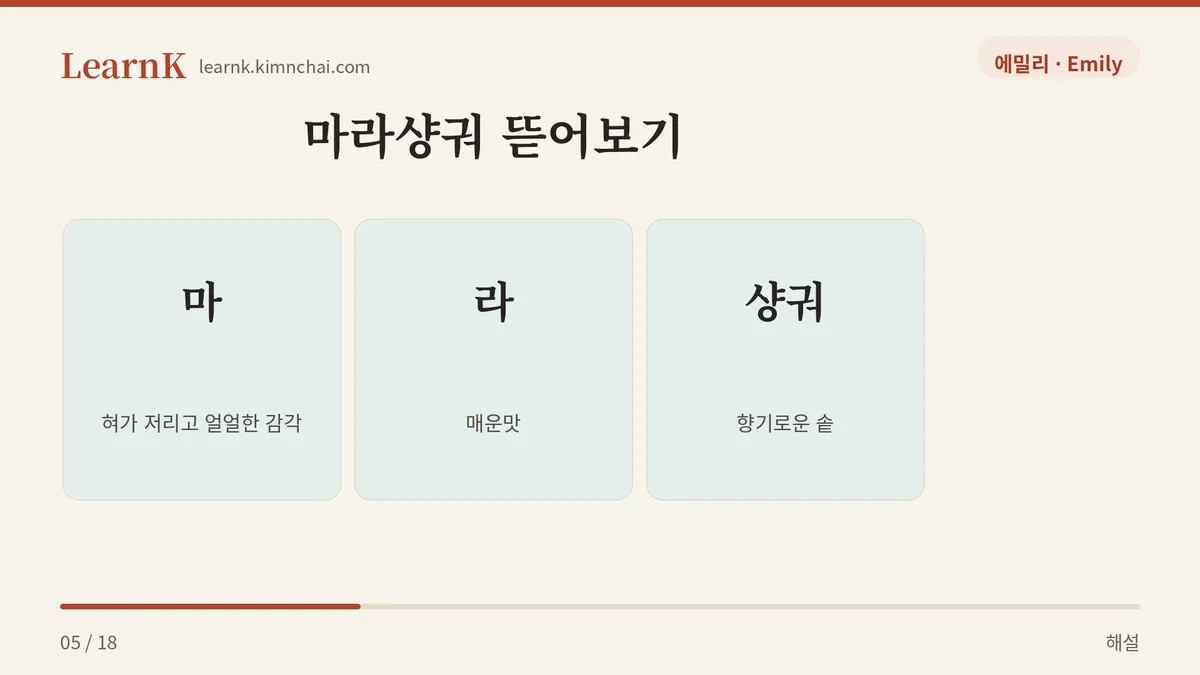
The way the flavor gets described is also a little special within Korean. Spiciness in Korean food is usually summed up with the single word 「맵다 (maepda)」, but mala’s heat arrives together with a tingling, numbing sensation on the tongue. So when Koreans talk about this taste, they reach for words like 얼얼하다 (eoreolhada) and 혀가 마비된다 (hyeoga mabidoenda) instead of 「맵다」. If someone eating 마라샹궈 for the first time says 「맵다기보다 혀가 없어지는 것 같아 (maepdagiboda hyeoga eopseojineun geot gata)」— “it’s less spicy and more like my tongue is vanishing” — that’s not an exaggeration. It’s a pretty accurate description.
Let’s settle the spelling while we’re here. In Korea the form that has stuck is 마라샹궈 (marasyanggwo). You’ll occasionally spot signs written 「마라상궈 (marasanggwo)」 or 「마라향궈 (marahyanggwo)」, but the form people say and search for is 마라샹궈. It also gets shortened to just 마라 (mara). Say 「오늘 마라 어때? (oneul mara eottae?)」 and you mean “let’s go to that shop,” whether you end up with 마라샹궈 or 마라탕.
Seeing It in a Real Conversation
Situation: A mala shop in a university neighborhood. Two people are standing in front of the ingredient display with tongs in hand. Emily’s basket is already piled high.
Jun-kyung: 야, 그거 다 담으면 삼만 원 넘어. 100그램에 삼천 원이야. Hey, if you pile all that in it’ll come to over 30,000 won. It’s 3,000 won per 100 grams.
Emily: 어? 나 마라샹궈 저울로 계산하는 건 오늘 처음 알았어. Huh? Today’s the first time I learned malaxiangguo is priced by weight.
Jun-kyung: 청경채는 좀 빼. 볶으면 확 줄어들어. Take out some bok choy. It shrinks a lot when it’s stir-fried.
Emily: 아 맞다, 마라샹궈는 볶는 거지. 나 계속 국물 나오는 줄 알았네. Oh right, malaxiangguo is stir-fried. I kept thinking it came with broth.
Jun-kyung: 국물은 마라탕이고. 맵기는 몇 단계로 할래? Broth is malatang. What spice level do you want?
Emily: 1단계. 나 어제 속 안 좋았거든… Level 1. My stomach wasn’t great yesterday…
Saying It This Way Sounds Off
마라샹궈 is a food name rather than a word that shifts depending on who you’re speaking to, so it isn’t the kind of expression that becomes rude with someone older than you. Instead, here are the two misunderstandings learners actually bump into most often.
✗ (at the shop) 이모, 마라샹궈 국물 좀 더 주세요. (imo, marasyanggwo gungmul jom deo juseyo.) ✓ (at the shop) 이모, 마라샹궈 소스 좀 넉넉히 넣어 주세요. (imo, marasyanggwo soseu jom neokneokhi neoeo juseyo.) → 마라샹궈 is a stir-fry, so there’s no broth to begin with. Asking for more broth marks you as someone who has mixed it up with 마라탕. If you want more of the thick seasoning, you have to say 「소스 (soseu)」 or 「양념 (yangnyeom)」 rather than 「국물 (gungmul)」 for the request to land.
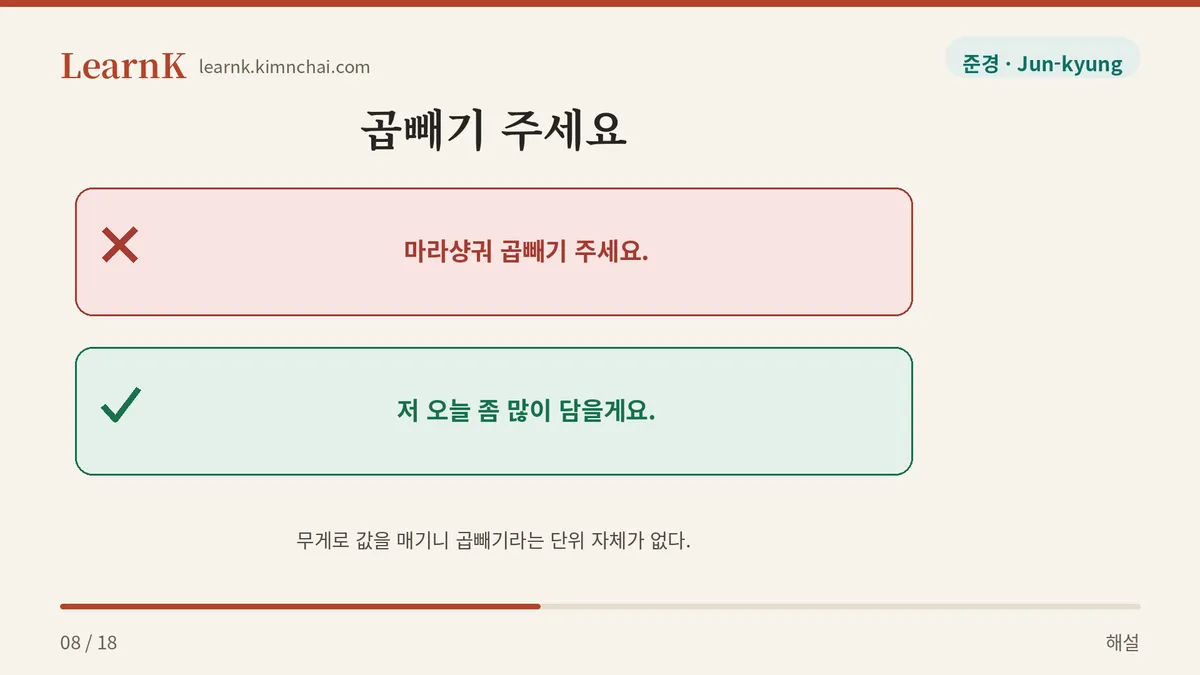
✗ (while ordering) 마라샹궈 곱빼기 주세요. (marasyanggwo gopppaegi juseyo.) ✓ (while filling the basket) 저 오늘 좀 많이 담을게요. (jeo oneul jom mani dameulgeyo.) → Jjajangmyeon and gukbap come in a 곱빼기 (gopppaegi, “extra-large portion”), but 마라샹궈 is priced by weight, so the unit 곱빼기 doesn’t exist for it. The portion size isn’t decided when you order — it’s already been decided while you stood there with the tongs.
Example Sentences by Situation
1. Suggesting dinner to a friend on the way home from work
오늘 저녁 마라샹궈 어때? 나 얼큰한 거 당겨. (oneul jeonyeok marasyanggwo eottae? na eolkeunhan geo danggyeo.)
「당기다 (danggida)」 is a thoroughly everyday word for when you’re really craving a particular food. When you’re picking what to eat, using this instead of 「먹고 싶어 (meokgo sipeo)」 makes the sentence sound far more like something a Korean would actually say.
2. Ordering for the first time at a shop (polite speech)
마라샹궈 1단계로 해 주시고, 면은 넓적당면으로 주세요. (marasyanggwo il-dangyero hae jusigo, myeoneun neopjeokdangmyeoneuro juseyo.)
Spice levels usually start at 1단계 (il-dangye, “level 1”). If it’s your first time, starting at level 1 is the safe move. At a Korean mala shop, level 1 doesn’t mean “not spicy” — it means “the least spicy thing that particular shop makes.”
3. To a coworker who’s just back from lunch
너 점심에 마라샹궈 먹었지? 냄새 난다. (neo jeomsime marasyanggwo meogeotji? naemsae nanda.)
That distinctive mala aroma lingers in your clothes and hair for a long time. So this joke gets passed around offices constantly. 「마라 냄새 난다 (mara naemsae nanda)」 is teasing, but there’s nothing mean in it — usually 「나도 먹고 싶다 (nado meokgo sipda)」, “now I want some too,” comes right after.
Polite and Casual Forms, and Similar Expressions
마라샹궈 is a noun, so the word itself doesn’t shift into an honorific or humble form. What changes is the predicate that follows it. With a friend it’s 마라샹궈 먹을래? (marasyanggwo meogeullae?), and with a senior or someone older it becomes 마라샹궈 드실래요? (marasyanggwo deusillaeyo?). Only 「먹다 (meokda)」 turns into 「드시다 (deusida)」 — the food’s name stays exactly the same.
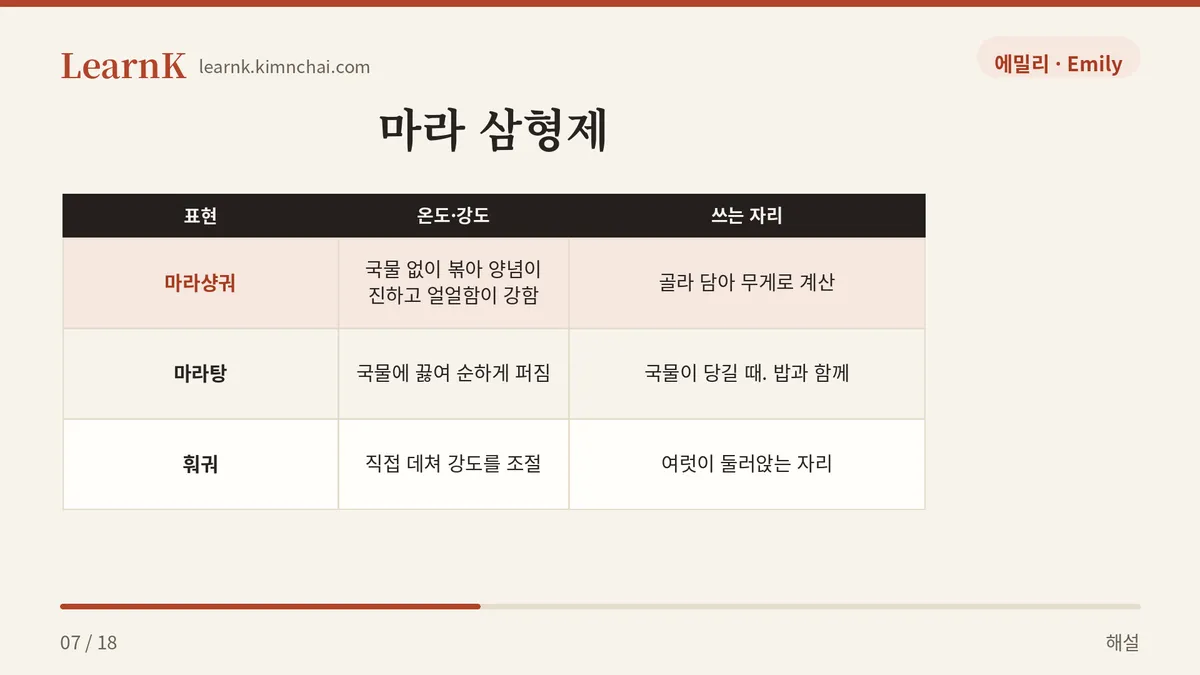
The differences between the related mala dishes come through more clearly in a table.
| Expression | Heat & Intensity | Where It’s Used |
|---|---|---|
| 마라샹궈 (marasyanggwo) | Stir-fried with no broth, so the seasoning is concentrated and the numbing hit is strong | You pick your ingredients and pay by weight. Works alone or as a pair |
| 마라탕 (maratang) | Simmered in broth, so the heat spreads out and mellows. Easier on the stomach | Same shop, for when you’re in the mood for something soupy. Goes with rice or twisted doughnuts |
| 훠궈 (hwogwo) | You blanch each piece yourself, adjusting the intensity as you go | For a group gathered around one table. When you have plenty of time |
Even at the same shop with the same ingredients in your basket, whether you say 「볶아 주세요 (bokka juseyo)」 or 「끓여 주세요 (kkeuryeo juseyo)」 at the end decides whether it comes out as 마라샹궈 or 마라탕.
Cultural Background — 마 (麻), the Numbing One, and the Fragrant Pot
Take the name apart and the flavor is sitting right inside it. 마라샹궈 comes from the Chinese málà xiāngguō (麻辣香锅). 마 (麻) is the tingling, numbing sensation; 라 (辣) is spicy heat; and 샹궈 (香锅) means “fragrant pot.” In other words, the name already contains “numbness + heat + the wok it’s fried in.” Korean’s 「맵다 (maepda)」 only carries over the 라 (辣) and can’t hold the 마 (麻), and Koreans fill that empty space with 「얼얼하다 (eoreolhada)」. That numbness comes from 화자오 (hwajao, 花椒) — Sichuan peppercorn, a member of the prickly ash family. If a first-timer thinks 「이건 매운 게 아니라 다른 감각인데? (igeon maeun ge anira dareun gamgaginde?)」— “this isn’t spicy, it’s some other sensation” — they have met precisely that 마 (麻).
Mala shops became noticeably common in Korea in the late 2010s. They started in restaurants in neighborhoods with large ethnic-Korean-Chinese populations, spread to university districts, and from there to delivery apps and mukbang videos. Now there’s a red sign near just about every subway station, and convenience stores line up mala-flavored ramyeon next to mala-flavored snacks.
There’s a reason 마라샹궈 took root in Korea so particularly well: you choose the ingredients yourself. Koreans have always used their hands a lot at the table. They grill the meat themselves, wrap each lettuce leaf to their own taste, and decide on the spot what goes into the ramyeon. Standing in front of a display case deliberating with tongs in hand didn’t feel foreign at all. That’s why 「마라샹궈 먹으러 가자 (marasyanggwo meogeureo gaja)」 carries a quiet second meaning: 「같이 골라 담자 (gachi golla damja)」, “let’s pick things out together.” Peering into each other’s baskets and teasing — 「너 그것도 넣어? (neo geugeotdo neoeo?)」, “you’re putting that in?” — is part of the dish’s procedure too.
Today’s Quiz
You’re ordering 마라샹궈 at a mala shop. Which of the following sounds off?
① 1단계로 해 주세요. (il-dangyero hae juseyo.) ② 국물 좀 더 주세요. (gungmul jom deo juseyo.) ③ 넓적당면도 넣을게요. (neopjeokdangmyeondo neoeulgeyo.)
The answer is ②. 마라샹궈 is stir-fried without broth, so there’s no broth to ask more of. If you wanted the soupy version, you should have ordered 마라탕 from the start. When you want more seasoning, just say 「소스 좀 넉넉히 넣어 주세요 (soseu jom neokneokhi neoeo juseyo)」.