무한리필 (muhanripil) — Pay Once, Eat Meat Until You Drop
무한리필 (muhanripil) means a way of selling food where you pay once and can then keep getting refills of a set menu, as much as you want, with no extra charge. If you’ve ever walked down a street lined with Korean barbecue joints, you’ve definitely run into these four syllables — on signs like 삼겹살 무한리필 15,000원 (samgyeopsal muhanripil 15,000-won), in red letters with an exclamation point tacked on for good measure.
The situations where this word comes up are very specific. Deciding what to eat with a friend on the way home from work. Picking a venue for a big company dinner. When someone in an exchange-student group chat asks, “anywhere cheap and filling?” So 무한리필 isn’t the name of a food — it’s the name of a way of paying. It tells you not what you’ll eat, but how the bill works.
무한리필
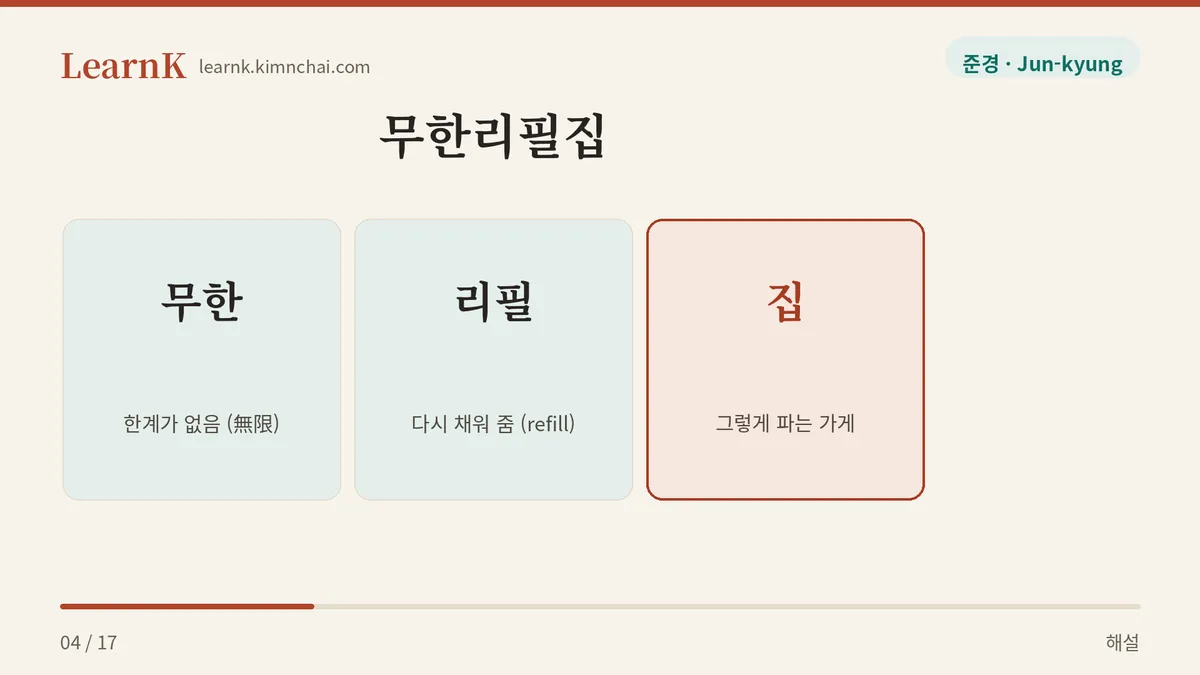
It’s a noun. That’s why all kinds of things attach to the end of it. 무한리필집 (muhanripiljip) is a restaurant that sells this way. 무한리필이다 (muhanripilida) is the statement “they sell it that way.” 무한리필로 시키다 (muhanripillo sikida) means choosing that option, out of several, when you order. The fact that it is not a verb matters. It isn’t what a customer says to ask for more food — it’s the name of the deal the restaurant is advertising. Miss that distinction and you produce the awkward sentences we’ll look at below.
There’s one pronunciation trap. It’s written 무한리필, but it actually comes out as [무할리필] (muhallipil). In Korean, when ㄴ meets ㄹ, the ㄴ shifts to ㄹ. It’s the same rule that makes 신라 sound like [실라] (Silla) and 연락 sound like [열락] (yeollak). If you read it out letter by letter — “무한 · 리필” — carefully separated, you’ll immediately sound like a foreigner. Memorize it as one chunk: [무할리필].
The temperature of the word is light and practical. It’s not elegant in the slightest. But it isn’t negative either. If anything, it’s closer to a signal that says, “tonight we eat without worrying about money.” So when this word shows up, the mood of the conversation lifts a little.
One more thing. These days it has spread beyond food and gets used as a joke. Anything that goes on and on endlessly can be called 무한리필. But that metaphor is banter that only works among peers, so it depends on the company. More on that below.
A Real Conversation
Scene: Saturday evening at a neighborhood samgyeopsal place. The first round of meat is nearly done grilling.
Jun-kyung: 야, 고기 거의 다 먹었는데 더 시킬까? Hey, we’re almost out of meat — should we order more?
Emily: 여기 무한리필이야? 난 그냥 1인분씩 파는 덴 줄 알았는데. Is this place all-you-can-eat? I thought they just sold it by the portion.
Jun-kyung: 응, 1인 만 오천 원에 무한리필. 대신 두 시간이야. Yeah, fifteen thousand won a head, unlimited refills. But there’s a two-hour limit.
Emily: 오, 그럼 목살도 돼? 나 삼겹살보다 목살파인데. Oh, does neck meat count too? I’m more of a pork-neck person than belly.
Jun-kyung: 되지. 근데 남기면 추가 요금 받으니까 조금씩 시켜. It does. But they charge extra if you leave food, so order in small batches.
Emily: 알겠어. 이모님~ 여기 목살 이 인분이요! Got it. Excuse me, ma’am! Two servings of pork neck over here!
Sounds Off If You Say It This Way
✗ (asking for more banchan at an ordinary home-style diner) 사장님, 김치 무한리필 해 주세요. (sajangnim, kimchi muhanripil hae juseyo.) ✓ (at an ordinary home-style diner) 사장님, 김치 좀 더 주세요. (sajangnim, kimchi jom deo juseyo.) → 무한리필 is the name of a sales format the restaurant has advertised, not a phrase customers use to request more food. Say it somewhere that isn’t an all-you-can-eat place and it lands as “give me unlimited food for free” — and the owner’s face will freeze.
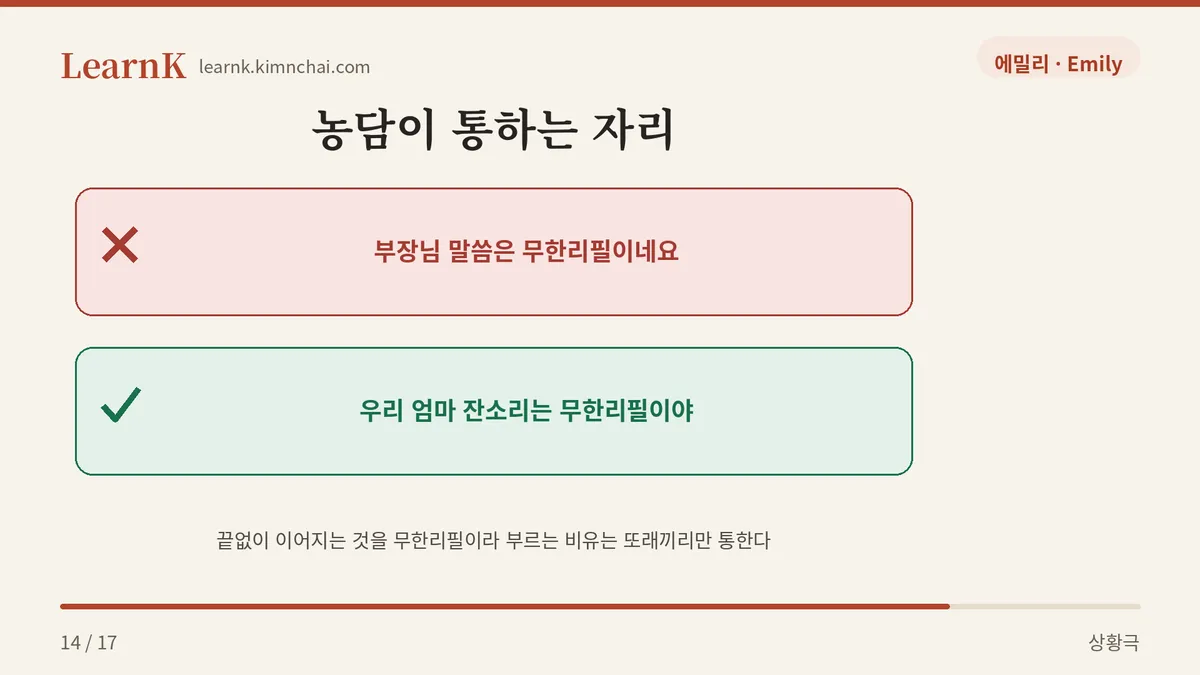
✗ (to your department head) 부장님 말씀은 무한리필이네요. (bujangnim malsseumeun muhanripilineyo.) ✓ (to a friend) 우리 엄마 잔소리는 무한리필이야. (uri eomma jansorineun muhanripiliya.) → Calling something endless “무한리필” is a joke traded between peers. Aim it at someone senior to you and it becomes a jab meaning “you talk too much.”
Example Sentences by Situation
One. In the group chat picking a place for the company dinner (casual speech)
인원도 많은데 그냥 무한리필집으로 가자. 이차 갈 돈은 남겨야지. (inwondo manheunde geunyang muhanripiljibeuro gaja. ichagal doneun namgyeoyaji.)
The more people you have, the harder it is to predict the total at a place that charges by the portion. So a 무한리필집 also carries the meaning of “a place where nobody has to tally up who ate how much.” In Korea, half of this word is a conversation about food and half is a conversation about the bill.
Two. Checking at the door before you go in (polite speech)
저기요, 이거 두 시간 무한리필 맞죠? 두 명인데 둘 다 시켜야 하나요? (jeogiyo, igeo du sigan muhanripil matjyo? du myeongindae dul da sikyeoya hanayo?)
All-you-can-eat places usually come with hidden conditions: a time limit, and the “everyone must order” rule. Having one person order and splitting it between two is generally not allowed. Asking about these two things before going in is the standard Korean move.
Three. At a café (casual speech)
여기 아메리카노 무한리필이라서 하루 종일 앉아 있어도 눈치가 안 보여. (yeogi amerikano muhanripiliraseo haru jongil anja isseodo nunchiga an boyeo.)
It isn’t a barbecue-joint-only word. Cafés that refill your cup all day for the price of one coffee also put up signs reading 커피 무한리필 (keopi muhanripil). You’ll see it especially often in university neighborhoods during exam season.
Politeness Levels and Similar Expressions
무한리필 is a noun, so the word itself carries no politeness. The level is decided at the end of the sentence. To a server: 무한리필 맞죠? (muhanripil matjyo?) To a friend: 무한리필이야? (muhanripiriya?) You never need to change the word itself.
Let’s line up some expressions that look similar but belong in different places.
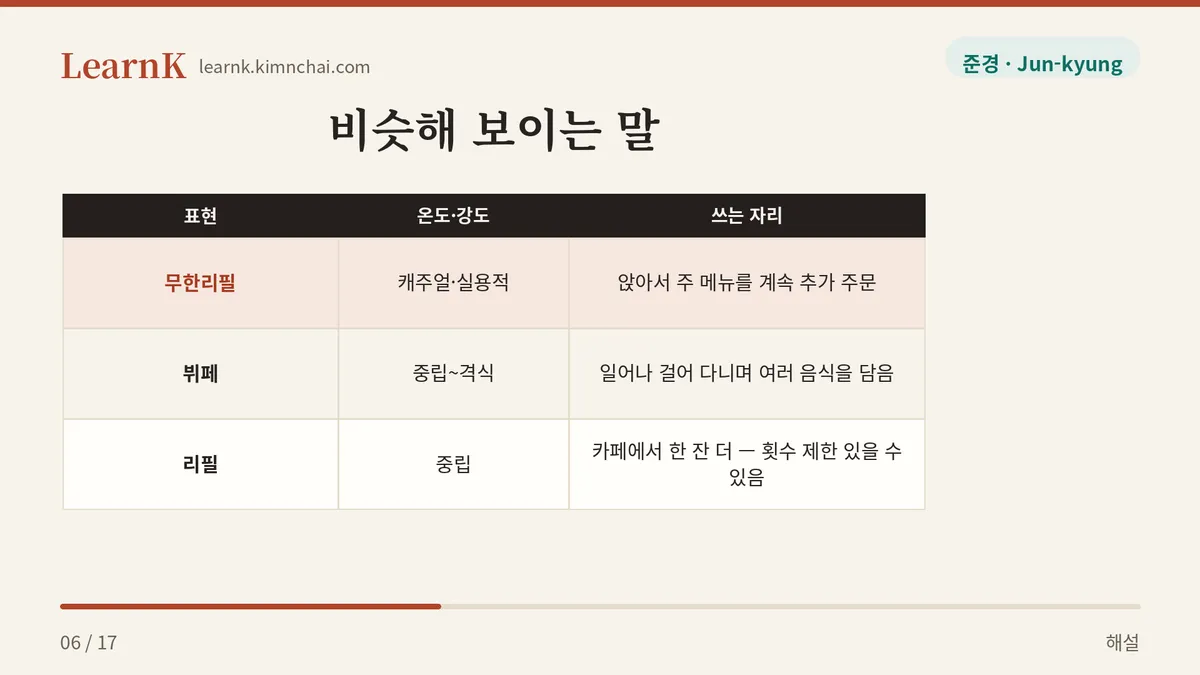
| Expression | Tone / Intensity | Where it’s used |
|---|---|---|
| 무한리필 (muhanripil) | Casual and practical, with price talk underneath | Signs at barbecue and sushi places; friends choosing where to eat |
| 리필 (ripil) | Neutral | Getting another cup at a café. There may be a limit on how many |
| 무제한 (mujehan) | A bit stiffer | Phone plans, data, passes. For food, only in written notices |
| 뷔페 (bwipe) | Neutral to formal | A place where you serve yourself from many dishes. Hotels, first-birthday parties |
| 셀프바 (selpeuba) | Casual | The corner where customers help themselves to side dishes or drinks |
The pair that trips people up most is 무한리필 and 뷔페. At a 뷔페, many dishes are laid out in a row and you walk around with a plate filling it up. 무한리필 means placing repeated “additional orders” of one main dish, and usually a staff member brings you a fresh plate. Are you sitting, or are you up and walking around? Remember it by that difference and it’s easy.
Cultural Background — The Two-Hour Condition
Start with the shape of the word. 무한리필 is built by gluing together the Sino-Korean word 무한 (muhan, 無限, “without limit”) and 리필 (ripil), a loanword from English refill. A Chinese character compound and an English word standing side by side inside one word — a very common assembly method in contemporary Korean. 리필 originally took hold in cafés, referring to topping up your coffee; once 무한 got attached to the front, it spread out to pork belly, sushi, and grilled shellfish.
The places where this format caught on reveal the character of Korean dining culture directly. Several people sit around one table sharing the same dishes, and the bill is usually covered by one person or split by headcount. In that setup, the moment someone starts calculating “did I eat two extra pieces?” the mood turns awkward. 무한리필 erases that calculation entirely. The price is fixed in advance, so there’s nothing to feel self-conscious about. The sense of liberation this word gives isn’t really about the volume of food — it’s about that peace of mind.
Of course, there are conditions. Usually a time limit of ninety minutes to two hours, plus an extra charge for food you leave uneaten. The rule that everyone in the party must order is common too. For a word meaning “limitless,” there are quite a few walls — and Koreans call the whole thing, walls included, 무한리필.
These signs show up often in dramas and variety shows, too. They set the scene for broke college students and people fresh out of school gathering together, or for the shot of everyone walking out patting their full stomachs. The fact that people’s real feelings come out in front of this grill rather than at some fancy restaurant is a piece of grammar Korean dramas have used for a long time. So a 무한리필집 isn’t just a cheap backdrop — it’s closer to a device for showing that these people are close enough to drop their guard.
Today’s Quiz
Which of the following uses 무한리필 naturally?
- (at an ordinary home-style diner) 사장님, 밥 무한리필 해 주세요. (sajangnim, bap muhanripil hae juseyo.)
- (to your department head) 부장님 말씀은 무한리필이네요. (bujangnim malsseumeun muhanripilineyo.)
- (to a friend) 저 집 두 시간 무한리필인데 오늘 가 볼래? (jeo jip du sigan muhanripilinde oneul ga bollae?)
The answer is number 3. Number 1 uses the name of a sales format as if it were a request, at a place that isn’t an all-you-can-eat restaurant, so it comes off as rude — 밥 좀 더 주세요 (bap jom deo juseyo) is what you want. Number 2 throws a peers-only joke at a superior. Pointing at a restaurant along with its conditions (two hours), as in number 3, is exactly where this word belongs.
Definitions and example sentences are from the National Institute of Korean Language’s Basic Korean Dictionary (krdict.korean.go.kr); that portion of this post, including our translations, is licensed under CC BY-SA 2.0 KR.