가슴이 뭉클하다 (gaseumi mungkeulhada): The Heart-Swelling Moment Words Can't Capture
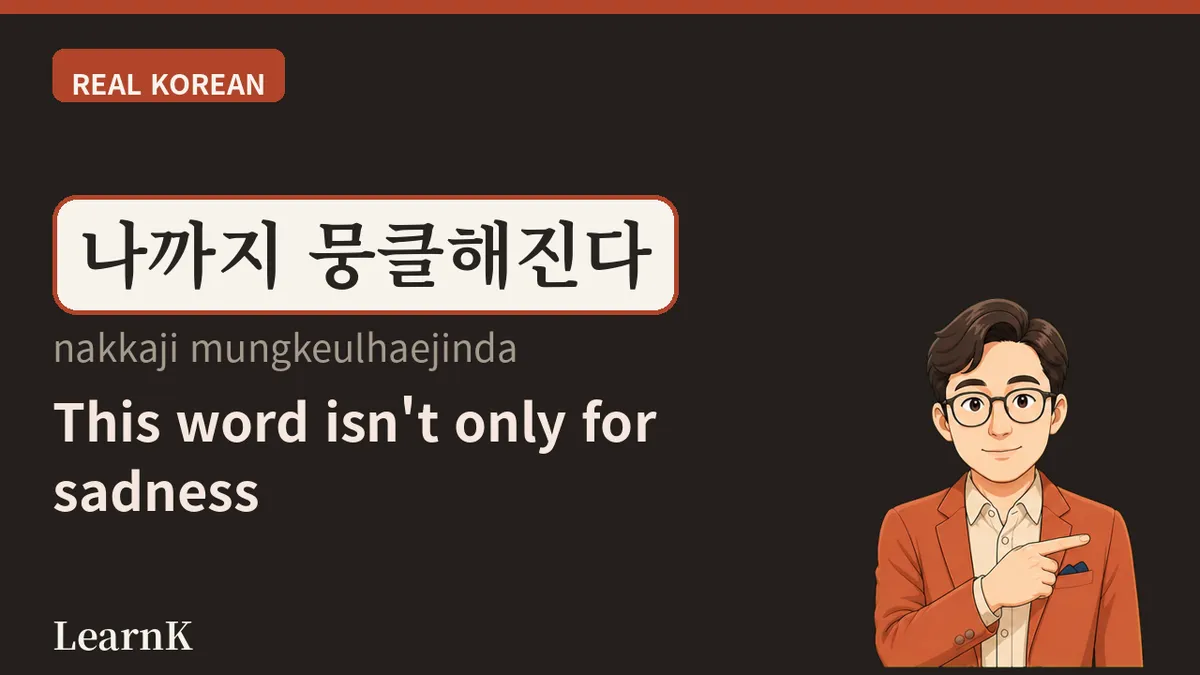
There are times when a certain scene suddenly leaves you speechless. It isn’t sad enough to make you burst into tears, nor joyful enough to make you laugh out loud — yet the center of your chest grows warm and something wells up until it feels completely full. When you unfold a handwritten letter from parents you haven’t seen in ages, or when you meet someone in a foreign country who quietly reaches out a hand to you, Koreans have one phrase for it. That phrase is 뭉클하다 (mungkeulhada).
뭉클하다
뭉클하다 (mungkeulhada) is an adjective that describes a state in which some emotion or feeling surges in so strongly that your chest fills up completely. The key point is that it’s a state of “something welling up inside you that you can’t fully put into words.” That’s why, when people feel 뭉클하다, they actually grow quieter, their throat tightens, and their eyes redden.
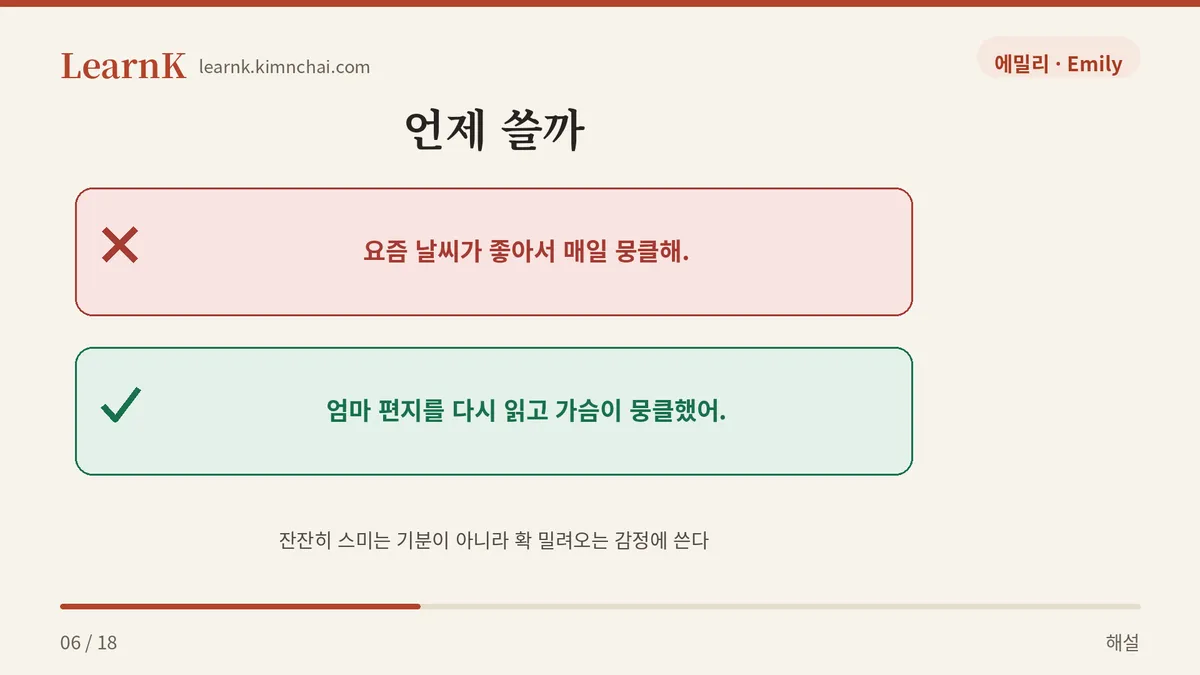
One thing to watch for is that this word isn’t reserved for sadness alone. Being moved, gratitude, longing, overflowing joy — it can hold any emotion that shakes your heart strongly. That said, it’s used not for feelings that seep in gently, but for those that rush in all at once with a sudden “whoosh” and fill up your chest. That’s why it’s mostly used paired with ‘가슴 (chest)’ or ‘마음 (heart/mind),’ as in 가슴이 뭉클하다 (gaseumi mungkeulhada) or 마음이 뭉클하다 (maeumi mungkeulhada).
Checking the National Institute of Korean Language Dictionary
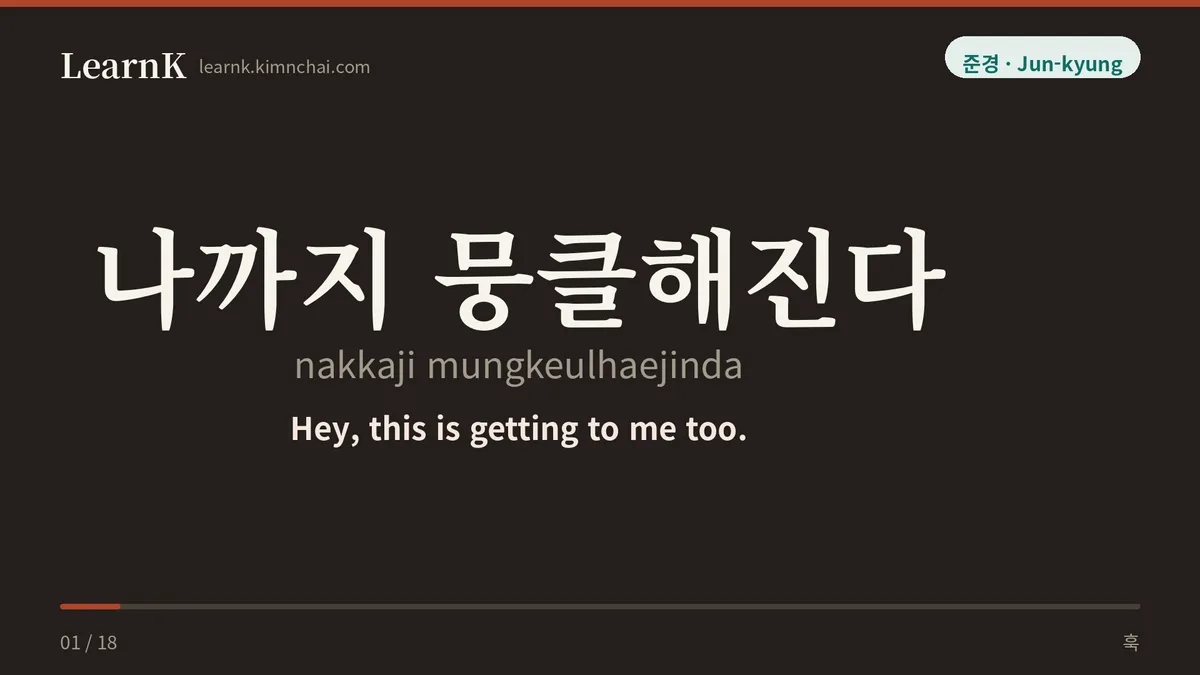
First, let’s confirm the exact meaning through the dictionary of an authoritative national institution.
뭉클하다 (adjective): To have the feeling that one’s chest is filled to the brim because some emotion or sentiment arises very strongly in one’s heart. — National Institute of Korean Language, Basic Korean Dictionary (krdict.korean.go.kr)
Definitions in several major languages are also provided.
[English] touching; moving — Feeling that one’s heart is filled with a strong emotion or sentiment. [Japanese] じいんとする。こみあげる【こみ上げる】 [Spanish] emocionante, conmovedor [Chinese] 心头一热,感动,感慨 — National Institute of Korean Language, Basic Korean Dictionary (krdict.korean.go.kr)
A Portuguese translation isn’t listed in the dictionary, so rendering it ourselves based on the definition above, something like emocionante, comovente comes closest. (our own translation)
Let’s also look at the actual usage examples the dictionary provides.
가슴이 뭉클하다. — National Institute of Korean Language, Basic Korean Dictionary (krdict.korean.go.kr)
This is the most representative form. It’s used in moments when emotion surges up, like reading a touching letter or finally meeting someone you’ve long waited for.
마음이 뭉클하다. — National Institute of Korean Language, Basic Korean Dictionary (krdict.korean.go.kr)
Swapping ‘마음’ in for ‘가슴’ means almost the same thing. It’s the phrase that comes out naturally when your heart is moved by someone’s small act of consideration or care.
Seeing It in a Real Conversation
Situation: On moving day, while sorting through the luggage, a bundle of letters spills out of an old box.
Jun-kyung: 이 상자 뭐야? 되게 무겁네. What’s this box? It’s really heavy.
Emily: 아, 그거… 나 처음 한국 왔을 때 엄마가 보내준 편지들이야. Oh, that’s… the letters my mom sent when I first came to Korea.
Jun-kyung: 진짜? 15년 전 거를 아직도 갖고 있어? Seriously? You still have stuff from 15 years ago?
Emily: 응. 아까 몇 개 다시 읽었는데, 나 진짜 가슴이 뭉클하더라. Yeah. I reread a few just now, and it really touched my heart.
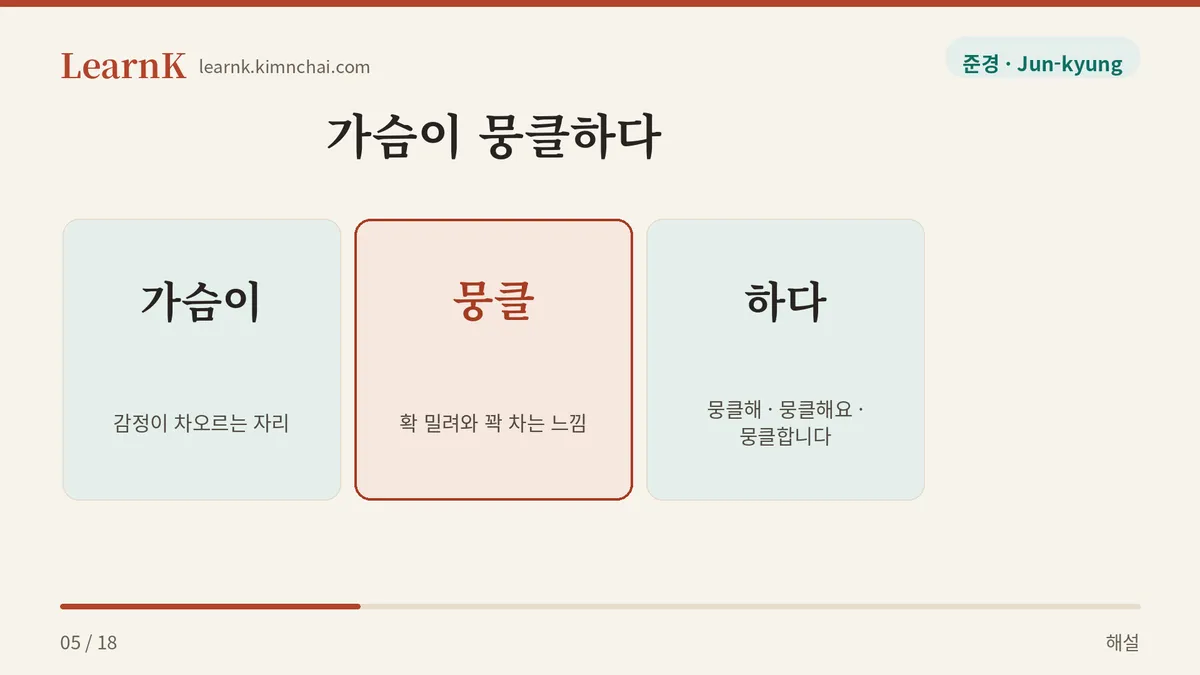
Jun-kyung: (편지를 들여다보며) …야, 나까지 뭉클해진다. 어머니 글씨 참 곱다. (looking at the letter) …hey, this is getting to me too. Your mom’s handwriting is beautiful.
Emily: 그치? 이건 도저히 못 버리겠어. Right? There’s no way I can throw these away.
Example Sentences by Situation
Let’s broaden your feel for the word with some sentences we made ourselves.
-
군대 간 아들이 첫 휴가를 나와 문을 여는 순간, 어머니는 가슴이 뭉클해 말을 잇지 못했다. (gaseumi mungkeulhae) — A classic scene where emotion surges up and the throat tightens before a long-awaited reunion. (Her son, away on military service, comes home on his first leave, and the moment he opens the door, his mother is so choked up she can’t get a word out.)
-
관객들은 마지막 장면에서 다들 마음이 뭉클해져 한동안 자리에서 일어나지 못했다. (maeumi mungkeulhaejyeo) — This is a 뭉클함 closer to “overwhelming emotion” than to sadness. (In the final scene, the whole audience was so moved that they couldn’t get up from their seats for a while.)
-
낯선 골목에서 길을 잃었을 때 할머니가 직접 데려다주셔서, 별것 아닌 일에도 괜히 뭉클했다. (mungkeulhaetda) — This shows how even a small kindness can suddenly fill up your heart. (When I got lost in an unfamiliar alley, an elderly woman walked me there herself, and even over something so minor I found myself unexpectedly moved.)
Formal & Informal Speech and Similar Expressions
Since ‘뭉클하다’ is an adjective, you just need to change the ending to suit the situation.
- Informal (반말): 뭉클해 (mungkeulhae) / 뭉클했어 (mungkeulhaesseo)
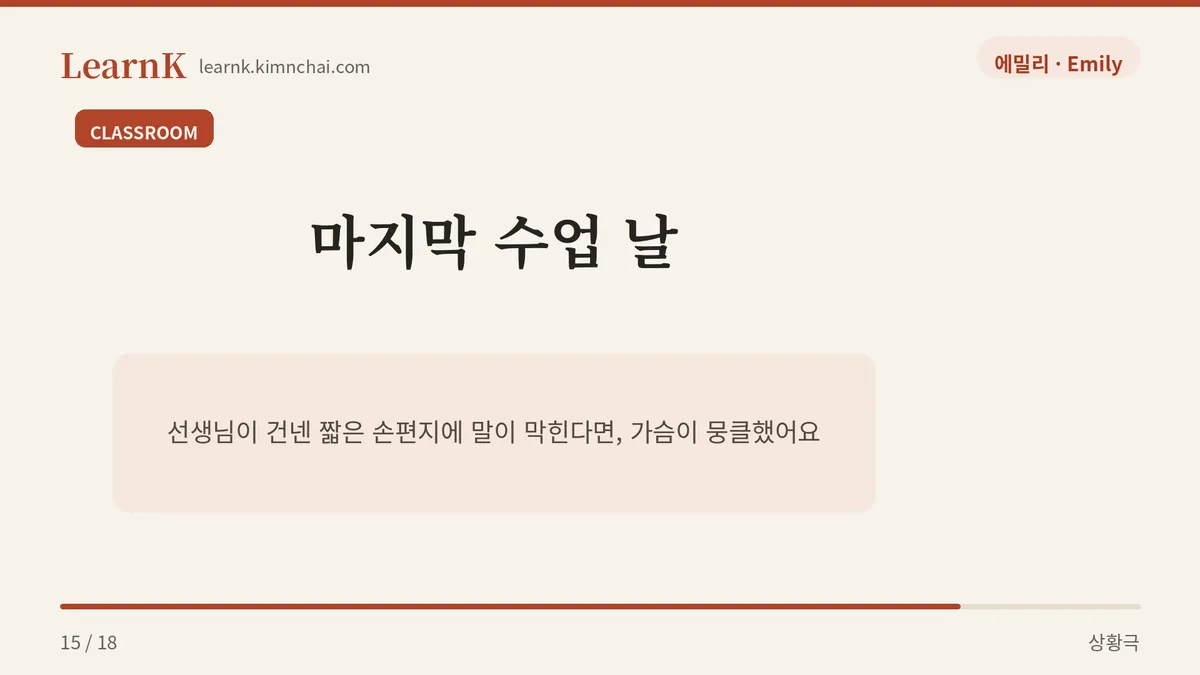
- Polite (존댓말): 뭉클해요 (mungkeulhaeyo) / 뭉클했어요 (mungkeulhaesseoyo) / in the formal style, 뭉클합니다 (mungkeulhamnida)
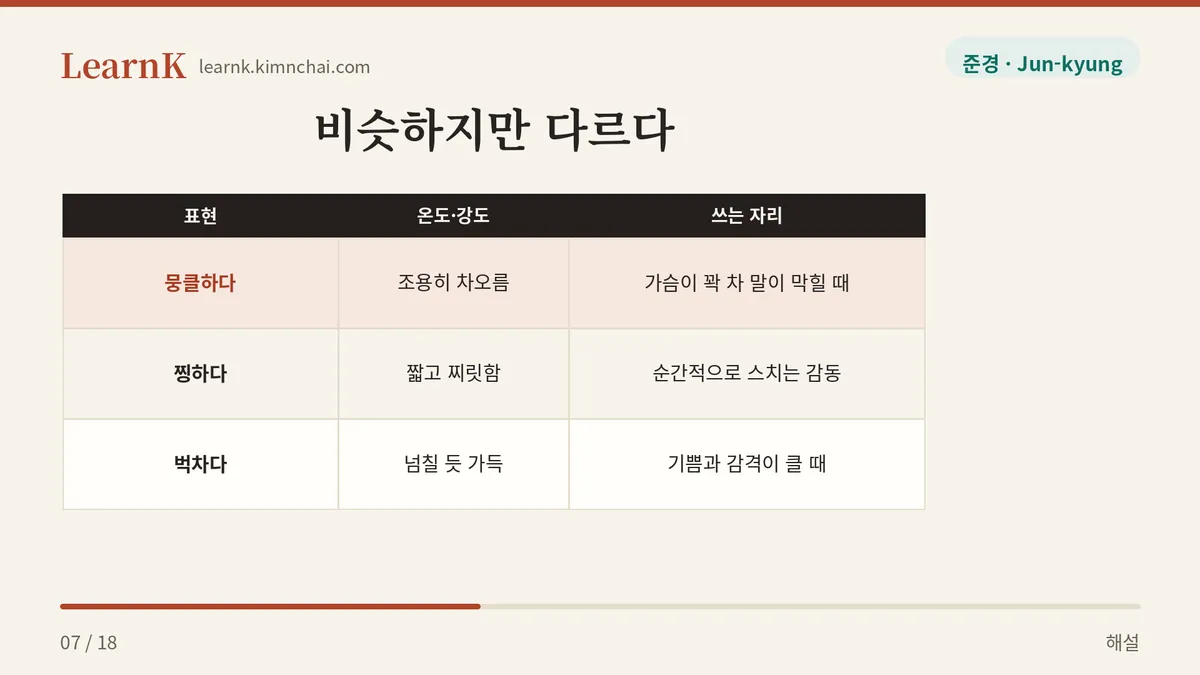
It also helps to know the differences from similar expressions. 찡하다 (jjinghada) is very close to 뭉클함, but it feels a bit shorter and more like a sharp, tingling flash. 벅차다 (beokchada) is about an emotion filling you up until it overflows, and it leans more toward joy and elation. 감동적이다 (gamdongjeogida) objectively describes something as “moving” from the outside, so it has a different texture from ‘뭉클하다,’ which directly expresses the reaction inside your own chest.
Cultural Background
When you watch Korean dramas or films, you often see actors holding back tears and pressing a hand to their chest. A reunion after a long separation, the moment of belatedly realizing a parent’s sacrifice — in front of scenes like these, viewers leave comments like “아, 진짜 뭉클하다 (Ah, this is so moving).” In Korean culture, which prizes an emotional style of pressing feelings down and holding them in rather than pouring them out loudly, ‘뭉클하다’ is the word that best captures that restrained kind of emotion.
Closing Quiz
Which word fits best in the blank below?
10년 만에 고향에 돌아와 어릴 적 살던 집을 마주한 그는, 가슴이 ______ 한참을 문 앞에 서 있었다. (Returning to his hometown after ten years and facing the house he’d lived in as a child, his heart ______, he stood in front of the door for a long while.)
① 뭉클해 ② 답답해 ③ 심심해 ④ 어색해 (① touched/moved ② stifled ③ bored ④ awkward)
(Answer: ①. Since this is a situation where emotion surges up strongly upon reencountering a place he’d long yearned for, ‘뭉클해’ is the most natural fit.)
Definitions and example sentences are from the National Institute of Korean Language’s Basic Korean Dictionary (krdict.korean.go.kr); that portion of this post, including our translations, is licensed under CC BY-SA 2.0 KR.