명대사 (myeongdaesa): The Moment a Single Drama Line Lodges in Your Heart

Have you ever been watching the final episode of a drama when a single line hits you right in the chest? A line that comes back to you along with that scene even years later; a sentence you chew over with a friend, saying, “Remember that line?” Koreans call a line like that a 명대사 (myeongdaesa). Today, let’s take a deep look at this word — a must-know for any fan of Korean culture.
명대사
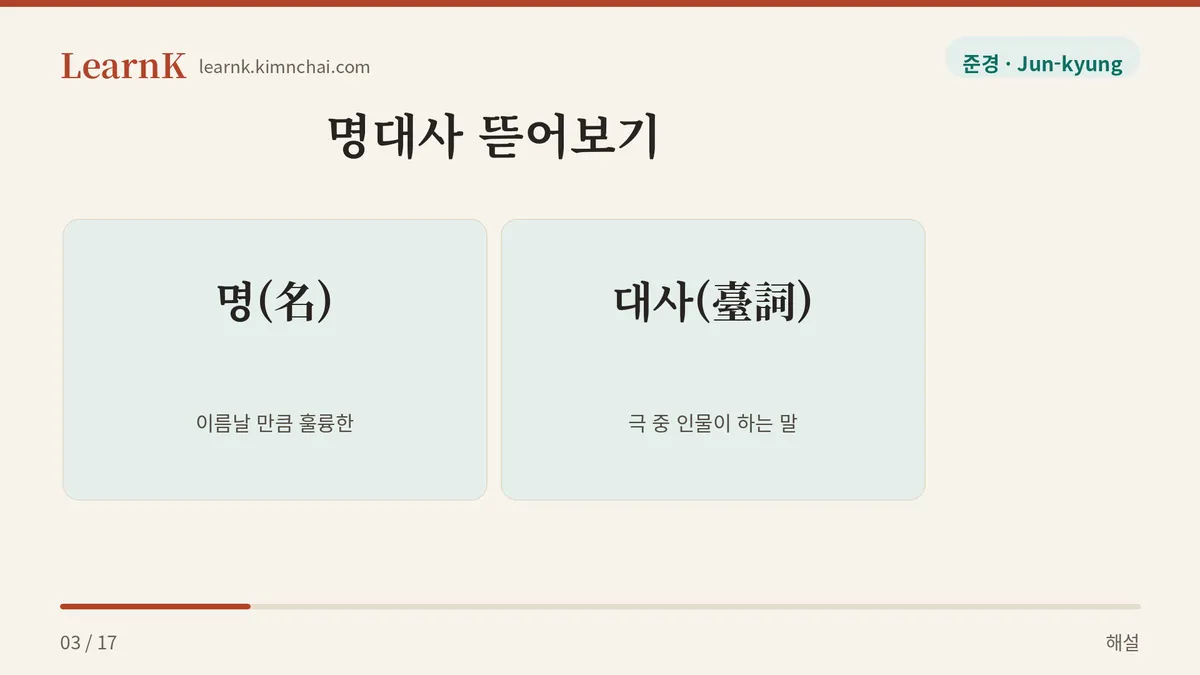
명대사 (myeongdaesa) is made up of the character for “name/fame” (名) plus 대사(臺詞), meaning “lines” (an actor’s dialogue). Read literally, it means “a famous line” — a line so excellent and striking that it stays remembered for a long time. Here, 대사 (daesa) refers to the words an actor speaks within a work. So a 명대사 isn’t just any old line; it’s a line that, though short, compresses a character’s emotions and the whole story and lodges firmly in people’s hearts.
Shall we look at the nuance a bit more? A 명대사 almost always carries praise and admiration. When someone says, “That’s a total 명대사,” there’s a note of awe mixed in — “that line was written so well, it’ll stick around for a long time.” It’s used not only for dramas and films but, these days, for variety shows and webtoons, and even in everyday conversation — when someone says something brilliant, people joke, “Wait, that was a 명대사 just now, wasn’t it?”
Checking the National Institute of Korean Language Dictionary

The National Institute of Korean Language’s Basic Korean Dictionary defines 명대사 like this:
명대사 (noun): A great and impressive line used in a movie or play. [en] famous line — A great and impressive line from a movie or play. [ja] 名セリフ — 映画や演劇で使われた素晴らしく印象深いセリフ。 [es] frase famosa — Frase genial e impresionante de una película o obra de teatro. [zh] 名台词,经典台词 — 电影或戏剧中优秀且令人印象深刻的台词。 — National Institute of Korean Language, Basic Korean Dictionary (krdict.korean.go.kr)
Looking at the actual usage examples the dictionary provides really helps it click.
이 영화에는 오래 기억될 명대사들이 나온다. — National Institute of Korean Language, Basic Korean Dictionary (krdict.korean.go.kr)
This sentence shows that a single film can hold several 명대사. Note that it’s used naturally in the plural, too, as in 명대사들 (myeongdaesadeul).
이 드라마는 명대사로 시청자를 웃기고 또 울렸다. — National Institute of Korean Language, Basic Korean Dictionary (krdict.korean.go.kr)
This nicely reveals that a 명대사 isn’t merely a cool line — it has the power to play with the viewer’s emotions.
유명 드라마 작가는 여러 작품들을 통해서 수많은 명대사를 남겼다. — National Institute of Korean Language, Basic Korean Dictionary (krdict.korean.go.kr)
Here you can see the pairing 명대사를 남기다 (myeongdaesareul namgida) — literally “to leave behind a famous line.” It’s used very often to mean putting a great line out into the world.
응. ‘내 안에 너 있다.’라는 대사가 누구나 아는 명대사가 되었더라고. — National Institute of Korean Language, Basic Korean Dictionary (krdict.korean.go.kr)
This example shows the process by which a particular line, over time, settles into a “nationwide 명대사.” Becoming a line that many people share together — that’s the highest honor a 명대사 can earn.
A Look at a Real Conversation
Setting: Sunday night. The final episode of a drama they’ve watched together for six weeks has just ended. Both of them are sprawled on the couch.
Jun-kyung: 아… 끝났네. 나 마지막 대사에서 진짜 눈물 핑 돌았어. Ah… it’s over. That last line actually made me tear up.
Emily: 나도! 주인공이 공항에서 돌아서면서 딱 한마디 하잖아. 그거 완전 명대사야. Me too! The lead turns around at the airport and says just one line — that’s a total famous line.
Jun-kyung: 그치? 저런 대사 하나만 잘 뽑아도 드라마 전체가 오래 기억에 남더라. Right? Just one good line like that, and the whole drama stays with you.
Emily: 맞아. 근데 나 아직 한국 드라마 명대사 많이 몰라. 꼭 봐야 할 옛날 명작 하나만 추천해줘. True. But I still don’t know many Korean drama famous lines. Recommend me one must-watch classic.
Jun-kyung: 음, 2000년대 멜로 하나 있는데, 거기 고백 장면 대사가 아직도 회자돼. Hmm, there’s a 2000s romance — the confession-scene line still gets quoted to this day.
Emily: 오, 당장 찾아볼래. 명대사부터 알고 보면 훨씬 재밌겠다. Ooh, I’ll look it up right now. It’ll be way more fun if I know the famous line going in.
Example Sentences by Situation
1. Recommending a drama to a friend ‘이 드라마, 명대사 (myeongdaesa) 가 진짜 많아서 대사 하나하나 곱씹게 돼.’ (I deurama, myeongdaesaga jinjja manaseo daesa hanahana gopssipge dwae.) — Here you’re recommending the drama while praising the sheer quality of its lines.
2. Wrapping up a presentation or a piece of writing ‘발표 끝에 영화 명대사 한 줄 인용하면 인상이 확 남아요.’ (Balpyo kkeute yeonghwa myeongdaesa han jul inyonghamyeon insangi hwak namayo.) — A practical use, drawing on a 명대사 as material to quote.
3. Praising an actor or a writer ‘좋은 배우는 관객에게 오래 남을 명대사를 남긴다.’ (Joeun baeuneun gwangaegege orae nameul myeongdaesareul namginda.) — This sentence carries over the very phrase 명대사를 남기다 we saw in the dictionary examples.
Formal vs. Casual Speech, and Similar Expressions
Because 명대사 is a noun, its form doesn’t change between formal and casual speech. Only the predicate that ends the sentence changes.
- Casual: ‘이거 완전 명대사다.’ (i-geo wanjeon myeongdaesada)
- Formal: ‘이건 정말 명대사네요.’ (i-geon jeongmal myeongdaesaneyo)
It’s good to learn some similar-but-different words alongside it, too.
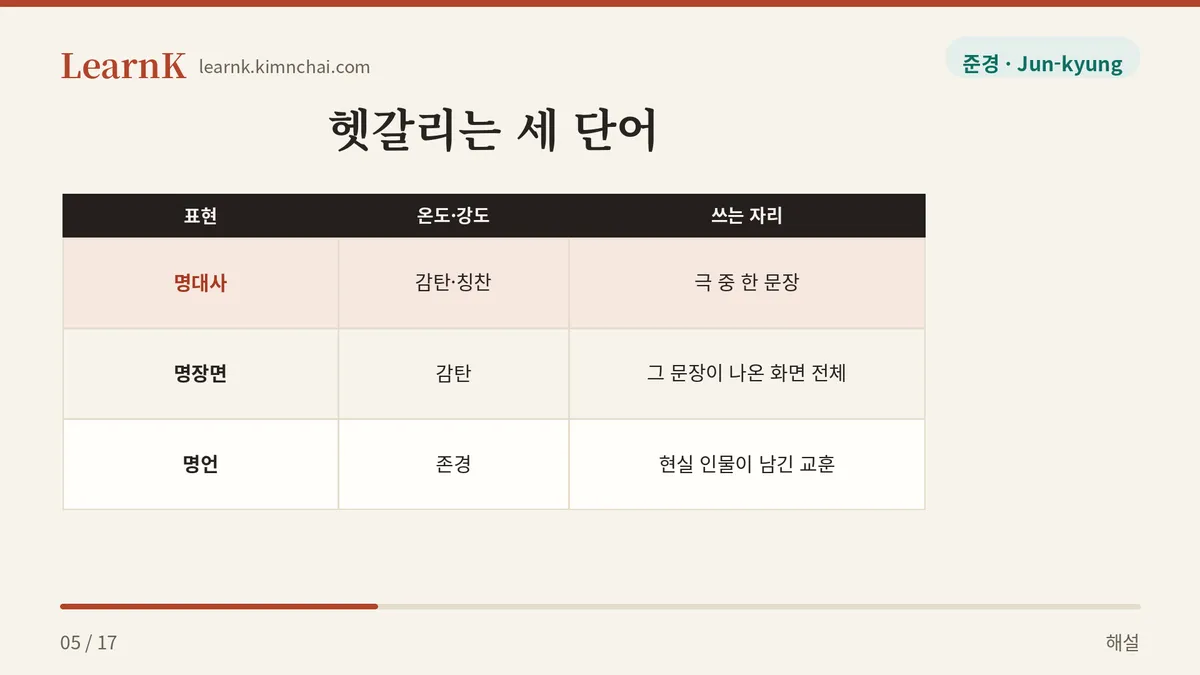
- 명장면 (myeongjangmyeon): An impressive “scene.” This points to the whole shot and staging, not the line.
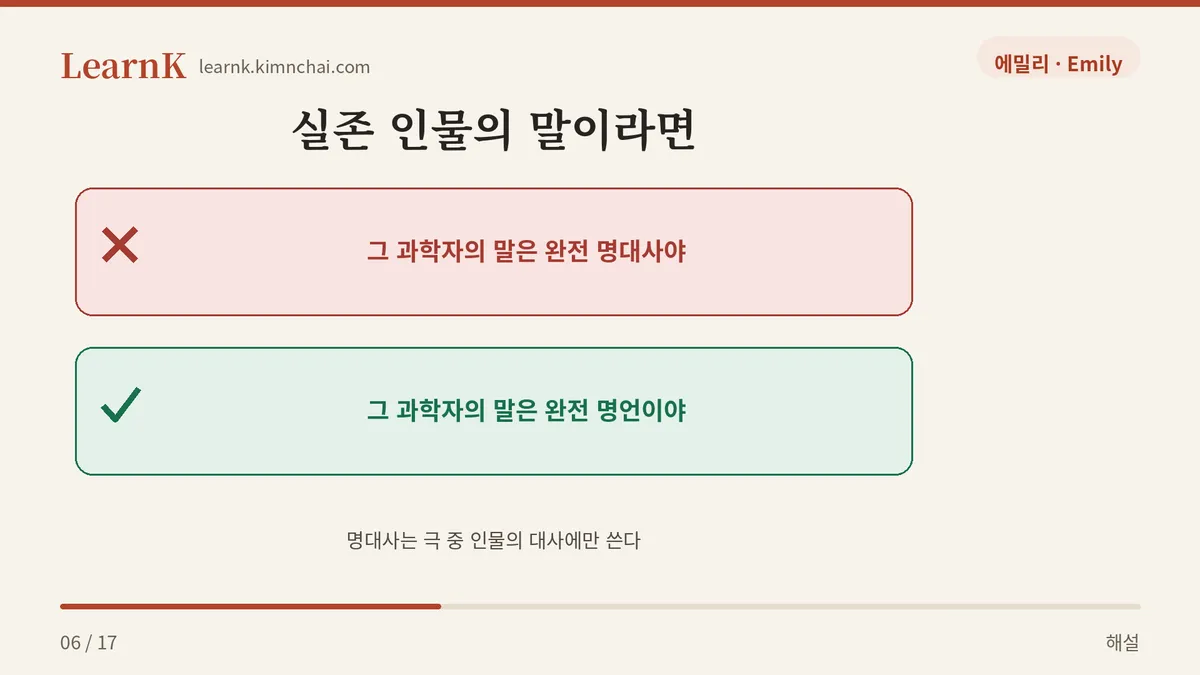
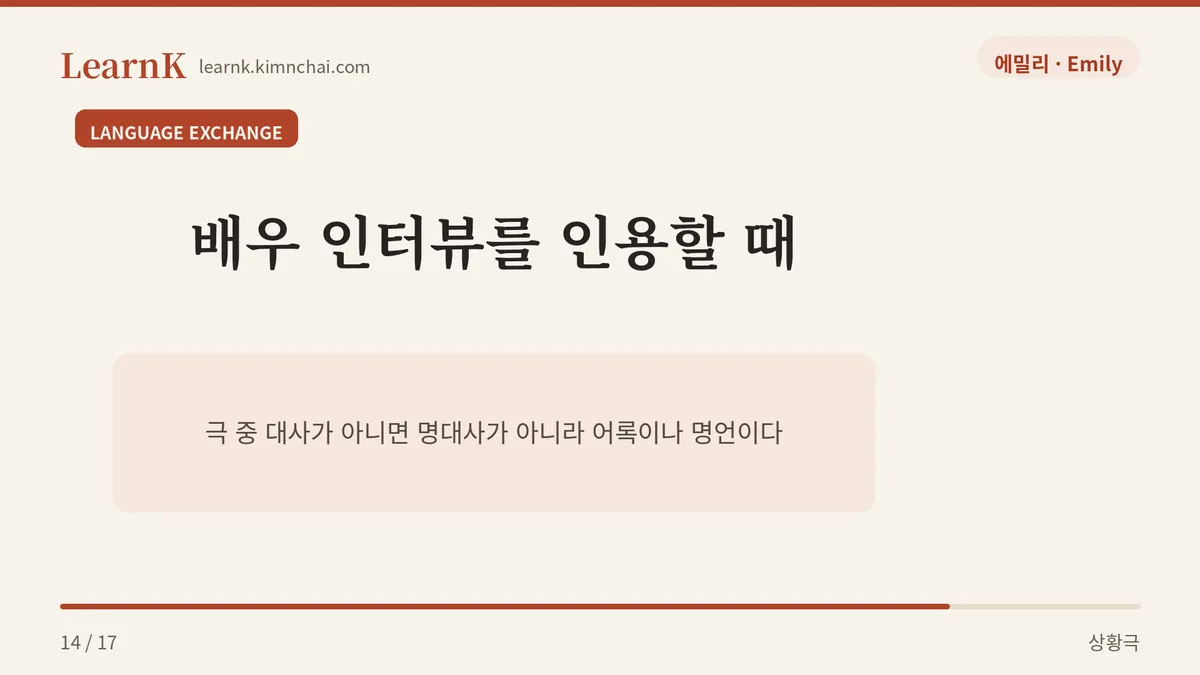
- 명언 (myeongeon): A “great saying” left by a great or famous person. It’s closer to a real-world maxim than a line within a work.
- 어록 (eorok): A collection of things a particular person has said. Used like ‘그 배우 어록 (that actor’s quotes).’
In short: a single sentence within a drama is a 명대사; the whole shot that sentence appears in is a 명장면; and a lesson from a real-life great figure is a 명언.
Cultural Background
In Korea, 명대사 goes beyond mere dialogue — it’s a cultural phenomenon. When a popular drama ends, its 명대사 trend on portal sites, and fans turn those scenes into short videos (clips) to share. A 명대사 becomes a meme, endlessly remixed in comments and everyday conversation, and even years later, a single “You know that line, right?” connects across generations. From a Korean learner’s standpoint, a 명대사 is also great study material: it’s short, it’s loaded with emotion, and you can listen to it over and over with subtitles. Try memorizing a 명대사 from your favorite drama, one whole sentence at a time. That one sentence will stay with you far longer than ten lines of grammar explanation.
Closing Quiz
Which word best fits the blank below?
‘이 드라마는 배우들의 연기도 좋지만, 무엇보다 오래 기억될 ______ 가 많아서 명작으로 꼽힌다.’ (“This drama has good acting, but above all it’s counted a masterpiece because it has so many long-to-be-remembered ______.”)
① 명장면 ② 명대사 ③ 명언 ④ 어록
(Hint: this is a spot for praising the “lines” (대사). The answer is ②, 명대사! 명언 is a real-world maxim and 명장면 refers to a whole shot, so neither fits here.)
Definitions and example sentences are from the National Institute of Korean Language’s Basic Korean Dictionary (krdict.korean.go.kr); that portion of this post, including our translations, is licensed under CC BY-SA 2.0 KR.