What Do 남주 and 여주 Mean? Must-Know Abbreviations Every K-Drama Fan Uses
Have you ever been watching a K-drama and decided to read the comments from Korean fans? You’ll see an endless stream of sentences like “이번 남주 진짜 잘생겼다” (this show’s namju is seriously handsome) and “여주 연기 미쳤다” (the yeoju’s acting is insane). You won’t find these words in the dictionary, yet every Korean instantly knows what they mean. Today we’re digging deep into the two words that pop up most often in the K-drama world: 남주 (namju) and 여주 (yeoju). Just knowing these two words will make conversations in Korean fan communities suddenly snap into focus.
남주 / 여주
남주 (namju) is a shortened form of 남자 주인공 (namja jugong) — in other words, the “male main character.” 여주 (yeoju) is short for 여자 주인공 (yeoja jugong), the “female main character.” You’ll see these words used anywhere there’s a story: dramas, movies, webtoons, and web novels.
Korean loves to shorten long words by taking just the first letter of each part. 남자 주인공 → 남주, 여자 주인공 → 여주. Once you know the pattern, they’re easy to remember. By the way, the rival who serves as a counterpart to the main character — the “secondary male lead” — is called 서브남주 (seobeu-namju), or 서브남 (seobeunam) for short. When fans in a love-triangle story say “나는 서브남 응원해” (I’m rooting for the seobeunam), it means they like the rival character more than the main lead.
Let’s touch on the nuance too. Rather than being official standard words listed in the dictionary, 남주 and 여주 are everyday abbreviations that took hold among fans and viewers. That’s why news articles and official press releases still use the full expressions ‘남자 주인공’ and ‘여자 주인공’. On the flip side, when you’re texting a friend on KakaoTalk or posting a review on social media, it’s almost 100% 남주 and 여주. So just remember it this way: formal writing = 주인공 / casual conversation = 남주·여주.
Example Sentences by Situation
① When recommending a new drama
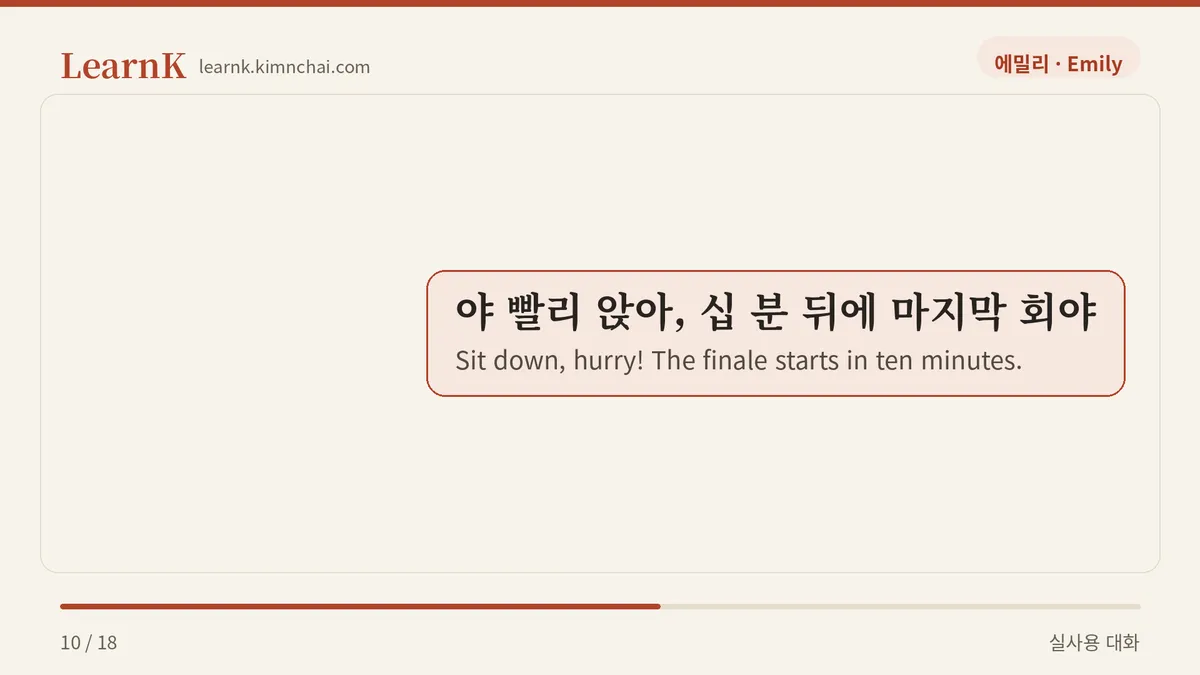
이번 주에 시작한 드라마 남주가 완전 내 취향이야. 너도 꼭 봐! (ibeon jue sijakhan drama namjuga wanjeon nae chwihyangiya.) The namju in the drama that started this week is totally my type. You have to watch it!
Here you’re recommending a new show to a friend. ‘내 취향’ means ‘the style I like,’ so this is saying the namju’s looks or personality are exactly to your taste.
② When praising a character’s storyline
여주가 혼자 힘으로 회사를 키우는 게 진짜 멋있어. (yeojuga honja himeuro hoesareul kiuneun ge jinjja meosisseo.) It’s so cool how the yeoju builds up her company all by herself.
This expresses that you love a story where the female lead grows on her own terms. It perfectly captures the taste for the ‘주체적인 여주’ (independent female lead) that’s popular in K-dramas these days.
③ When talking about two actors’ rapport
남주랑 여주 케미가 장난 아니라서 눈을 못 떼겠어. (namjurang yeoju kemiga jangnan aniraseo nuneul mot ttegesseo.) The chemistry between the namju and yeoju is unreal — I can’t take my eyes off the screen.
Here, 케미 (kemi) comes from the English word “chemistry” and refers to the great rapport between two actors. ‘눈을 못 떼다’ (can’t take your eyes off) is an idiom meaning you’re so absorbed that you can’t look away from the screen.
Formal vs. Casual Speech, Plus Similar Expressions
Since 남주 and 여주 aren’t terms of address for calling out to people but rather ‘nouns that point to a role,’ the words themselves don’t carry a formal/casual distinction. Instead, the level of formality is determined by the verb ending that closes the sentence.
- Casual: 남주 진짜 멋있어. (namju jinjja meosisseo.)
- Formal: 남주가 정말 멋있어요. (namjuga jeongmal meosisseoyo.)
Shall we sort out some similar words too? 주연 (juyeon) mainly refers to an actor, as in ‘주연 배우’ (lead actor), while 주인공 (jugong) is the broadest term, meaning the central figure in a story overall. 주인공 can be used regardless of gender, so you can say something like “이 드라마의 주인공은 두 명이야” (this drama has two protagonists) without specifying gender at all. In contrast, 남주 and 여주 are casual abbreviations with the gender clearly fixed — that’s the difference.
Cultural Background — Why Do Fans Love These Words?
It’s no exaggeration to say that half the fun of a K-drama lies in ‘how the namju and yeoju end up together.’ The so-called ‘밀당’ (push-and-pull) of bickering their way into love, the class gap between a chaebol namju and an ordinary yeoju, the bittersweet love triangle with a seobeu-namju — the two leads are the axis around which all of these stories turn. That’s why fans get buzzing even before a show airs, asking “남주 누가 맡아?” (who’s playing the namju?) and shouting “여주 캐스팅 떴다!” (the yeoju casting is out!).
Let’s picture one scene. The gruff, standoffish namju, for the first time, pours out his true feelings toward a yeoju who’s in danger — a confession scene. In this moment that any Korean drama fan can easily call to mind, viewers flood the live chat with “남주 드디어 고백한다!!” (the namju is finally confessing!!). In this way, 남주 and 여주 have become more than simple abbreviations — they’ve become a language of emotion that fans use to swoon and cheer together.
Today’s Quiz
A friend watched a new drama and said this: “여주가 스스로 사건을 해결하는 게 너무 멋져!” (It’s so cool how the yeoju solves the case herself!). Who is your friend praising here?
① The male lead ② The female lead ③ The drama’s director
The answer is ②, the female lead. 여주 = 여자 주인공 (female main character) — don’t forget it! Now you too can naturally shout “이번 남주 최고!” (this show’s namju is the best!) among Korean fans. 🎬