네요 (neyo) — The Signal That You Just Found Out
네요
네요 (neyo) is a polite sentence-final ending that you attach when you react — with a little surprise or admiration — to something you have just this moment learned. Spend even a single day in Korea and you will have a hard time getting through it without hearing these two syllables. Hold out your card at a convenience store and the clerk says, “아, 이거 오늘부터 할인이네요 (a, igeo oneulbuteo harinineyo)” — oh, this is on sale starting today. Someone you haven’t seen in a while looks at your face and says, “머리 자르셨네요 (meori jareusyeonneyo)” — you got a haircut. The delivery driver hands over the box: “이거 좀 무겁네요 (igeo jom mugeomneyo)” — this one’s a bit heavy. All three sentences do the same job. They announce out loud, to the person in front of you, something you have just discovered.
Textbooks usually introduce ‘네요’ in a single line as an exclamatory ending and move on. In real conversation, though, this ending does far more than exclaim. This is exactly the point where the speech of someone who has studied Korean for a few years parts ways with the speech of someone who has lived in Korea for a few years. The sentences may all be correct, but without ‘네요’ your words land stiffly and drop dead; with it, the conversation keeps rolling.
There are three keys to using ‘네요’ well.
First, just now. It doesn’t attach to things you already knew. I know that my company is in Seoul, so I don’t say “우리 회사는 서울에 있네요 (uri hoesaneun Seoure inneyo).” But if I open a map and find out for the first time that the office is a five-minute walk from the subway station, then out comes 어, 역에서 가깝네요 (eo, yeogeseo gakkamneyo) — oh, it’s close to the station. Same company, same fact, different ending. The difference isn’t the information; it’s when that information arrived in my head.
Second, firsthand confirmation. ‘네요’ sits well on what you have learned by seeing, hearing, tasting, or touching. It is far more natural for what you’ve verified with your own eyes than for a story you heard secondhand. That’s why this ending multiplies in restaurants, in a home you’re visiting for the first time, in front of a face you haven’t seen in ages, in front of a delivery box you’ve just opened.
Third, temperature. ‘네요’ carries an attitude that is turned slightly toward the other person. It can be muttered to yourself, but usually it’s said for the person beside you to hear. It’s a signal that says, “I found something — did you see it too?” and an invitation to keep the conversation going. So when a Korean has nothing particular to say once the other person has finished speaking, they reach for 그렇네요 (geureonneyo) rather than 그렇군요 (geureokunyo). The former is warmer and less formal.
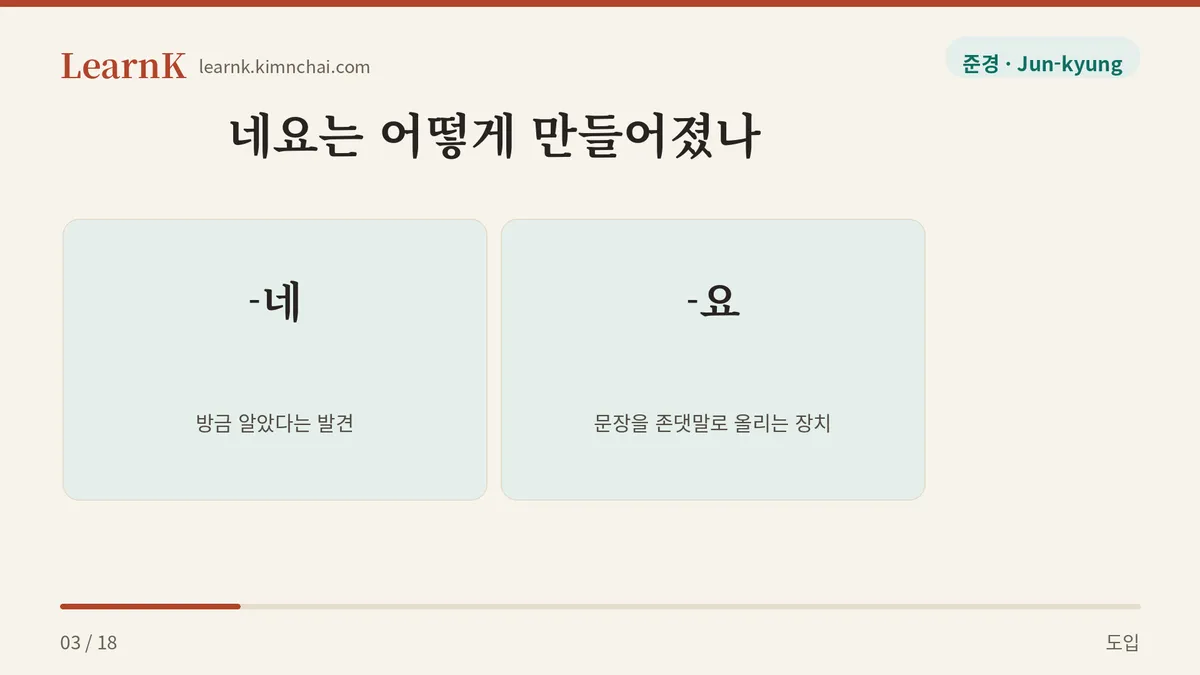
And, exactly as the ‘요’ in it suggests, this is 존댓말 (jondaenmal), polite speech. It’s the casual ending ‘-네’ with the polite ‘-요’ stuck on the back, so among friends you can simply drop the ‘-요’ and say 좋네 (jonne).
A Real Conversation
Scene: Saturday morning, the studio apartment Emily has just moved into. Jun-kyung has come up the stairs for the first time, arms around a box.
Jun-kyung: 어, 여기 생각보다 넓네요. 사진으로 볼 땐 좁아 보였는데. Oh, this place is bigger than I expected. It looked small in the photos.
Emily: 그쵸? 저도 계약할 때 놀랐어요. 근데 계단이 좀… Right? I was surprised too when I signed. But the stairs are a bit…
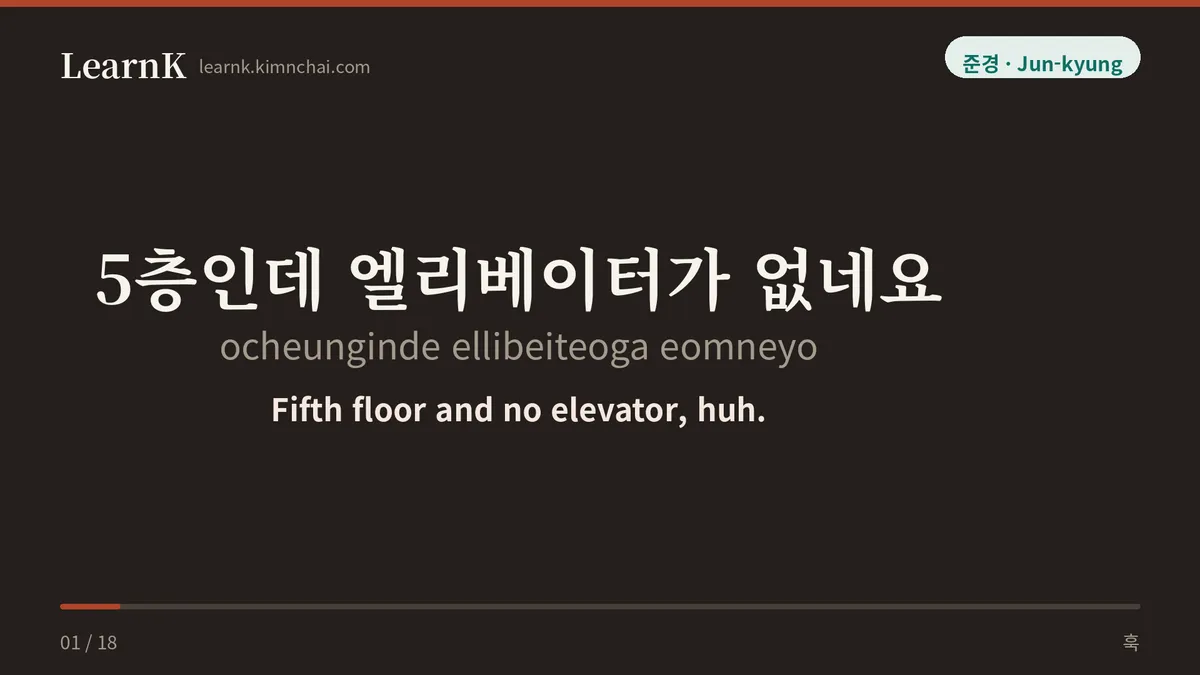
Jun-kyung: 아, 진짜. 5층인데 엘리베이터가 없네요. (숨 고르며) 아이고. Ah, seriously. Fifth floor and no elevator, huh. (catching his breath) Oof.
Emily: 죄송해요… 커피라도 타 드릴게요. 어, 근데 컵이 어느 박스에 있지? Sorry… let me at least make you a coffee. Wait, which box are the cups in?
Jun-kyung: 됐어요, 그냥 앉아요. 저기 창문 좀 봐요. 볕 잘 드네요. Never mind, just sit. Look at that window — the sunlight comes right in.
Emily: 아 진짜 좋다. 이제 좀 우리 집 같네요. Oh, that’s really nice. Now it finally feels like my place.
Notice that all four instances of ‘네요’ are attached to something seen for the first time: the room that turned out to be roomy, the elevator that isn’t there, the sunlight streaming in, and the my-place feeling that only arrives once the last box is upstairs. That’s why moving day is peak season for ‘네요’.
When It Comes Out Wrong
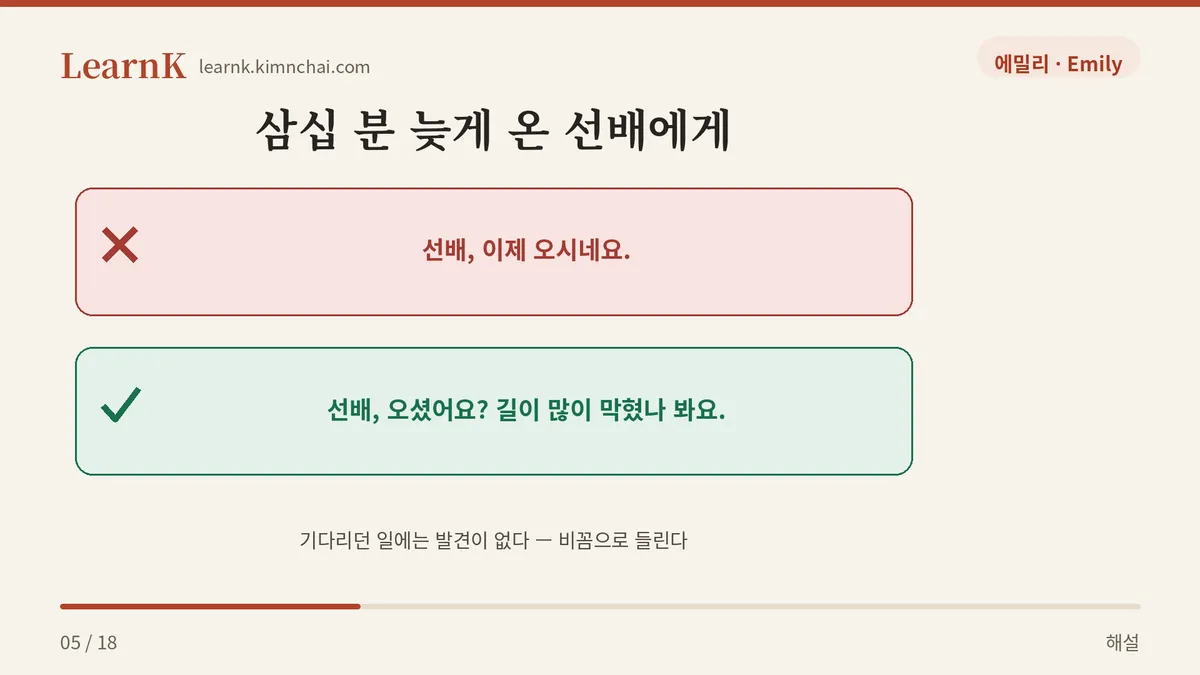
✗ (to a 선배 who showed up thirty minutes late) 선배, 이제 오시네요. (seonbae, ije osineyo.) — Oh, so you’re here now. ✓ (to a 선배 who showed up thirty minutes late) 선배, 오셨어요? 길이 많이 막혔나 봐요. (seonbae, osyeosseoyo? giri mani makyeonna bwayo.) — You made it. Traffic must have been terrible. → ‘네요’ is the ending of discovery: “ah, I only just realized.” Pin it on something you were plainly sitting there waiting for and it stops being a discovery and becomes a dig. It’s one of the most common sarcasm devices in Korean, so aimed at someone senior to you it sounds like an open complaint.
✗ (to a colleague who just told you they failed an exam) 아, 떨어지셨네요. (a, tteoreojisyeonneyo.) — Ah, so you failed. ✓ (to a colleague who just told you they failed an exam) 아… 고생 많으셨어요. 얼마나 속상하세요. (a… gosaeng maneusyeosseoyo. eolmana soksanghaseyo.) — Ah… you worked so hard for that. You must be so upset. → The grammar is perfectly sound. The problem is the temperature. ‘네요’ has a grain of exclaiming-and-spectating mixed into it, so attached to someone else’s bad news it turns you into a bystander watching from outside. For another person’s misfortune, put a sentence of empathy where the ending of discovery would have gone.
Examples by Situation
Situation 1 — First spoonful at the 국밥 (gukbap) place a colleague recommended
어, 국물이 진하네요. (eo, gungmuri jinhaneyo.) Oh, the broth is rich.
If you take the first spoonful in front of the person who recommended the place and say nothing, that silence itself becomes your review. A single ‘네요’ delivers “I tasted it” and “it’s good” at the same time. This is the most heavily used ending at the dinner table.
Situation 2 — Seeing the face of someone you haven’t met in two months
머리 자르셨네요. (meori jareusyeonneyo.) You got a haircut.
In Korea, the first thing you say to someone you haven’t seen in a long time is usually an observation. You’ve lost weight; you look well; you cut your hair. Adding the honorific with the ‘-셨네요’ shape layers on the meaning “I’ve been looking closely at you.” It’s a form of greeting where observation comes before compliment.
Situation 3 — After reading a friend’s long message all the way through
아, 그런 일이 있었네요. (a, geureon iri isseonneyo.) Ah, so that’s what happened.
You use ‘네요’ for stories you read, too — because you’ve only just learned them. When someone unspools a long story in a KakaoTalk chat, sending this one line first is a signal that says “I read it, and I’ve taken it in.” Leave it out and jump straight to advice, and you come across as cold.
Polite and Casual Forms, and Nearby Expressions
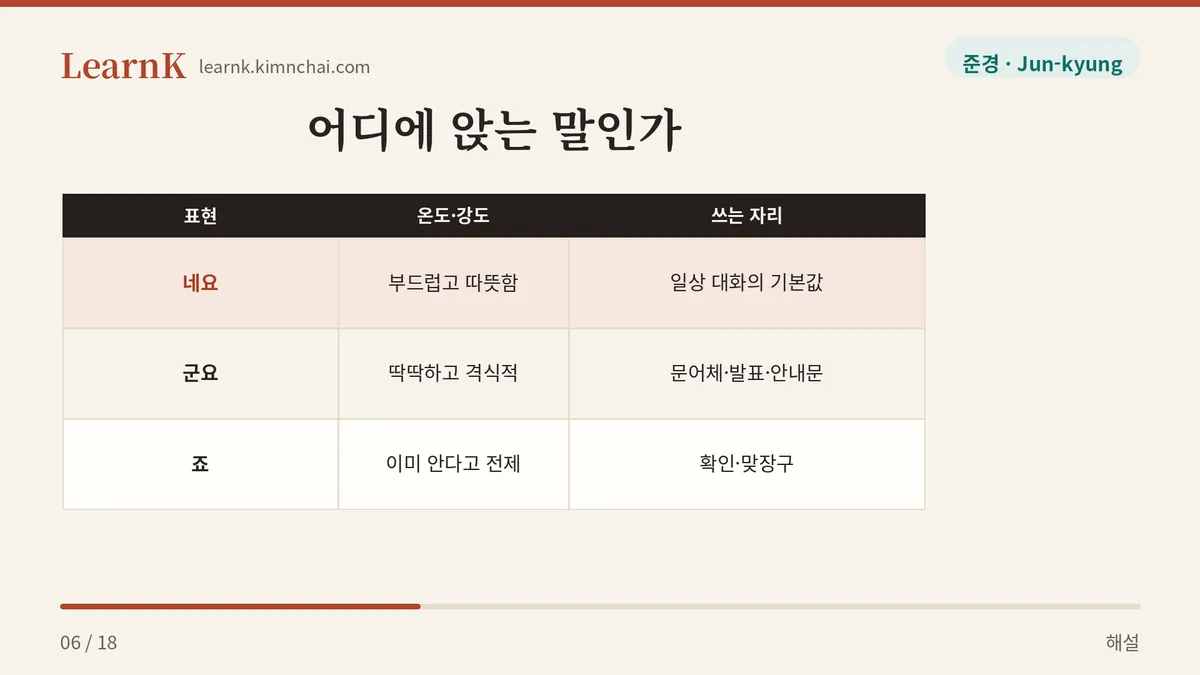
| Expression | Temperature & strength | Where it belongs |
|---|---|---|
| 네요 (neyo) | Soft and warm. A light exclamation about something just noticed | Almost anywhere polite speech is needed. Safe across the board — at work, with people you’ve just met, even with elders |
| 네 (ne) | The casual version of the same meaning. More immediate, more relaxed | Friends and people younger than you. “와, 크네 (wa, keune)” — whoa, it’s big |
| 군요 (gunyo) | Stiffer and more formal. Lower emotional temperature | Written style, presentations, official notices. Overuse it in daily conversation and you sound like an older generation |
| 죠 (jyo) | Assumes the listener already knows it too, and asks for agreement | Confirming and chiming in, as in “좋죠? (jotjyo?)” — nice, right? Can’t be used for new information |
| 더라고요 (deoragoyo) | Reporting now something you experienced and learned firsthand in the past | Recollection. “가 보니까 멀더라고요 (ga bonikka meoldeoragoyo)” — I went, and it turned out to be far — discovered back then, not now |
The pair that confuses learners most is 네요 and 군요. The meanings are nearly the same; the settings are not. Looking at a room right in front of you, “넓네요 (neolleyo)” is the natural choice; writing it up in a report, you don’t reach for “넓군요 (neolkkunyo)” either — you switch to an entirely different register. That’s why, when a foreign learner uses ‘군요’ a lot, Koreans quietly register it: “ah, learned from a book.” For everyday conversation you’re better off setting 네요 as your default.
The second most confusing pair is 네요 and 죠. If you just found out, ‘네요’; if you knew all along, ‘죠’. At a restaurant you’re visiting for the first time, asking “여기 맛있죠? (yeogi masitjyo?)” lays down the assumption that this is a fact both you and I already know, and the whole thing turns awkward.
Cultural Background — Where Chiming In Is Politeness
The construction is simple. It’s just the casual ending -네 with the polite -요 added. In Korean, ‘요’ is the shortest device there is for lifting an entire casual sentence up into polite speech. 가? → 가요? / 먹어 → 먹어요 / 좋네 → 좋네요 (ga? → gayo? / meogeo → meogeoyo / jonne → jonneyo). That puts ‘네요’ among the easier polite endings to learn: pick it up in casual form first, then lay the ‘요’ on top.
There is a cultural reason this ending is heard so constantly. In Korean conversation, it gets uncomfortable when the listener goes quiet. If the other person makes no sound at all, the speaker starts to worry — are they even listening? So Koreans chime in nonstop. 아, 진짜요? 그랬구나. 그러네요. (a, jinjjayo? geuraetguna. geureoneyo.) — oh, really? I see. It really is. On that list of chime-ins, ‘네요’ is the cheapest and safest card in the deck. It doesn’t require content, it doesn’t pass judgment on the other person, and because it’s polite speech you can hand it to anyone without an accident.
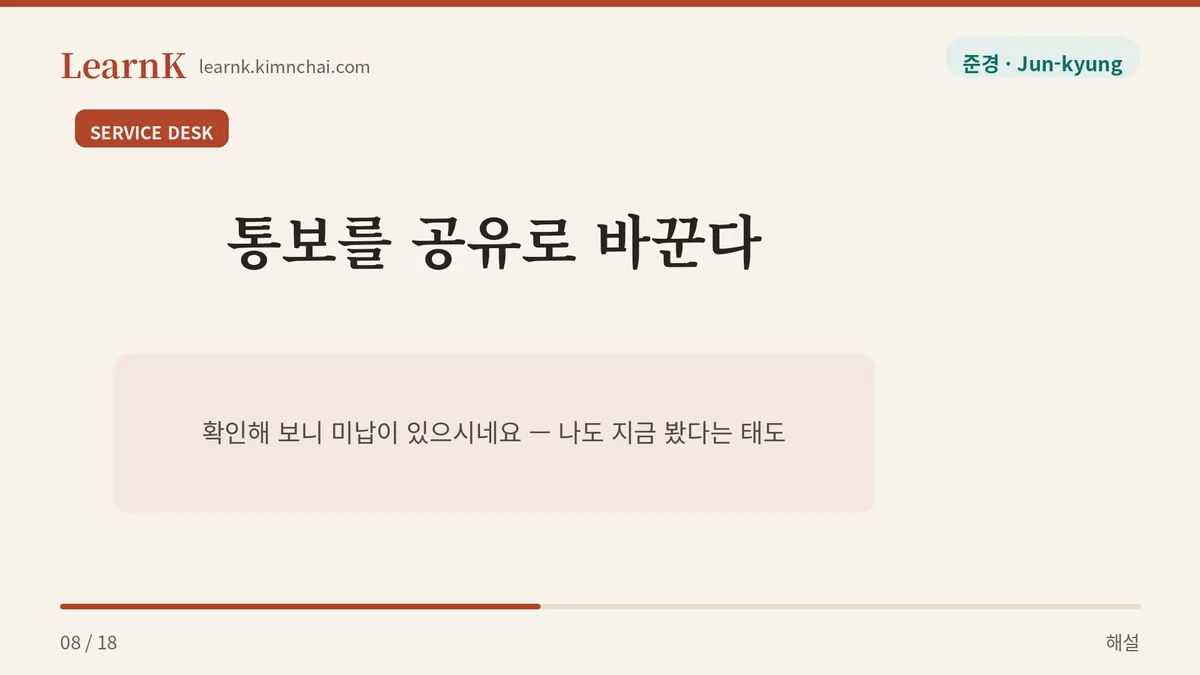
In service work this ending takes on another job: it’s the padding wrapped around bad news. Instead of an agent flatly saying “미납 요금이 있으십니다 (minap yogeumi isseusimnida)” — you have an unpaid balance — saying “확인해 보니 미납이 있으시네요 (hwaginhae boni minabi isseusineyo)” — I’ve checked, and it looks like there’s an unpaid balance — creates the sense that they only just learned it too, that the two of you are looking at the same screen from the same side. A notification becomes something shared.
The scene where ‘네요’ shows up at its densest in dramas is the first meeting. Matchmaking dates, job interviews, blind dates. Opening with “생각보다 ○○하시네요 (saenggakboda ○○hasineyo)” — you’re more ○○ than I expected — on first sight of the other person is ancient grammar in Korean drama. That one line pulls off two things at once: a declaration that you have observed them, and a knock on the door to start a conversation. When you’re watching a Korean drama, the moment this ending appears, look at the character’s face instead of the subtitles and you’ll see exactly whether it’s admiration or sarcasm. The “이제 오시네요” from earlier is precisely that case.
Today’s Quiz
Which of the following sentences is awkward with ‘네요’?
- (Looking around a friend’s place for the first time) 집이 참 아늑하네요. (jibi cham aneukaneyo.) — Your place is really cozy.
- (Talking about your own business trip, which was already fixed last week) 저 내일 부산에 가네요. (jeo naeil Busane ganeyo.) — I’m going to Busan tomorrow.
- (Looking out the window) 어, 비 오네요. (eo, bi oneyo.) — Oh, it’s raining.
- (Tasting it for the first time) 생각보다 안 맵네요. (saenggakboda an maemneyo.) — It’s less spicy than I expected.
Answer: 2
‘네요’ attaches to facts you have just come to know. My own travel schedule is something I’ve known since last week, so there is nothing left to discover. Put ‘네요’ on it and you sound like a spectator watching your own calendar as if it were somebody else’s news. Here you simply say 저 내일 부산에 가요 (jeo naeil Busane gayo) — I’m going to Busan tomorrow. Flip it around: if you were told this morning that a trip had suddenly been scheduled, then “어, 저 내일 부산 가네요 (eo, jeo naeil Busan ganeyo)” is perfectly natural. Whether the very same sentence sounds right comes down to when you found out — remember that one thing and you’ve got ‘네요’ finished.