노답 (nodap) — The Two-Syllable Word Koreans Use to Call a Situation Hopeless
노답 (nodap) is internet slang shortened from 답이 없다 (dabi eopda), “there’s no answer.” It means that no matter what you try, no solution is in sight. Think of that sinking feeling when you get an exam paper and there isn’t a single question you can solve — 노답 takes that feeling and pastes it onto an entire situation.
When the subway has been sitting still for twenty minutes and the announcement keeps repeating 잠시만 기다려 주십시오 (jamsiman gidaryeo jusipsio), “please wait a moment.” When the rainy season has dragged on for two weeks and your laundry has started to smell sour. When nobody has answered in the group project chat for three days. Koreans don’t explain at length in moments like these. They toss out one short line and leave it there: 이거 진짜 노답이다 (igeo jinjja nodabida), “this is seriously hopeless.”
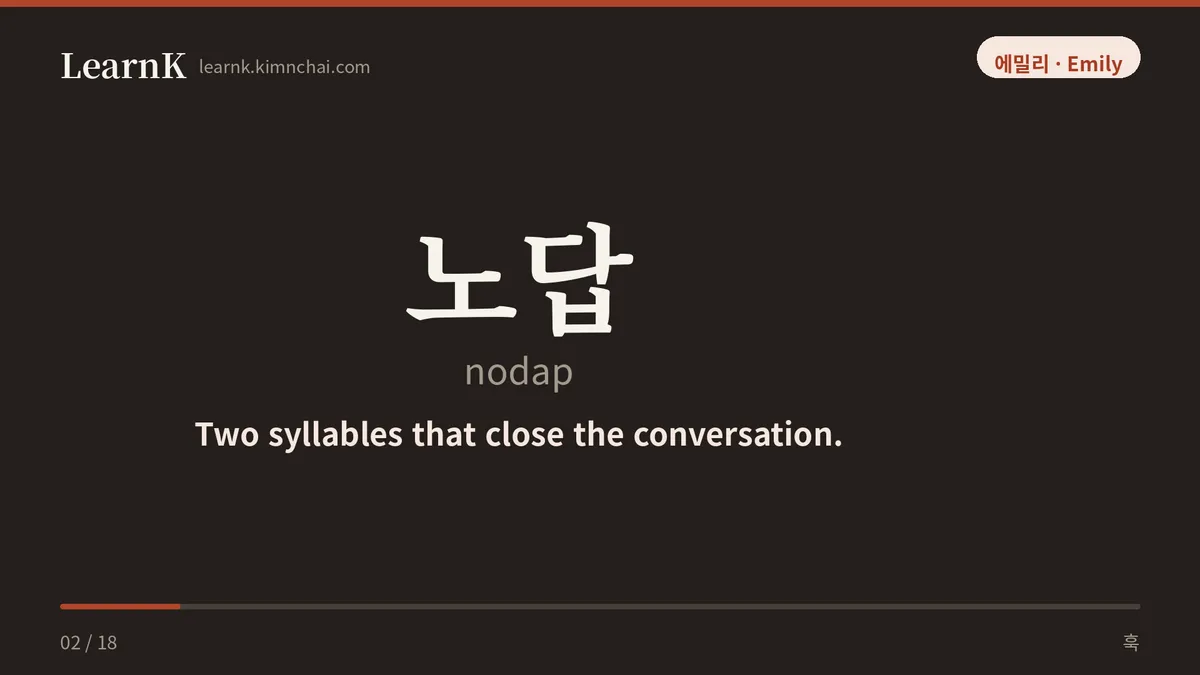
노답
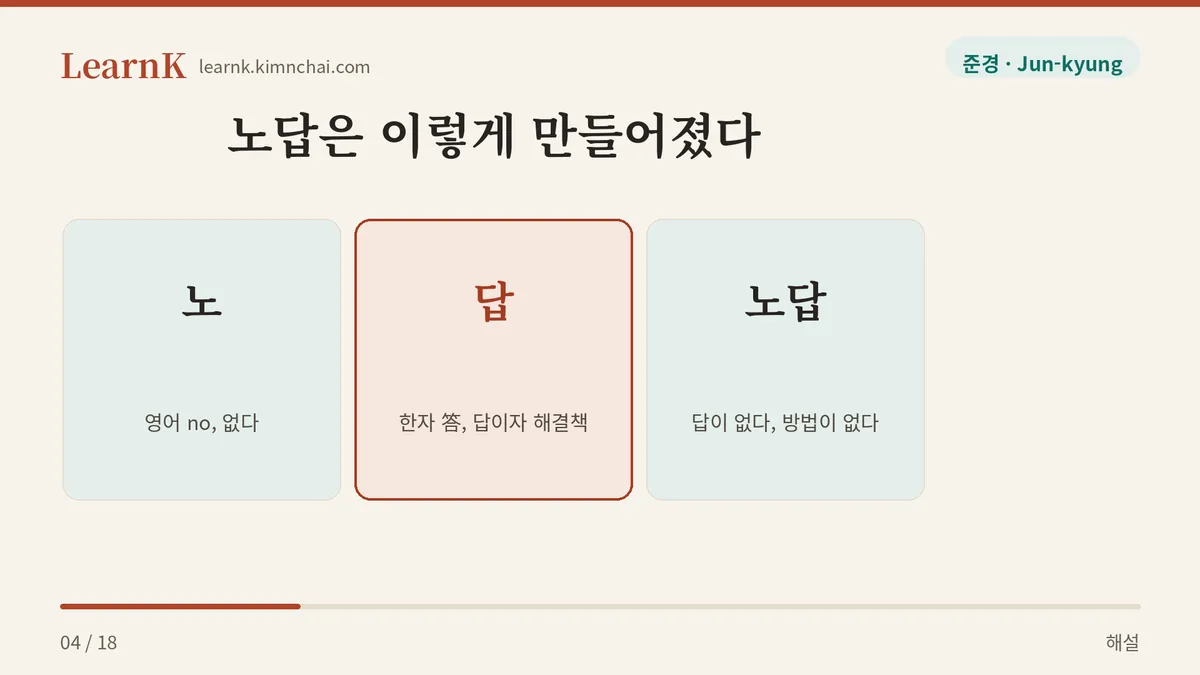
노답 is built from two pieces: the English no and the Sino-Korean 답 (答), “answer.” A whole sentence — 답이 없다 — chopped down to two syllables. And the way it’s chopped tells you what kind of word it is. 노답 isn’t a word that analyzes; it’s a word that delivers a verdict. It doesn’t explain why something won’t work. It declares that it won’t, and closes the conversation.
That’s why it runs hot. If 답이 없다 (dabi eopda), which means almost the same thing, is a sigh, then 노답 is closer to shutting the folder and dusting off your hands. Put 완전 (wanjeon), “totally,” or 진짜 (jinjja), “seriously,” in front and the intensity goes up another notch.
Grammatically it behaves like a noun. You can attach a predicate — 노답이다 (nodabida), 노답이야 (nodabiya), 완전 노답 (wanjeon nodap) — or cut it off with no particle and no verb at all, as in 우리 조 노답 (uri jo nodap), “our team? hopeless.” It also slots in front of another noun to modify it: 노답 상황 (nodap sanghwang), “a hopeless situation,” 노답 인생 (nodap insaeng), “a hopeless life.” The shorter you cut the sentence, the heavier the resignation — that’s the signature move of this word.
Just remember one thing. The weight of 노답 changes completely depending on whether the subject is a situation or a person. 이 날씨 노답이야 (i nalssi nodabiya), “this weather is hopeless,” is a complaint. 너 노답이야 (neo nodabiya), “you’re hopeless,” is a declaration that you’ve given up on someone entirely. That second one can sever a friendship even if you say it with a smile — so as a learner, it’s safest to recognize the person-as-subject usage without ever using it yourself.
Seeing It in a Real Conversation
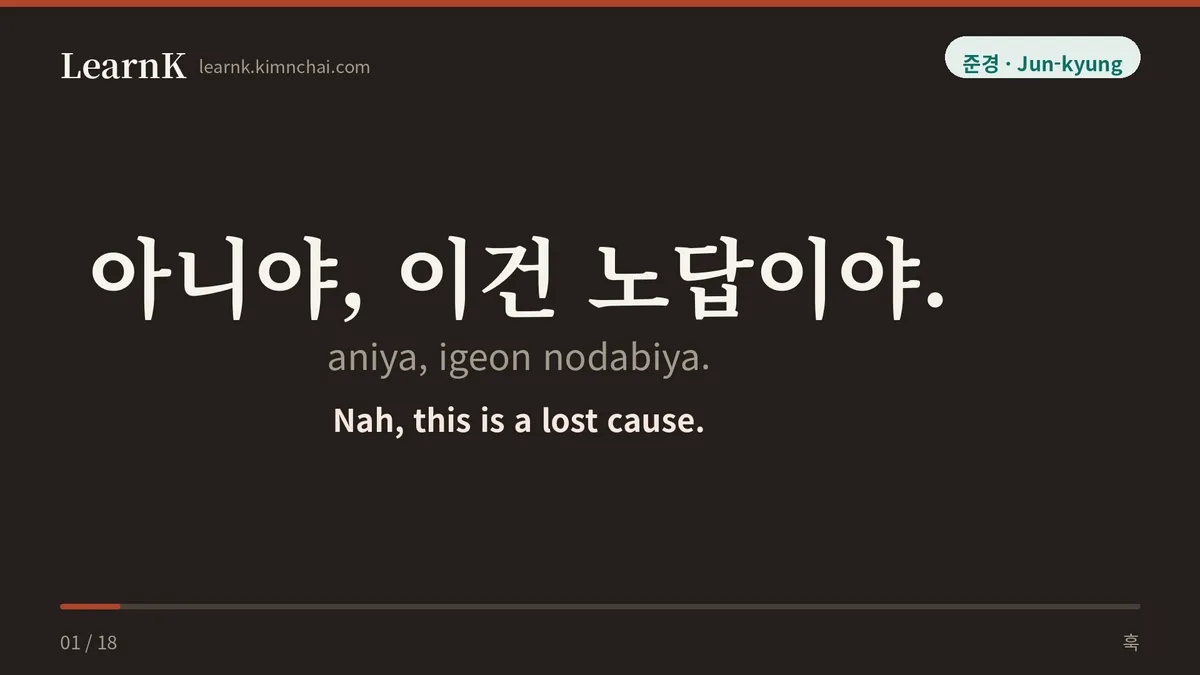
Scene: Saturday afternoon, in front of Exit 3 of the subway station. The seller they arranged to buy a secondhand bike from hasn’t shown up for thirty minutes.
Jun-kyung: 또 읽씹이야. 벌써 톡 열 개는 보냈는데. He’s leaving me on read again. I’ve already sent him like ten messages.
Emily: 아까는 5분이면 온다며. 진짜 노답이다. He said five minutes a while ago. This is seriously hopeless.
Jun-kyung: 전화도 안 받아. 좀만 더 기다려 볼까? He’s not picking up either. Should we wait a little longer?
Emily: 자전거 마음에 들었잖아. 딱 십 분만 더. You did like that bike. Just ten more minutes.
Jun-kyung: 아니야, 이건 노답이야. 이런 사람한테 사면 나중에 더 골치 아파. Nah, this is a lost cause. Buying from someone like this only means trouble later.
Emily: 하긴. 그럼 붕어빵이나 먹으러 가자. Fair enough. Let’s go get some bungeoppang instead.
Emily’s first 노답 is frustration aimed at the seller. Jun-kyung’s second 노답 is the conclusion that the deal is off. The same two syllables crossing over from emotion to decision — in real conversation this word usually shows up exactly twice like this. Once to vent, once to end it.
When It Sounds Off
✗ (reporting to your team leader) 팀장님, 이번 분기 실적은 그냥 노답입니다. Boss, this quarter’s numbers are just hopeless. ✓ (reporting to your team leader) 팀장님, 이번 분기 실적은 단기간에 회복하기 어려워 보입니다. Boss, this quarter’s numbers look difficult to recover in the short term. → 노답 is slang, and it passes judgment without offering any way forward. Used in a formal report, it makes you sound like someone who hasn’t actually grasped the situation. In front of a superior, it’s safer to unpack your point into a full sentence.
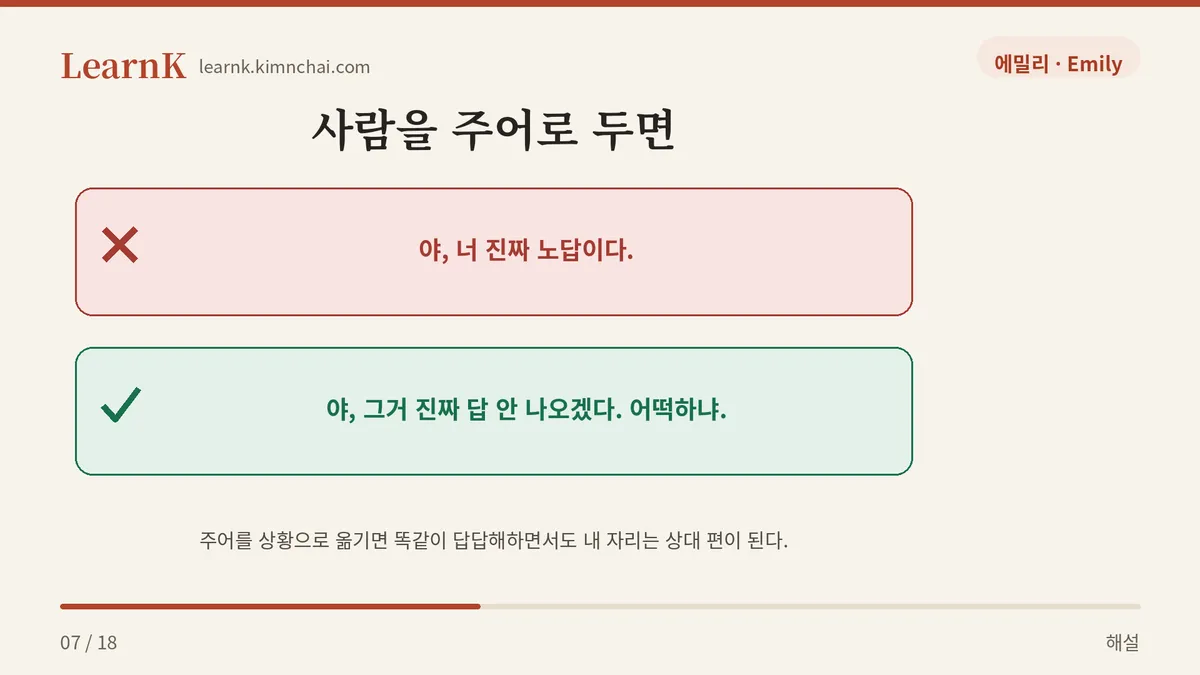
✗ (while a friend is seriously opening up about a problem) 야, 너 진짜 노답이다. Hey, you’re seriously hopeless. ✓ (while a friend is seriously opening up about a problem) 야, 그거 진짜 답 안 나오겠다. 어떡하냐. Man, that really has no way out. What are you going to do? → Make a person the subject and it becomes a personal attack: “you’re beyond saving.” Shift the subject to the situation and you sound just as exasperated, but now you’re standing on your friend’s side.
Example Sentences by Situation
1. Rainy season, staring at laundry that hasn’t dried in three days
이번 장마는 진짜 노답이야. 건조기 사야 되나. (ibeon jangmaneun jinjja nodabiya. geonjogi saya doena.) This rainy season is seriously hopeless. Maybe I should just buy a dryer.
Using it on something nobody can control, like the weather, is the safest possible use. No one gets hurt, and the person listening will usually come back with “tell me about it.”
2. When nobody answers in the group project chat
우리 조 노답. 나 혼자 발표까지 해야 될 듯. (uri jo nodap. na honja balpyokkaji haeya doel deut.) Our team is a disaster. Looks like I’ll be doing the presentation alone too.
This is the classic form: cut off as a bare noun, no predicate. The shorter the cut, the stronger the “I’ve already given up” nuance. That said, if this line gets back to your teammates it will damage the relationship — in practice it’s something you say to a different friend, as a vent.
3. Checking your credit card statement at the end of the month
나 이번 달 카드값 노답이다. 약속 다 취소해야 돼. (na ibeon dal kadeugap nodabida. yaksok da chwisohaeya dwae.) My credit card bill this month is beyond saving. I have to cancel all my plans.
Aimed at your own circumstances, it stops being self-criticism and becomes a self-deprecating joke. It’s an easy, low-stakes use — the other person can laugh and answer “same here.”
Polite vs. Casual, and Similar Expressions
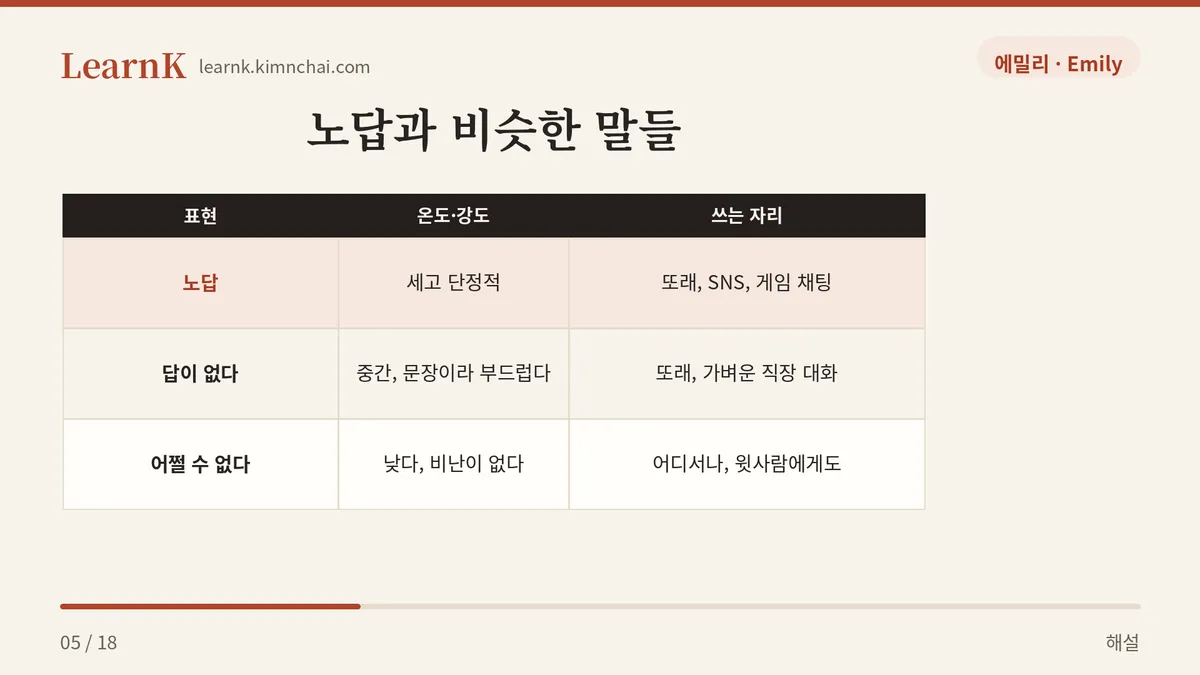
노답 has essentially no polite form. You can say 노답입니다 (nodabimnida), but in a formal setting what sticks out isn’t the grammar — it’s the attitude, and it usually gets taken as a joke. When you need to be polite, swap in 방법이 없습니다 (bangbeobi eopsseumnida), “there is no way to do it,” or 대책이 서지 않습니다 (daechaegi seoji ansseumnida), “we have no countermeasure.”
| Expression | Heat & intensity | Where to use it |
|---|---|---|
| 노답 (nodap) | Strong and final. Close to declaring surrender | Peers, social media, game chat. Not with superiors or in formal settings |
| 답이 없다 (dabi eopda) | Medium. Same meaning, but softer because it’s a full sentence | Peers, and even light workplace conversation |
| 대책이 없다 (daechaegi eopda) | Neutral. More judgment than emotion | Usable even in meetings and reports |
| 어쩔 수 없다 (eojjeol su eopda) | Low. Resignation with no blame at all | Anywhere. Safe even with superiors |
Same frustration, but the further down the table you go, the safer it gets when you’re talking to someone above you.
Cultural Background — Words That Take 노 (no)
노답 wasn’t born alone. Korean internet slang has a whole family built by sticking the English no on the front to make a negative: 노잼 (nojaem, no + 재미 → “not funny”), 노맛 (nomat, “tastes bad”), 노관심 (nogwansim, “not interested”). The two-syllable, snap-it-off rhythm fits a chat window perfectly, so these spread through internet communities and game chat, and by now they’ve filtered down into variety-show subtitles and everyday speech.
Slang built around 답 travels in a pack too. The best-known example is 답정너 (dapjeongneo), short for 답은 정해져 있고 너는 대답만 하면 돼 (dabeun jeonghaejyeo itgo neoneun daedapman hamyeon dwae), “the answer is already decided and you just have to say it” — a label for someone who asks a question when they’ve already settled on the answer they want. Put these two words side by side and you can see that in Korean, 답 doesn’t only mean the correct answer on a test; it stretches to mean the exit from a situation, the solution to a relationship. No exit means 노답. An exit that’s already been decided for you means 답정너.
In Korean dramas, this word turns up mostly in coming-of-age and school stories. A job seeker muttering to himself after yet another rejection text. A high schooler checking a mock-exam grade and collapsing face-down onto the desk. It’s the fastest thing to reach for when a character who hasn’t fully acquired adult language yet needs to sum up a situation — which makes it a handy device for telling you a character’s age and circumstances in a single line.
But just because you hear it often doesn’t mean you can use it anywhere. 노답 is a conversation-ender. In a Korean workplace, or in front of older adults, what’s expected is language that keeps the situation going rather than shutting it down — so this expression is best left among peers. Keep one step of distance between understanding it when you hear it and saying it yourself.
Today’s Quiz
In which of the following situations would 노답 not sound out of place?
① Introducing yourself in a job interview — 제 학점은 노답입니다. (“My GPA is hopeless.”) ② Texting with a friend — 이 더위 진짜 노답이야. (“This heat is seriously hopeless.”) ③ Presenting a proposal to your boss — 이번 계획은 노답입니다. (“This plan is hopeless.”) ④ Meeting your parents-in-law for the first time — 요즘 물가 노답이에요. (“Prices these days are hopeless.”)
Answer: ②
It’s a private conversation between peers, and the subject isn’t a person — it’s 더위 (deowi), “the heat,” a situation. Nobody gets hurt. ① and ③ amount to passing judgment with slang in a formal setting, which comes across as irresponsible, and ④ uses casual-register slang with in-laws you barely know yet, which reads as flippant. If you’re ever unsure whether to use 노답, just check two things: Is the listener a peer, and is the subject something other than a person? Only reach for it when both are true, and you won’t slip up.