노래방 (noraebang): The Korean Sanctuary for Blowing Off Steam — Wanna Go Belt Out a Song?

노래방
If you watch enough Korean dramas, you’ve surely seen the scene at least once: after a company dinner, everyone piles into a room, grabs a microphone, and sings their hearts out. It’s the place students rush to in a big group after exams are over, and the place a heartbroken main character goes alone to sing until their voice gives out. That’s exactly today’s expression — 노래방 (noraebang).
If you’re a fan of the Korean Wave, you might love K-POP and yet find the word “노래방” unfamiliar. But few spaces are as important for understanding Korean culture. Once you really get this one expression down, you’ll be able to answer with confidence when a Korean friend asks, “우리 노래방 갈래? (uri noraebang gallae?)”
Meaning and Nuance
노래방 (noraebang), taken literally, breaks down into 노래 (norae, meaning “song”) + 방 (bang, meaning “room”) — in other words, a “singing room.” It’s a space equipped with a machine that lets you sing along to backing music while reading the lyrics on a screen. It’s similar to what English speakers call karaoke, but a defining feature of the Korean 노래방 is that it’s usually a small, enclosed private room that a group of people enters together.
Checking the National Institute of Korean Language Dictionary
First, let’s check the definition from the authoritative Basic Korean Dictionary published by the National Institute of Korean Language.
노래방 (noun): A place furnished with a music machine so that people can sing while reading lyrics. [en] noraebang; singing room — A place furnished with a karaoke machine so that people can sing to lyrics. [zh] 练歌房,练歌厅 — 设有可以看着歌词唱歌的音响设施的场所。 — National Institute of Korean Language, Basic Korean Dictionary (krdict.korean.go.kr)
Let’s also look at the real usage examples the dictionary provides. Try picturing the situation as you read.
모범생이던 민준이가 수업을 빠지고 노래방에 간다는 건 상상이 안 간다. — National Institute of Korean Language, Basic Korean Dictionary (krdict.korean.go.kr)
→ This means there’s no way a diligent student would skip class and go to a noraebang. Here, the noraebang carries the image of a “place for playing around rather than studying.”
노래방에 가서 가요를 불렀다. — National Institute of Korean Language, Basic Korean Dictionary (krdict.korean.go.kr)
→ Here, 가요 (gayo) refers to Korean pop songs. It’s an example that plainly describes the most common activity at a noraebang.
노래방에서 친구들과 돌아가며 노래 한 곡절씩 신나게 했다. — National Institute of Korean Language, Basic Korean Dictionary (krdict.korean.go.kr)
→ Everyone taking a turn one by one, 돌아가며 (doragamyeo, taking turns in order) — this is the quintessential scene of a Korean noraebang.
노래방에 가지 않을래? — National Institute of Korean Language, Basic Korean Dictionary (krdict.korean.go.kr)
→ This is a casual (반말) way of inviting a friend. A very practical, real-life sentence.
The dictionary doesn’t include a Portuguese translation, so if we render it ourselves, “노래방” could roughly be introduced as casa de canto / karaokê (coreano). (Please note this is our own translation and not something recorded in the dictionary.)
Example Sentences by Situation
Shall we build a feel for real conversation with some sentences we made ourselves?
① Suggesting a “round two” after a company dinner
밥 다 먹었으니까 이제 노래방으로 갈까요? (bap da meogeosseunikka ijae noraebang-euro galkkayo?) — A suggestion to head over to the noraebang now that everyone has finished eating.
② When you want to blow off steam
요즘 너무 힘든데, 노래방에서 소리 좀 지르고 싶어. (yojeum neomu himdeunde, noraebang-eseo sori jom jireugo sipeo.) — This captures the nuance of the noraebang as a place to relieve stress by singing at the top of your lungs.
③ Talking about your go-to song
제 노래방 애창곡은 발라드예요. (je noraebang aechanggok-eun balladeu-yeyo.) — 애창곡 (aechanggok) means “a song you love to sing,” and it’s often used together with noraebang.
Polite vs. Casual Speech and Similar Expressions
When inviting someone, your tone changes depending on who you’re talking to.
- Casual (반말): 노래방 갈래? (noraebang gallae?) — for friends and people your own age.
- Polite (존댓말): 노래방 가실래요? (noraebang gasillaeyo?) — for elders or people you’ve just met.
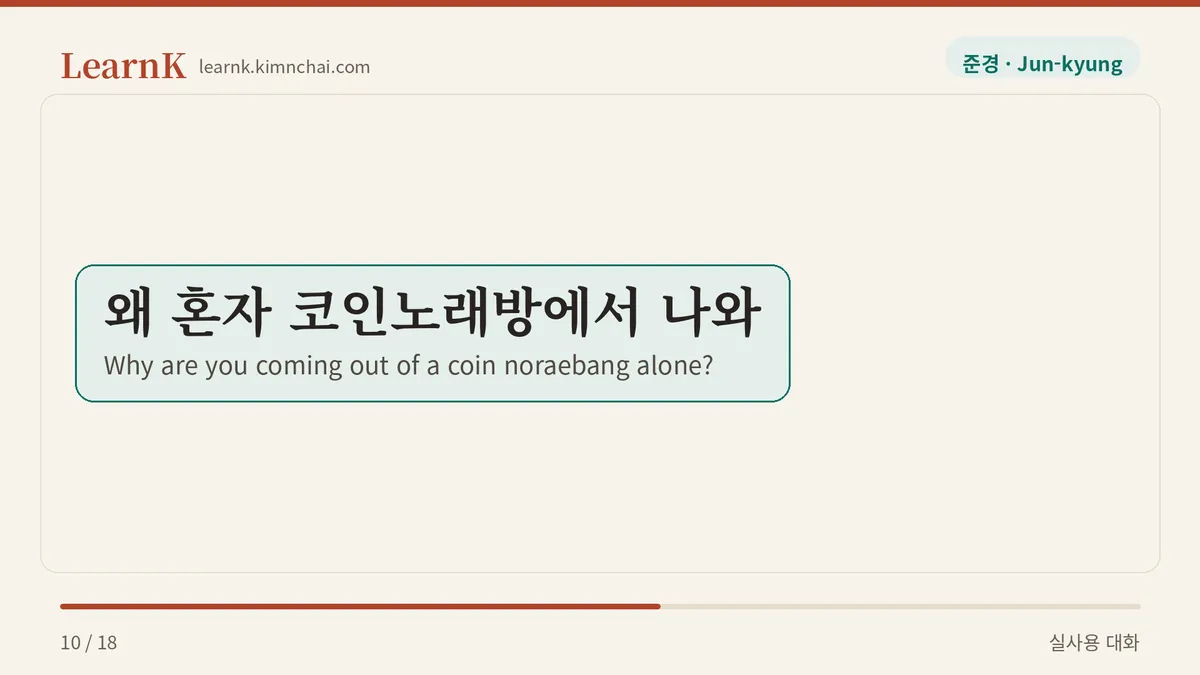
A related term is 코인노래방 (coin-noraebang). It’s a small, one-person noraebang where you drop in coins to sing just a song or two, and it’s especially popular with the younger generation these days. It’s perfect for when you want to practice quietly on your own.
Cultural Background
In Korea, the noraebang isn’t just a form of entertainment — it’s a social space for strengthening relationships. It’s the final course of a company dinner and a kind of lubricant that eases awkward relationships. Everyone shaking a tambourine along to the boss’s favorite song even counts as a form of etiquette (?). In dramas, characters often visit a noraebang alone to work through the pain of a breakup, which shows that the noraebang is a release valve where Koreans can pour out their emotions to their heart’s content. After all, the moment you grab the microphone, anyone can be the star.
Wrap-up Quiz
Shall we check what we learned today? If you want to politely invite a senior colleague you’ve just met at work — “Would you like to go to the noraebang together?” — which of the following would sound most natural?
- 노래방 갈래?
- 노래방 가실래요?
- 노래방 가!
The answer is number 2, 노래방 가실래요? (noraebang gasillaeyo?). Number 1 is casual and number 3 is commanding, so both could come across as rude to someone senior to you. Next time you meet a Korean friend, use what you learned today to confidently suggest belting out a song!
Definitions and example sentences are from the National Institute of Korean Language’s Basic Korean Dictionary (krdict.korean.go.kr); that portion of this post, including our translations, is licensed under CC BY-SA 2.0 KR.