프사 (peusa): What Do You Get When You Shorten "Profile Picture"? The Essential Korean Social-Media Slang

As you scroll through your KakaoTalk friends list, one day someone’s little round photo suddenly changes from a puppy to a selfie. When that happens, Koreans say something like this: “Huh? You changed your 프사 (peusa)?” Packed into that one line are all sorts of curiosities — “Something good happening lately?” or “Did you start dating someone?” Today, let’s dig deep into a key keyword of Korean social-media culture: 프사 (peusa).
프사
프사 (peusa) is a shortened form of 프로필 사진 (peuropil sajin), meaning “profile picture.” It’s the exact same idea as “pfp,” which takes just the first letters of the English “profile picture.” By pulling out only the first syllables ‘프’ and ‘사’ from 프로필 사진 and sticking them together, you get a classic Korean-style abbreviation.
The “profile picture” it refers to is that small round (or square) representative image that appears next to your name in apps like KakaoTalk, Instagram, and Facebook. It could be a selfie, a photo of your favorite idol, a pet, a landscape — or even a meaningless gray background.
Meaning and Nuance

프사 (peusa) doesn’t simply mean “photo.” In Korea, a profile picture is seen as a little window (窓) that shows “this person’s current state.”
- Changing your 프사 often → “Is something shifting in their mood?”
- Making your 프사 a couple photo → “An official relationship announcement”
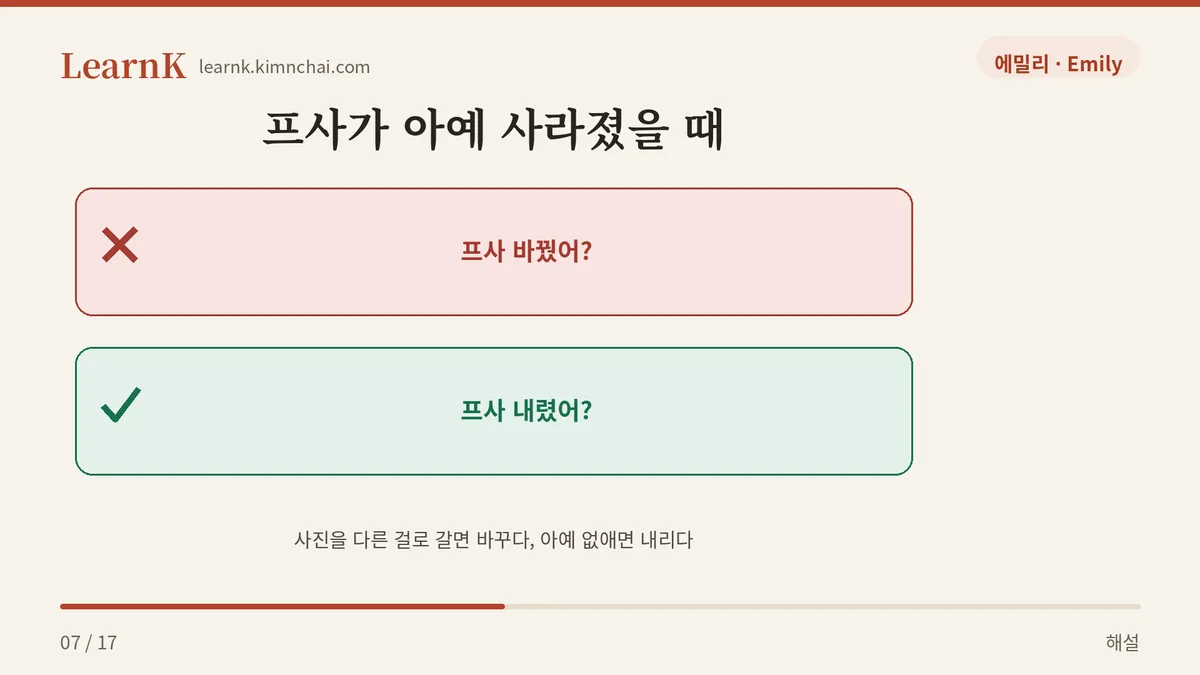
- Removing your 프사 or making it gray → “Is something wrong? (They took their 프사 down.)”
In other words, a 프사 is a nonverbal signal that conveys emotion without a single word being spoken. That’s why “You changed your 프사?” is both a greeting and an expression of interest.
Example Sentences by Situation
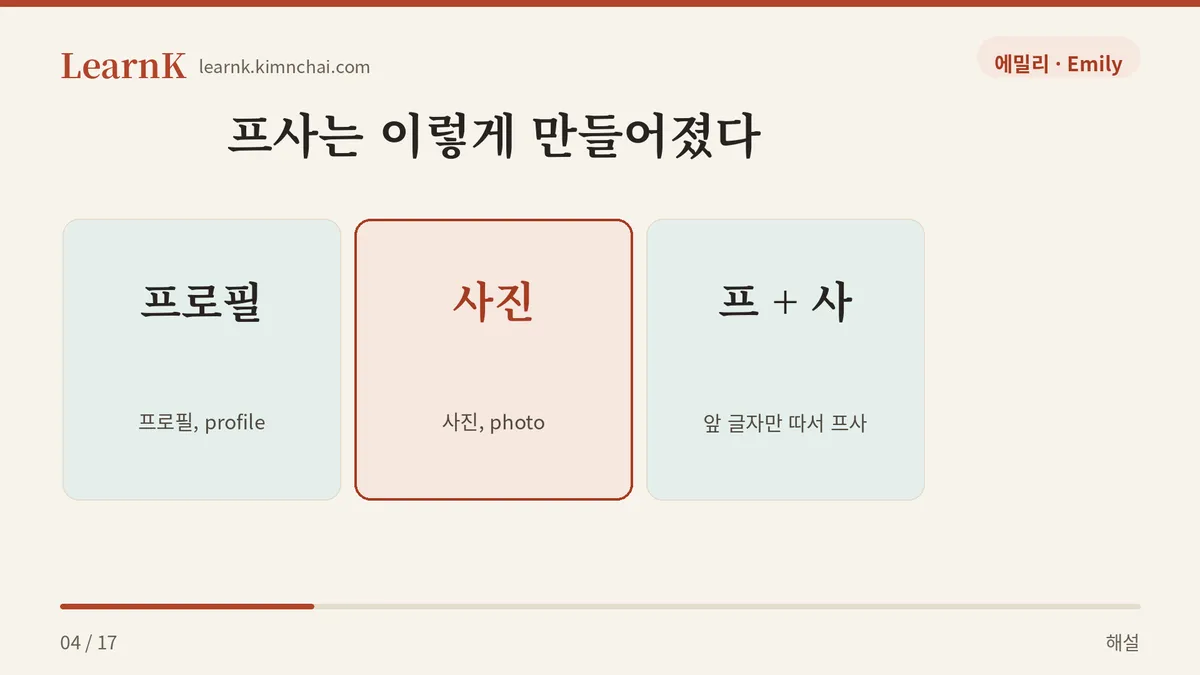
Situation 1 — Checking in on a friend you haven’t talked to in a while
야, 프사 바꿨더라? 여행 갔었어? (ya, peusa bakkwotdeora? yeohaeng gateosseo?) “Hey, I noticed you changed your 프사? Did you go on a trip?”
Here, someone sees an unfamiliar beach photo pop up as a 프사 and naturally asks how the other person has been. A 프사 becomes a topic that gets a conversation flowing.
Situation 2 — Teasing a friend who’s now in a relationship
프사 커플 사진이야?! 언제부터 사귄 거야? (peusa keopeul sajiniya?! eonjebuteo sagin geoya?) “Is your 프사 a couple photo?! Since when have you two been dating?”
You can pick up on the fact that someone’s dating just from their 프사. In Korea, a couple 프사 is a kind of “public declaration,” so this reaction comes up a lot.
Situation 3 — When you can’t tell who someone is
프사가 강아지라서 누군지 몰랐어. (peusaga gangajiraseo nugunji mollasseo.) “Your 프사 was a puppy, so I didn’t know who you were.”
This is when someone uses a pet or a character instead of their own face as their 프사, and you fail to recognize them. It’s a very common “프사 joke.”
Comparing Polite and Casual Speech, and Similar Expressions
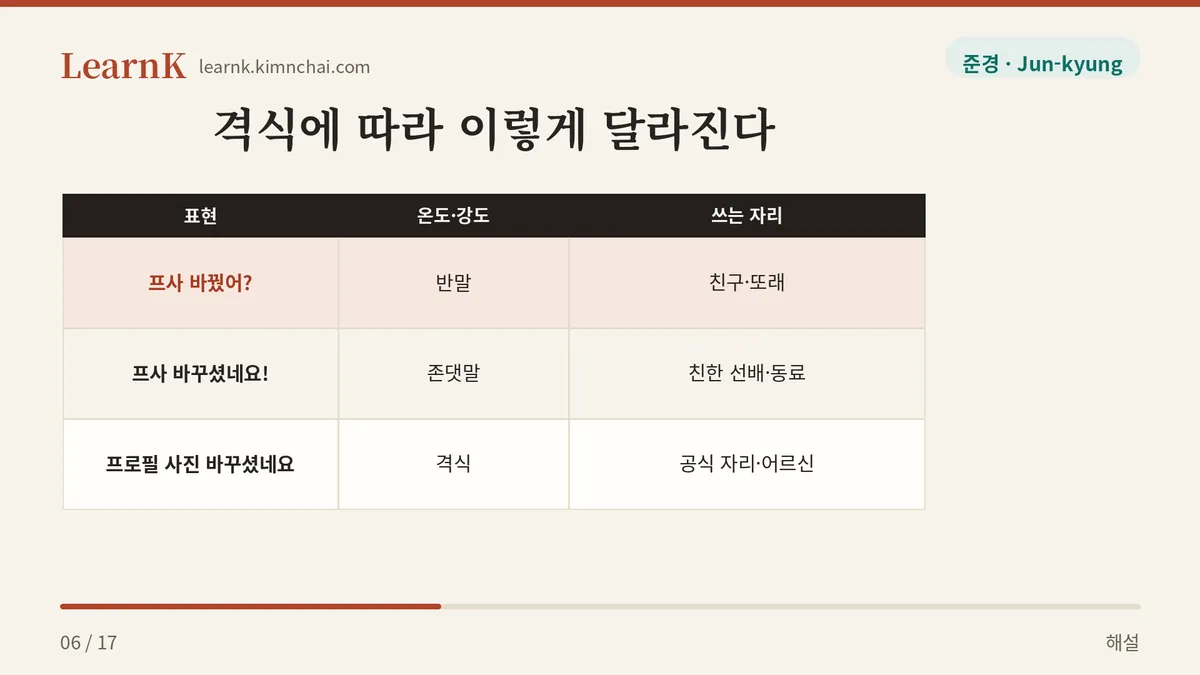
Since 프사 is slang, it’s basically used in casual speech (반말) among friends and peers. But because the word itself isn’t vulgar, it attaches naturally to polite speech too, as long as you keep your manners.
- Casual: 프사 바꿨어? (peusa bakkwosseo?) — “Did you change your 프사?”
- Polite: 프사 바꾸셨네요! (peusa bakkusyeonneyo!) — “You changed your 프사!”
That said, in very formal settings (official company documents, a first conversation with an elder), it’s safer to say the full 프로필 사진 (peuropil sajin) instead of the abbreviation.
It’s good to learn some similar social-media slang alongside it, too.
- 단톡 (dantok): short for a group KakaoTalk room (a group chat room)
- 인스타 (inseuta): short for Instagram
- 디엠 (diem): DM, i.e., a private message
Use it together with 프사 and you can get two pieces of slang in a single sentence, like “단톡 프사 누구야?” (“Who’s in the group chat’s 프사?”).
Cultural Background
Korea is a country with an overwhelmingly high KakaoTalk usage rate by global standards. Since almost everyone opens the app every single day, a 프사 is practically an “online face.” In dramas, too, there are frequent scenes where the main character secretly zooms in on someone’s 프사, or notices a change in a relationship after seeing that a 프사 has changed. A single 프사 can express everything from the flutter of a one-sided crush to the pain of a breakup.
Young people in particular actively use their 프사 as a means of “self-expression.” Some put up a photo of their favorite K-pop idol as their 프사 to show off their ‘덕질 (deokjil)’ — their fan activity — and during exam season, some make a “wishing for success” message their 프사. So if you make a Korean friend, keep an eye on their 프사. It’ll tell you more than words do.
Closing Quiz

A friend changes their KakaoTalk 프사 to gray and says nothing about it. What’s the thought a Korean is most likely to have in this moment?
ⓐ Oh, they bought a new phone ⓑ Is something wrong? (They took their 프사 down.) ⓒ Ah, they must hate having their picture taken
The answer is ⓑ. In Korea, emptying out your 프사 or switching it to gray is often read as a subtle signal that “my mood has sunk.” Starting today, why not look at your Korean friend’s 프사 and check in on them? “You changed your 프사?” — that one line is all it takes!