필수템 (pilsutem) — The One Thing Your Day Falls Apart Without
필수템
필수템 (pilsutem) means “a thing you can’t be without — something you absolutely have to bring.” It’s a coined word: the Sino-Korean 필수 (必須, pilsu, “essential”) plus -템 (-tem), a clipped form of “item.” The moment your hand stops mid-pack over a suitcase, standing in front of the new-arrivals shelf at a convenience store, the first day you move into a place of your own — the places Koreans pull this word out most often are usually places where they’re buying or packing something.
The important thing is that this word does not point to something that’s merely nice to have. A 필수템 is an item whose absence knocks your whole day out of joint. Only someone who has walked into a meeting in soaked clothes because they had no umbrella, or endured two hours on a boat without motion-sickness pills, calls a thing a 필수템. That’s why there’s always experience baked into this word. It means the speaker has already been burned once.
The temperature is light and upbeat. It’s a word used when recommending something to someone, or showing off a possession you treasure, so the voice lifts a little. If 필수품 (pilsupum) — which means the same thing — is a word that sits plainly in a notice or a news article, 필수템 arrives with the speaker’s affection and recommendation attached. That’s exactly why 재난 대비 필수품 (jaenan daebi pilsupum, “disaster-preparedness necessities”) sounds natural while 재난 대비 필수템 feels somehow out of place.
A Real Conversation
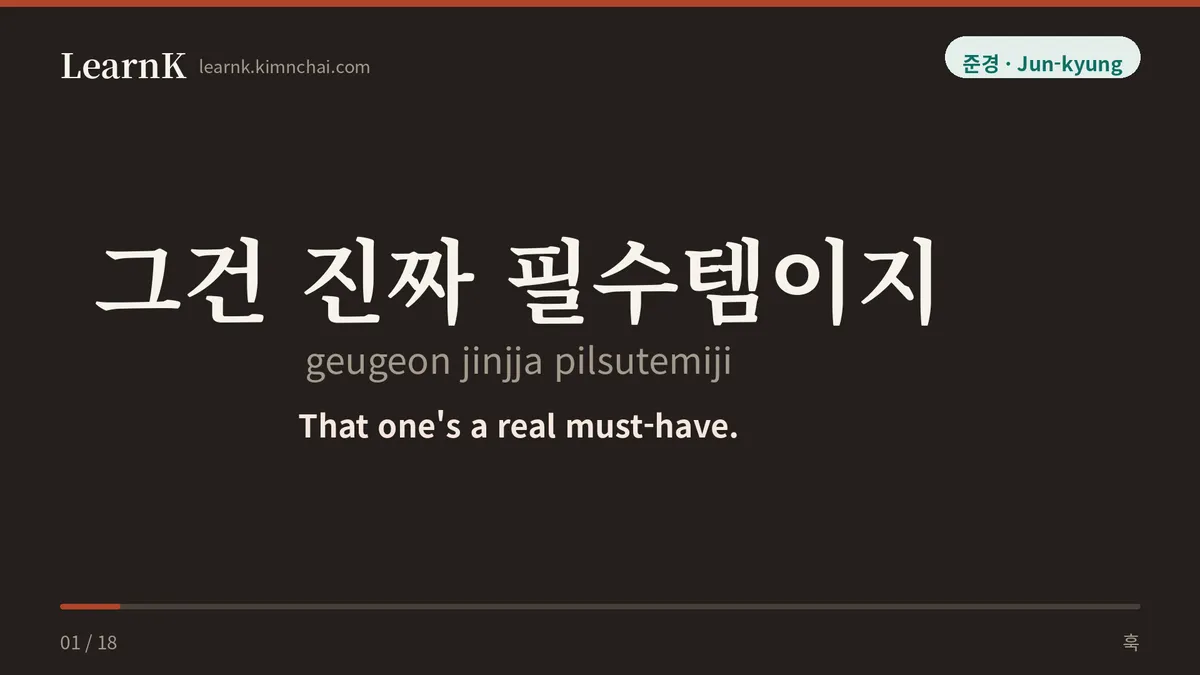
Scene: The night before leaving for Jeju. A suitcase is spread open on the living room floor, and the two of them are packing together.
Jun-kyung: 야, 우산은 왜 넣어? 3박인데 짐만 늘어. Hey, why are you packing an umbrella? It’s only three nights — it just adds bulk.
Emily: 8월 제주잖아. 접이식 우산 하나는 필수템이야. It’s Jeju in August. One folding umbrella is a must-have.
Jun-kyung: 하긴… 작년에 비 쫄딱 맞고 하루 통째로 날렸지. True… last year we got soaked and lost a whole day.
Emily: 그리고 이것도. 멀미약. 우리 배 탈 거잖아. And this too. Motion sickness pills. We’re taking the ferry, remember.
Jun-kyung: 아 맞다. 그건 진짜 필수템이지. 너 아니었으면 또 까먹을 뻔했다. Oh right. That one’s a real must-have. I would’ve forgotten again if it weren’t for you.
Emily: 거봐. 필수템은 내가 챙긴다니까. See? I’m the one who packs the essentials.
Where It Sounds Off
✗ (Presenting to executives) 이 장비는 저희 팀의 필수템입니다. — “This equipment is our team’s must-have.” ✓ (Presenting to executives) 이 장비는 저희 팀의 필수 장비입니다. — “This equipment is essential equipment for our team.” → The word grew up in advertising and on social media, so dropping it into an official report or document makes you sound underprepared. Even with the polite -입니다 ending attached, the lightness of the word itself stays right where it was.
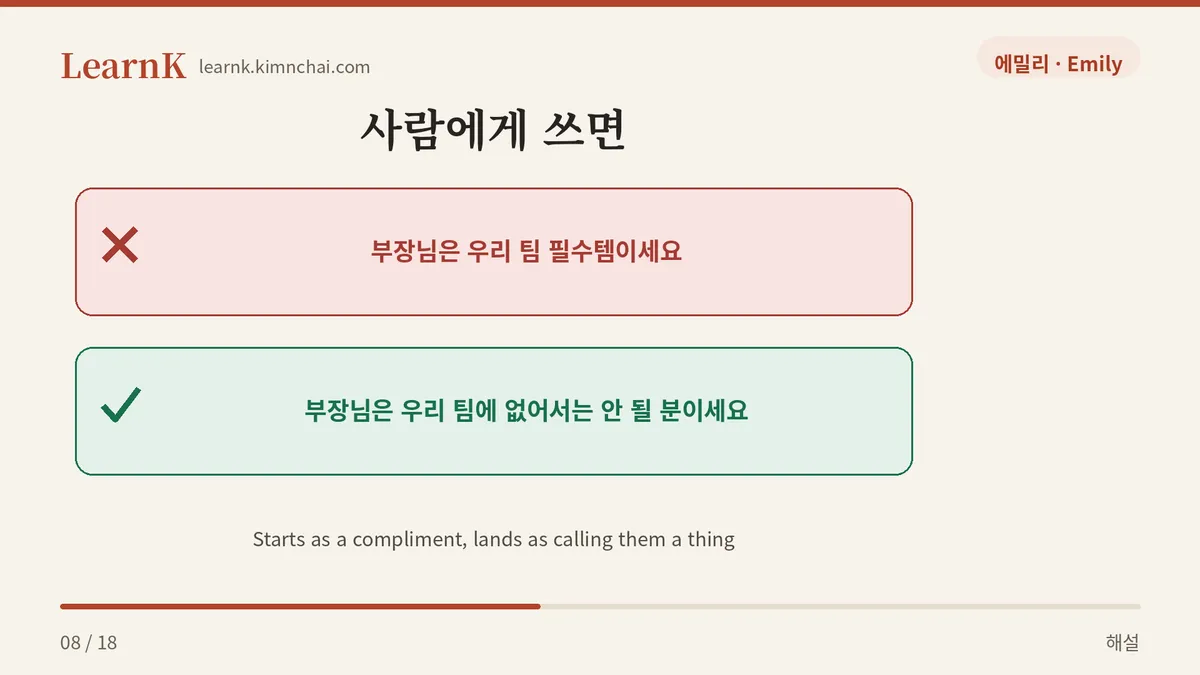
✗ (Pointing at your department head) 부장님은 우리 팀 필수템이세요. — “Sir, you’re our team’s must-have item.” ✓ 부장님은 우리 팀에 없어서는 안 될 분이세요. — “Sir, you’re someone our team couldn’t do without.” → -템 attaches to objects, so using it for a person starts out as a compliment and ends up treating them like a thing. It works as a joke between close friends of the same age, but with anyone senior to you it’s safer to leave it alone.
Example Sentences by Situation
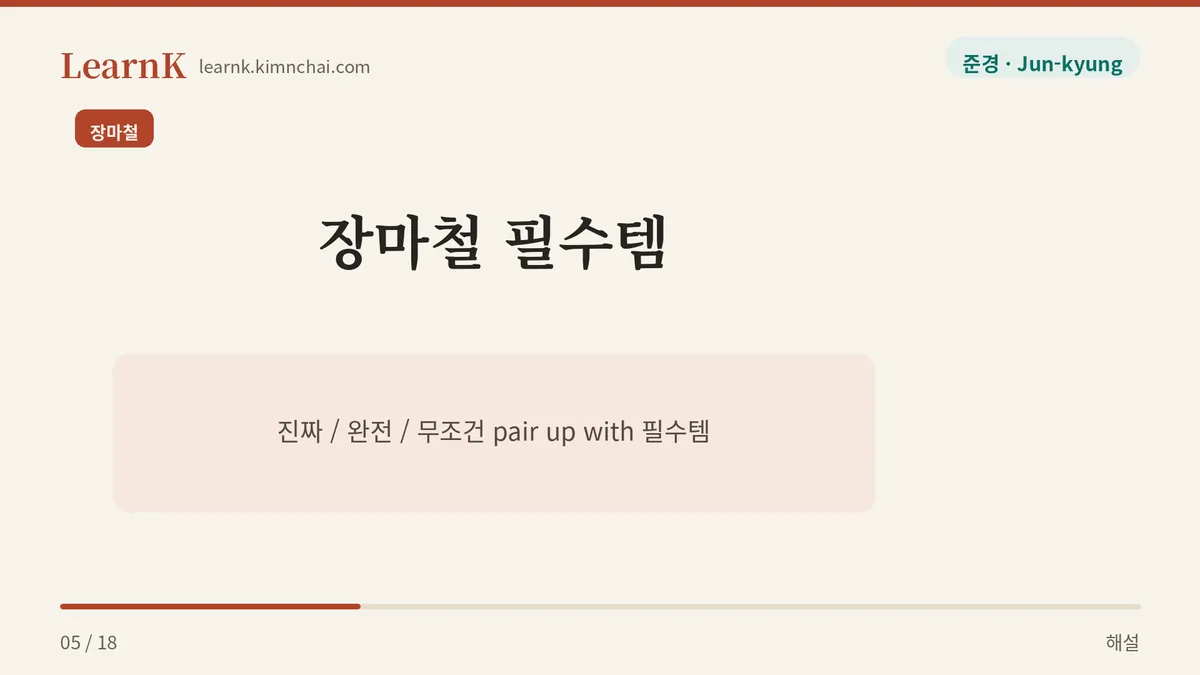
1. Catching a friend on their way to work during monsoon season From late June through August, rain comes down in Korea without warning. It’s common to leave the umbrella at home because the morning was clear, then get caught out on the way back.
장마철엔 접이식 우산이 진짜 필수템이야. 가방에 그냥 넣어 놔. (jangmacheoren jeobisik usani jinjja pilsutemiya. gabange geunyang neoeo nwa.) During monsoon season a folding umbrella is a genuine must-have. Just keep one in your bag.
Putting 진짜 (jinjja, “really”) in front adds emphasis. 필수템 often pairs up with adverbs like 진짜, 완전 (wanjeon, “totally”), and 무조건 (mujogeon, “no question”).
2. To a younger friend who’s just started living alone The first thing someone who has just found their first place in Korea searches for is 자취 필수템 (jachwi pilsutem, “living-alone essentials”). The phrase has hardened into something like a search term, so you can stick the situation straight onto the front of it.
자취 필수템 좀 알려 주세요. 뭐부터 사야 할지 모르겠어요. (jachwi pilsutem jom allyeo juseyo. mwobuteo saya halji moreugesseoyo.) Please tell me the must-haves for living alone. I have no idea what to buy first.
Just attach a noun to the front: 자취 필수템, 캠핑 필수템 (kaemping pilsutem, “camping essentials”), 장마철 필수템 (jangmacheol pilsutem, “monsoon-season essentials”). Leaving the particle out is actually the more natural choice.
3. Stepping back a little while recommending something 필수템 is a strong word, so when you want to dial it down, this is how you create some distance.
이건 필수템까진 아니고, 있으면 좋은 정도야. (igeon pilsutemkkajin anigo, isseumyeon joeun jeongdoya.) This isn’t quite a must-have — it’s more of a nice-to-have.
Attaching -까진 아니다 (-kkajin anida) means “it’s not that big a deal.” It’s an expression that takes the pressure off the other person when you’re recommending something, so it’s worth learning alongside.
Politeness Levels and Similar Expressions
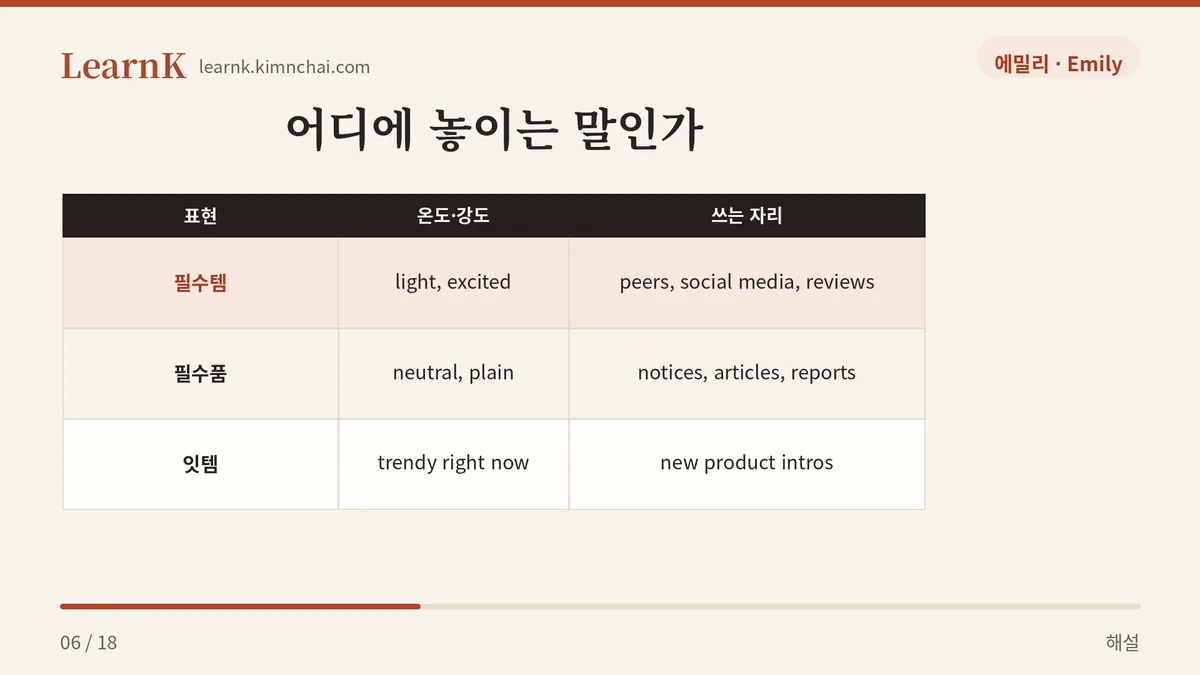
필수템 is a noun, so the level of politeness is decided by the predicate that follows it. Casual is 필수템이야 (pilsutemiya), and polite is 필수템이에요 (pilsutemieyo). But even with -이에요 attached, this is still a word for private settings. Adding a polite ending doesn’t earn it a place in a meeting room or an official document. When the occasion calls for formality, it’s safer to switch over to the expressions on the right side of the table below.
| Expression | Tone & Intensity | Where It’s Used |
|---|---|---|
| 필수템 (pilsutem) | Light and excited; a recommending voice | Talk among peers, social media, reviews. Not used in official documents |
| 필수품 (pilsupum) | Neutral, plain | Anywhere. Notices, articles, reports |
| 잇템 (ittem) | Emphasizes trendiness: “this is what’s hot right now” | Introducing new products. Feels dated once the trend passes |
| 없어서는 안 될 것 (eopseoseoneun an doel geot) | Calm and serious | Formal settings and writing. Can be used for people too |
필수템 and 잇템 travel together often, but they point in different directions. 필수템 leans toward “you’re in trouble without it,” while 잇템 leans toward “everyone has one right now.” A monsoon-season umbrella is a 필수템, not a 잇템.
Cultural Background — The Little Tail -템
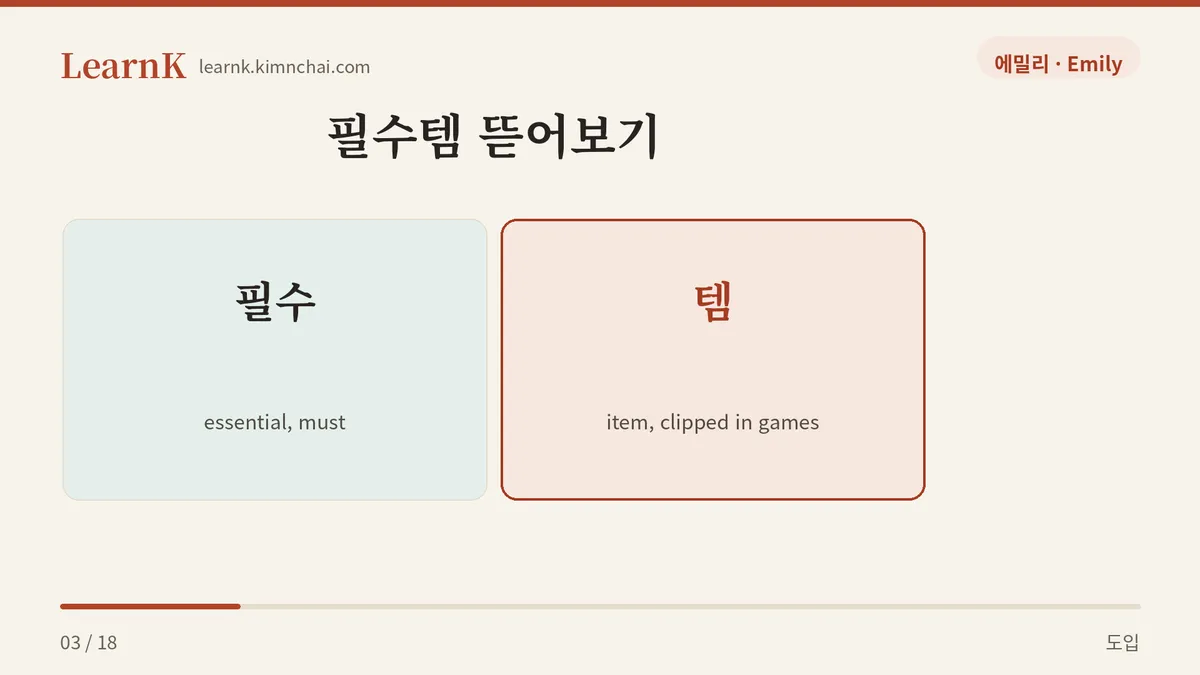
The root of -템 is online gaming. Inside games, “item” got shortened to 템 (tem), and the word walked out of the community and into everyday speech. In a game, an item is a thing that makes your character stronger if you have it. That sense is still there, so calling something a 필수템 sounds a bit like saying “this one thing lowers the difficulty of your day.” A way of looking at objects as equipment is packed into that single syllable.
Once it settled in, -템 started attaching itself to everything. A newly released product becomes 신상템 (sinsangtem), something good for the price becomes 꿀템 (kkultem, literally “honey item”), and the thing you love most becomes 최애템 (choeaetem). Over the course of the 2010s this little tail stopped belonging to the younger generation alone, and now you can spot it without much trouble in home-shopping subtitles and on signs above supermarket shelves.
The place this word fits best is Korean shopping culture. Walk into a store like Olive Young or Daiso and you’ll find seasonal signs reading 여름 필수템 (yeoreum pilsutem, “summer must-haves”), and it turns up in review-video titles almost like a formula. In dramas, too, the word often appears as a subtitle over a scene where a character pulls something out of a bag and hands it to someone else — and there, 필수템 is less the name of an object than a signal that means “I looked out for you.” Listen to what the person packing the bags calls a 필수템, and you’ll learn how far into someone else’s day their imagination reaches.
Today’s Quiz
Which of the following sentences is the most awkward place to use 필수템?
- 캠핑 갈 때 헤드랜턴은 필수템이야. — “A headlamp is a must-have when you go camping.”
- 겨울철 립밤은 제 필수템이에요. — “Lip balm is my must-have in winter.”
- 본 보고서에 따르면 해당 설비는 공정의 필수템입니다. — “According to this report, the facility in question is a must-have in the process.”
- 이건 필수템까진 아니고, 그냥 있으면 편해. — “This isn’t quite a must-have; it’s just handy to have around.”
Answer: 3. 필수템 is a light word that grew up in peer conversation and on social media, so it doesn’t suit formal writing like a report. Here it should be changed to 필수 설비 (pilsu seolbi, “essential equipment”) or 필수 요소 (pilsu yoso, “essential element”). The other three sentences all take place in private settings where someone is recommending or introducing an object, so they sound natural.
Definitions and example sentences are from the National Institute of Korean Language’s Basic Korean Dictionary (krdict.korean.go.kr); that portion of this post, including our translations, is licensed under CC BY-SA 2.0 KR.