푹 쉬세요 (puk swiseyo) — The Phrase That Says “I Know You Worked Hard”
푹 쉬세요
푹 쉬세요 (puk swiseyo) is a polite way of telling someone to rest — fully, deeply, all the way through. Pull the sentence apart and it’s simple enough: the verb 쉬다 (swida, “to rest”), the degree adverb 푹 (puk), and the polite ending -세요 (-seyo). But in Korea, the moments where this phrase comes out are fairly fixed. At the end of a day when you’re parting ways. When the other person is sick. And when you know exactly how hard they worked today.
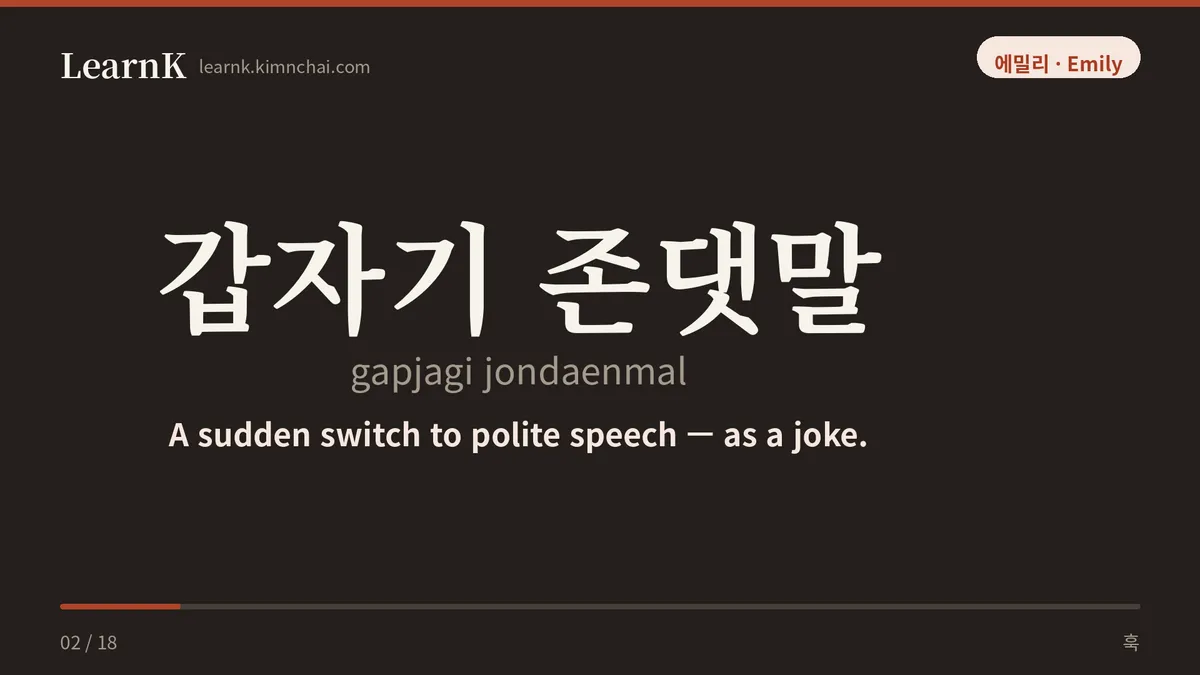
푹 (puk) paints a degree that leaves nothing lacking — reaching not just the surface but all the way to the inside. 푹 자다 (puk jada, to sleep deeply), 푹 삶다 (puk samda, to boil until tender), 푹 익다 (puk ikda, to cook through) — every one of them is a state reached by taking plenty of time until it goes right to the core. Which is why there’s a bigger gap than you’d expect between 쉬세요 (swiseyo) and 푹 쉬세요 (puk swiseyo). The first one can accidentally land like an instruction: “That’s enough, go rest.” But the moment 푹 attaches, the sentence’s center of gravity shifts over to the other person’s exhaustion. I know today was hard on you, so don’t rest halfway — rest properly. That’s the extra layer being added.
So this phrase is closer to acknowledgment than to information. Korean has plenty of parting greetings, but 푹 쉬세요 is one that only someone who has watched your day can use. It doesn’t come out easily with a person you’ve just met; it comes out to a colleague who pulled an all-nighter with you, to someone going home early with a cold, to the person who stood in the kitchen all through the holiday. Even the reply is more or less set — “네, ○○ 씨도 푹 쉬세요 (ne, ○○ ssi-do puk swiseyo),” “Yes, you rest well too, ○○.” A short ritual of confirming each other’s tiredness once before saying goodbye.
See It in a Real Conversation
Scene: Eleven o’clock at night on moving day. The unpacking is about half done, and Jun-kyung is about to head home after carrying in the last box.
Jun-kyung: 자, 이게 마지막. 냉장고 옆에 놓으면 되지? Alright, this is the last one. Next to the fridge, right?
Emily: 어, 거기. 진짜 고마워… 나 지금 팔이 안 올라가. Yeah, right there. Thank you so much… I literally can’t lift my arms right now.
Jun-kyung: 나머지는 내일 해. 오늘은 그냥 푹 쉬어. Leave the rest for tomorrow. Just get some good rest today.
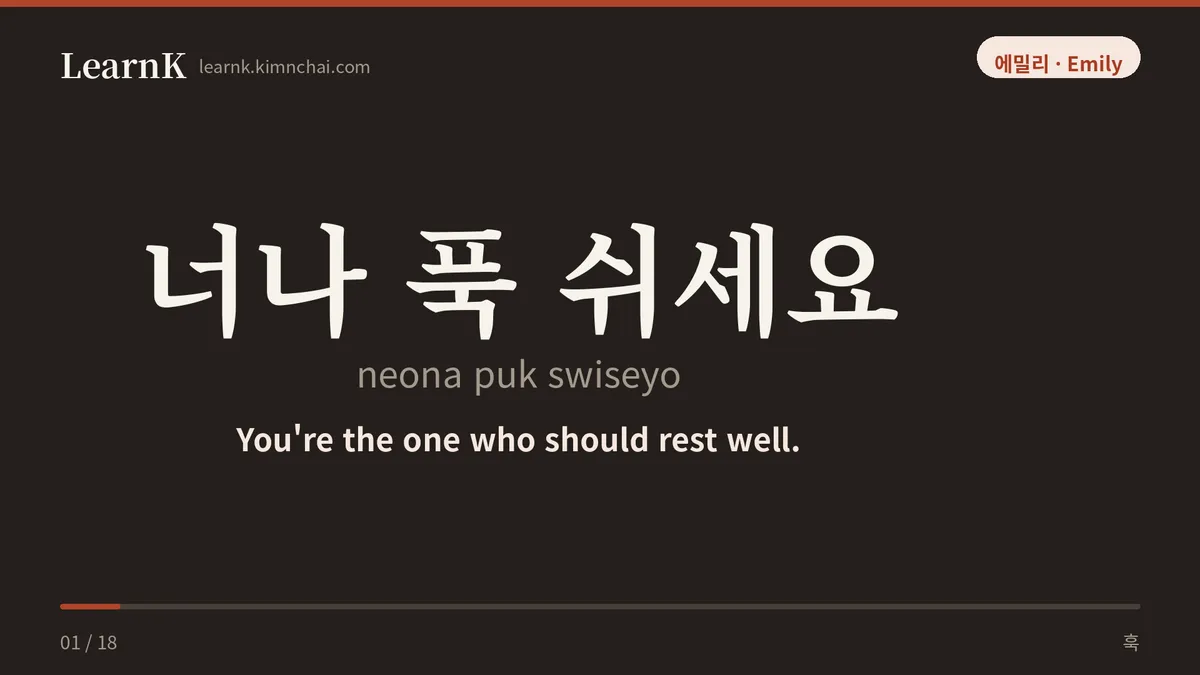
Emily: 너나 푹 쉬세요. 아침 일곱 시부터 사다리차 지킨 사람이 누군데. You’re the one who should rest well. Who’s been babysitting the ladder truck since seven this morning?
Jun-kyung: 야, 난 괜찮아. 들어가서 씻고 바로 잘 거야. Hey, I’m fine. I’ll shower and go straight to bed.
Emily: 조심히 가고, 도착하면 연락해. 푹 자고 푹 쉬어. Get home safe, and text me when you’re there. Sleep well and rest up.
Notice that Emily has been speaking casually, then flips into polite speech for “너나 푹 쉬세요.” In Korean, deliberately using 존댓말 (jondaenmal, polite speech) with someone you’re close to turns into a joke — teasing, or mock-flattery. Here it’s a device for handing the line right back with a grin: “If anyone worked hard today, it’s you.”
When It Sounds Off
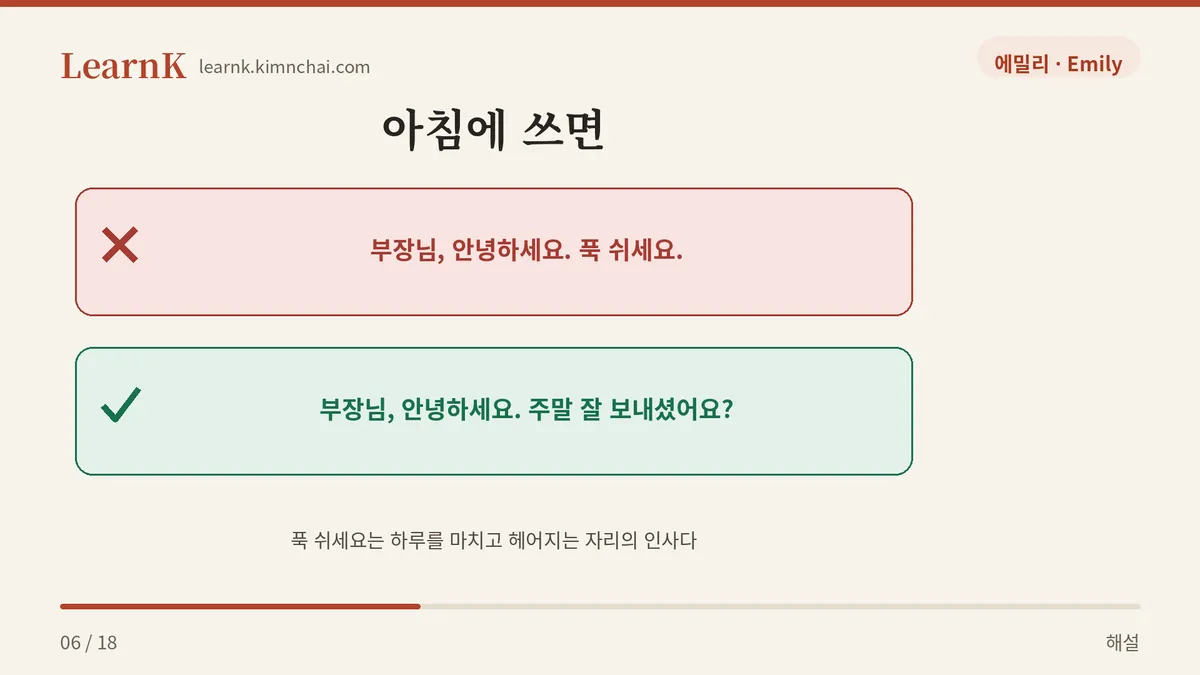
✗ (Running into your department head on the way in on Monday morning) 부장님, 안녕하세요. 푹 쉬세요. (bujangnim, annyeonghaseyo. puk swiseyo.) — “Good morning, sir. Get some good rest.” ✓ (Running into your department head on the way in on Monday morning) 부장님, 안녕하세요. 주말 잘 보내셨어요? (bujangnim, annyeonghaseyo. jumal jal bonaesyeosseoyo?) — “Good morning, sir. Did you have a good weekend?” → 푹 쉬세요 belongs to the moment you part after finishing a day, or the moment the other person is heading off to rest. Say it in the morning when work is only just starting and it lands like “Alright, time for you to stop working” — the other person will pause for a beat.
✗ (At the end of an email to a client contact you’re writing to for the first time) 검토 부탁드립니다. 푹 쉬세요. (geomto butakdeurimnida. puk swiseyo.) — “Please take a look. Get some good rest.” ✓ (At the end of an email to a client contact you’re writing to for the first time) 검토 부탁드립니다. 감사합니다. (geomto butakdeurimnida. gamsahamnida.) — “Please take a look. Thank you.” → The grammar is perfectly fine, but the temperature is too high. Underneath this phrase sits a personal observation — “I know you’re worn out” — so using it in a formal first contact, before you know each other at all, makes you look like someone whose sense of distance is off. Once you’ve worked together a few times, it slots naturally into the end of an email right before a long holiday.
Example Sentences by Situation
1. Sending home a coworker who looks sick
감기 심해 보이시는데 오늘은 일찍 들어가서 푹 쉬세요. 남은 건 제가 정리할게요. (gamgi simhae boisineunde oneureun iljjik deureoga-seo puk swiseyo. nameun geon jega jeongnihalgeyo.) You look like you’ve got a bad cold — head home early and get some proper rest. I’ll wrap up what’s left.
When a Korean office sends a sick person home, people often don’t stop at “들어가세요 (deureogaseyo, go on home)” — they add 푹 쉬세요 after it. If the first sentence is permission, the second is care, and that’s what lets the person leave without feeling like they’re being watched.
2. On the last workday before a holiday
이번 연휴 잘 보내시고 푹 쉬세요. 오셔서 뵙겠습니다. (ibeon yeonhyu jal bonaesigo puk swiseyo. oseoseo boepgetseumnida.) Enjoy the holiday and get plenty of rest. See you when you’re back.
Right before Seollal or Chuseok, this is the greeting people almost invariably trade on their way out of the office. If “잘 보내세요 (jal bonaeseyo)” is a greeting aimed at the time, 푹 쉬세요 is one aimed at the body — put them together and you get the complete set.
3. A text sent after parting late at night
오늘 정말 고생 많으셨어요. 씻고 푹 쉬세요. 내일 봬요. (oneul jeongmal gosaeng manheusyeosseoyo. ssitgo puk swiseyo. naeil bwaeyo.) You worked so hard today. Wash up and get a good rest. See you tomorrow.
This is the classic text that arrives about ten minutes after a company dinner or a late shift ends and everyone has scattered into their own taxis. You can safely think of “고생 많으셨어요 (gosaeng manheusyeosseoyo)” and 푹 쉬세요 as a pair that travels together.
Polite, Casual, and Similar Expressions
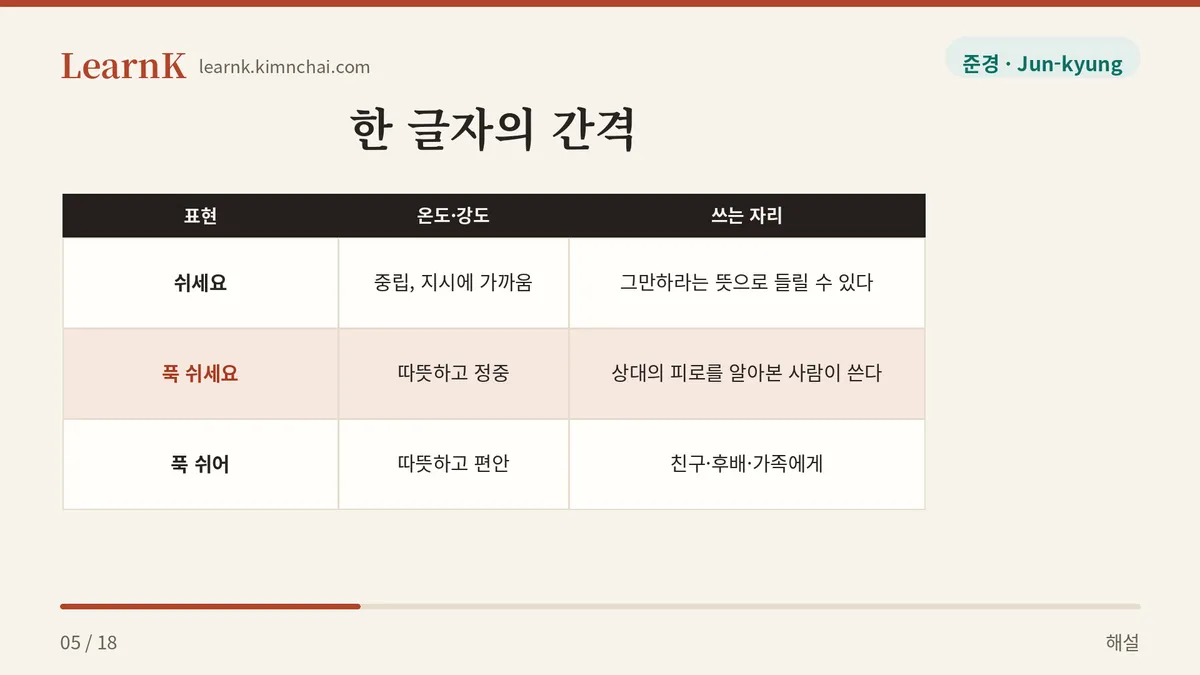
| Expression | Warmth / intensity | Where it’s used |
|---|---|---|
| 푹 쉬세요 (puk swiseyo) | Warm and polite | Seniors, colleagues, people at a bit of a distance. When parting, when they’re ill |
| 푹 쉬어 (puk swieo) | Warm and relaxed | Friends, juniors, family. The same feeling in casual speech |
| 푹 쉬십시오 (puk swisipsio) | Formal, warmth held in check | Official settings, the military, much older adults. A written-style greeting |
| 쉬엄쉬엄하세요 (swieomswieomhaseyo) | A gentle “ease up” | To someone who is working right now. Not “stop” but “slow down” |
| 안녕히 주무세요 (annyeonghi jumuseyo) | Polite, limited to sleep | The moment someone goes to bed. When you’re in the same house or lodging |
The last two are the easy ones to mix up. 쉬엄쉬엄하세요 is said standing beside someone whose work isn’t finished yet, so it doesn’t work as a parting greeting; and 안녕히 주무세요 hooks only onto sleep, so it doesn’t carry the sense of “recover from this whole day.” Taking on a full day’s worth of fatigue is 푹 쉬세요’s job.
Cultural Background — A Phrase That Recognizes the Effort
Line up the verbs that 푹 likes to keep company with and the picture comes into focus. 푹 자다 (puk jada, sleep deeply), 푹 삶다 (puk samda, boil until tender), 푹 익다 (puk ikda, cook through), 푹 고다 (puk goda, simmer down to a broth). None of them brush past quickly; all of them take ample time and reach all the way in. So the rest that 푹 쉬세요 recommends isn’t the kind where you sit down for a minute and move on. It’s closer to rest until the broth has drawn out, until the bones have gone soft.
In Korea, rest isn’t left to be a private matter each person quietly handles alone. You first acknowledge the other person’s labor with “고생 많으셨습니다 (gosaeng manheusyeotseumnida),” then recommend recovery with 푹 쉬세요. Only when those two lines pass back and forth as a set does the day feel properly closed. Conversely, if you part in silence from someone you worked through the night with, the work is done but something feels left unfinished.
In Korean dramas, too, this line usually sits not in the scene where emotion swells but just before or just after it. Someone slips it out quietly while leaving a hospital room, while switching off the lights in an office after overtime, while people who kept vigil all night at a funeral home scatter at dawn. The line itself is plain; it gains its weight from where it’s placed. For a learner, this is the crux — with 푹 쉬세요, knowing when to reach for it is far harder, and far more valuable, than memorizing the sentence.
One more thing. This phrase only has power when the other person actually had a hard time. Tack it on out of habit on a day when nothing happened and it easily sounds hollow. Take one moment to recall what they actually did today before you say it, and those same few syllables arrive at an entirely different temperature.
Today’s Quiz
Six o’clock on a Friday evening. Your team leader — who has worked late three nights straight to hit the project deadline — packs up her bag, says “먼저 갈게요 (meonjeo galgeyo, I’m heading out first),” and stands up. What’s the most natural thing to say?
- 팀장님, 쉬엄쉬엄하세요.
- 팀장님, 고생 많으셨습니다. 주말에 푹 쉬세요.
- 팀장님, 안녕히 주무세요.
Show the answer
Answer: 2
Option 1, 쉬엄쉬엄하세요, is for telling someone still in the middle of working to slow down, so it misses the mark for a person who is already leaving for the day. Option 3, 안녕히 주무세요, is a greeting used only at the moment someone goes to bed, so it’s odd in an office at six in the evening. Do it like option 2 — acknowledge her three long days first with “고생 많으셨습니다,” then recommend recovery with 푹 쉬세요 — and the goodbye closes cleanly.
Definitions and example sentences are from the National Institute of Korean Language’s Basic Korean Dictionary (krdict.korean.go.kr); that portion of this post, including our translations, is licensed under CC BY-SA 2.0 KR.