편애 (pyeonae) — The Word You Use to Confess Your Bias, Originally a Word for Calling Someone Out
편애 (pyeonae)
편애 (pyeonae) means loving only one person, or only one side, in a lopsided way. You tell everyone you love a seven-member group, and then your timeline is twenty photos of the same member. Even when you pick concert seats, you start with the ones that give you the best view of that member’s path across the stage. This is the moment when Korean fans say it about themselves: 나 오늘부터 대놓고 편애할래. (Na oneulbuteo daenotgo pyeonaehallae.) — “From today on, I’m playing favorites right out in the open.”
Open a dictionary, though, and the mood is quite different. Classrooms, grandmothers, fathers, siblings — in the dictionary, 편애 (pyeonae) isn’t a confession made with a smile. It’s closer to a report that somebody got hurt. The same word is a confession inside a fandom and an accusation inside a family. Today we’re going to pin down that difference in temperature exactly.
The heart of 편애 (pyeonae) is not “there is no love” but “the love has tilted to one side.” It isn’t hating someone — it’s funneling everything to someone. Which means the word needs at least three seats to work: the person who is supposed to share the love out, the person who receives it all, and the person who gets pushed aside. If that third seat is empty, it isn’t 편애 (pyeonae) — it’s just “I like them best.” Remember that one structure and every misuse below sorts itself out in a single line.
One more thing. 편애 (pyeonae) is usually done by whoever holds the power. A parent, a teacher, a boss, a coach — someone with something in their hands to hand out. So saying 편애한다 (pyeonaehanda) carries a built-in charge underneath: “You were sitting in a seat that required fairness, and you weren’t fair.” That’s exactly why it’s funny when a fan uses this word on themselves. A fan has no obligation to be fair whatsoever, but confesses as if the obligation existed — and that gap is the joke.
Checking It in the National Institute of Korean Language Dictionary
편애 (pyeonae) (noun) 어느 한 사람이나 한쪽만을 치우치게 사랑함. [en] favoritism — One’s unequal love for a certain person or a certain group. [ja] へんあい【偏愛】 — ある人や物だけを偏って愛すること。 [es] favoritismo, preferencia — Acción de querer parcialmente a una determinada persona o parte. [zh] 偏爱,偏疼 — 偏面喜爱某一人或某一方。 — National Institute of Korean Language, Basic Korean Dictionary (krdict.korean.go.kr)
The Portuguese definition isn’t carried in the dictionary, so the single line below is our own rendering, not a dictionary quotation: favoritismo — amar de forma parcial apenas uma pessoa ou um lado.
The word to watch in the definition is 치우치게 (chiuchige), “in a tilted way.” The English gloss nails it down too: unequal love. What’s at issue is not the amount of love but its balance. Now let’s look at the sentences the dictionary actually uses to show this word in action.
김 선생이 승규를 편애하는 것은 다른 학생들에게 불만의 씨가 되었다. (Kim seonsaengi Seunggyureul pyeonaehaneun geoseun dareun haksaengdeurege bulmanui ssiga doeeotda.) Mr. Kim’s favoritism toward Seung-gyu became a seed of discontent among the other students. — National Institute of Korean Language, Basic Korean Dictionary (krdict.korean.go.kr)
This is the most typical classroom scene there is. What’s worth noticing is that the weight of the sentence rests not on 승규 (Seung-gyu) but on 다른 학생들 (dareun haksaengdeul), the other students. 편애 (pyeonae) never ends as a story about the person who was loved. It ends as a story about the people who were pushed aside.
할머니는 첫 손주인 지수만 편애를 하셔서 다른 손주들에게는 눈길도 안 주신다. (Halmeonineun cheot sonjuin Jisuman pyeonaereul hasyeoseo dareun sonjudeuregeneun nungildo an jusinda.) Grandma favors only Ji-su, her first grandchild, and won’t even spare a glance for the other grandchildren. — National Institute of Korean Language, Basic Korean Dictionary (krdict.korean.go.kr)
The split-off form 편애를 하다 (pyeonaereul hada), where the word stands alone as an object, shows up often as well. The reason attached here — 첫 손주 (cheot sonju), “the first grandchild” — is very Korean too. Traces of an era when birth order and rank counted as grounds for affection are still sitting inside this one sentence.
반장은 선생님의 편애를 받아서 거만했다. (Banjangeun seonsaengnimui pyeonaereul badaseo geomanhaetda.) The class president was arrogant because he got the teacher’s favoritism. — National Institute of Korean Language, Basic Korean Dictionary (krdict.korean.go.kr)
This time the one receiving is the subject. 편애를 받다 (pyeonaereul batda) is not a compliment. As you can tell from the 거만했다 (geomanhaetda), “was arrogant,” that follows it, even the person on the receiving end doesn’t get painted in a flattering light. In Korean, this word casts a shadow no matter which seat you’re standing in.
삼촌은 전실 자식들과 재혼 후 얻은 자식들을 편애하지 않았다. (Samchoneun jeonsil jasikdeulgwa jaehon hu eodeun jasikdeureul pyeonaehaji anatda.) My uncle didn’t play favorites between the children from his first marriage and the children he had after remarrying. — National Institute of Korean Language, Basic Korean Dictionary (krdict.korean.go.kr)
Put it in the negative and it turns into outright praise. 편애하지 않았다 (pyeonaehaji anatda) means, straightforwardly, “he was fair, he was a good man.” That’s your proof that 편애 (pyeonae) is fundamentally treated as a fault.
편애가 도를 넘다. / 선생님의 편애. / 부모님의 편애. (Pyeonaega doreul neomda. / Seonsaengnimui pyeonae. / Bumonimui pyeonae.) Favoritism crosses the line. / the teacher’s favoritism / the parents’ favoritism — National Institute of Korean Language, Basic Korean Dictionary (krdict.korean.go.kr)
These are the phrases it travels with most often. 편애가 도를 넘다 (pyeonaega doreul neomda), “the favoritism crosses the line,” is built on the assumption that it was tolerated up to a certain point. And the person who comes in front — 선생님의 (seonsaengnimui), 부모님의 (bumonimui) — is almost always someone standing in a position to hand something out.
Let’s See It in a Real Conversation
Scene: The evening a new album drops. Jun-kyung is unboxing the five albums he bought, with Emily helping. A pile of photocards has just spilled all over the floor.
Jun-kyung: 야, 이거 봐. 또 지호야. 벌써 네 장째. Hey, look at this. Jiho again. That’s the fourth one.
Emily: 뭐야, 포카 신이 너만 편애하네. 나는 지호 한 장이 없는데. What? The photocard gods are playing favorites with you. I don’t have a single Jiho.
Jun-kyung: 그럼 이거 가져. 대신 민서 나오면 나 줘. Then take this one. Just give me Minseo if you get her.
Emily: 오, 너 민서 편애하는 거 티 나. 지난 콘서트 때도 민서 슬로건만 샀잖아. Oh, it shows that you favor Minseo. You only bought her slogan at the last concert too.
Jun-kyung: 편애 아니야. 그냥… 조금 더 응원하는 거지. It’s not favoritism. I just… support her a bit more, that’s all.
Emily: 그걸 편애라고 하는 거야. That’s exactly what favoritism means.
This Is Where It Sounds Off
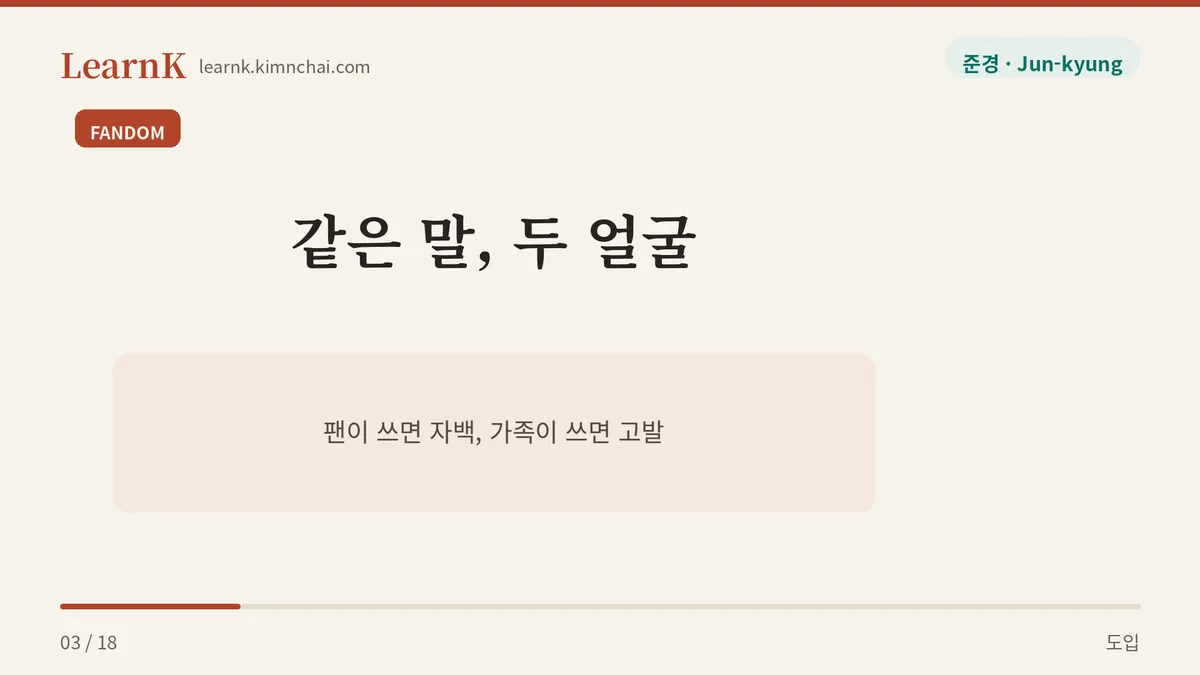
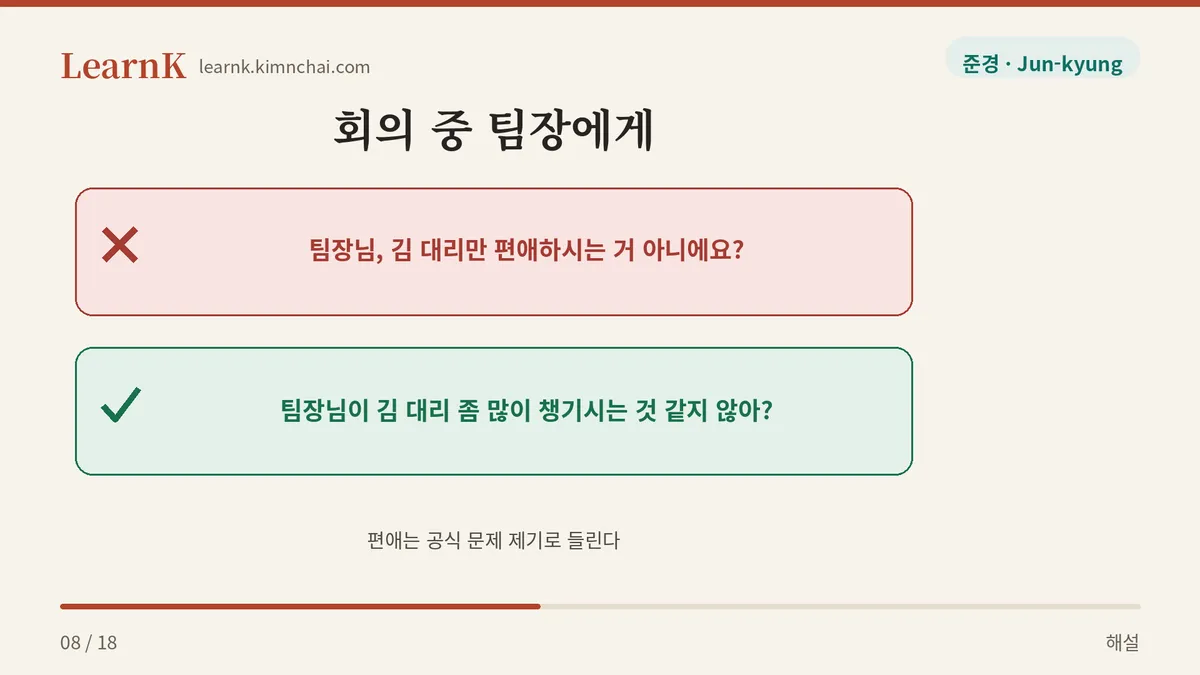
✗ (In a team meeting, in front of everyone, said straight to your manager) 팀장님, 김 대리만 편애하시는 거 아니에요? (Timjangnim, Kim daeriman pyeonaehasineun geo anieyo?) — “Boss, aren’t you playing favorites with Kim?” ✓ (Quietly to a coworker after the meeting is over) 팀장님이 김 대리 좀 많이 챙기시는 것 같지 않아? (Timjangnimi Kim daeri jom mani chaenggisineun geot gatji ana?) — “Don’t you think the boss looks out for Kim a lot?” → Even tossed out as a joke, 편애 (pyeonae) lands as a formal complaint: you have not been fair. Aim it directly at someone above you in front of a room full of people and it’s basically a declaration of war. If you want to lower the temperature, switch over to 챙기다 (chaenggida).
✗ (When a friend keeps picking up and cuddling only one of their two puppies) 너 지금 차별하는 거야? (Neo jigeum chabyeolhaneun geoya?) — “Are you discriminating right now?” ✓ (Same situation) 너 얘만 편애하네? (Neo yaeman pyeonaehane?) — “Wow, you totally favor this one, huh?” → Here it’s the other way around. 차별 (chabyeol) is a heavy word for calling out unjust treatment, so using it in a moment like this makes a joke turn suddenly serious. When it’s just affection tilting to one side, 편애 (pyeonae) is exactly the right weight.
Example Sentences by Situation
1. Broaching the subject carefully at a parent-teacher meeting
선생님, 아이가 반에서 편애를 느끼는 것 같아 걱정이에요. Seonsaengnim, aiga banaeseo pyeonaereul neukkineun geot gataseo geokjeongieyo. Teacher, I’m worried that my child feels there’s favoritism in the class.
→ Instead of asking head-on, “편애하시죠? (Are you playing favorites?),” this wraps it in one protective layer: “my child seems to feel it.” Throw 편애 (pyeonae) as a fastball and the conversation almost always turns into a defensive standoff. The trick is moving the subject from the other person over to your child.
2. On the phone with a fan friend after watching a comeback stage
이번 무대 분량 편애 너무 심한 거 아니야? Ibeon mudae bullyang pyeonae neomu simhan geo aniya? Isn’t the screen-time favoritism in this stage way too much?
→ Here it’s attached not to a person but to 분량 (bullyang, screen time). It means the broadcaster funneled the cameras and the lines to one member, and this is the usage you’ll see most often in fan communities. This one isn’t a joke — it’s genuine criticism.
3. When siblings dig up old stories after a long time
엄마가 형만 편애한 거, 나 아직도 기억난다. Eommaga hyeongman pyeonaehan geo, na ajikdo gieongnanda. I still remember how Mom favored only you.
→ Past tense, casual speech. This is the setting where old resentment gets pulled out wearing the costume of a joke. Say it in the present tense — 편애해 (pyeonaehae) — and it stops being an old story and becomes a conflict that’s happening right now. One tense change splits the mood completely.
Polite and Casual Forms, Plus Similar Expressions
In casual speech you get 편애해 (pyeonaehae), 편애하네 (pyeonaehane), and 편애하지 마 (pyeonaehaji ma). In polite speech it becomes 편애하세요 (pyeonaehaseyo) and 편애하시는 것 같아요 (pyeonaehasineun geot gatayo). That said, using the polite forms directly on someone above you almost never happens. 편애하지 마세요 (pyeonaehaji maseyo) in particular is grammatically polite but is a head-on protest in content, so in real life a sentence like 조금 서운했어요 (jogeum seounhaesseoyo), “I felt a little hurt,” takes its place. Politeness comes from word choice, not from verb endings.
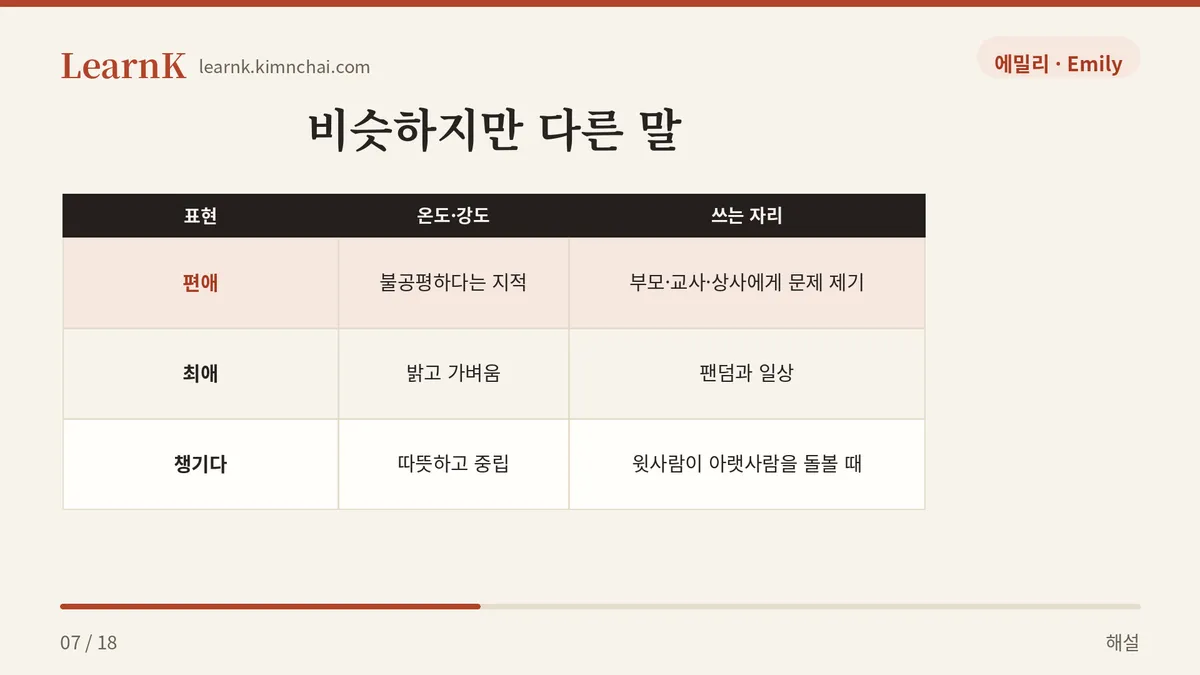
| Expression | Temperature & intensity | Where it’s used |
|---|---|---|
| 편애 (pyeonae) | Pointing out unfairness; flips into a joke inside fandom | Raising an issue with parents, teachers, bosses / fans confessing about themselves |
| 차별 (chabyeol) | Heavy and sharp; unjust treatment | Public protest, systemic and human-rights issues. Used as a joke among friends, it kills the mood |
| 최애 (choeae) | Bright and light; no negative sense at all | Fandom and everyday life. Works for menu items and objects, not just people |
| 챙기다 (chaenggida) | Warm, neutral to positive | When someone senior looks after someone junior. Can be used with no blame attached |
| 밀어주다 (mireojuda) | Support with backing layered on top | Companies, teams, and fandoms alike. A nuance of taking sides still lingers |
A lot of learners in particular mix up 최애 (choeae) and 편애 (pyeonae). 최애 is a noun pointing at the object of your greatest love itself, while 편애 is the act of loving in a lopsided way. 민서가 내 최애야 (Minseoga nae choeaeya) is natural, but 민서가 내 편애야 doesn’t hold together. If you must connect them, it becomes 나는 민서를 편애해 (Naneun Minseoreul pyeonaehae).
Cultural Background — How a Word for Accusing Became a Word for Confessing
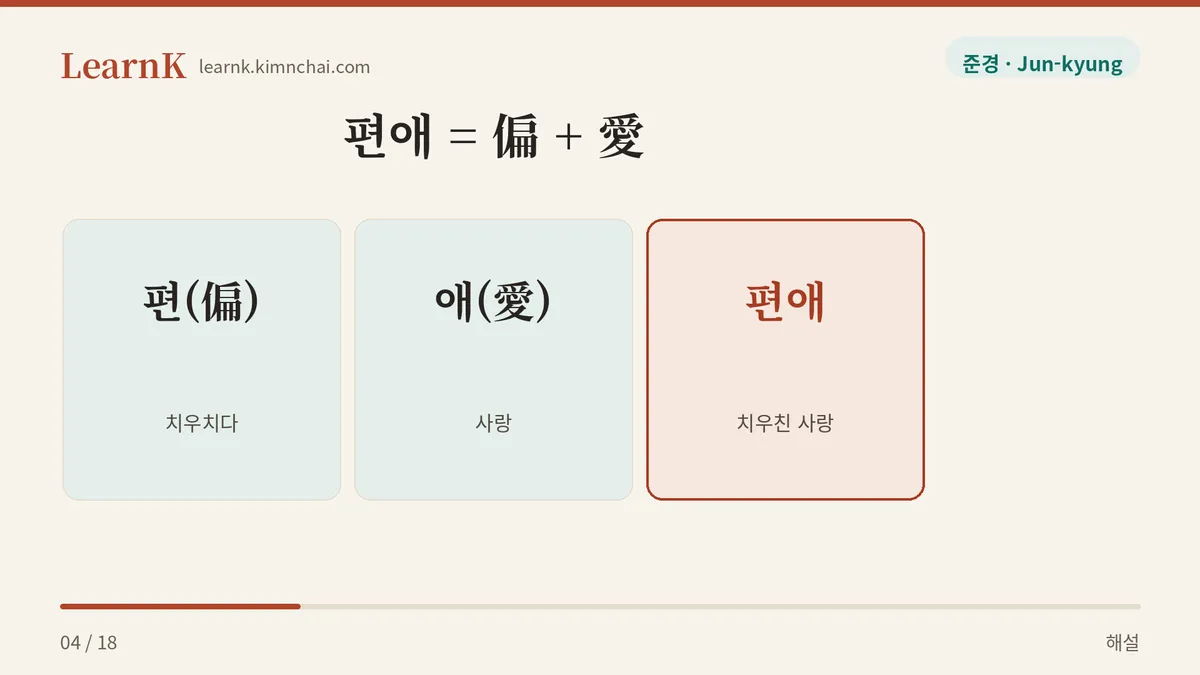
편애 (pyeonae) is the Chinese characters 偏 (치우칠 편, “to lean”) and 愛 (사랑 애, “love”) joined together just as they are. Literally, “tilted love.” The word-building is so transparent that once you hear the meaning, it doesn’t slip away.
For a long time this was a word of families and classrooms. It’s no accident that the dictionary examples bring up 남아 선호 사상 (nama seonho sasang, son preference), 첫 손주 (cheot sonju, the first grandchild), and 전실 자식 (jeonsil jasik, children from a previous marriage). Sons and daughters, the eldest son and the youngest, children from before a remarriage and after — in an era when there was never enough to go around, which way the affection tilted often became a wound that lasted a lifetime. That’s exactly why the trigger for sibling conflict in Korean family dramas can almost always be summed up in this single word.
And then K-pop fandom turned it inside out. As a culture took hold in which loving one member out of a whole group isn’t hidden but announced first, 대놓고 편애한다 (daenotgo pyeonaehanda), “I play favorites out in the open,” became a cute confession. A fan bears no responsibility to be fair, so this confession costs nothing. Variety show subtitles float the word up as a punchline too, whenever a cast member looks after one particular person.
The interesting part is that the word keeps both of its faces intact within that same fandom. When I do it, it’s a confession and it’s cute; when the broadcaster or the agency does it, it becomes 편애 논란 (pyeonae nollan), a favoritism controversy, and snaps right back to its original weight. When the cameras and the parts all pile onto one member, the word fans reach for is precisely that 편애. Once you know about this double life, posts in Korean fan communities read far more clearly. Just check who is written as having favored whom, and whether the subject of that sentence is a fan or the production staff — that alone tells you instantly whether it’s a joke or a protest.
Today’s Quiz
Which of the following is a situation where 편애 (pyeonae) is hard to use?
- The homeroom teacher always funnels the good roles to the class president.
- Grandma slips extra pocket money to only one of her four grandchildren.
- I live alone and absolutely adore my one cat.
The answer is number 3. As we saw earlier, for 편애 (pyeonae) to hold together, there has to be someone who got pushed aside. If there’s no one else to share with, it isn’t favoritism — it’s just “I absolutely adore them.” In numbers 1 and 2, there are clearly students who didn’t get roles and grandchildren who didn’t get the money. That empty seat is what completes this word.
Definitions and example sentences are from the National Institute of Korean Language’s Basic Korean Dictionary (krdict.korean.go.kr); that portion of this post, including our translations, is licensed under CC BY-SA 2.0 KR.