새해 복 많이 받으세요 (saehae bok mani badeuseyo) — Korea's New Year Greeting, and the Heart Behind This One Sentence
새해 복 많이 받으세요
As the year draws to a close, Korea’s streets, TV broadcasts, and messenger windows all light up with this one sentence: 새해 복 많이 받으세요 (saehae bok mani badeuseyo). If you’ve watched Korean dramas, you’ve surely seen a scene where characters dressed in hanbok exchange this phrase while giving a deep bow, or where an idol sends a video message to fans with a bright smile. Today, let’s take a deep dive into this national greeting that every Korean uses at least dozens of times a year.
When and in What Situations Do You Use It?
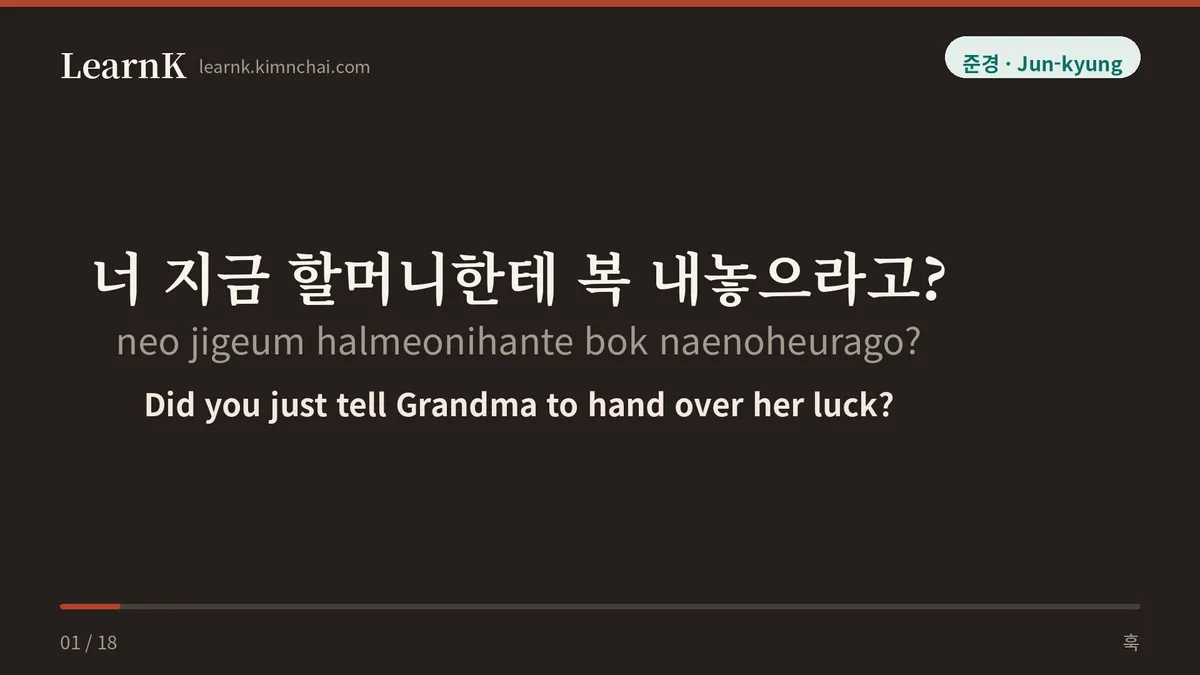
This expression is, quite literally, a well-wish meaning “may you receive lots of good fortune in the new year.” In Korea, there are actually two New Years. One is the solar New Year on January 1st (신정, sinjeong), and the other is the lunar New Year (구정, gujeong). Families gather to exchange this greeting especially during the lunar New Year holiday. From late December through January, and up until around the lunar New Year, this greeting stays in use for nearly two months at times.
Meaning and Nuance
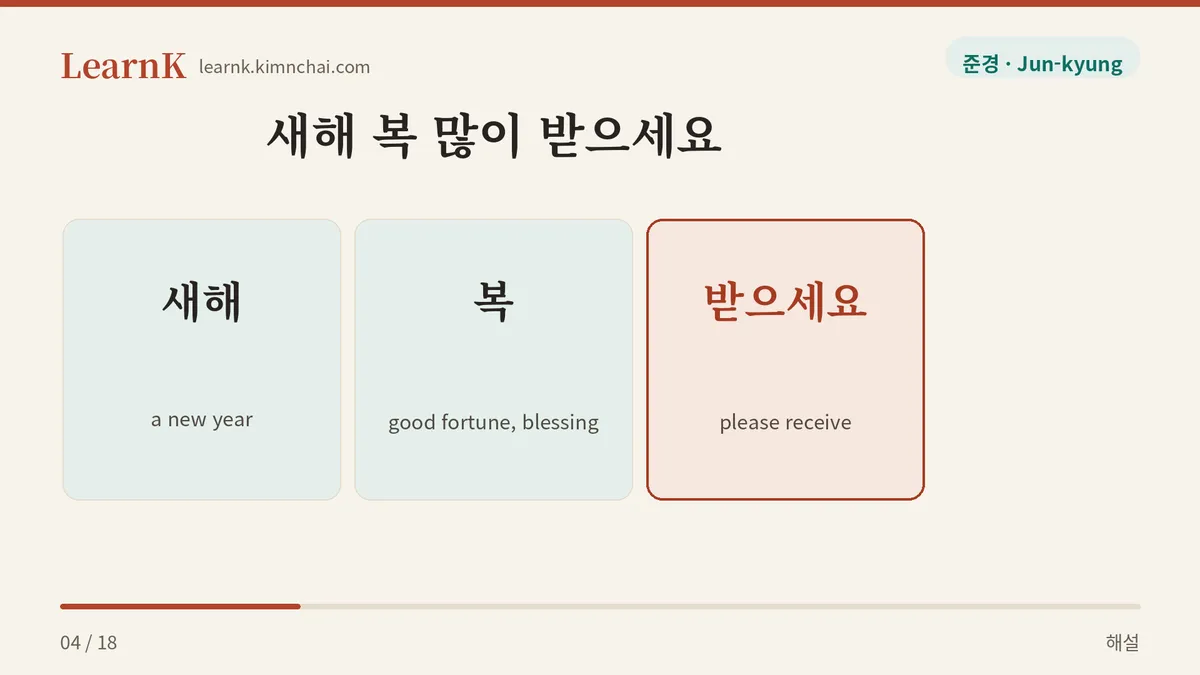
Let’s break the sentence down piece by piece.
- 새해 (saehae): ‘a new year’ — that is, the New Year
- 복 (bok): good fortune, luck, blessing
- 많이 (mani): a lot
- 받으세요 (badeuseyo): the polite command form of ‘받다 (batda, to receive)’ — “please receive”
A literal translation is “Please receive lots of good fortune in the new year.” What’s interesting is that you don’t say “I give you good fortune” but rather “May you receive good fortune.” Good fortune is something bestowed by the heavens or the world, and you are simply wishing that the other person receives it in abundance — this is a humble and warm-hearted expression.
Example Sentences by Situation
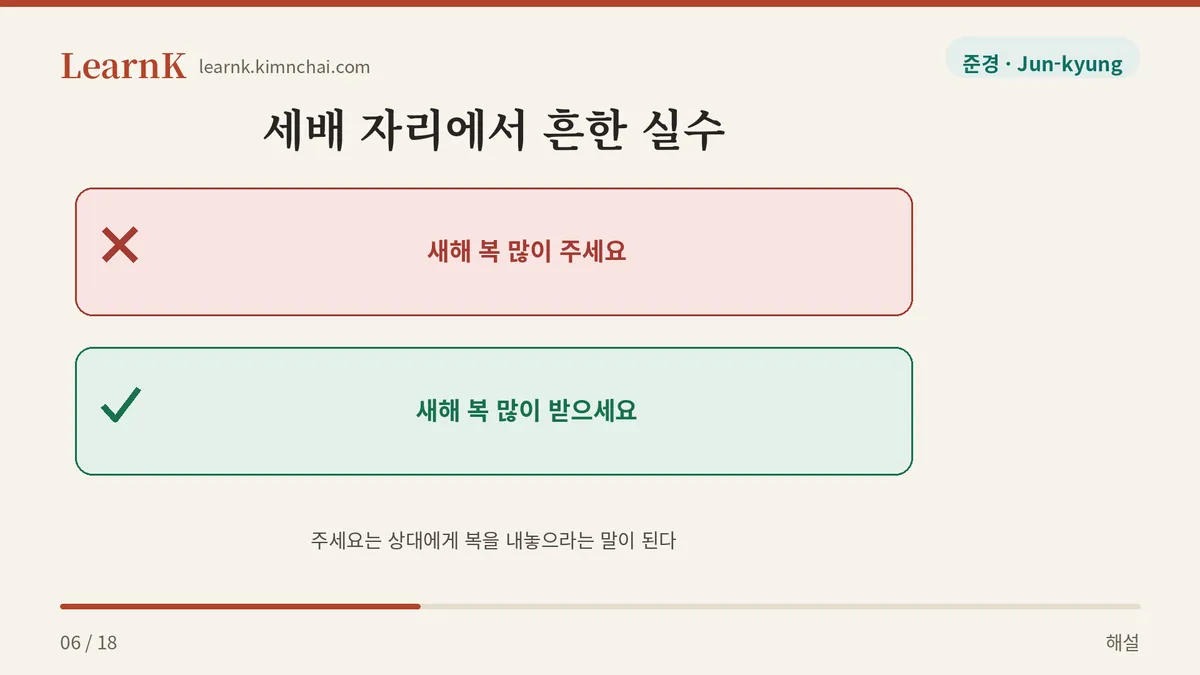
Situation 1 — A Family Bow (세배, sebae)
On the morning of the lunar New Year, a child gives a deep bow to their grandmother and grandfather and then says:
할머니, 할아버지, 새해 복 많이 받으세요! (harmeoni, harabeoji, saehae bok mani badeuseyo!)
The elders then give 세뱃돈 (sebaetdon, the spending money given after a New Year’s bow) and reply, “오냐, 너도 건강하게 잘 자라라 (onya, neodo geonganghage jal jarara)” — “There, there, may you grow up healthy too.”
Situation 2 — Workplace and Business Contacts
You also use it on the first workday of the new year, when greeting a boss or colleague formally.
부장님, 새해 복 많이 받으세요. 올해도 잘 부탁드립니다. (bujangnim, saehae bok mani badeuseyo. olhaedo jal butakdeurimnida.)
If you add “잘 부탁드립니다 (jal butakdeurimnida)” — roughly, “I look forward to working with you again this year” — at the end, you’ve got a New Year’s greeting that sounds perfectly natural in professional life.
Situation 3 — Messenger and Social Media
When you send a quick message to a friend or acquaintance over KakaoTalk, you write it like this:
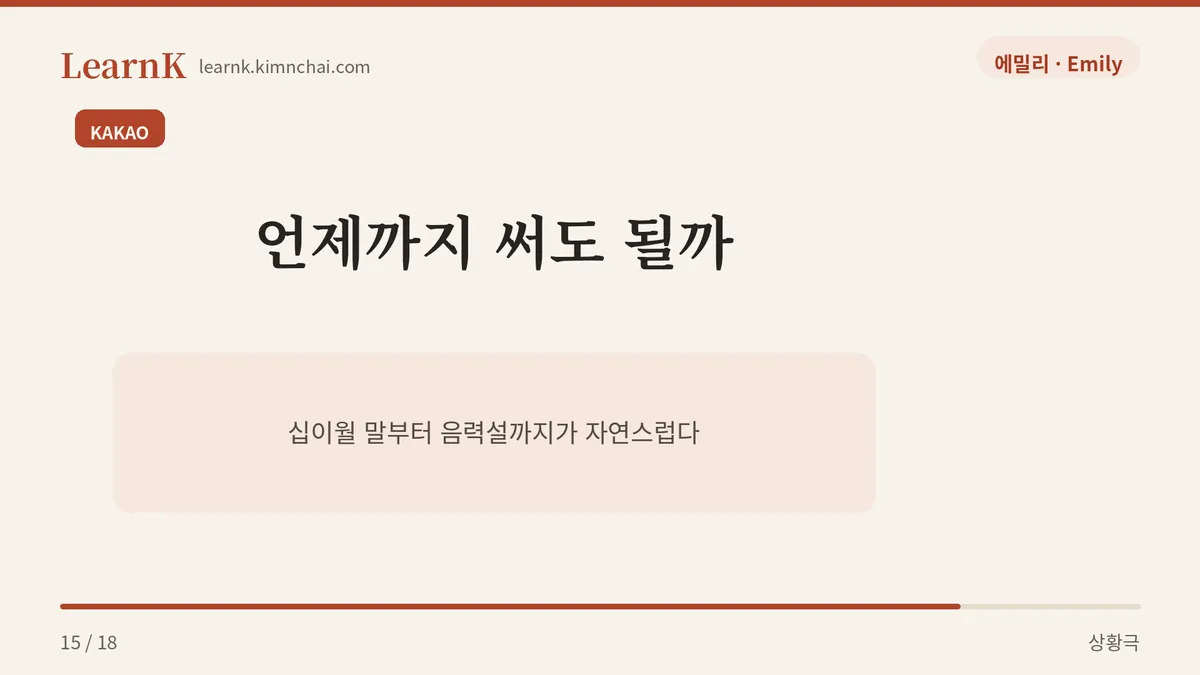
새복많이! 🎉 (saebokmani!)
Younger generations sometimes shorten ‘새해 복 많이 받으세요’ to a playful 새복많이 (saebokmani).
Comparing Formal, Casual, and Similar Expressions
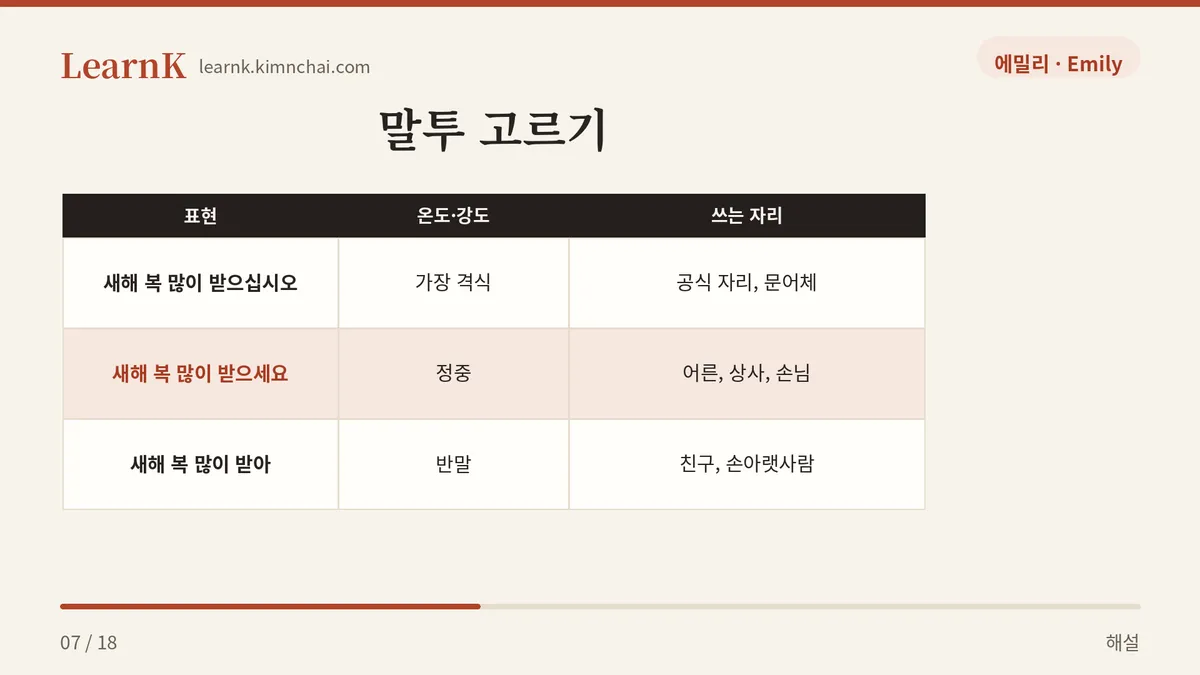
You have to change your tone depending on who you’re speaking to.
- Polite (respectful): 새해 복 많이 받으세요 (saehae bok mani badeuseyo) — for elders, bosses, and guests
- More formal: 새해 복 많이 받으십시오 (saehae bok mani badeusipsio) — for official occasions or written language
- Casual (friends and those younger than you): 새해 복 많이 받아 (saehae bok mani bada)
There are also expressions that are similar but carry a slightly different flavor. 건강하세요 (geonganghaseyo) means “I wish you good health” and is often added on around the new year. Where the English “Happy New Year” focuses on joy, ‘새해 복 많이 받으세요’ is distinctive in that it wishes someone 복 (bok) — the good fortune and well-being of the entire year ahead.
Cultural Background
At the root of this greeting lies Korea’s 세배 (sebae) custom. On the morning of the lunar New Year, younger people bow to their elders and offer New Year’s well-wishes, and the elders reply with well-wishes of their own along with 세뱃돈 (sebaetdon). Scenes in holiday-themed dramas and variety shows, where the whole family sits together in hanbok and exchanges this greeting, are one of the warmest symbols of the year-end and New Year season for Koreans.
One tip — as long as it’s not a New Year that has already passed, but rather one that’s approaching soon or the very start of a new year, it’s natural to use anytime. That said, once February is well behind you it starts to feel a bit awkward, so it’s best used while that “new year” mood still lingers.
Closing Quiz
You want to give a New Year’s greeting to a close friend using casual speech (반말, banmal). Which of the following sounds the most natural?
- 새해 복 많이 받으십시오 (saehae bok mani badeusipsio)
- 새해 복 많이 받아 (saehae bok mani bada)
- 새해 복 많이 받으세요 (saehae bok mani badeuseyo)
The answer is number 2, 새해 복 많이 받아 (saehae bok mani bada). Numbers 1 and 3 are polite expressions used for elders or people you need to be formal with. This year, why not offer this greeting to a Korean friend of your own? They’ll surely smile wide and send it right back with a “새해 복 많이 받으세요! (saehae bok mani badeuseyo!)”