"사랑해" vs. "사랑합니다": How a Single Syllable Changes the Distance Between Hearts

It’s the climax of the drama. Two people stand face to face in the pouring rain. The lead, in a trembling voice, lets out just three syllables: 사랑해 (saranghae). The moment the subtitle flashes on screen, hearts sink in unison all around the world. If you’re learning Korean, this is probably one of the very first sentences you memorized. But even when the feeling behind it is the same, Koreans carefully choose between 사랑해 (saranghae), 사랑해요 (saranghaeyo), and 사랑합니다 (saranghamnida) depending on the situation. Today, let’s dig into that subtle difference.
사랑해 / 사랑합니다
Both expressions share the same root verb, 사랑하다 (saranghada) — “to hold a heart that cherishes and treasures someone deeply.” How you end the word is what decides the distance between you and the other person.
- 사랑해 (saranghae) — casual speech (반말). Used with lovers, very close friends, and family — relationships with no walls. The hottest, most private feeling of the three.
- 사랑해요 (saranghaeyo) — polite, but with a soft and warm tone. For when you want to show affection while still showing respect.
- 사랑합니다 (saranghamnida) — formal speech. The most polite and official. It shows up often on stage, in letters, at fan meetings, or when pouring your heart out to your parents.
Here’s the interesting part: 사랑합니다 doesn’t necessarily mean a “deeper love.” If anything, it carries courtesy, gravity, and a “polite step back.” If lovers suddenly said “사랑합니다” to each other, it would sound either playful or like an extremely serious, formally staged confession.
Meaning and Nuance at a Glance
Korean honorifics (존댓말) aren’t just about “raising someone up” — they’re a thermostat for a relationship. If 사랑해 is a whisper shared under the blanket between just two people, 사랑합니다 is closer to a declaration made in a suit in front of everyone. The same feeling changes clothes depending on where you’re standing.
Example Sentences by Situation
Situation 1 — A goodnight message to your partner (casual speech)
잘 자, 내 꿈 꿔. 사랑해. (jal ja, nae kkum kkwo. saranghae.)
A sweet way to close out the day between people who are comfortable and close. No ‘요’, no ‘습니다’ — a tone allowed only with the person nearest to your heart.
Situation 2 — A wedding toast or an on-stage confession (formal speech)
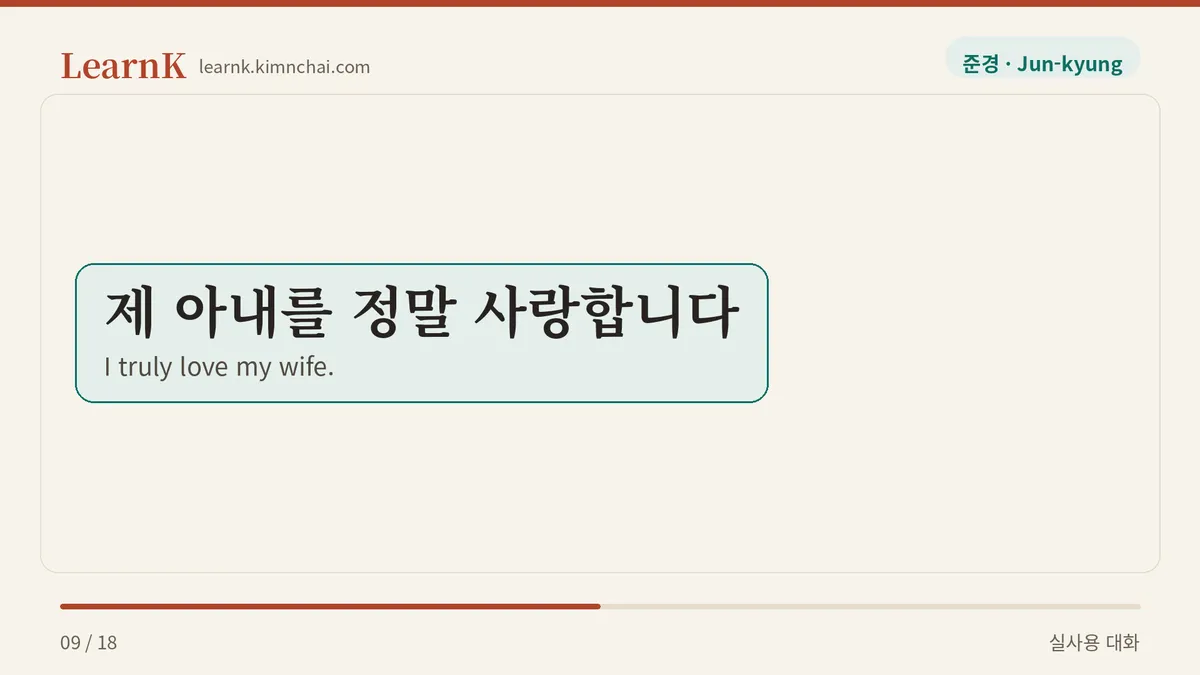
여러분, 오늘 이 자리에 와 주셔서 감사합니다. 그리고 내 아내를 정말 사랑합니다. (yeoreobun, oneul i jarie wa jusyeoseo gamsahamnida. geurigo nae anaereul jeongmal saranghamnida.)
When you’re officially declaring your feelings in front of a crowd, 사랑합니다 feels natural. It’s weighty and sincere.
Situation 3 — Texting your parents (soft polite speech)
엄마, 오늘도 고마웠어요. 많이 사랑해요. (eomma, oneuldo gomawosseoyo. mani saranghaeyo.)
With family, but when you want to include a note of respect, you use 사랑해요. It’s the middle ground — more polite than casual speech, warmer than formal speech.
Comparing Polite Speech, Casual Speech, and Similar Expressions
Korean also has plenty of ways to express love indirectly. 좋아해 (joahae), from ‘좋아하다’ (to like), is used in that fluttery stage that’s still too early to call “love.” That’s why, early in a confession, “너 좋아해” (I like you) is far more common than “너 사랑해” (I love you). And 보고 싶어 (bogo sipeo) literally means “I want to see you,” but to Koreans it means “I miss you” — and it doubles as a subtle confession of love. It’s the roundabout route favored by people who feel too shy to say “사랑해” directly.
Cultural Background — Why Don’t Koreans Say It Easily?
In Western cultures, family members trade “I love you” almost out of habit, but in Korea these words tend to be held a little more precious. That’s exactly why confession scenes in dramas hit so hard. In a K-drama, that single casual “사랑해” that finally bursts out after a long push-and-pull is also a symbolic moment of tearing down the wall of polite speech yourself. The scene where two people who had been speaking politely to each other drop into casual speech for the first time — this is the “crossing the threshold of a relationship” romance that only Korean can express.
Today’s Quiz
On stage at a company’s founding anniversary event, the CEO wants to officially convey gratitude and affection to the employees. Which of the following is the most natural expression?
- 여러분을 사랑해
- 여러분을 사랑합니다
- 여러분을 보고 싶어
The answer is #2, 사랑합니다 (saranghamnida). In an official setting, in front of many people, formal speech fits best. Now that you’ve learned the difference these few syllables make, you’ll be able to choose the right one for the right situation, won’t you?