Second Male Lead Syndrome — The Place Your Heart Goes Even When You Know the Ending
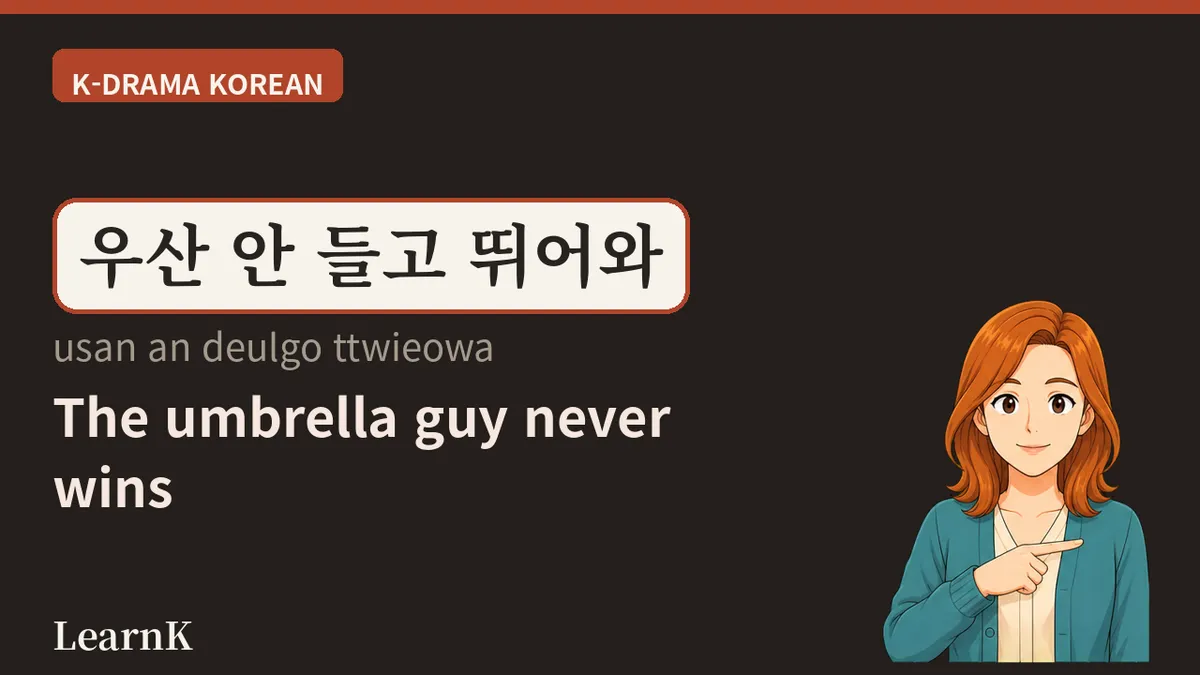
서브남주 신드롬
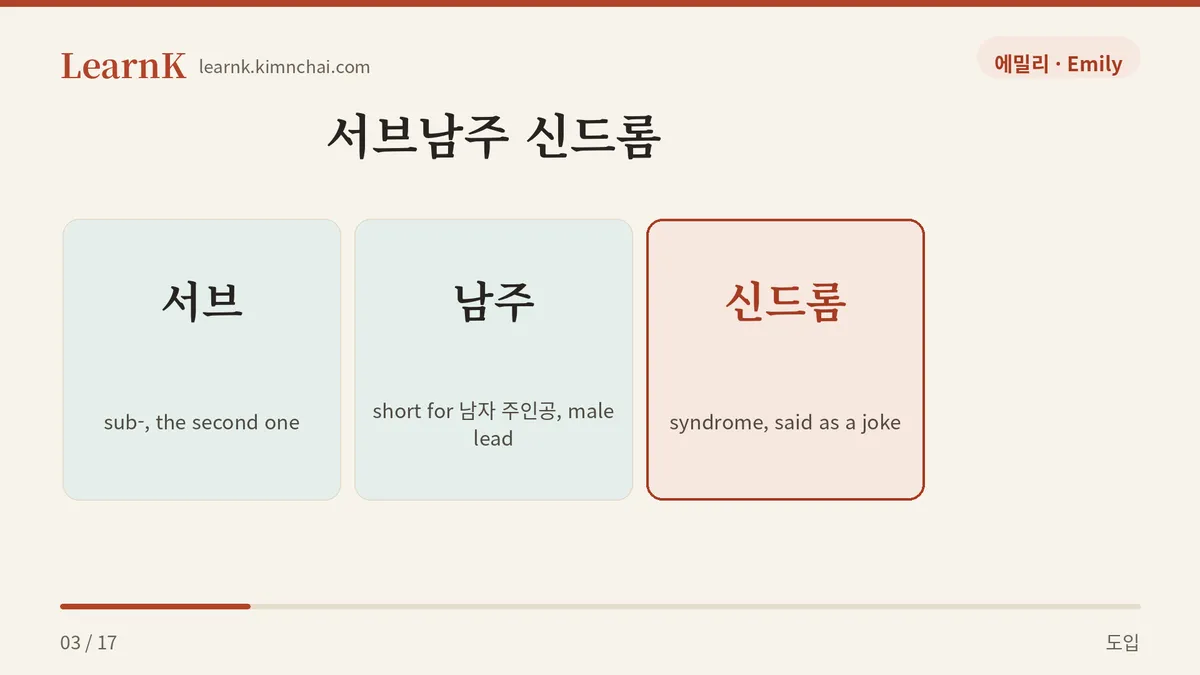
서브남주 신드롬 (seobeunamju sindeurom) — “second male lead syndrome” — is the term for a familiar drama phenomenon: the viewer’s heart leans toward the second male lead, the man who in the end will never be with the heroine. You can already see how it ends in episode 1, and yet, episode after episode, it isn’t the male lead but the person standing beside him who keeps catching your eye. That’s the exact spot this word points to.
If you watch Korean dramas, it happens to you sooner or later. The male lead starts out cold and gruff and only opens up in the back half of the show, while the second lead is kind from episode 1. He’s the one standing there holding an umbrella, the one who makes porridge when she’s sick, the one who stays beside her knowing perfectly well that she likes someone else. The viewer is torn between “the person who’s good to her right now” and “the person who will change later.” And because you know that leaning will never be rewarded, a faint ache always runs underneath the word.
The temperature of the word is light. Attaching something as grand as “syndrome” is a joke in itself — a device for describing your own feelings as if they were an illness, putting one step of distance between you and them. That’s why it doesn’t land like a serious confession, and why friends can toss it back and forth while laughing. Still, there’s real regret at the bottom of it, and it’s common for the person saying it to genuinely feel low for a few days over a fictional character. A joke on the outside, sincerity on the inside — that double structure is the heart of this expression.
It isn’t standard dictionary Korean. It’s a coinage born in drama fandom that traveled through online communities and social media and now turns up even in article headlines. So it isn’t used in public settings or formal writing; instead it lives in reviews, reaction posts, and casual chat.
A real conversation
The scene: Sunday, 11 p.m. The finale of a 16-episode drama has just ended and the closing credits are rolling. Jun-kyung’s living-room couch.
에밀리: 아, 진짜… 나 이번에도 서브남주 신드롬 왔어. Ugh, seriously… I’ve got second male lead syndrome again.
준경: 또? 너 저번 드라마 때도 딱 그랬잖아. Again? You were exactly like this with the last drama too.
에밀리: 아니 봐 봐, 저 사람 12회 내내 우산 들고 서 있었다고. I mean, look — he stood there holding an umbrella for twelve whole episodes.
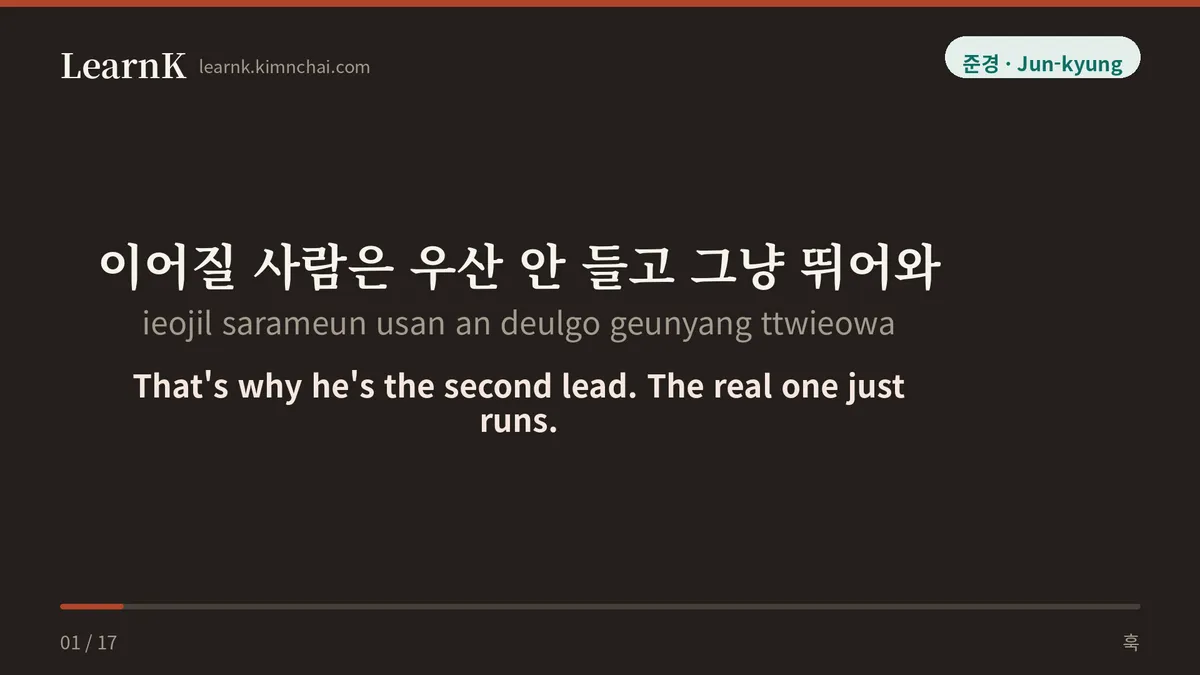
준경: 그러니까 서브남주지. 이어질 사람은 우산 안 들고 그냥 뛰어와. That’s exactly why he’s the second lead. The one who ends up with her just runs over without an umbrella.
에밀리: 야, 그 말이 더 아파. 나 오늘 잠 다 잤다. Hey, that hurts even more. There goes my sleep tonight.
준경: 서브남주 신드롬은 원래 최종회 다음 날이 제일 심해. 내일 출근길 조심해. Second male lead syndrome is always worst the day after the finale. Be careful on your commute tomorrow.
Using it this way sounds off
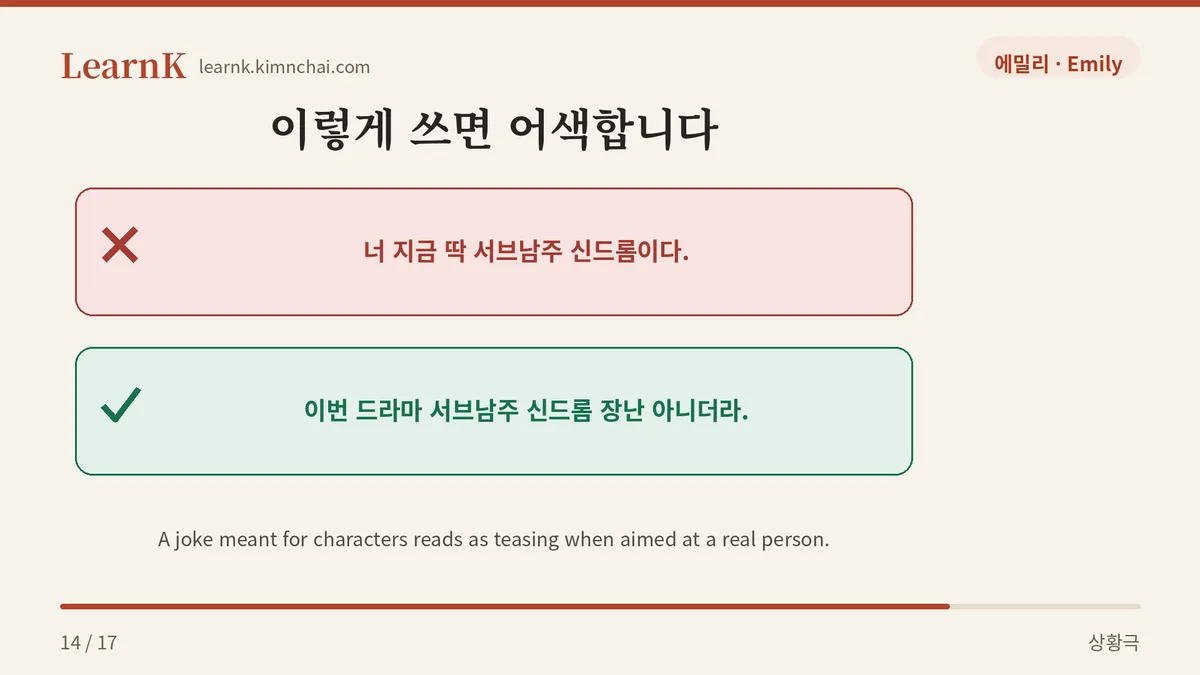
✗ (to a friend with a one-sided crush) 야, 너 지금 완전 서브남주 포지션인데? 서브남주 신드롬 오겠다. Hey, you’re totally in the second-male-lead position right now. Someone’s going to catch second male lead syndrome over you.
✓ (while chatting about a drama) 이번 드라마 서브남주 신드롬 장난 아니더라. The second male lead syndrome in this drama is no joke.
→ This expression is a joke about drama roles and nothing more. Pin it on someone who is actually hurting and it turns their feelings into a spectacle. A line meant to be funny ends up poking exactly where it hurts most.
✗ 서브남주가 결국 여주랑 이어졌어. 완전 서브남주 신드롬이야. The second lead ended up with the heroine after all. Total second male lead syndrome.
✓ 서브남주가 결국 여주랑 이어졌어. 이번엔 서브남주 신드롬 겪을 일이 없네. The second lead ended up with the heroine after all. No second male lead syndrome for me this time.
→ The weight of this word rests on “knowing it will never happen.” If he does end up with the heroine, the ache disappears — and without the ache, there’s no syndrome. This is the point beginning learners miss most often.
Example sentences by situation
Situation 1 — Monday lunch break, when a coworker brings up last night’s finale
나 어제부터 서브남주 신드롬 심하게 왔어. (na eojebuteo seobeunamju sindeurom simhage wasseo.) I’ve had a bad case of second male lead syndrome since yesterday.
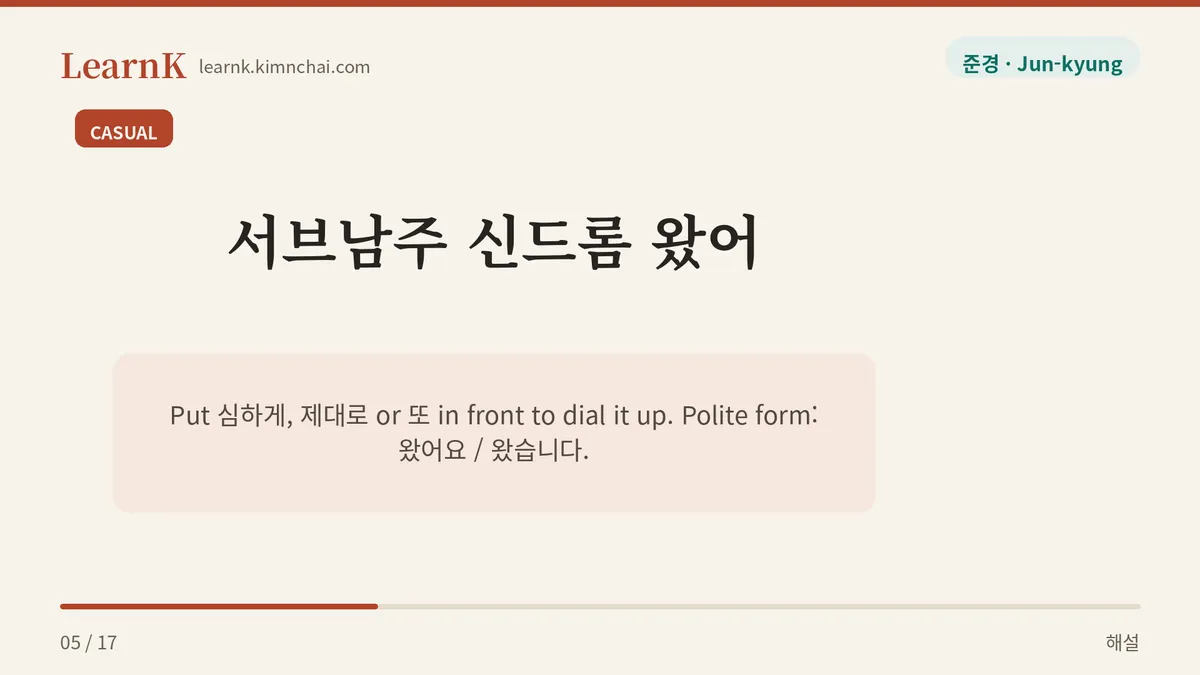
The fun part is that it pairs with the verb 왔다 (watda), “it came.” Like a cold, you talk about it as something that arrived on its own rather than something you invited. Words like 심하게 (simhage, badly), 제대로 (jedaero, properly), or 또 (tto, again) go in front to dial the intensity up or down. This is the most natural form in casual speech.
Situation 2 — Warning someone who hasn’t watched the drama yet
이 드라마 보실 거면 각오하세요. 서브남주 신드롬 옵니다. (i deurama bosil geomyeon gagohaseyo. seobeunamju sindeurom omnida.) If you’re going to watch this drama, brace yourself. Second male lead syndrome is coming.
You can absolutely use it in polite speech too — being slang doesn’t make it casual-only. The formality is carried by the verb ending at the end of the sentence, while the word itself stays light. So it’s fine for drama small talk with your boss, but not for a report or a presentation.
Situation 3 — Posting a reaction on social media
16회까지 버텼는데 결국 서브남주 신드롬으로 끝났다. (sibyukhoekkaji beotyeonneunde gyeolguk seobeunamju sindeuromeuro kkeutnatda.) I held out all the way to episode 16 and still ended up with second male lead syndrome.
Adding -으로 끝났다 (-euro kkeutnatda) brings out the nuance of “I resisted to the end, but I lost anyway.” This expression shines most naturally in sentences like this, where you’re poking fun at yourself. Rather than using it to pass judgment on others, its original use is confessing where your own heart went.
Polite and casual forms, and similar expressions
For casual speech it’s 서브남주 신드롬 왔어 (seobeunamju sindeurom wasseo), and for polite speech you just switch to 서브남주 신드롬 왔어요 / 왔습니다 (wasseoyo / watseumnida). The word itself doesn’t need to change. That said, the higher the formality goes, the more out of place the word itself becomes — so in very public writing, people spell it out as something like ‘두 번째 남자 주인공에게 감정이 이입되는 현상’ (the phenomenon of empathizing with the second male lead).
Lining it up against neighboring expressions makes its place clearer.
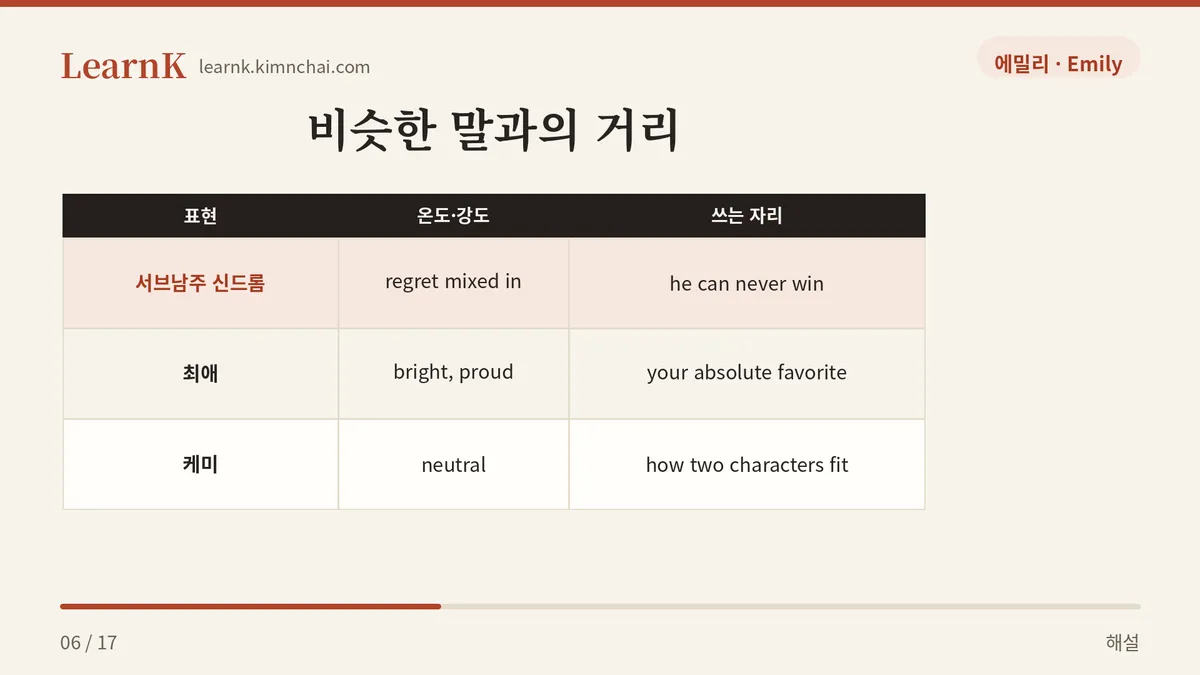
| Expression | Temperature / intensity | Where it’s used |
|---|---|---|
| 서브남주 신드롬 | Excitement mixed with regret. Half joke, half sincere | Drama reviews, reaction posts, social media. Works in both casual and polite speech |
| 서브남주 (seobeunamju) | Neutral. A name for a person | Any time you’re referring to the character |
| 최애 (choeae) | Bright and definite. No regret | Fandom in general — dramas, idols, anything |
| 케미 (kemi) | A word that evaluates a relationship. Neutral | When talking about how well two characters fit together |
최애 (choeae) means “the one I love most,” so it’s a bright, confident word. 서브남주 신드롬 has none of that confidence — it’s the feeling of knowing you’re in a fight you can’t win. 케미 (kemi) looks at the chemistry between two people, so the one doing the feeling is the character on screen, not the viewer. Korean also has the productive suffix -앓이 (-ari), which gives you forms like 서브남주 앓이 (seobeunamju ari); that one is more personal and lasts longer. If a syndrome is “something everyone catches at once, like a trend,” then 앓이 is “aching alone for a long time.”
Cultural background — the place of the man with the umbrella
Start with how the word is built. 서브 (seobeu) is English “sub-,” and 남주 (namju) is short for ‘남자 주인공’ (male lead). The heroine becomes 여주 (yeoju) the same way. Then 신드롬 (sindeurom, syndrome) is tacked on. One Korean abbreviation and two loanwords, arm in arm. English-speaking K-drama fandom uses “second male lead syndrome” right alongside it, so this expression essentially grew up moving back and forth between two languages.
Why does this phenomenon stand out so much in Korean dramas specifically? There’s a structural reason. A Korean drama usually traces how one relationship changes over the course of 16 episodes. The male lead has to start out arrogant or clumsy — otherwise there’s no room left for him to change. The second lead, on the other hand, doesn’t need to change, so he shows up fully formed in episode 1: warm, perceptive, willing to wait. For the first eight hours, the person being good to the viewer is the second lead. By the time the male lead finally opens up, the viewer’s affection has already gone elsewhere. The syndrome isn’t a writer’s mistake so much as something this structure makes almost inevitable.
Dramas like Reply 1988 (tvN, 2015–2016), which hide “who is the husband?” until the very end, used this feeling head-on. Viewers gathered evidence and argued about it every week, hearts in their throats right up to the finale. Korea’s viewing culture — watching live and reacting in online communities at the same moment — poured fuel on the fire. Being sad about it alone is just sadness; tens of thousands of people being sad about it at the same instant is a syndrome.
Fans take it one step further and joke that when the second lead lets go and walks away, he has 성불했다 (seongbulhaetda) — “attained Buddhahood.” A term that originally means becoming a Buddha in Buddhism, applied to the end of a one-sided love. It’s a great example of how Korean fandom builds language: take a heavy word, bring it into a light setting, and suddenly you can talk about an aching heart with a smile. 서브남주 신드롬 is, in the end, an invention of the same family.
Today’s quiz
Which of the following uses 서브남주 신드롬 most naturally?
- 어제 최종회 봤는데, 서브남주가 여주랑 이어져서 서브남주 신드롬 제대로 왔어. I watched the finale yesterday, and the second lead ended up with the heroine, so I’ve got a serious case of second male lead syndrome.
- 나 이번 드라마 서브남주 신드롬 와서 최종회 못 보겠어. 결말 뻔한데 마음이 계속 그쪽으로 가. I’ve got second male lead syndrome with this drama and I can’t bring myself to watch the finale. The ending is obvious, but my heart keeps going his way.
- (to a friend who got dumped yesterday) 너 지금 딱 서브남주 신드롬이다. You’re in a textbook case of second male lead syndrome right now.
Answer: number 2.
In number 1, the second lead ended up with the heroine, so the ache is gone — the conditions for the syndrome don’t exist. Number 3 takes a joke meant for drama characters and pins it on someone who is actually hurt, so it reads as teasing rather than comfort. Number 2 captures the core of the expression exactly: knowing how it ends and having your heart go there anyway.
Definitions and example sentences are from the National Institute of Korean Language’s Basic Korean Dictionary (krdict.korean.go.kr); that portion of this post, including our translations, is licensed under CC BY-SA 2.0 KR.