세계관 (segyegwan) — The One Word Shared by Philosophy Books and Idol Albums
세계관
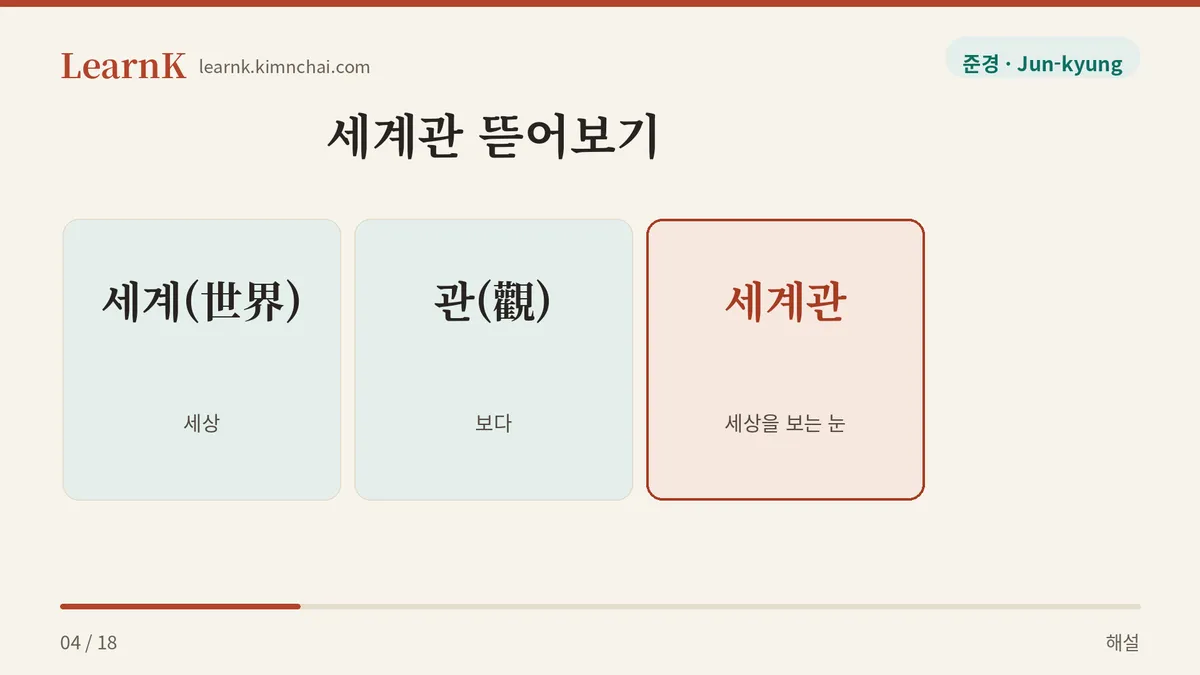
세계관 (segyegwan) means the way a person thinks about the world, and about the significance and value of the human beings and lives that make up that world. Break the Chinese characters apart and the picture gets sharper — 세계(世界) is ‘the world’ and 관(觀) is ‘to see’, so it literally means the eye you use to look at the world: how you see everything.
But the place where a Korean learner first runs into this word is usually not a philosophy book. It’s the YouTube comment section at 1 a.m. on the day a new album drops, or a summary thread posted by a fan account. Sentences like ‘이번 앨범 세계관 대박이다 (ibeon aelbeom segyegwan daebagida — the 세계관 of this album is incredible)’ or ‘이 그룹 세계관 정리 영상 어디 있어? (i geurup segyegwan jeongni yeongsang eodi isseo? — where’s the video that lays out this group’s 세계관?)’. The dictionary meaning and the fandom meaning overlap, but they’re slightly out of alignment — so memorizing the definition alone can leave you more confused.
Here’s the difference between the two uses. The dictionary 세계관 is the big framework a person uses to understand the world and life. It usually comes with a modifier in front — 과학적 세계관 (gwahakjeok segyegwan, a scientific worldview), 동양적 세계관 (dongyangjeok segyegwan, an Eastern worldview) — pointing to a school of thought. It’s a very large word, so attaching it to a person carries the weight of defining that person in their entirety. The 세계관 used in K-pop, games, and webtoons, on the other hand, is a single fictional setting running through a body of works — closer to English lore or universe. Still, the two share a root. One picture that threads everything together rather than isolated pieces: that’s the heart of the word 세계관.
Checking the National Institute of Korean Language dictionary
세계관 (segyegwan) (noun) The way someone thinks about the world, and about the significance and value of the people and lives that make up that world. [en] world view — The way someone thinks about the world, and the significance and values of the people and lives that make up the world. [ja] せかいかん【世界観】 — 世界と、その世界を成している人間・人生の意義と価値についての考え方。 [es] visión del mundo — Valoraciones que las personas o grupos tienen acerca del mundo y de los otros, su significado, y las relaciones que constituyen su universo. [zh] 世界观 — 对世界或构成世界的人类、以及人生的意义和价值的想法。 — National Institute of Korean Language, Basic Korean Dictionary (krdict.korean.go.kr)
A Portuguese gloss isn’t included in this dictionary, so the following is our own rendering (self-translated): visão de mundo — o modo como alguém entende o mundo, e o sentido e o valor da vida humana que o compõe.
Let’s look at the dictionary’s actual usage examples, exactly as they appear.
과학적 세계관. (gwahakjeok segyegwan. — A scientific worldview.) 동양적 세계관. (dongyangjeok segyegwan. — An Eastern worldview.) 다원론적 세계관. (dawollonjeok segyegwan. — A pluralistic worldview.) — National Institute of Korean Language, Basic Korean Dictionary (krdict.korean.go.kr)
All three follow the shape ‘◯◯적 + 세계관’. That shows you exactly where this word most often stands. 세계관 rarely sits alone; it pairs with a word in front that specifies which kind of worldview it is. Learn just this one frame and you’ll follow newspaper columns and general-education lectures far more easily.
세계관을 강제하다. (segyegwaneul gangjehada. — To impose a worldview.) — National Institute of Korean Language, Basic Korean Dictionary (krdict.korean.go.kr)
Short, but heavy. The verb 강제하다 (gangjehada, to force/impose) carries the built-in premise that a worldview is not something another person can plant in you by force. This combination shows up often in critical contexts — writing about education, religion, or politics.
구조주의 세계관으로 보면 세상은 여러 요소들이 서로 관계를 맺고 있는 하나의 큰 체계이다. (gujojuui segyegwaneuro bomyeon sesangeun yeoreo yosodeuri seoro gwangyereul maetgo inneun hanaui keun chegyeida. — Seen through a structuralist worldview, the world is one large system in which many elements form relationships with one another.) — National Institute of Korean Language, Basic Korean Dictionary (krdict.korean.go.kr)
Notice the expression ’◯◯ 세계관으로 보면’ (…segyegwaneuro bomyeon, ‘seen through the … worldview’). This sentence treats a worldview like a pair of glasses. The very structure of the sentence contains the idea that the same world looks different depending on which worldview you put on. It’s a frame you can lift straight into a presentation or a paper whenever you want to switch perspectives.
그 철학가는 하나의 절대적인 원리에서 우주가 탄생한 것은 아니라는 다원론적 세계관을 가지고 있다. (geu cheolhakganeun hanaui jeoldaejeogin wollieseo ujuga tansaenghan geoseun aniraneun dawollonjeok segyegwaneul gajigo itda. — That philosopher holds a pluralistic worldview, according to which the universe was not born from a single absolute principle.) — National Institute of Korean Language, Basic Korean Dictionary (krdict.korean.go.kr)
Here we get 세계관을 가지고 있다 (segyegwaneul gajigo itda, ‘to have a worldview’) — the most basic verb linking a person to a worldview. Remember: 세계관 goes with 가지다 (gajida, to have), not 하다 (hada, to do).
A real conversation
Setting: 1 a.m. The comeback music video dropped about ten minutes ago. In Jun-kyung’s living room, the two of them are shoulder to shoulder in front of a single laptop.
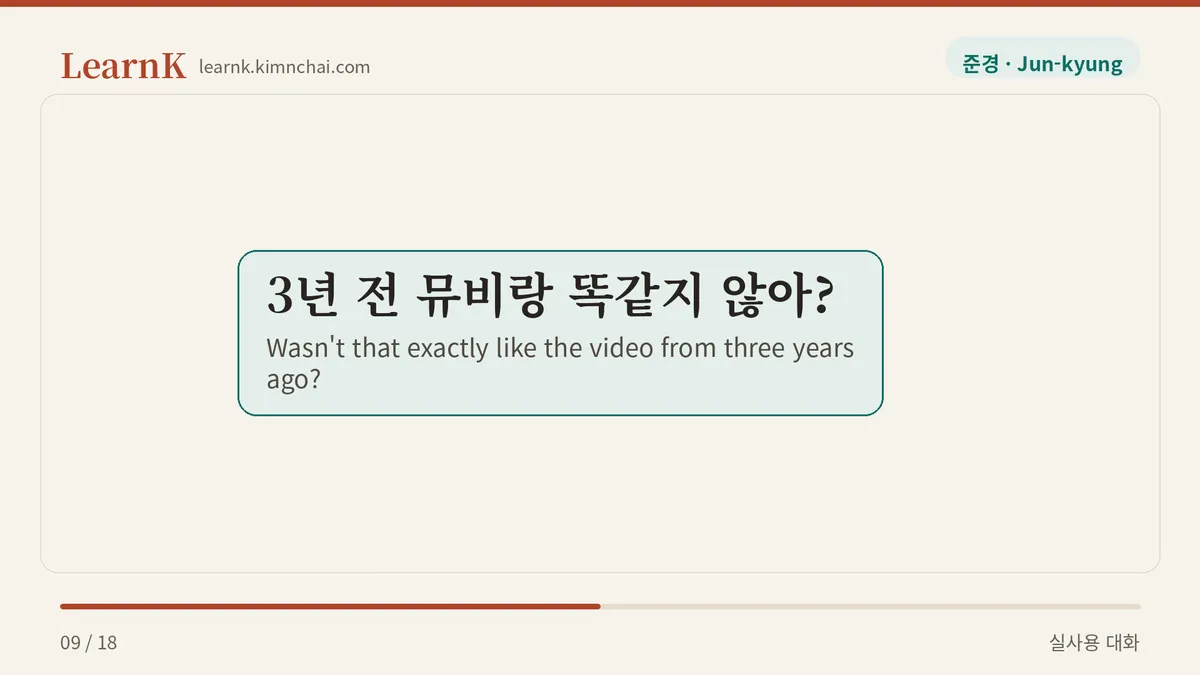
준경: 야, 잠깐만. 방금 저 문 열리는 장면, 3년 전 뮤비랑 똑같지 않아? Hey, hold on. That shot of the door opening — wasn’t that exactly like the video from three years ago?
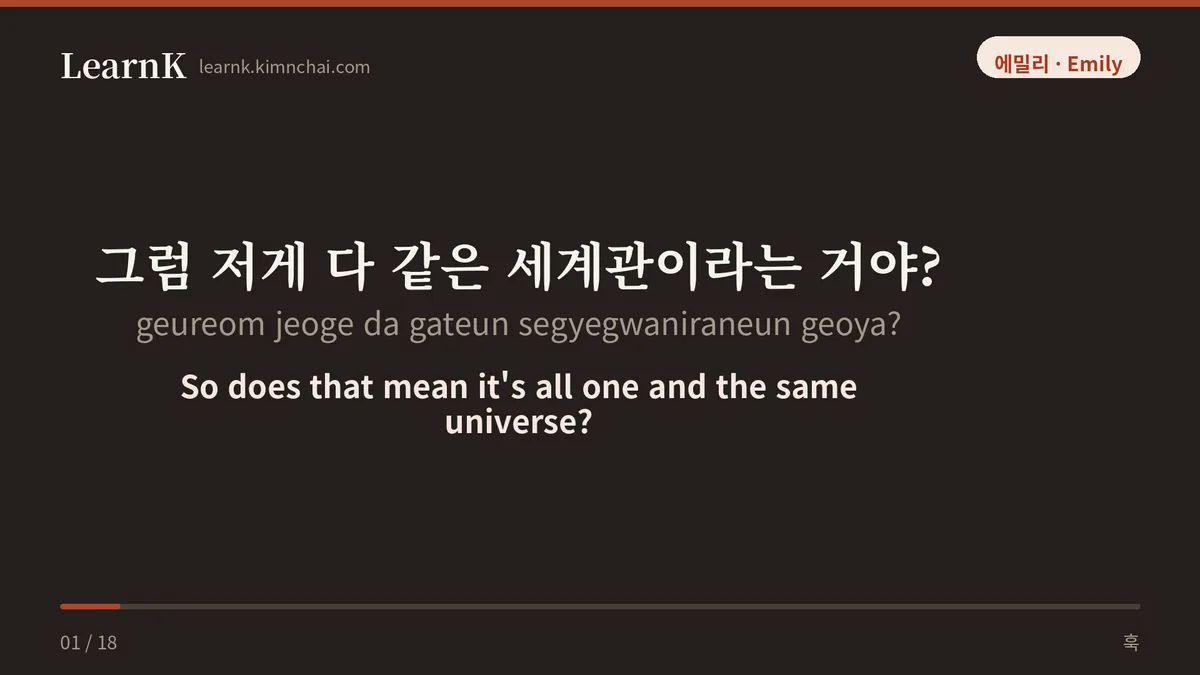
에밀리: 어, 진짜네. 그럼 저게 다 같은 세계관이라는 거야? Oh, you’re right. So does that mean it’s all one and the same universe?
준경: 그렇지. 앨범 세 장을 하나로 꿰는 세계관이라 순서대로 봐야 이해돼. Exactly. It’s a world that ties three albums together, so you have to watch them in order.
에밀리: 아, 어쩐지. 나 저번엔 최신 거부터 봐서 하나도 이해 못 했잖아. Ah, that explains it. Last time I started with the newest one and understood nothing.
준경: 그래서 팬들이 세계관 정리 영상을 만드는 거야. 나도 그거 보고 겨우 따라갔어. That’s why fans make those lore-summary videos. I only caught up after watching one myself.
에밀리: 링크 좀. 나 오늘 밤 새우겠다. Send me the link. I’m definitely pulling an all-nighter.
These uses sound off
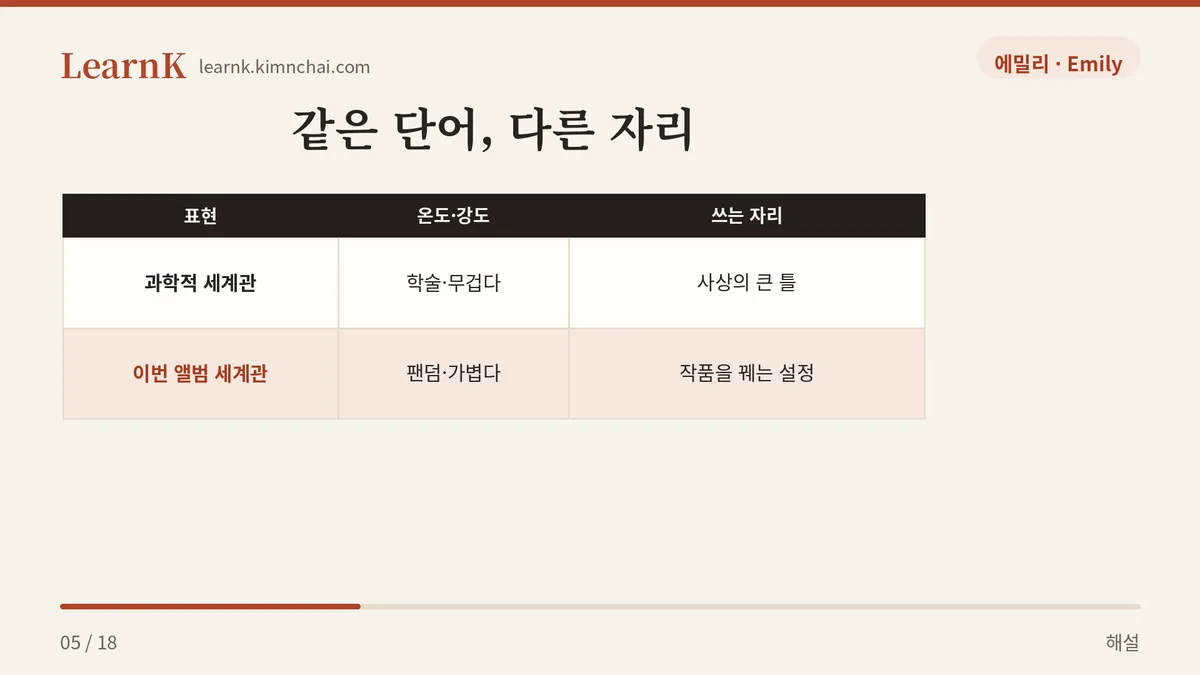
✗ (presenting in a philosophy class) 이 철학자의 세계관, 떡밥 진짜 많지 않나요? (i cheolhakjaui segyegwan, tteokbap jinjja manchi annayo? — This philosopher’s worldview drops a ton of teasers, doesn’t it?) ✓ (presenting in a philosophy class) 이 철학자의 세계관은 해석이 여러 갈래로 갈립니다. (i cheolhakjaui segyegwaneun haeseogi yeoreo gallaero gallimnida. — Interpretations of this philosopher’s worldview split in several directions.) → The word 세계관 itself works in both settings, but the temperature of the words around it differs. 떡밥 (tteokbap) is fan slang, so bringing it into an academic setting makes the whole presentation sound lightweight.
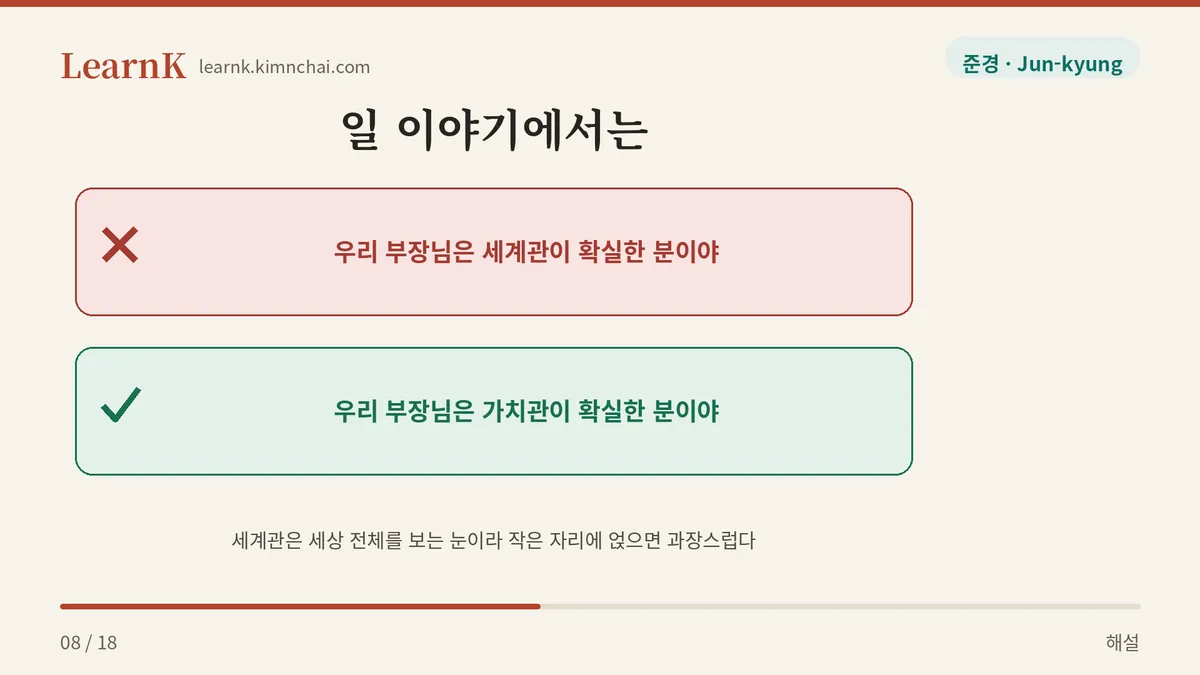
✗ (talking about how someone handles work) 우리 부장님은 세계관이 확실한 분이야. (uri bujangnimeun segyegwani hwaksilhan buniya. — Our department head is someone with a firm worldview.) ✓ (talking about how someone handles work) 우리 부장님은 가치관이 확실한 분이야. (uri bujangnimeun gachigwani hwaksilhan buniya. — Our department head is someone with firm values.) → 세계관 is a big word pointing at ‘how you see the entire world’. Drop it into a small setting like a team dinner or shop talk and it sounds grandiose — sometimes even sarcastic.
Example sentences by situation
1) Introducing a friend to an idol group for the first time You’re recommending they get into the group and telling them the viewing order. You use it to say that listening to the songs alone means missing something.
이 그룹은 노래보다 세계관부터 봐야 재밌어. (i geurubeun noraeboda segyegwanbuteo bwaya jaemisseo.) With this group, you have to start with the 세계관 rather than the songs — that’s what makes it fun.
2) Leaving a review of a game or a novel A review sentence that mixes praise with disappointment. It’s common in assessments where the setup was good but didn’t hold together to the end.
초반 설정은 촘촘한데 세계관이 끝까지 유지되지 않아서 아쉬웠어요. (choban seoljeongeun chomchomhande segyegwani kkeutkkaji yujidoeji anaseo aswiwosseoyo.) The early setup is tightly built, but the 세계관 doesn’t hold up to the end, which was a shame.
3) Gently disagreeing at a book club An expression that keeps some distance without putting the author down. Paired with ‘완전히 ~하지는 않아요 (wanjeonhi ~hajineun anayo)’, it becomes a softened disagreement.
저는 그 작가의 세계관에 완전히 동의하지는 않아요. (jeoneun geu jakgaui segyegwane wanjeonhi donguihajineun anayo.) I don’t entirely agree with that author’s 세계관.
Polite vs. casual speech, and similar expressions
세계관 is a noun, so it carries no honorific level on its own. The temperature is set by the verb that follows. Casual: 완전 새로운 세계관이야 (wanjeon saeroun segyegwaniya). Polite: 완전히 새로운 세계관입니다 (wanjeonhi saeroun segyegwanimnida). What actually trips learners up isn’t the politeness level, though — it’s the difference in scale between this word and its similar-looking neighbors.
| Expression | Temperature / intensity | Where it’s used |
|---|---|---|
| 세계관 (segyegwan) | Big and heavy. The picture that threads everything together | Philosophy, literature, religion / in fandom, the setting running through a whole album series or game |
| 가치관 (gachigwan) | Personal and everyday | A person’s standards of judgment. Job interviews, counseling, dating advice |
| 인생관 (insaenggwan) | In between. One’s attitude toward life | Conversations about life itself, like career paths or marriage |
| 설정 (seoljeong) | Light and specific | Individual rules inside a work. One size smaller than 세계관 |
As the table shows, 세계관 and 설정 operate at different scales. ‘이 캐릭터는 물을 못 만진다 (i kaerikteoneun mureul mot manjinda — this character can’t touch water)’ is a 설정; when those settings add up into a single universe, that’s a 세계관. This is exactly why fans say 설정 오류 (seoljeong oryu, a continuity/setting error) but rarely say 세계관 오류 (segyegwan oryu).
Cultural background — words ending in 관(觀), and the idol universe
Start with word formation. 세계관 is 세계(世界) plus 관(觀), ‘to see’. That 관 is a productive suffix, so new words keep getting built depending on what you put in front of it: 가치관 (gachigwan, values), 인생관 (insaenggwan, view of life), 역사관 (yeoksagwan, view of history), 결혼관 (gyeolhongwan, view of marriage), 직업관 (jigeopgwan, view of work). Learn one Chinese character and you get five words at once. For what it’s worth, 세계관 is understood to be a translation of the German Weltanschauung that entered Korean by way of Japanese — which is part of why an academic scent still clings to it.
This stiff word crossed over into pop culture in the 2010s. A number of K-pop groups began laying down a single fictional setting from debut, stringing albums and music videos together like a serialized work. Each member gets a symbol or a power, and one object in a music video reappears years later in another song. EXO’s debut-era concept, BTS’s linked music videos, and the virtual-world setting aespa built their identity on are examples fans have discussed for years. (Lyrics are copyrighted, so we won’t reproduce any song’s contents here — only the broad strokes.)
The result is a distinctive viewing culture in Korean fandom. When a new music video drops, people pause on individual frames, compare them against earlier works, and produce ‘세계관 정리 (segyegwan jeongni)’ — lore-summary — content. That’s exactly why Jun-kyung and Emily in the dialogue above are glued to a laptop at 1 a.m. Game and webtoon fans use the word the same way. In news articles and editorials, meanwhile, 세계관 almost always means the original dictionary sense: a framework of thought. When you meet the word, context tells you which one it is — if something like 과학적 (gwahakjeok, scientific) or 동양적 (dongyangjeok, Eastern) comes in front, it’s philosophy; if 이번 앨범 (ibeon aelbeom, this album) or 이 게임 (i geim, this game) comes in front, it’s fandom.
Today’s quiz
Which of the following sentences uses 세계관 unnaturally?
- 그 감독은 영화마다 일관된 세계관을 보여 준다. (geu gamdogeun yeonghwamada ilgwandoen segyegwaneul boyeo junda. — That director shows a consistent worldview in every film.)
- 이 게임은 세계관이 방대해서 입문용 안내서가 따로 있다. (i geimeun segyegwani bangdaehaeseo immunyong annaeseoga ttaro itda. — This game’s universe is so vast that there’s a separate beginner’s guide.)
- 오늘 점심 메뉴에 대한 제 세계관은 김치찌개입니다. (oneul jeomsim menyue daehan je segyegwaneun gimchijjigaeimnida. — My worldview regarding today’s lunch menu is kimchi stew.)
The answer is number 3. 세계관 is a big word for how you see the world and life as a whole, so attaching it to something small like a lunch preference comes out ridiculous. Here, something like 제 취향은 김치찌개예요 (je chwihyangeun gimchijjigaeyeyo — my preference is kimchi stew) sounds natural. Of course, friends do sometimes use it this way on purpose to be funny by overstating things — but that’s a joke that works precisely because the speaker knows it’s off.
Definitions and example sentences are from the National Institute of Korean Language’s Basic Korean Dictionary (krdict.korean.go.kr); that portion of this post, including our translations, is licensed under CC BY-SA 2.0 KR.