성함이 어떻게 되세요? — The Most Polite Way to Ask Someone's Name in Korea
If you live in Korea, there’s a sentence you’re bound to hear sooner or later. At the hospital reception desk, at the bank after you’ve pulled a number, on the phone with a delivery driver, on a call confirming a restaurant reservation — in situations where someone needs to ask your name, Koreans surprisingly don’t often say “이름이 뭐예요? (ireumi mwoyeyo?)” Instead, they ask it like this.
성함이 어떻게 되세요?
성함이 어떻게 되세요? (seonghami eotteoke doeseyo?)
This is the most polite way in Korean to ask “이름이 무엇입니까? (ireumi mueosimnikka?)” — “What is your name?” In English, it’s closest to “May I have your name?” The meaning is simple, but two devices are what make this sentence polite.
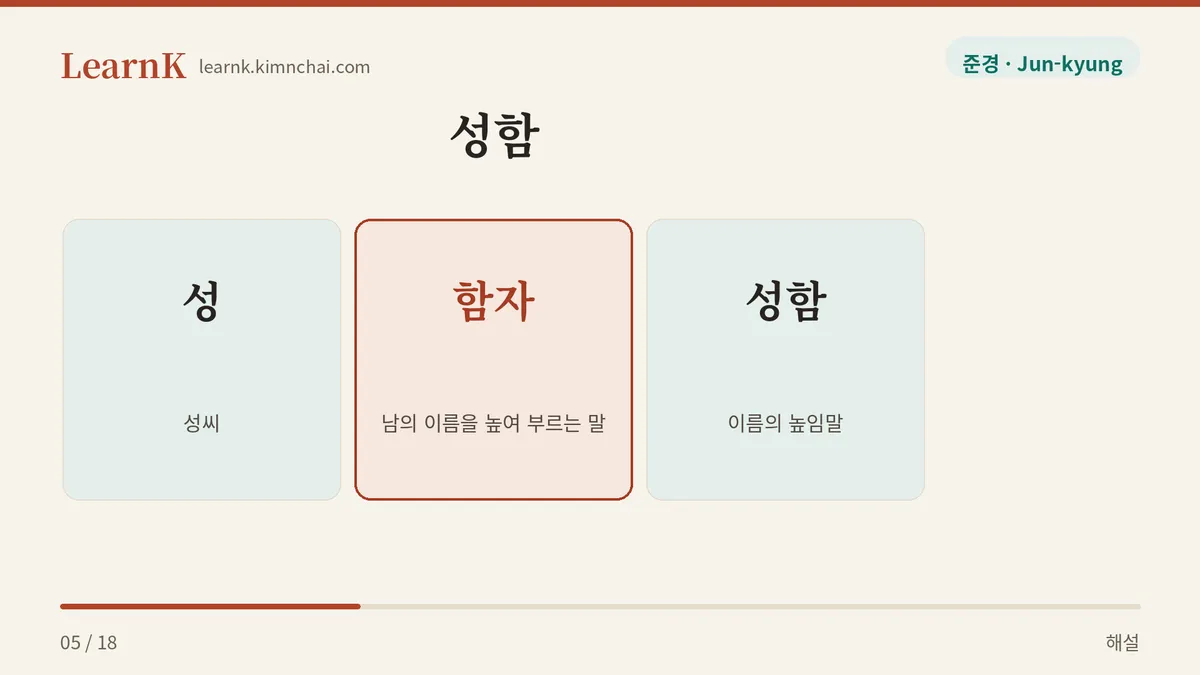
First, 성함 (seongham). This is the honorific word for “name.” It’s a Sino-Korean compound joining 성 (surname) and 함자 (an honorific term for a given name), and the word itself carries the attitude that you don’t casually toss around someone else’s name. Korean has a number of word pairs like this — one plain, one honorific, same meaning — 나이/연세 (age), 집/댁 (house), 말/말씀 (words), 밥/진지 (meal). The moment you reach for the honorific one, the temperature of the sentence changes.
Second, 어떻게 되세요 (eotteoke doeseyo). Where “무엇입니까? (mueosimnikka?)” — “what is it?” — demands an answer head-on, “어떻게 되세요? (eotteoke doeseyo?)” — closer to “how does it come to be?” — asks while taking half a step back. It’s a cushion that keeps the question from pointing straight at the other person. That’s why this same frame gets reused whenever the information is a little delicate, like age, address, or family relations — 연세가 어떻게 되세요 (yeonsega eotteoke doeseyo, “how old are you,” polite), 댁이 어디세요 (daegi eodiseyo, “where do you live,” polite).
Seeing It in a Real Conversation
Scene: A Saturday morning in the waiting room of an orthopedic clinic. Emily comes back from the reception desk and plops down next to Jun-kyung.
Jun-kyung: 접수 다 했어? 근데 왜 그렇게 웃어. Did you finish checking in? Why are you grinning like that?
Emily: 아니, 간호사님이 성함이 어떻게 되세요? 하시는데, 나 순간 성이랑 이름을 따로 말하라는 줄 알았잖아. The nurse asked for my name — and for a second I thought she wanted my surname and given name separately.
Jun-kyung: 야, 15년 살고 아직도? 그냥 이름 물어보는 높임말이야. Come on, fifteen years here and you still? It’s just the polite way to ask someone’s name.
Emily: 알지. 근데 나한테 그렇게 물어본 사람 거의 없었어. 다들 나한텐 “이름이 뭐예요?” 하거든. I know. But almost nobody asks me like that. To me everyone says “ireumi mwoyeyo?”
Jun-kyung: 아… 그건 좀 그렇다. 이제 성함이 어떻게 되세요 소리 듣기 시작했으면 너도 여기서 어른 대접 받는 거야. Ah… that’s a bit much. If you’re starting to get asked that way, you’re being treated as a grown-up here now.
Emily: 어른은 무슨. 그럼 진료비도 어른답게 네가 내라. Grown-up my foot. Then pay the bill like a grown-up.
Example Sentences by Situation
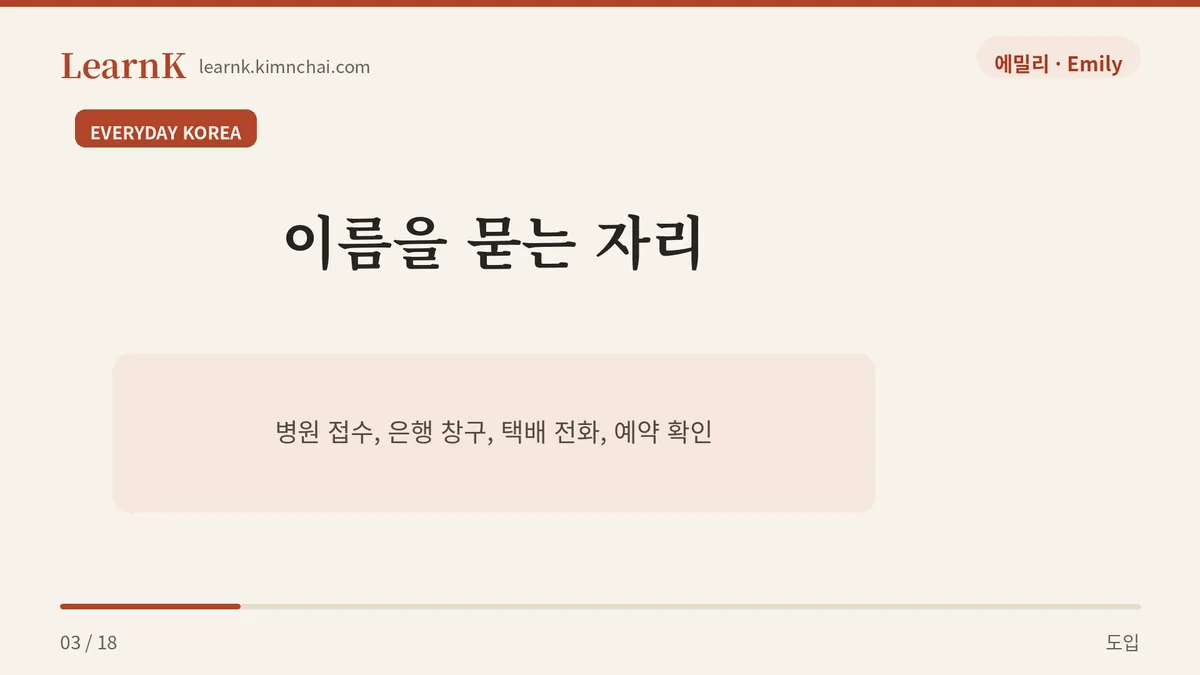
1. At a reception desk (staff → customer)
환자분, 성함이 어떻게 되세요? (hwanjabun, seonghami eotteoke doeseyo?) Sir/Ma’am, may I have your name?
This is the form you’ll hear most often at hospitals, community service centers, and banks. It’s almost standard for “생년월일도 말씀해 주시겠어요? (saengnyeonwolildo malsseumhae jusigesseoyo?, “Could you also tell me your date of birth?”)” to follow right behind it.
2. When confirming a reservation by phone
예약하신 분 성함이 어떻게 되실까요? (yeyakhasin bun seonghami eotteoke doesilkkayo?) Could I ask the name the reservation is under?
‘되실까요 (doesilkkayo)’ is one notch more careful than ‘되세요 (doeseyo).’ It’s a softly-pressing tone that service industries love to use.
3. When being introduced (person → person)
실례지만 성함이 어떻게 되세요? (sillyejiman seonghami eotteoke doeseyo?) Excuse me, but may I ask your name?
Adding ‘실례지만 (sillyejiman, “excuse me, but”)’ up front layers on the sense that “even asking this is a little delicate.” It’s a good one to use when you never got someone’s business card.
Comparing Casual Speech, Polite Speech, and Similar Expressions
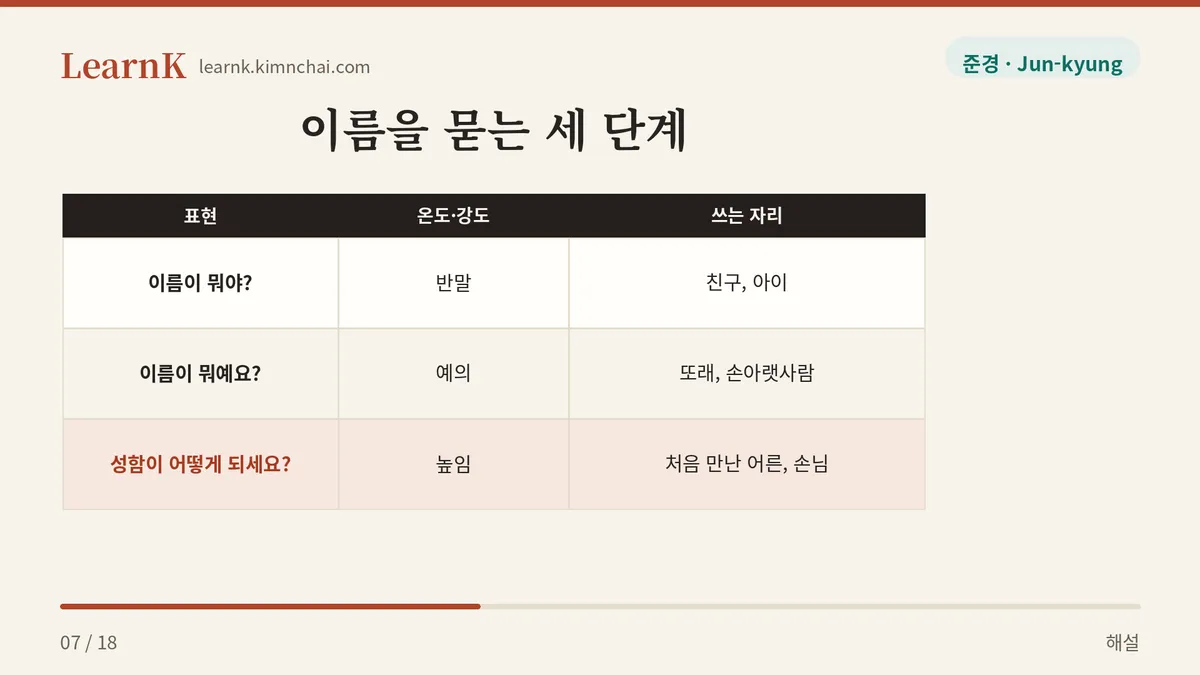
| Expression | Romanization | To whom |
|---|---|---|
| 이름이 뭐야? | ireumi mwoya? | Friends, children |
| 이름이 뭐예요? | ireumi mwoyeyo? | Peers or younger people, just polite enough |
| 성함이 어떻게 되세요? | seonghami eotteoke doeseyo? | Adults you’re meeting for the first time, customers, formal settings |
| 성함이 어떻게 되십니까? | seonghami eotteoke doesimnikka? | Formal (official events, broadcasting) |
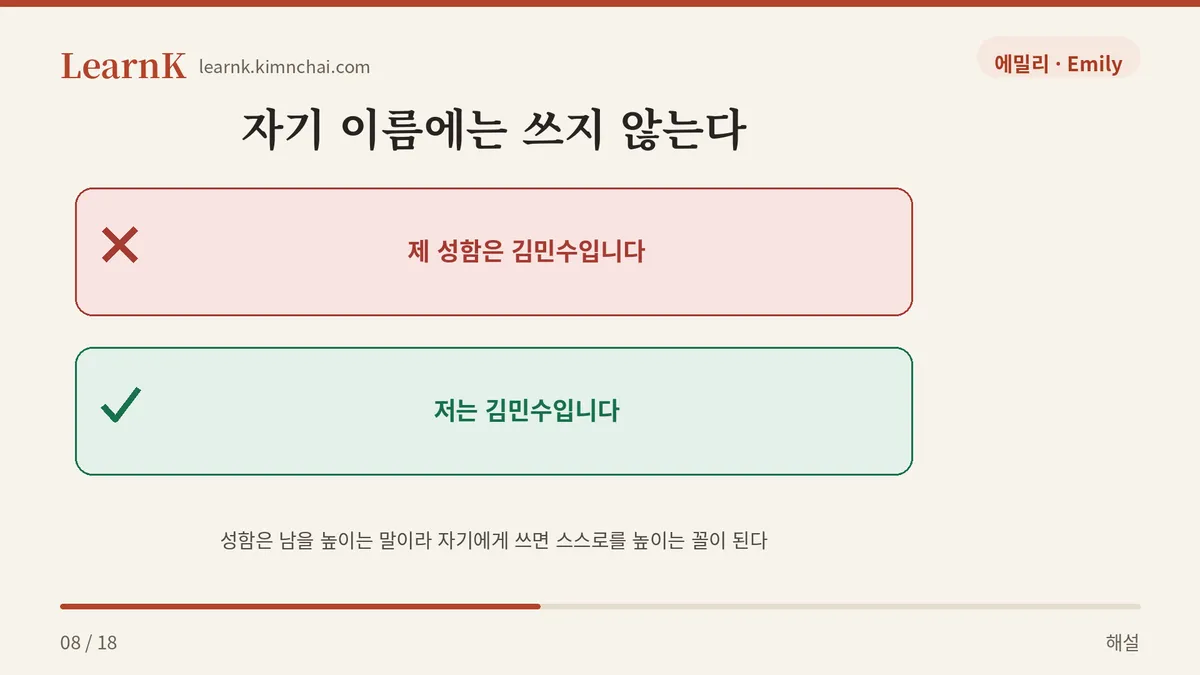
One trap to watch for: when stating your own name, never say “제 성함은 ○○입니다 (je seonghameun ○○imnida).” That ends up honoring yourself, and listeners will laugh. The correct forms are 저는 ○○입니다 (jeoneun ○○imnida) or 제 이름은 ○○입니다 (je ireumeun ○○imnida).
Cultural Background
In Korean dramas, this sentence is often used as a signal marking the start of a relationship. A detective to a witness, a nurse to a guardian, or two people who’ve just exchanged business cards — this line lands in those awkward few seconds before anyone has decided what to call the other. That’s because Korean is a language where you need to know someone’s name before you can settle on a form of address, and you need a form of address before you can settle on the right level of honorifics.
This is also a common experience for foreign learners: even when your Korean is quite good, people keep asking with the simpler “이름이 뭐예요? (ireumi mwoyeyo?)” That’s usually not a dismissal — it’s consideration. So if one day at a counter you hear 성함이 어떻게 되세요? addressed straight to you, it means the other person has stopped treating you as “a foreigner learning Korean” and started treating you as just another adult.
Today’s Quiz
A bank teller asks you, “성함이 어떻게 되세요? (seonghami eotteoke doeseyo?)” What’s the most natural response?
- 제 성함은 김민수입니다. (je seonghameun Gim Minsu imnida.)
- 김민수입니다. (Gim Minsu imnida.)
- 이름이 김민수예요? (ireumi Gim Minsu-yeyo?)
Answer: 2. ‘성함’ is an honorific for someone else’s name, so it isn’t used for your own. At a counter, a short answer like “김민수입니다 (Gim Minsu imnida)” is the most natural, and if you want something a bit more polished, “저는 김민수입니다 (jeoneun Gim Minsu imnida)” works too.
Definitions and example sentences are from the National Institute of Korean Language’s Basic Korean Dictionary (krdict.korean.go.kr); that portion of this post, including our translations, is licensed under CC BY-SA 2.0 KR.