Teaser (티저) — If It Shows Everything, It's Not a Teaser
티저 (tijeo)
티저 (tijeo) means a preview that reveals only a very short fragment of an upcoming song, video, or album in order to stir up curiosity. If you’re a K-pop fan, you learned this word from a notification, not a textbook. One photo goes up on your favorite group’s official account: the background is all black, a single wrist is barely visible and out of focus, and below it there are only eight digits. The comments are already in the thousands. Nobody knows what song this is or what the concept is. And yet nobody can sleep. That exact thing is called a 티저.
The reason this word is fun for Korean learners isn’t that the meaning is difficult — it’s that the heart of it sits at the opposite end from what you’d expect. Normally a preview means “telling you in advance.” But the purpose of a 티저 isn’t to tell you; it’s to hold back. A fifteen-second video has three seconds of melody in it, only the eyes show on the face, and at the end a date appears and it’s over. The less information, the better the teaser. That’s why fans use 이번 티저 진짜 아무것도 안 보여 준다 (ibeon tijeo jinjja amugeotdo an boyeo junda) — “this teaser really shows nothing” — as a compliment. Once you have a feel for that, every example below will read naturally.
Its part of speech is noun. It has no honorific form of its own; the predicate attached to it sets the temperature of the sentence. Memorize the frequent pairings as whole chunks and you can start using them right away.
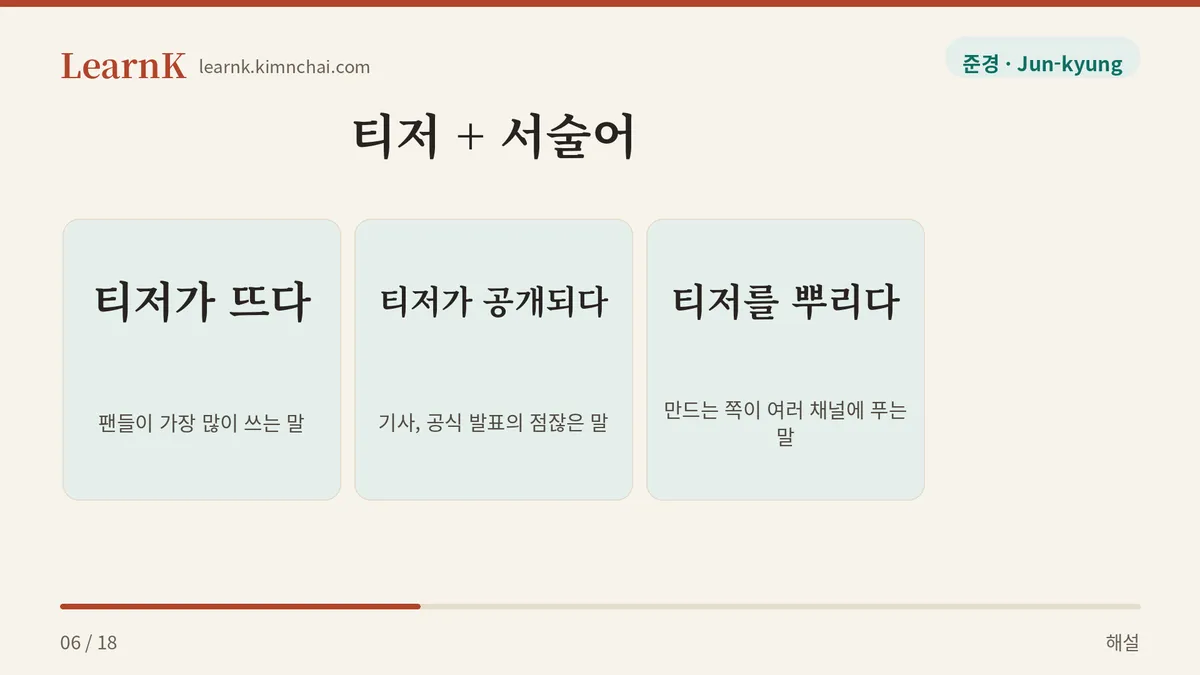
- 티저가 뜨다 (tijeoga tteuda) — a teaser goes up. The expression fans use most. 떴다! (tteotda!) works as an exclamation all on its own.
- 티저가 공개되다 (tijeoga gonggaedoeda) — the dignified wording used in news articles and official announcements.
- 티저를 올리다 / 뿌리다 (tijeoreul ollida / ppurida) — the language of the people making it. 뿌리다 (ppurida) has the feel of scattering it across several channels at once.
- 티저 영상, 티저 포스터, 티저 이미지, 콘셉트 티저 (tijeo yeongsang, tijeo poseuteo, tijeo imiji, konsepteu tijeo) — nouns attach directly after it.
Seeing it in a real conversation
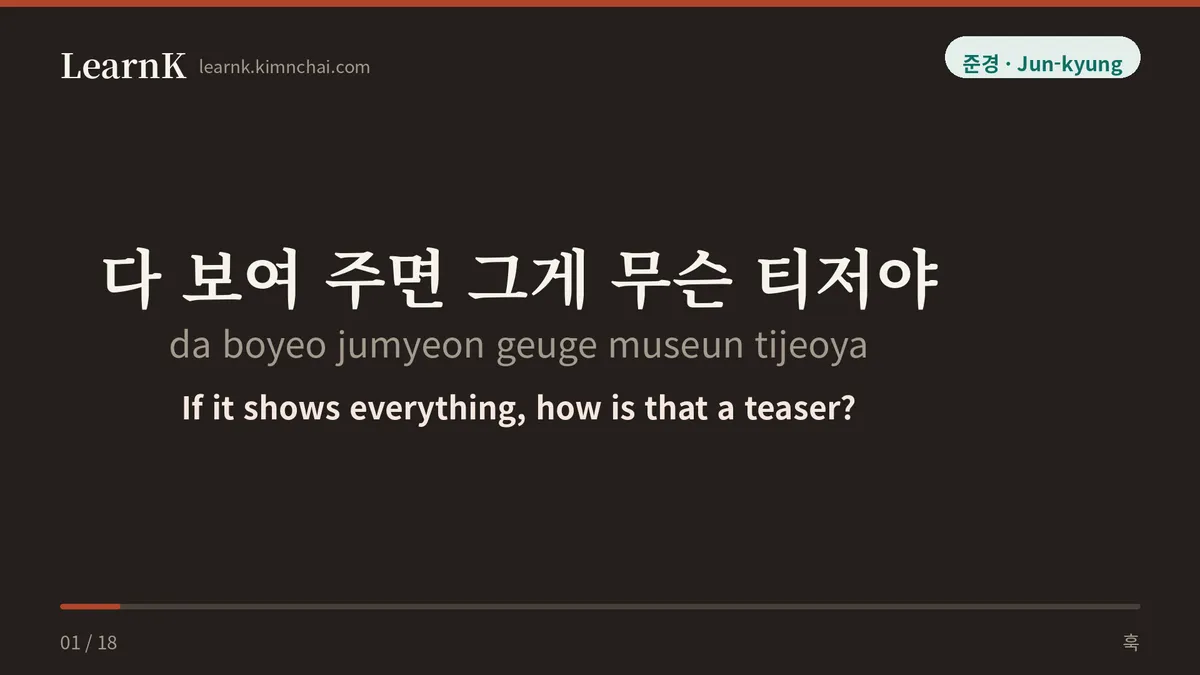
Scene: Four minutes to midnight. Their favorite group’s comeback teaser is about to go up. Jun-kyung and Emily are on a video call, each from home.
Jun-kyung: 야, 몇 분 남았어? 나 새로고침만 백 번째야. Hey, how many minutes left? This is my hundredth refresh.
Emily: 4분. 근데 이번 티저 진짜 아무것도 안 보여 준대. Four minutes. But they say this teaser really shows nothing.
Jun-kyung: 그게 맞지. 다 보여 주면 그게 무슨 티저야. That’s how it should be. If it shows everything, how is that a teaser?
Emily: 어어 떴다 떴다! Oh it’s up, it’s up!
Jun-kyung: 뭐야, 십오 초? 손등만 나왔잖아! What, fifteen seconds? Only the back of a hand showed!
Emily: 그러니까 티저지. 우리 지금 딱 걸린 거야. That’s exactly why it’s a teaser. We just got hooked.
That last line is the whole word in a nutshell. Showing nothing but the back of a hand for fifteen seconds and making people wait four days — Emily’s 딱 걸렸다 (ttak geollyeotda), “we got hooked,” is the condition for a teaser’s success.
It sounds off if you use it this way
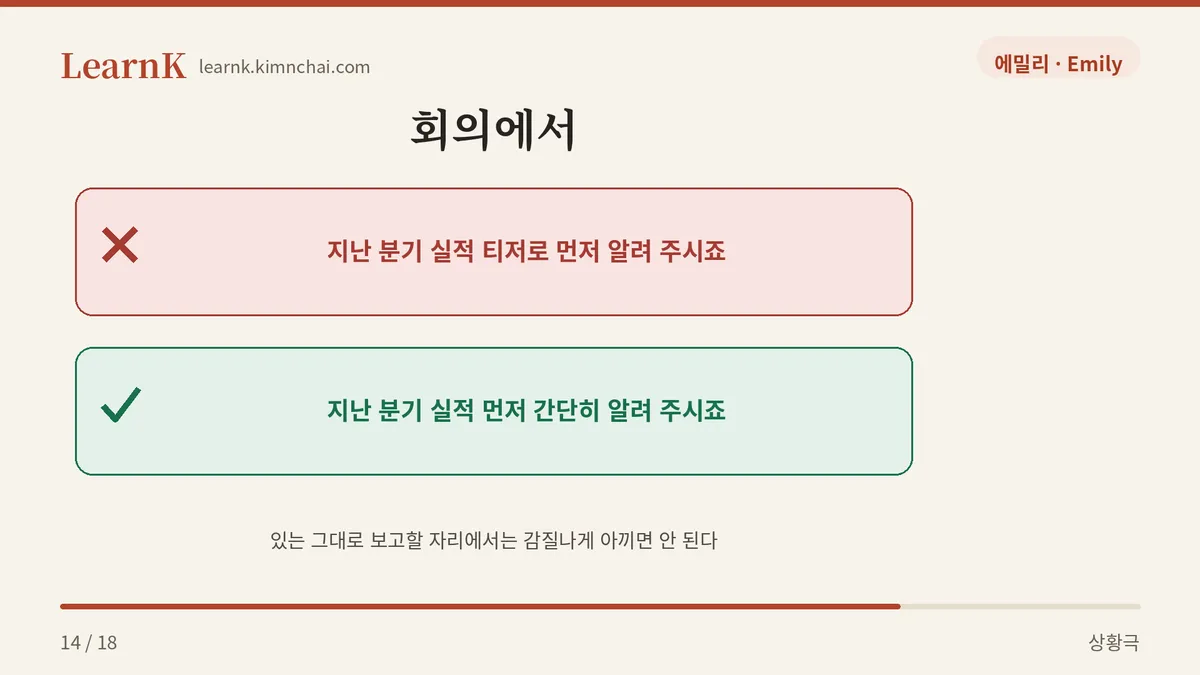
✗ (to your team lead in a meeting) 팀장님, 지난 분기 실적 티저로 먼저 알려 주시죠. Boss, could you give us last quarter’s results as a teaser first? ✓ (to your team lead in a meeting) 팀장님, 지난 분기 실적 먼저 간단히 알려 주시죠. Boss, could you give us a quick rundown of last quarter’s results first? → 티저 presumes a bit of staging — “I’m tantalizingly holding this back.” Use it in a setting where you’re supposed to report things exactly as they are, and you’ll sound like someone treating a serious matter as a game. In that same meeting, though, 신제품 티저 공개 일정 (sinjepum tijeo gonggae ilijeong), “the release schedule for the new product teaser,” is perfectly natural when you’re talking about a marketing plan — the problem isn’t the word, it’s the setting.
✗ 내가 티저 하나 해 줄게. 3화에서 주인공 형이 범인이야. Let me give you a teaser. In episode 3, the main character’s older brother is the culprit. ✓ 내가 티저 하나 해 줄게. 3화 마지막 1분만 보면 밤새게 될걸. Let me give you a teaser. Watch just the last minute of episode 3 and you’ll be up all night. → If you give away the ending, that’s not a teaser, it’s a spoiler. Making someone curious is a teaser; deflating them is a spoiler — the two point in opposite directions. This is also the point learners mix up most often.
Example sentences by situation
1) When your phone buzzes on the subway during your commute
티저 떴어? 나 지금 지하철이라 소리를 못 들어. (tijeo tteosseo? na jigeum jihacheollira soril mot deureo.) — Is the teaser up? I’m on the subway right now, so I can’t listen with sound.
This is the single most common sentence among fans. The video is up but you don’t have earphones, so you ask the person next to you to watch it for you. The clipped casual form 떴어? (tteosseo?) goes with this word better than anything else.
2) When someone who runs a YouTube channel is talking about their plans
다음 편은 티저부터 짧게 올려 볼까 해요. (da-eum pyeoneun tijeobuteo jjalge ollyeo bolkka haeyo.) — For the next episode, I’m thinking of putting up a short teaser first.
This is the maker’s side of things. Not just K-pop — YouTube, webtoons, games, even exhibition promotion: if it’s “a short something tossed out before the main thing,” it’s called a 티저. Attach a polite predicate and it becomes a sentence you can use in a meeting as is.
3) When a friend holds back the story just to tease you (a figurative extension)
야, 티저만 던지지 말고 본편 좀 풀어 봐. (ya, tijeoman deonjiji malgo bonpyeon jom pureo bwa.) — Hey, stop dropping little hints and tell me the whole story.
Know this usage and your Korean grows a notch. When a friend says 나 어제 소개팅했다? (na eoje sogaetinghaetda?) — “I went on a blind date yesterday, you know?” — and then clams up, that situation itself gets called a 티저. It started as a content-industry term, but it has migrated all the way into the way people talk. Here 본편 (bonpyeon), “the main feature,” doesn’t mean the main video — it means “the real story.”
Polite and casual forms, and similar expressions
티저 is a noun, so there’s no honorific built into it. The predicate sets the temperature: 티저 떴어 (tijeo tteosseo) (between friends) → 티저 떴어요 (tijeo tteosseoyo) (relaxed polite) → 티저가 공개되었습니다 (tijeoga gonggaedoeeotseumnida) (news and official notices). That third form shows up far more often in official-account posts than in conversation between people.
Here are the neighboring words that tend to get confused.
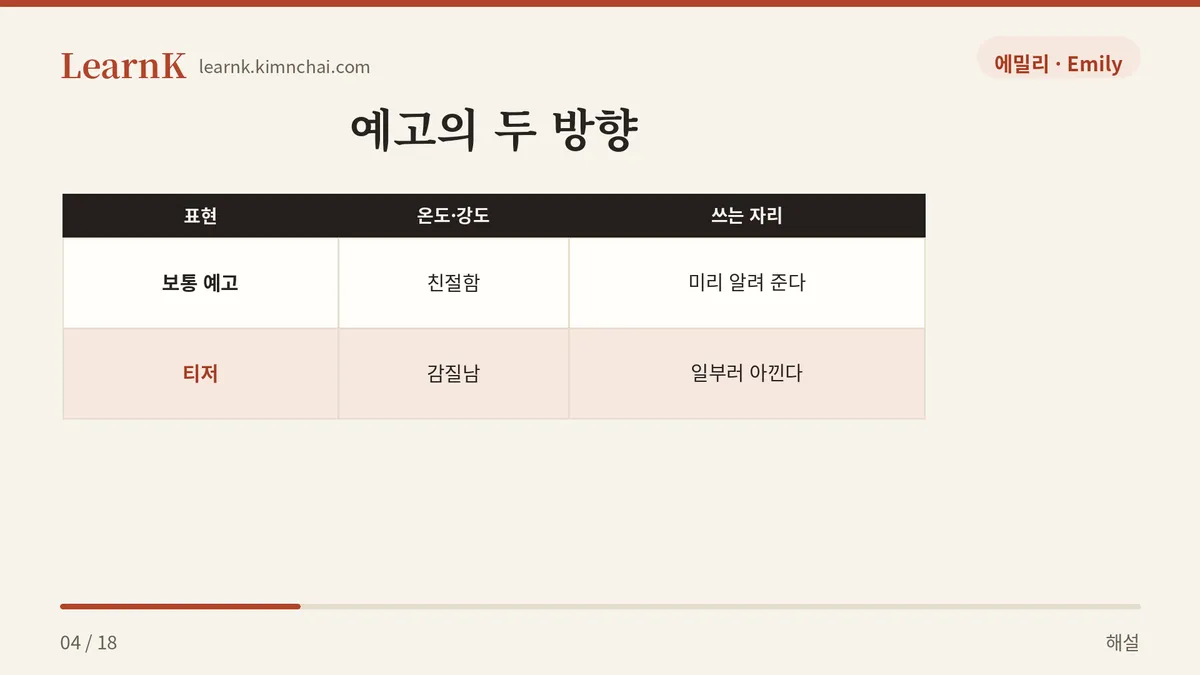
| Expression | Temperature / intensity | Where it’s used |
|---|---|---|
| 티저 (tijeo) | Tantalizing and thrilling; almost no information | K-pop, dramas, marketing. A fragment of about fifteen seconds |
| 예고편 (yegopyeon) | Neutral; a fair amount of information | Films and dramas. Shows the plot and the characters |
| 선공개 (seongonggae) | Plain and official | Releasing one full album track ahead of time |
| 맛보기 (matbogi) | Friendly and colloquial, a native-Korean feel | Anywhere in daily life, from food to lectures |
| 스포일러 (seupoilleo) | Negative, a letdown | When you give away the ending. The opposite of a teaser |
The most important boundary lies between 티저 and 예고편. A 예고편 tells you “here’s the story”; a 티저 tells you only “there’s something here.” That’s why, for a single release, the 티저 comes first and the 예고편 comes later. The reverse order is almost unheard of.
Cultural background — the door that opens at midnight
티저 is the English word teaser brought over as is. The verb tease means “to tantalize, to needle” — so the needling is already baked into the word. In Korea, people first got used to it through the advertising term 티저 광고 (tijeo gwanggo), “teaser ad” — the kind that hides both the product and the company name and leaves nothing but a question mark hanging there. Then the K-pop industry lifted that whole approach into comeback preparation, and today you hear the word far more often around idols than around advertising.
A K-pop comeback isn’t a one-day event; it’s a schedule that stretches over about two weeks. First the comeback scheduler goes up, telling you only what will be revealed and when. Then come the concept photos, the teaser video, the highlight medley, and finally the music video. Each stage shows exactly one step more than the one before it. Fans climb these stairs together over those two weeks and enjoy the waiting itself.
Release time is usually midnight Korea time. That hour has created a scene of its own. Because of time zones it’s lunchtime for one person and the small hours for another, but fans all over the world watch the same fifteen seconds at the same moment. And within minutes, posts appear picking the thing apart frame by frame. What time the clock on the wall reads, whether the ring on that wrist is the same one from the last album, whether the final two notes of the background music are in the same key as an older song — precisely because there’s so little information, the interpretations explode. A well-made teaser doesn’t hand out answers; it hands out questions.
This is exactly why I recommend this word to Korean learners. 티저 looks like a loanword you’re done with once you know the definition, but in practice it carries a whole sensibility: not saying everything yet is both good manners and the fun of it. That’s why it migrates all the way into stories about people. When a friend holds back a story, you say they’re tossing you a teaser; when they blurt it all out, you say 김샜다 (gimsaetda) — the fizz went out of it. One word with the rhythm of a whole culture inside it.
Today’s quiz
A friend says 나 어제 소개팅했다? (na eoje sogaetinghaetda?) — “I went on a blind date yesterday, you know?” — and then just smiles and says nothing more. What’s the most natural thing to say here?
- 야, 스포일러 하지 마.
- 야, 티저만 던지고 끊지 마.
- 야, 예고편 진짜 잘 만들었네.
Answer: 2. Your friend left you with nothing but curiosity and held the content back — that’s a teaser, exactly. Number 1 is what you say to stop someone from giving away the ending, so the situation is reversed. Number 3 gets the idea across, but 예고편 carries the premise that you “show a fair amount of the plot,” which clashes with a situation where nothing at all has been said. Once you can toss 티저 out casually in a moment like this, the word stops being something you memorized and becomes something you use.
Definitions and example sentences are from the National Institute of Korean Language’s Basic Korean Dictionary (krdict.korean.go.kr); that portion of this post, including our translations, is licensed under CC BY-SA 2.0 KR.