티켓팅 (tiketing) — 8 O'Clock Sharp: A War Waged with Your Fingertips
티켓팅
티켓팅 (tiketing) means grabbing a ticket for a popular concert or game at the very moment tickets are released, competing against everyone else trying to do the same. Five minutes before sales open, fans log into the ticketing site ahead of time, save their payment details, and pull up a server clock accurate to the second. Then, the instant the clock hits the hour, they hit refresh. Everything that unfolds in the few minutes after that — all of it is 티켓팅 (tiketing).
So the word doesn’t simply mean “to buy a ticket.” Booking an evening movie at your neighborhood theater is not 티켓팅 (tiketing). The word is used only when there are far more buyers than tickets — when the possibility of failure is built in from the very start. Queue numbers pop up, servers crash, some people make it and some don’t, and when it’s over the debriefs fly around the group chat. When a favorite group announces concert dates, fans write the ticketing day on their calendar before they write down the day of the show.
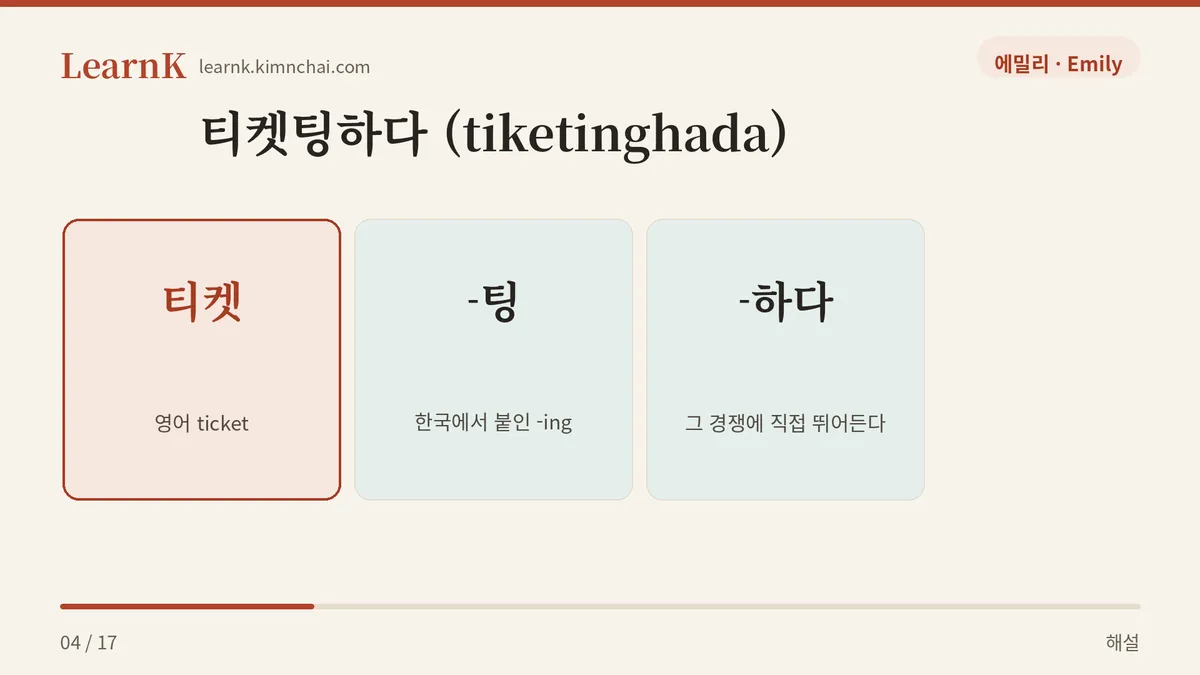
Grammatically it’s a noun, and you attach ‘-하다 (-hada)’ to turn it into a verb. 티켓팅하다 (tiketinghada) means to jump into that competition yourself. In practice, though, it rarely stands alone — it travels in pairs with a word for the outcome: 티켓팅 성공 (tiketing seonggong) “ticketing success,” 티켓팅 실패 (tiketing silpae) “ticketing failure,” and among fans, 티켓팅 뚫었다 (tiketing ttulheotda) to say you made it. The image is of punching straight through a wall.
The tone is neutral, but tension always clings to it. The moments when this word comes out are usually moments when palms are sweating, when someone has just failed and feels hollow, or when someone has just succeeded and is screaming. If you assume it’s a word almost never spoken calmly, your instincts are right.
Seeing It in Real Conversation
Situation: Three minutes before concert ticket sales open. Two laptops and a phone are scattered around Emily’s living room.
준경: 야, 서버 시계 띄웠어? 나 지금 손 떨려. Hey, did you pull up the server clock? My hands are shaking.
에밀리: 띄웠지. 근데 나 티켓팅 이거 벌써 세 번째야. 두 번 다 튕겼어. Of course I did. But this is already my third ticketing run. Both times before, I got kicked off.
준경: 그러니까 내가 대리 티켓팅 해 준다니까. 나 이래 봬도 성공률 팔 할이야. That’s exactly why I said I’d do the ticketing for you. Believe it or not, my success rate is eighty percent.
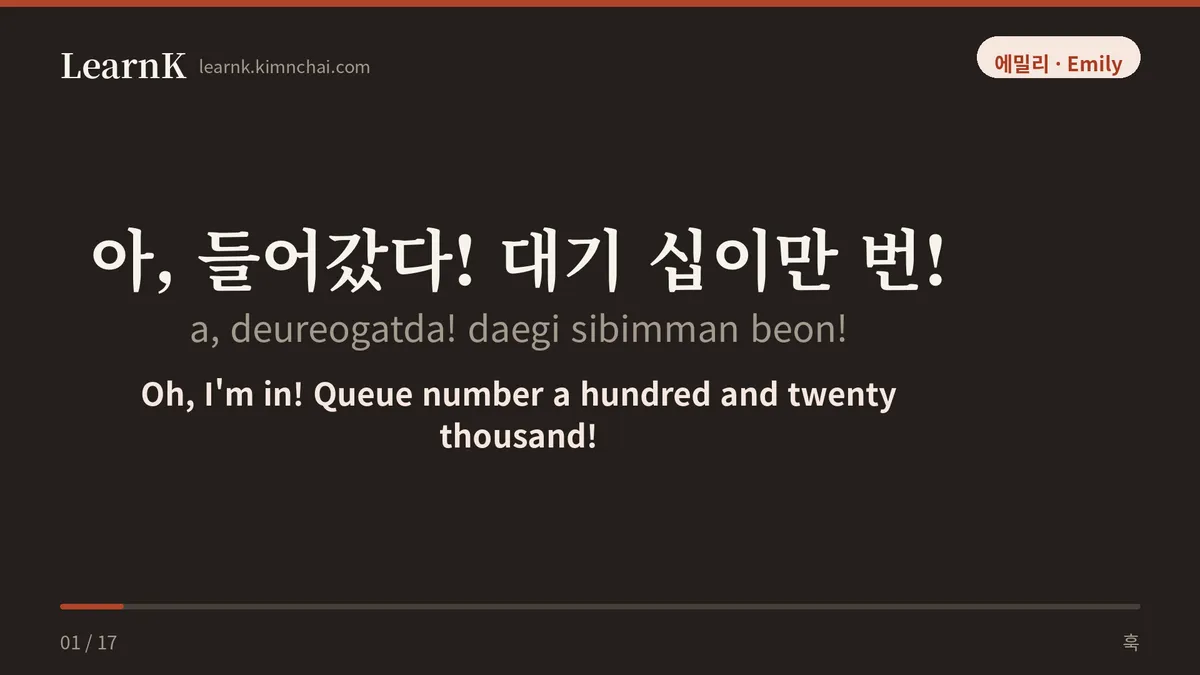
에밀리: 됐어. 내 손으로 잡아야 내 자리 같지. …아, 들어갔다! 대기 십이만 번! No thanks. It only feels like my seat if I grab it with my own hands. …Oh, I’m in! Queue number a hundred and twenty thousand!
준경: 십이만이면 끝났네. 야, 그냥 다음 주 부산 회차 티켓팅하자. A hundred and twenty thousand? Then it’s over. Hey, let’s just do the ticketing for next week’s Busan show instead.
에밀리: 아직 몰라. 취소표 나오잖아. 나 취켓팅으로 두 번 성공했어. You never know. Cancellations come up. I’ve gotten in twice through cancel-ticketing.
These Uses Sound Unnatural
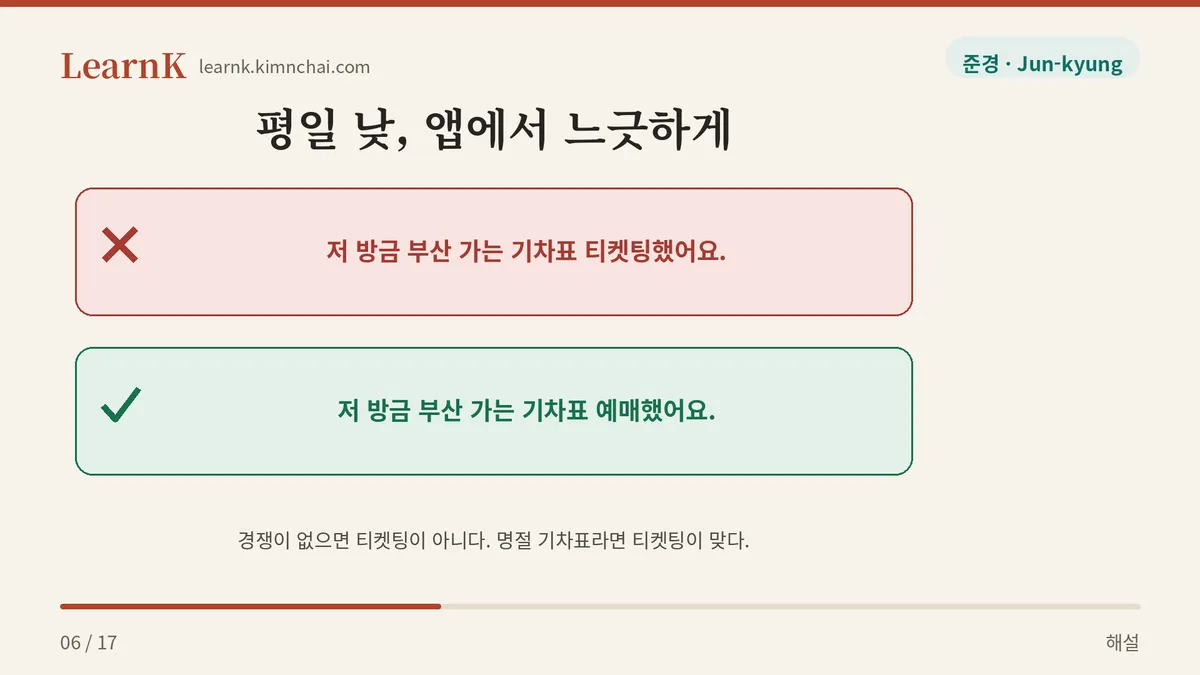
✗ (On a weekday afternoon, leisurely picking a seat in an app) 저 방금 부산 가는 기차표 티켓팅했어요. ✓ (On a weekday afternoon, leisurely picking a seat in an app) 저 방금 부산 가는 기차표 예매했어요. → If there’s no competition, it isn’t 티켓팅 (tiketing). For tickets that are still available whenever you want them, use 예매 (yemae), “to book in advance.” That said, for something like Chuseok or Lunar New Year train tickets that sell out in minutes, saying 명절 기차표 티켓팅 (myeongjeol gichapyo tiketing) sounds perfectly natural.
✗ (To your team lead) 팀장님, 저 오늘 반차 좀 쓰겠습니다. 오후에 피켓팅이 있어서요. ✓ (To a coworker) 나 오늘 반차 써. 오후에 피켓팅 있어. → 피켓팅 (piketing) is slang that only works inside a fandom, so using it with a superior at work makes the whole situation sound flippant. With someone above you, it’s safer to leave it at something like 개인 일정이 있어서요 (gaein iljeongi isseoseoyo), “I have a personal appointment.”
Example Sentences by Situation
Situation 1. Thirty seconds after ticket sales end, in the fan group chat
나 티켓팅 망했어. 대기 이십만 번 떴다가 튕겼어. na tiketing manghaesseo. daegi isimman beon tteotdaga twinggyeosseo. “I bombed the ticketing. I got queue number two hundred thousand and then got kicked off.” → This is the most common way to announce a failure. 티켓팅 (tiketing) pairs up with 망하다 (manghada), “to flop,” unusually often. One line like this and the group chat floods with consolation.
Situation 2. Two days before sales open, asking a friend for help
이번 티켓팅 좀 도와줄 수 있어? 나 혼자서는 무리야. ibeon tiketing jom dowajul su isseo? na honjaseoneun muriya. “Could you help me with this ticketing? I can’t manage it on my own.” → Having several people log on at once to raise the odds is a common favor to ask among fans. Note, though, that 대리 티켓팅 (daeri tiketing) — grabbing tickets for someone else for money — violates the ticket sellers’ terms of service, and fandoms don’t look kindly on it either.
Situation 3. At work the next day, to a senior colleague who likes the same group
선배님, 어제 티켓팅 성공하셨어요? seonbaenim, eoje tiketing seonggonghasyeosseoyo? “Did you manage to get tickets yesterday?” → Even in polite speech, the word 티켓팅 (tiketing) itself stays exactly the same. You just attach ‘-하셨어요 (-hasyeosseoyo)’. Unlike the slang terms 피켓팅 (piketing) and 취켓팅 (chwiketing), 티켓팅 (tiketing) shows up in news articles too, so it isn’t picky about the setting.
Polite and Casual Forms, and Similar Expressions
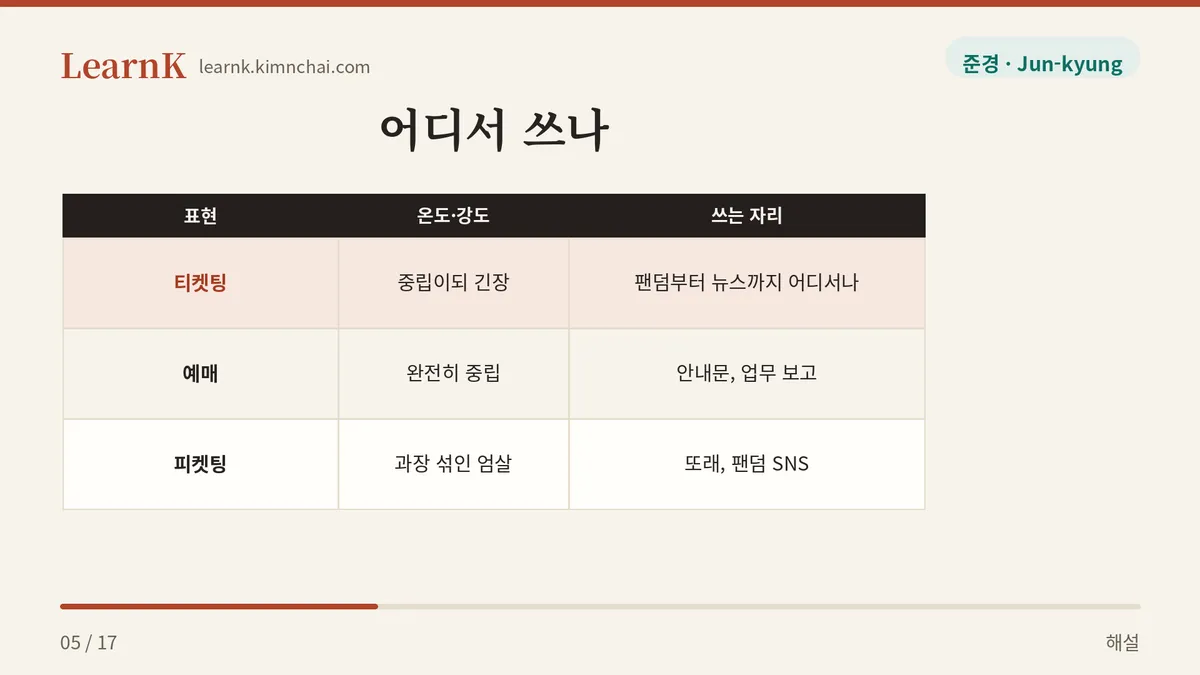
Conjugating it is easy. Among friends you say 티켓팅했어? (tiketinghaesseo?), and in polite speech 티켓팅하셨어요? (tiketinghasyeosseoyo?). The tricky part is the temperature of the word itself. Expressions that look similar actually belong in different places.
| Expression | Tone & intensity | Where it’s used |
|---|---|---|
| 티켓팅 (tiketing) | Neutral, but with tension running under it | Everywhere — fandom, everyday talk, even the news |
| 예매 (yemae) | Completely neutral, official | Notices, work reports. Used even when there’s no competition |
| 피켓팅 (piketing) | Exaggerated and half-joking-complaining, keyed up | Among peers, on fandom social media. Not with superiors or at work |
| 취켓팅 (chwiketing) | Lingering regret mixed with hope | Inside the fandom. Used after you’ve already failed |
| 광클 (gwangkeul) | A word that paints a gesture; playful | Among peers. Refers only to the physical act during ticketing |
To sum up: the venue’s official notice says 예매 (yemae), what comes out of fans’ mouths is 티켓팅 (tiketing), and only when that ticketing was especially brutal does it become 피켓팅 (piketing).
Cultural Background — The War at 8 O’Clock Sharp
티켓팅 (tiketing) was coined in Korea by attaching -ing to the English word “ticket.” In English, “ticketing” usually refers to issuing or selling tickets as a business function; it carries no sense of competing over tickets. That’s why saying “I did ticketing” to a foreign friend in English won’t get you very far. It’s a word Korean fandom refilled with a meaning that matched their own experience.
Just how heavy this word is shows in the number of spin-offs it has produced. 피켓팅 (piketing) is short for 피 튀기는 티켓팅 (pi twigineun tiketing), “blood-spattering ticketing” — that’s how fierce it is. 취켓팅 (chwiketing) comes from 취소표 티켓팅 (chwisopyo tiketing), “cancellation ticketing”: staying up all night hitting refresh, waiting for the seat of someone who gave up on their payment to be released again. 광클 (gwangkeul) means clicking like a maniac — a name given to just one hand motion pulled out of the ticketing process. When a single activity spawns this many words, it means that activity is repeated often, and desperately.
The real-life scenes are distinctive too. People pull up a separate clock synced to the ticket site’s server time, practice entering CAPTCHAs in advance, and travel to wherever the internet is fastest. The tug-of-war between ticket sellers trying to block macros and scalpers and the fans themselves never lets up, and these days plenty of shows check ID at the door. The scene in dramas and variety shows where a fan who failed at ticketing weeps in front of a laptop has become its own cliché.
티켓팅 (tiketing) has now spread well beyond K-pop. Holiday train tickets, hit musicals, the Korean Series in pro baseball — university students even jokingly call course registration 수강 티켓팅 (sugang tiketing). Wherever everyone rushes in at the same appointed second, this word follows.
Today’s Quiz
Which of the following sentences uses 티켓팅 (tiketing) naturally?
- 도서관에서 읽고 싶던 책을 티켓팅했어. (“I ticketed the book I’d wanted to read at the library.”)
- 콘서트 티켓팅 두 번 다 실패해서 하루 종일 우울해. (“I failed at the concert ticketing both times, so I’ve been down all day.”)
- 병원에서 접수하고 진료비를 티켓팅했어요. (“I checked in at the hospital and ticketed the consultation fee.”)
The answer is number 2. 티켓팅 (tiketing) is used only for grabbing tickets that sell out in an instant amid competition. For the library book in number 1, the right verb is 대출했어 (daechulhaesseo), “I checked it out”; for the medical fee in number 3, it’s 결제했어요 (gyeoljehaesseoyo), “I paid it.” Even when you are buying a ticket, if there’s no competition involved, 예매했어요 (yemaehaesseoyo) is the natural choice.
Definitions and example sentences are from the National Institute of Korean Language’s Basic Korean Dictionary (krdict.korean.go.kr); that portion of this post, including our translations, is licensed under CC BY-SA 2.0 KR.