츤데레 (Cheundere) — Cold on the Outside, Warm on the Inside
츤데레
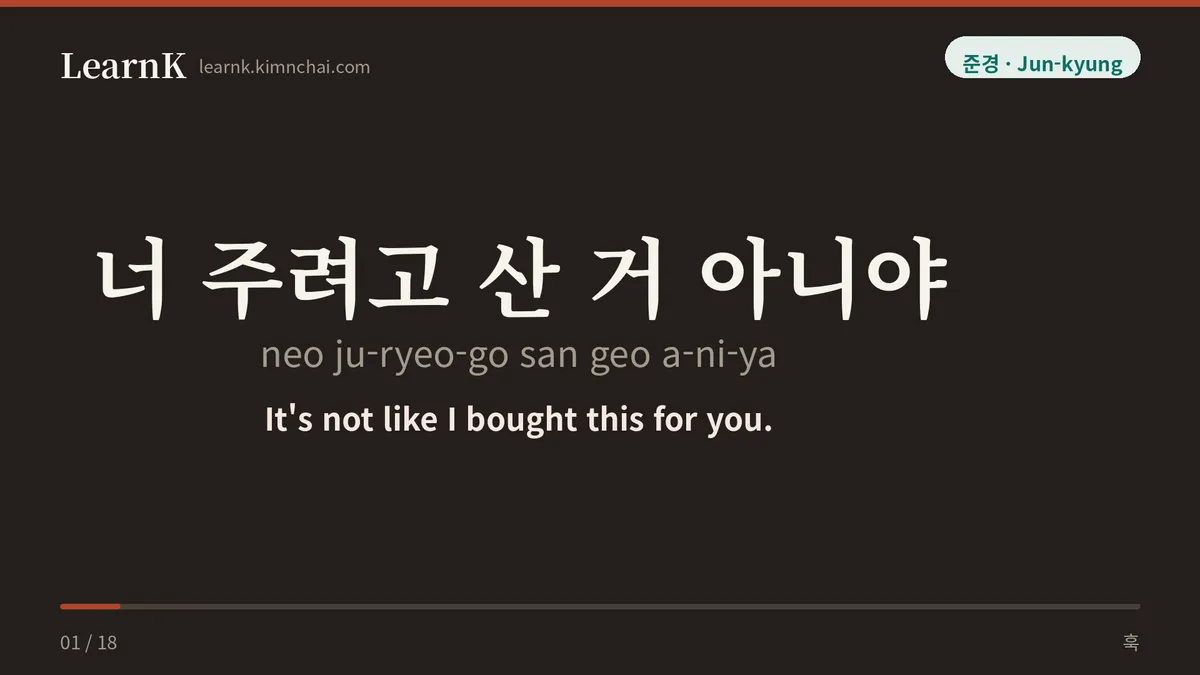
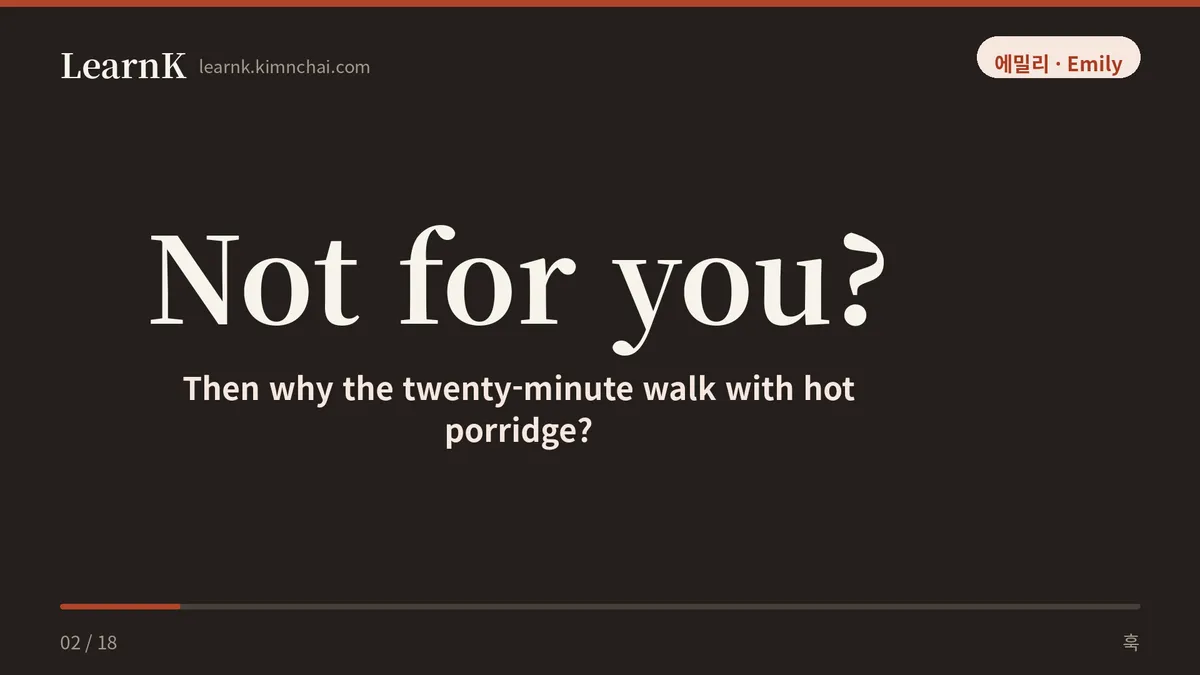
A friend is sick and can’t come to school, and that gruff, always-grumbling boy shows up out of nowhere with a bowl of rice porridge in hand, without a word. “It’s not like I was worried or anything. I was just passing by.” — that’s what he says. If you watch enough Korean dramas and webtoons, there’s always at least one character like this: the 츤데레 (cheundere). Today, let’s dig deep into this expression that every fan of Korean culture absolutely needs to know.
Meaning and Nuance
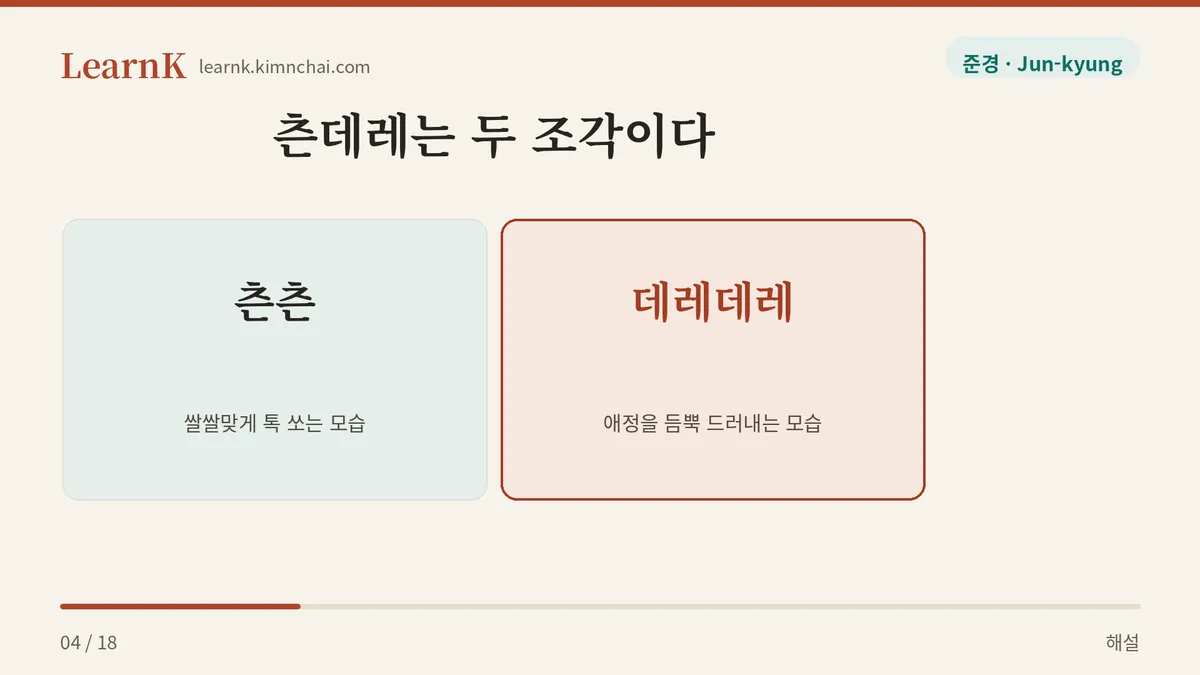
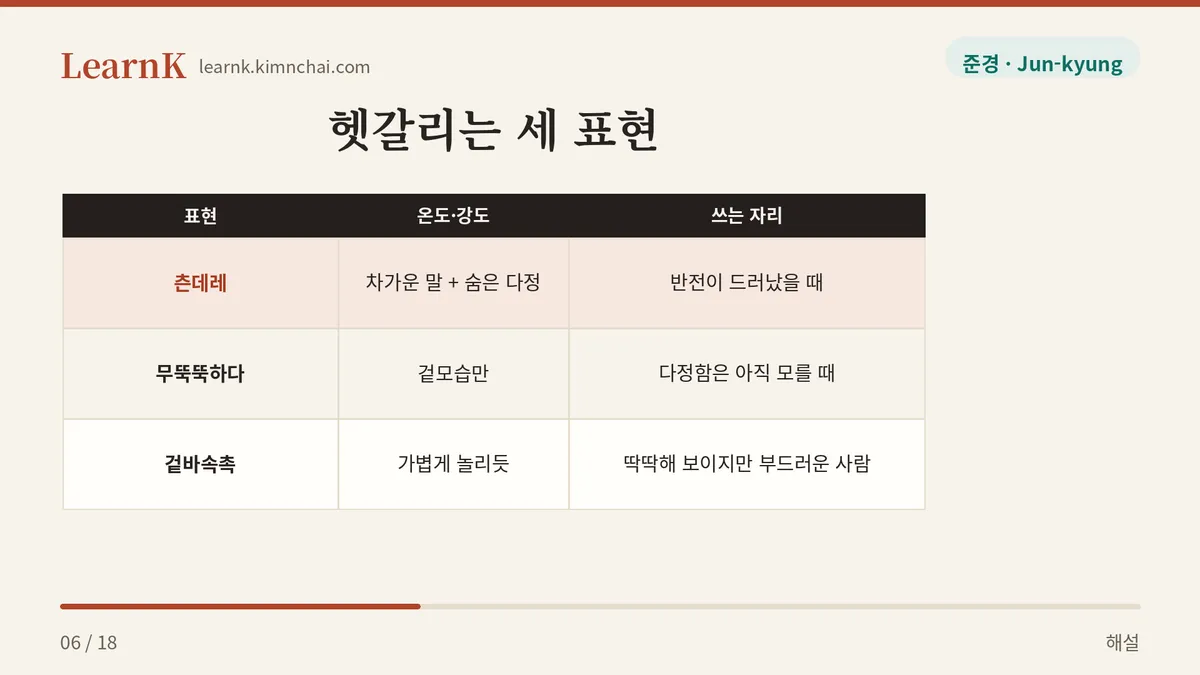
츤데레 (cheundere) is a loanword-based neologism that comes from the Japanese ツンデレ. It’s a blend of ‘츤츤 (tsuntsun / ツンツン),’ which describes acting cold and snippy, and ‘데레데레 (deredere / デレデレ),’ which describes being openly full of affection. In other words, it refers to someone who acts blunt and cold on the outside but is warm and overflowing with affection on the inside.
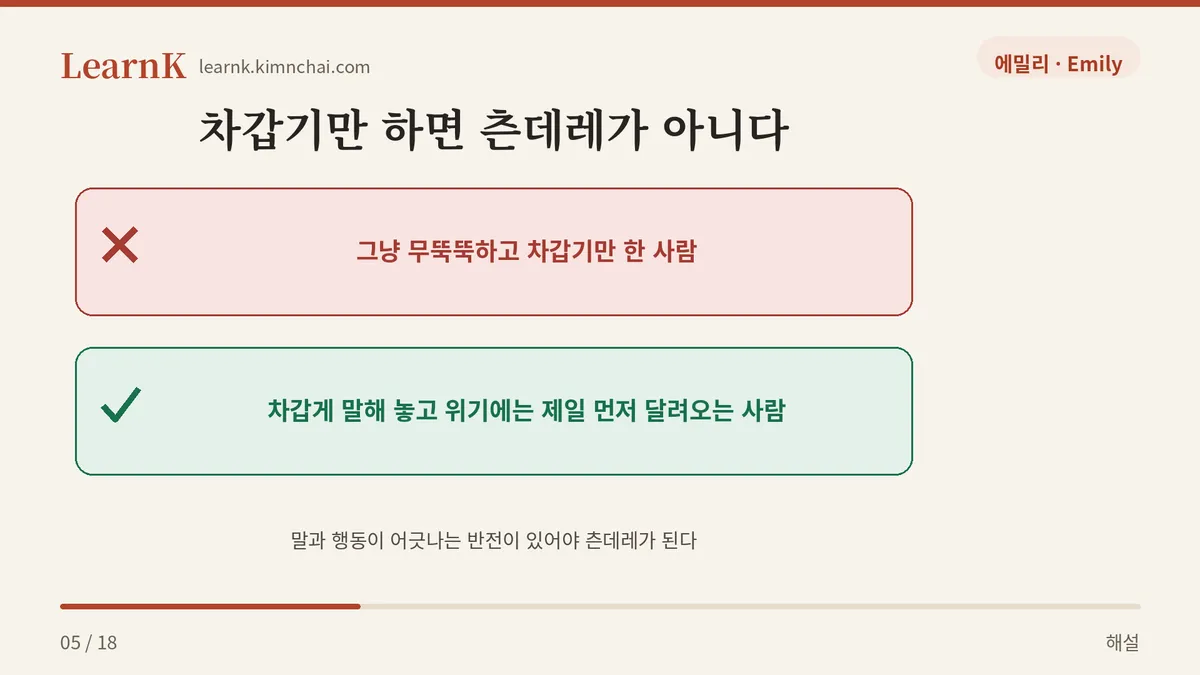
The key is this ‘twist.’ A person who is simply cold is not a 츤데레. Someone who says “I couldn’t care less about you” on the surface, yet is the first to come running the moment you’re in trouble — that gap between words and actions is the charm point of the 츤데레. It isn’t an official standard word listed in the dictionary, but it’s used very widely in the everyday conversations of the younger generation and online.
Example Sentences by Situation
Situation ① — When a friend misjudges a blunt person
A: Isn’t that senior kind of scary? He’s always so curt. B: No way, once you get to know him he’s a total 츤데레. Last time when I was going through a hard time, he secretly took care of everything for me. (a-ni-ya, al-go bo-myeon wan-jeon cheundere-ya.)
This is a situation where you’re telling someone not to judge by appearances. It often pairs with the expression ‘알고 보면 (al-go bo-myeon),’ meaning “once you really get to know (them).”
Situation ② — When teasing someone who hides their feelings
You clearly like them, so why do you keep acting indifferent? There’s a limit to being a 츤데레! (cheundere-do jeong-do-ga it-ji!)
This is an affectionate jab thrown at someone who can’t express their feelings honestly and grumbles instead.
Situation ③ — When describing family
My dad is a classic 츤데레. He does nothing but nag, but then he’ll secretly slip some allowance into my room. (u-ri a-ppa-neun jeon-hyeong-jeok-in cheundere-ye-yo.)
It’s used naturally not only in romantic situations but also to describe the ‘blunt affection’ of close relationships, like family.
Comparing Polite and Casual Speech, Plus Similar Expressions
Because 츤데레 is a noun, you make it polite or casual by changing the ending of the sentence. Between friends, you’d say “쟤 완전 츤데레야 (cheundere-ya)” (“That kid is a total 츤데레”), and in a setting where you need to be respectful, you’d say “그분은 츤데레세요 (cheundere-se-yo)” (“That person is a 츤데레”).
Let’s also learn some native Korean expressions with a similar feel. 겉바속촉 (geot-ba-sok-chok) originally describes food that is ‘crispy on the outside, moist on the inside,’ but these days it’s also used to playfully refer to a person who’s hard on the outside but soft on the inside. And 무뚝뚝하다 (mu-ttuk-ttuk-ha-da), meaning “to be blunt/gruff,” is a word that captures only the ‘outer appearance’ part of the 츤데레. Only when ‘hidden warmth’ is added to that bluntness is a 츤데레 truly complete.
Cultural Background
The 츤데레 character is a staple lead type in Korean romance dramas. You know the story — the son of a wealthy family treats the heroine meanly at first, then gradually opens his heart. Sound familiar? Gu Jun-pyo from the drama Boys Over Flowers (KBS, 2009) is a prime example. The way he keeps carelessly hurting the heroine yet protects her at every crucial moment shows the classic 츤데레 narrative. (We’re introducing only the situation, not the exact lines.)
One reason these characters are so loved is that they connect with a cultural sensibility that has long regarded showing emotions through actions, rather than expressing them directly in words, as a virtue. Instead of saying “I love you,” they make sure you eat; instead of saying “I’m worried about you,” they hold out an umbrella. The fun of reading the sincerity behind that bluntness is exactly what makes the 츤데레 so charming.
Closing Quiz
Which of the following sentences uses ‘츤데레’ most naturally?
- That person is a 츤데레 who always smiles and treats everyone kindly.
- He talks in a cold way, but seeing how he always looks out for you when times are hard, I think he’s a 츤데레.
- I just met them, so I don’t know yet whether they’re a 츤데레.
The answer is number 2. That’s because you can only call someone a 츤데레 when their outward coldness and inwardly hidden warmth form a ‘twist.’ So — who’s the 츤데레 in your life?