떼창 (ttechang): The Fan Chorus That Makes a Concert One
When you watch K-pop concert videos, there’s a moment when the singer on stage, mid-song, suddenly turns the microphone toward the audience. And then tens of thousands of people sing the next line in a single voice. The singer pauses for a moment and, with an overwhelmed look, just listens to that sound. This exact scene is what Korean calls 떼창 (ttechang). Today, let’s take a deep dive into this expression that every fan of Korean culture absolutely has to know.
떼창
떼창 (ttechang) is a combination of 떼 (tte), meaning “a crowd” or “a pack,” and 창 (chang, 唱), meaning “singing.” In other words, it refers to many people gathering as a group and singing out loud all together. It isn’t a stiff word that’s been sitting in the dictionary for ages — it’s a down-to-earth, everyday expression that arose naturally within concert culture and spread widely.
Shall we look at the nuance a bit more? 떼창 carries something hotter than just “singing together”: it holds the feeling that the audience sings voluntarily, full of overflowing emotion, becoming one. That’s why 떼창 is usually used in positive, moving situations. Korean audiences’ 떼창 in particular is famous worldwide, and foreign musicians who visit Korea often say things like, “The Korean fans’ 떼창 gave me goosebumps.”
The pronunciation is [떼:창] — it sounds natural if you press down on the first syllable a little longer and with a bit of force.
Example Sentences by Situation
1. At a concert
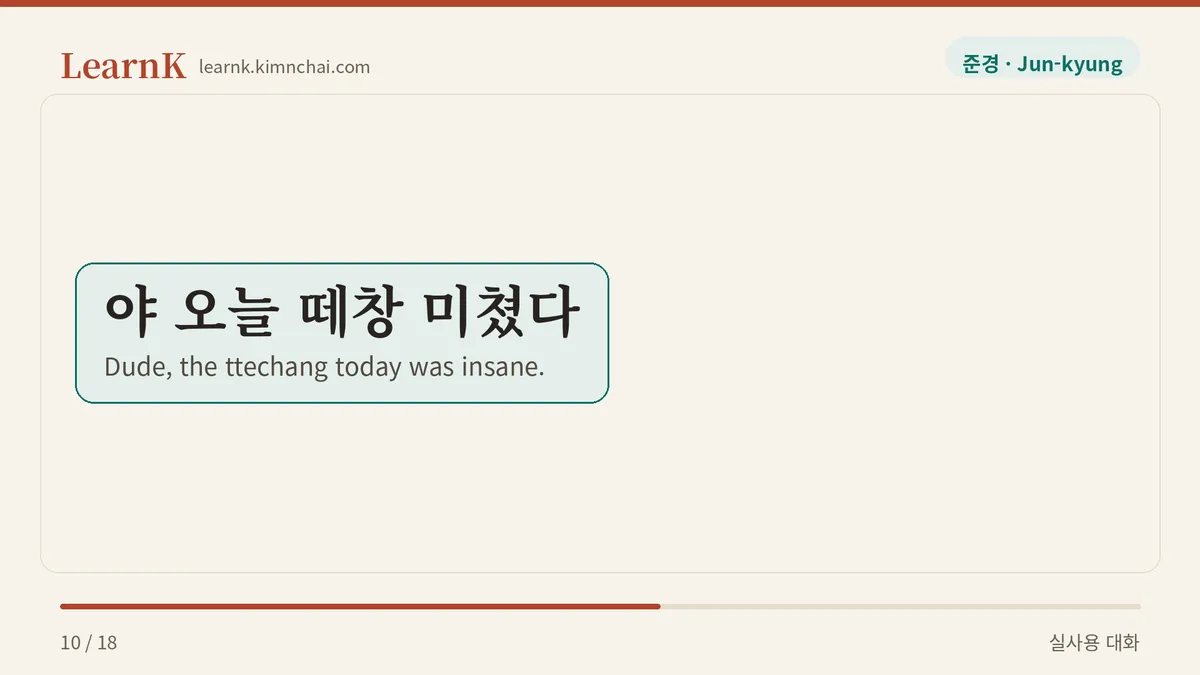
후렴구가 나오자 관객 전체가 떼창을 했어요 (ttechang-eul haesseoyo). (The moment the chorus came, the entire audience broke into 떼창.)
This is the situation where, at a concert by a group you love, the chorus of their signature song begins and the fans — as if they’d all agreed on it beforehand — sing along together. It’s most commonly used in the forms ‘떼창하다’ and ‘떼창을 하다’.
2. When you’re moved by watching a video
팬들 떼창 (ttechang) 소리 듣고 눈물 날 뻔했어. (I almost cried hearing the sound of the fans’ 떼창.)
Even if you can’t be there in person and only watch a YouTube video, you can still be moved by the majestic harmony that tens of thousands of overlapping voices create. Since this is a casual (반말) situation, the sentence ends short and comfortably.
3. At a noraebang (karaoke) or a company dinner
우리 부장님 애창곡 나오니까 다 같이 떼창하자 (ttechang-haja)! (Our manager’s favorite song is on, so let’s all 떼창 together!)
떼창 isn’t just for huge concerts. When a song everyone knows comes on at a noraebang with friends or at a company dinner, it’s often used to mean “Let’s all sing it together!” ‘떼창하자’ is a casual (반말) expression that suggests doing it together.
Comparing Formal/Casual Speech and Similar Expressions
Because 떼창 is a noun, you adjust the level of politeness by changing the verb attached to it.
- Casual: 떼창하자 (ttechang-haja) / 떼창했어 (ttechang-haesseo)
- Polite: 떼창해요 (ttechang-haeyo) / 떼창했어요 (ttechang-haesseoyo)
- Formal: 떼창을 했습니다 (ttechang-eul haetseumnida)
There are also expressions that are similar but have a different flavor. 합창 (hapchang) is “organized” singing where, like a choir, people sing in divided harmony according to a set score — it has a formal, musical nuance. 떼창, on the other hand, is all about voluntary, spontaneous heat. Also, 따라 부르다 (ttara bureuda) can be used even for a single person singing along to a song, but 떼창 always comes with the condition of “many people together.” This is exactly why, when the audience overlaps the song a singer is performing on stage almost like a roar, it’s called ‘관객 떼창’ (audience 떼창).
Cultural Background
Korea’s 떼창 culture isn’t just a habit — it’s a kind of “collective emotional expression.” It’s a culture built up layer by layer from the sentiment of gathering in a plaza to sing together during hard times, and from the experience of throwing arms around one another and singing at the top of your lungs in a noraebang. In dramas, too, a scene where a main character who’s gone through the pain of a breakup goes to a noraebang with friends and sings their heart out until their throat gives out, releasing their feelings, is a regular fixture. Scenes like these show that 떼창 is connected to the Korean sentiment that “even sorrow becomes bearable when it’s shared.” That’s why, for K-pop fandoms, 떼창 is both the hottest language of love sent to an artist and a moment of solidarity in which fans become one.
Closing Quiz
Which of the following uses 떼창 most naturally?
- 나는 방에서 혼자 조용히 떼창했다. (I quietly 떼창-ed alone in my room.)
- 앙코르 무대에서 팬들이 다 같이 떼창을 하며 함성을 질렀다. (At the encore stage, the fans all did 떼창 together and shouted out.)
- 그 가수는 악보를 보며 정확하게 떼창했다. (That singer 떼창-ed precisely while reading the sheet music.)
The answer is number 2. That’s because 떼창 is a word you use when “many people sing together, voluntarily, and passionately.” It doesn’t fit doing it alone (number 1) or organized harmony set to a score (number 3, which is closer to 합창).
As for the 떼창 (ttechang) you learned today — how about trying to write “이 부분 떼창 미쳤다! (The 떼창 in this part is insane!)” in the comments the next time you watch a concert video?