떡밥 (tteokbap) — The Bait Drama Fans Throw Out and Bite Every Week
떡밥
떡밥 (tteokbap) originally refers to a fishing bait made by kneading rice bran into small lumps, but in drama and idol fandoms it means a clue or teaser dropped in advance about something that will be revealed later. It’s Friday night, and right before episode 15 ends, the camera lingers for about three seconds on an old letter in a drawer. No dialogue, no explanation. The second the broadcast is over, a post goes up on a community board: 저 편지 떡밥 맞지? (jeo pyeonji tteokbap matji? — That letter’s a 떡밥, right?). From that moment until the finale a week later, people spend the entire week holding on to those three seconds.
The word is used in two broad directions. One is a clue planted inside the story itself — an object, a line, a facial expression whose meaning only becomes clear later. The other is news that leaks out from outside the story. A single photo posted by an agency with no explanation, a fifteen-second trailer released by a production company — to fans, all of it is 떡밥.
It’s much more useful if you memorize the verbs that travel with it. 떡밥을 던지다 (tteokbabeul deonjida), “to throw out a 떡밥,” is what the side dropping the clue does; 떡밥을 물다 (tteokbabeul mulda), “to bite the 떡밥,” is what the side that snaps it up and starts theorizing does. 떡밥 회수 (tteokbap hoesu) is the story properly explaining the clues it threw out, and 떡밥 가뭄 (tteokbap gamum), literally a “bait drought,” is one of those frustrating stretches with no news at all.
The temperature is light and excited. It isn’t a criticism. If anything, it’s closer to a happy sort of complaining: this show keeps making me wonder about things.
Checking it in the National Institute of Korean Language dictionary
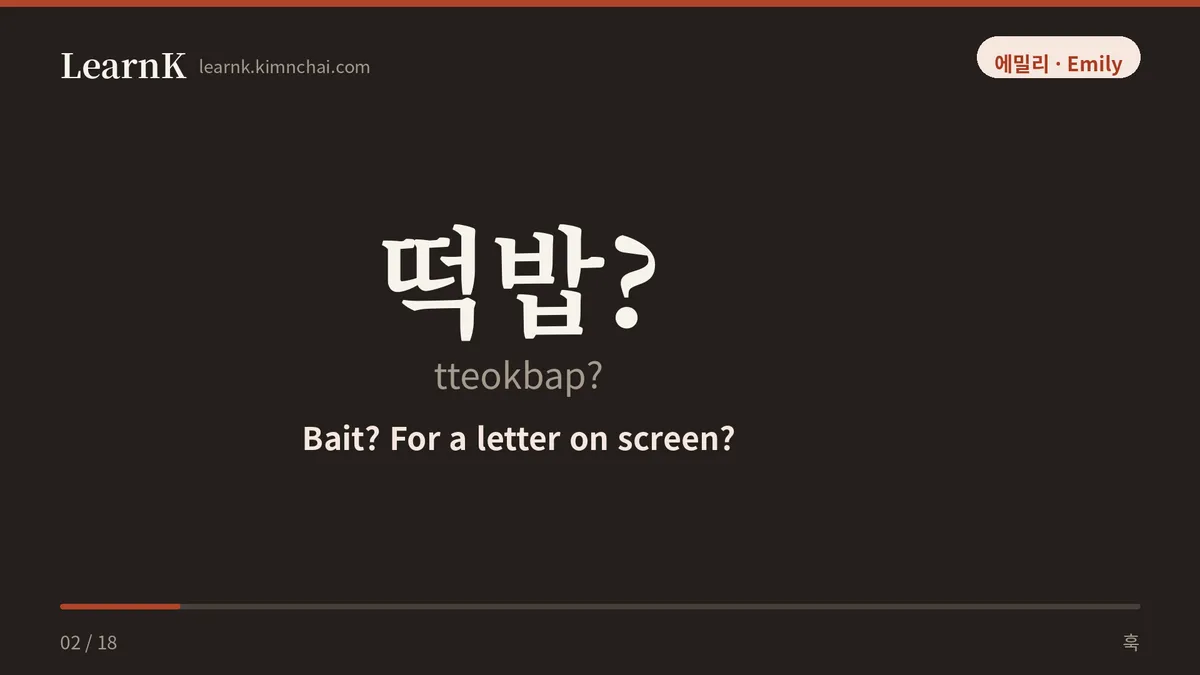
The interesting part is that this fandom usage isn’t in the dictionary yet. What the dictionary gives you is the word’s root.
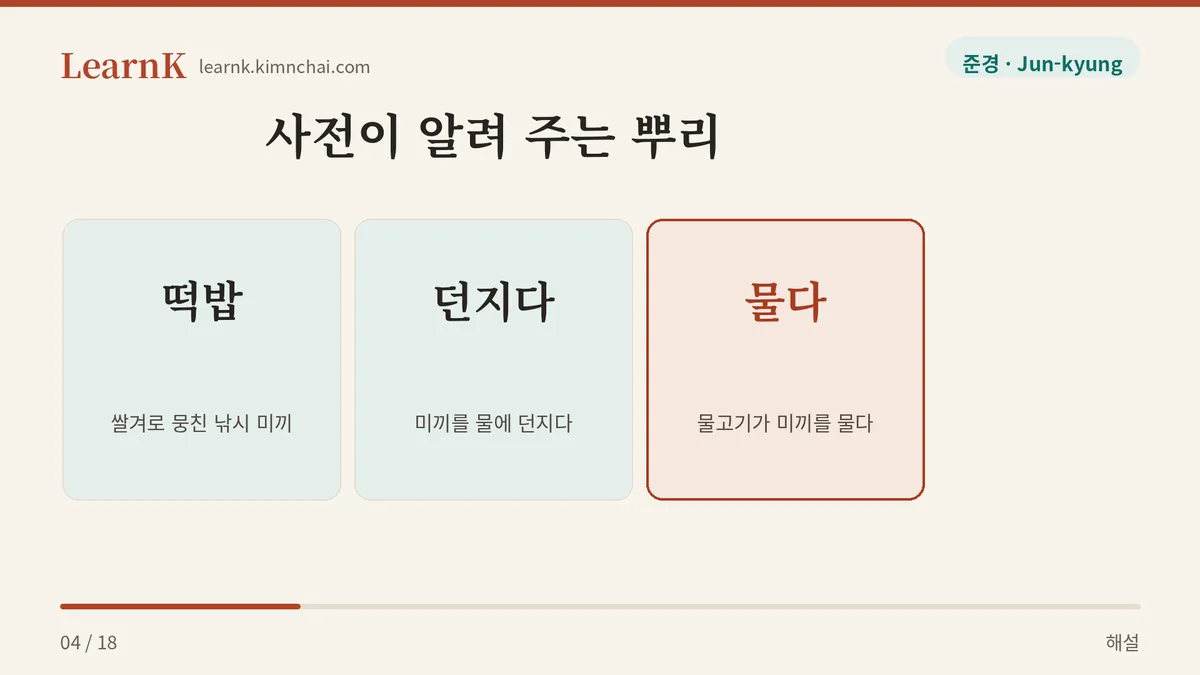
떡밥 「명사」
- 쌀겨에 콩가루나 번데기 가루 등을 섞어 반죽하여 조그마하게 뭉쳐 만든 낚시 미끼. [en] paste bait — Bait made by adding bean flour or pupa powder to rice bran, kneading the mix, and dividing it into small lumps. [ja] ねりえ【練り餌】 — ぬかにきな粉やさなぎ粉などを練り混ぜて固めた釣り餌。 [es] tteokbap, cebo, carnada — Carnaza para pescar. Es como una masita pequeña y redonda, y está hecha con cáscaras de arroz, harina de soja o crisálidas trituradas. [zh] 面鱼饵 — 在米糠中掺入豆粉或蚕蛹粉末搅拌之后揉成小团,用作鱼饵。 — National Institute of Korean Language, Basic Korean Dictionary (krdict.korean.go.kr)
떡밥 「명사」 2. 떡을 만들기 위하여 지은 밥. [en] tteokbap — Rice cooked to make tteok, rice cake. [ja] トッパ — トクを作るために炊いたご飯。 [es] tteokbap — Arroz cocido para preparar tteok o pastel de arroz. [zh] 做糕时提前蒸制备用的饭。 — National Institute of Korean Language, Basic Korean Dictionary (krdict.korean.go.kr)
The dictionary carries no Portuguese translation, so rendering the meanings ourselves: sense 1 would be ‘isca de pesca feita de farelo de arroz’ (fishing bait made from rice bran), and sense 2 ‘arroz cozido para fazer tteok’ (rice cooked to make tteok). We should note that these two lines are ours, not the dictionary’s.
Let’s look at the real usage examples the dictionary provides. First, sense 1 — 떡밥 as fishing bait.
아버지는 붕어 낚시를 할 때 떡밥으로 깻묵을 사용하신다. (abeojineun bung-eo naksireul hal ttae tteokbabeuro kkaenmugeul sayonghasinda.) When my father fishes for crucian carp, he uses sesame cake as his paste bait. 이렇게 낚싯바늘을 감싸게 밀어 넣고 풀리지 않게 떡밥을 잘 눌러 줘야 돼. (ireoke naksitbaneureul gamssage mireo neoko pulliji anke tteokbabeul jal nulleo jwoya dwae.) You push it on like this so it wraps around the hook, and you have to press the bait down well so it doesn’t come loose. 떡밥을 던지다. (tteokbabeul deonjida.) to throw out the bait 떡밥을 물다. (tteokbabeul mulda.) to bite the bait — National Institute of Korean Language, Basic Korean Dictionary (krdict.korean.go.kr)
The first sentence is someone at a reservoir, after crucian carp, talking about what he makes his bait from. The second has the tone of a person showing a first-time angler, hands and all, how to get the bait onto the hook. In “press it down well so it doesn’t come loose,” you can feel directly that 떡밥 isn’t a hard pellet but a dough you pinch together with your fingers.
And look closely at the third and fourth. 던지다 and 물다. The very verbs of today’s fandom usage are already sitting inside the dictionary — inside a fishing story, no less. That’s proof the slang didn’t just borrow a noun; it carried off a whole set of verbs along with it.
Next, sense 2 — rice cooked in order to make tteok.
떡밥을 떡메로 쳤더니 커다란 떡이 되는 게 신기해요. (tteokbabeul tteongmero chyeotdeoni keodaran tteogi doeneun ge singihaeyo.) It’s amazing how the rice turns into one big rice cake once you pound it with the mallet. — National Institute of Korean Language, Basic Korean Dictionary (krdict.korean.go.kr)
This is something said where freshly cooked rice is being pounded with a wooden mallet into injeolmi. It’s a scene you’d see at a holiday or a village event, and it has the tone of a child amazed at the moment the grains collapse into a single mass. Same two syllables, sitting in two completely different places: a fishing spot and a rice-cake board.
A real conversation
Setting: Friday night, in Jun-kyung’s living room. Episode 15 has just ended, and the preview for next week’s finale has gone by too.
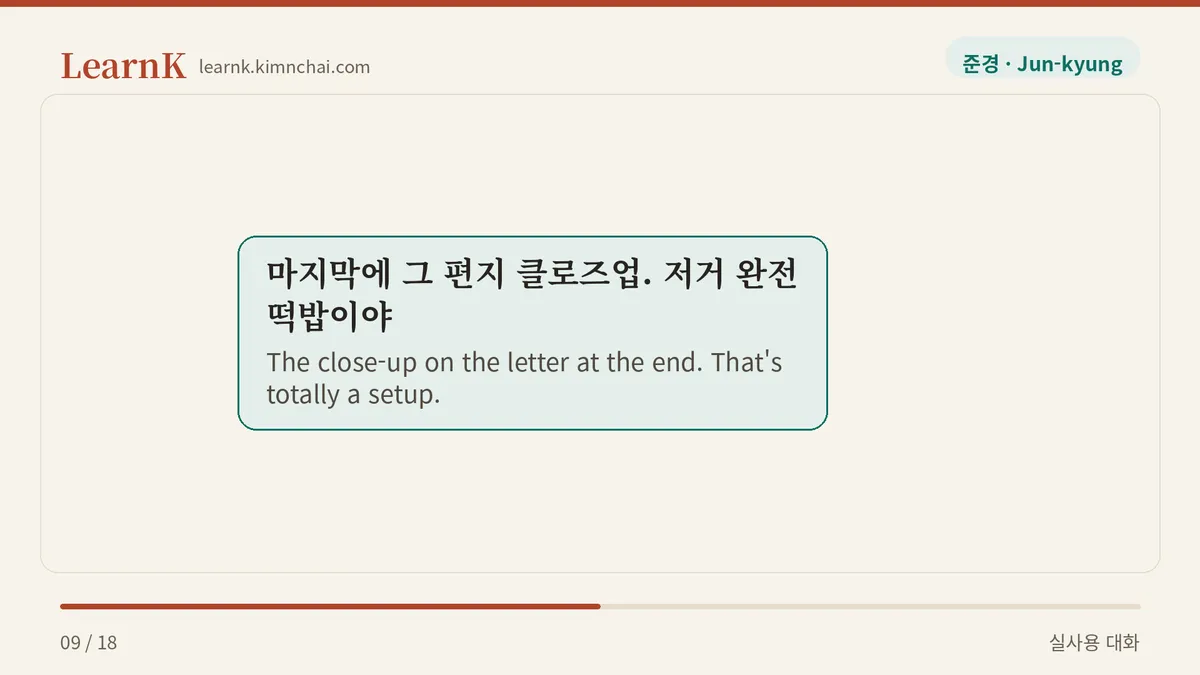
준경: 야, 봤어? 마지막에 그 편지 클로즈업. 저거 완전 떡밥이야. Hey, did you catch that? The close-up on the letter at the end. That’s totally a setup.
에밀리: 아 그거? 나 3화에 나온 우산이랑 이어지는 것 같은데. Oh, that? I think it connects to the umbrella from episode 3.
준경: 어우, 너 그걸 기억해? 소름. Whoa, you remembered that? Chills.
에밀리: 근데 이 작가 떡밥 회수 잘 안 하잖아. 지난 작품도 절반은 그냥 버렸어. But this writer isn’t great at paying things off. Half of them just got dropped in her last show too.
준경: 그러니까. 이번엔 던진 떡밥 좀 다 거둬 갔으면 좋겠다. Right? I really hope she picks up everything she’s thrown out this time.
에밀리: 뭐, 어차피 우리는 또 물겠지. Well, we’re going to bite either way.
These uses sound off
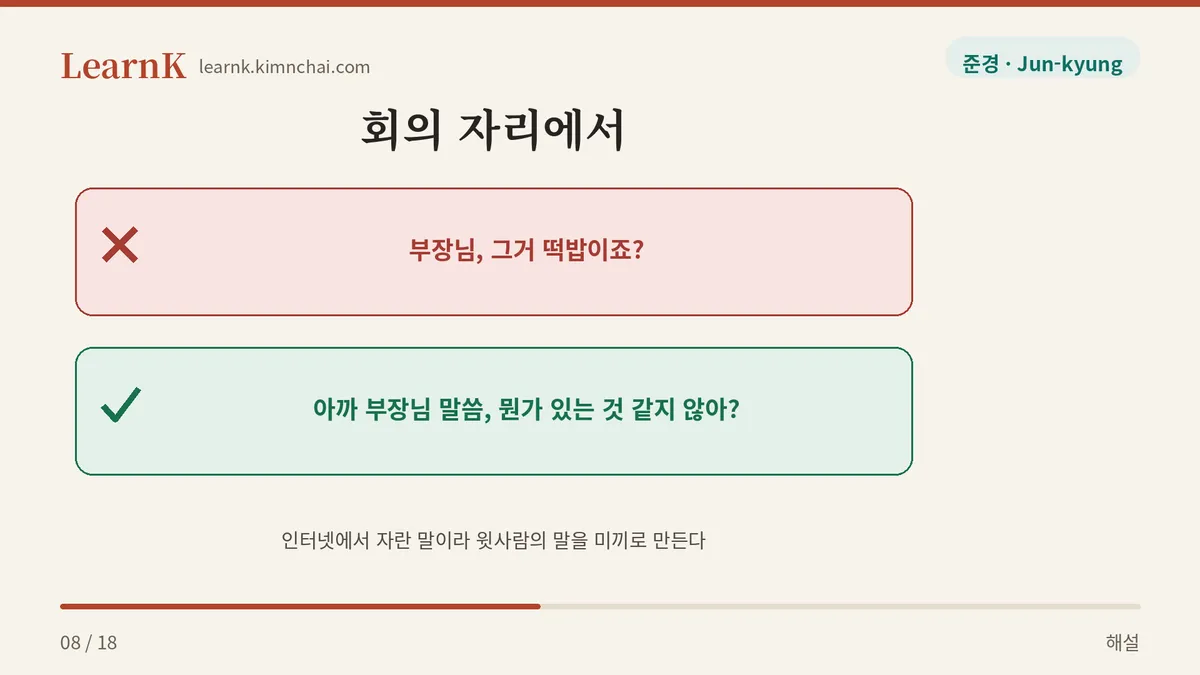
✗ (to your manager in a meeting) 부장님, 아까 하신 말씀 그거 떡밥이죠? (bujangnim, akka hasin malsseum geugeo tteokbabijyo? — Sir, that thing you said earlier, that was bait, right?) ✓ (to a coworker) 아까 부장님 말씀, 뭔가 있는 것 같지 않아? (akka bujangnim malsseum, mwonga inneun geot gatji ana? — That thing the manager said earlier — doesn’t it feel like there’s something behind it?) → The word grew up on the internet, and “bait” sits right underneath it, so you’d be treating a superior’s words like a fishhook. It doesn’t land well even as a joke.
✗ (watching news about a real accident) 이번 사건 완전 떡밥이네. 다음 소식 언제 나와? (ibeon sageon wanjeon tteokbabine. daeum sosik eonje nawa? — This case is a total teaser. When’s the next update coming?) ✓ (watching news about a real accident) 이건 좀 지켜봐야겠는데. (igeon jom jikyeobwayagenneunde. — I think we’ll have to watch how this one goes.) → It turns something with real victims into a spectacle where you wait for the next episode. The grammar is fine, but the listener will find it cold. This word belongs strictly to made-up stories and entertainment news.
Example sentences by situation
1. A group chat of idol fans ahead of a comeback — right after a photo with no caption goes up on the agency’s account.
- 소속사에서 새벽에 떡밥 뿌렸어. 티저 곧 나오나 봐. (sosoksaeseo saebyeoge tteokbap ppuryeosseo. tijeo got naonana bwa.)
- The agency dropped a teaser overnight. Looks like the trailer’s coming soon.
- 뿌리다 (ppurida), “to scatter,” is used when several things are let out at once. It suggests a bigger, more spread-out quantity than 던지다.
2. The day after watching the finale, over lunch — the letdown is as big as the expectations were.
- 떡밥 회수 하나도 안 되고 끝났어. 그 지하실은 뭐였는데? (tteokbap hoesu hana-do an doego kkeutnasseo. geu jihasireun mwoeonneunde?)
- Not a single thread got tied up. So what was the basement even about?
- 회수 (hoesu) originally means pulling back in what you threw out. When a story plants clues and ends without explaining them, this is the word that comes out.
3. A fan community for an actor who’s been silent for two months
- 요즘 완전 떡밥 가뭄이야. 사진 한 장이라도 좀 주지. (yojeum wanjeon tteokbap gaumiya. sajin han jangirado jom juji.)
- It’s a total drought lately. I’d take even one photo.
- 가뭄 (gamum) means a period with no rain. It’s an expression that treats news like water, so it shows up more and more the longer the wait drags on.
Formal and casual speech, and similar expressions
떡밥 is a noun, so there’s no honorific level built into the word itself. That said, the sentences it appears in are almost always 반말 (banmal, casual speech) or relaxed spoken style. Something like 떡밥이 많네요 (tteokbabi manneyo — there’s a lot of setup here) is natural in an online review or among peers, but in a presentation or a report you’re safer swapping in one of the other words in the table below.
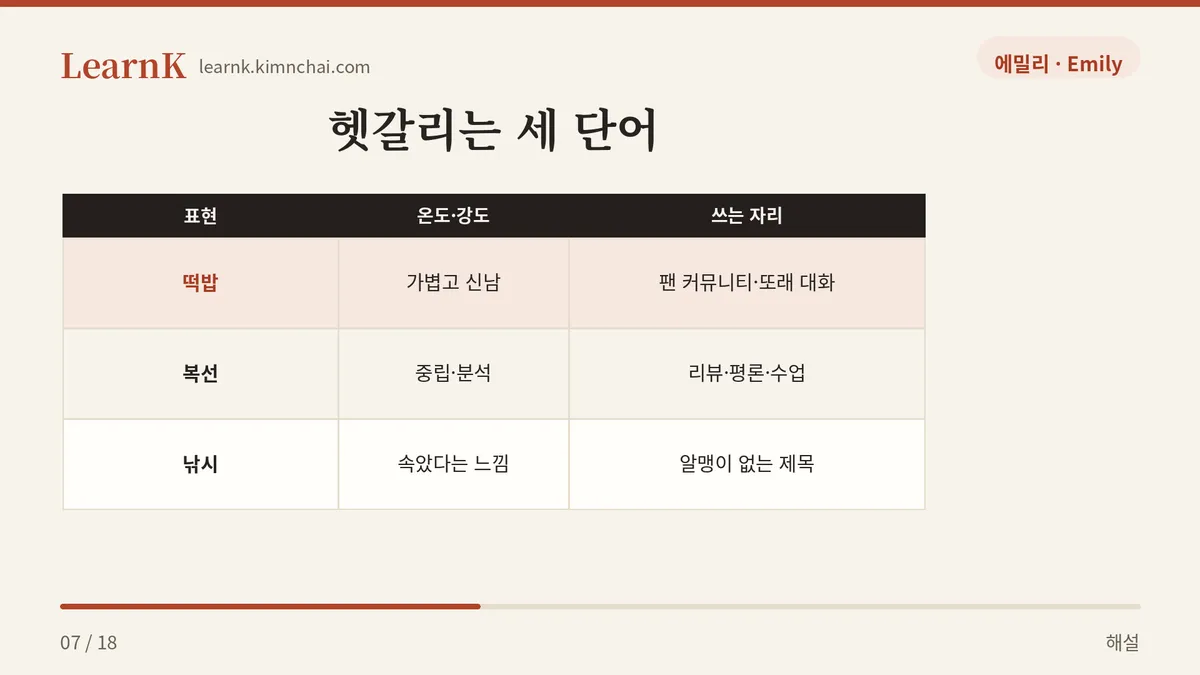
| Expression | Tone & intensity | Where it’s used |
|---|---|---|
| 떡밥 (tteokbap) | Light and excited; fond griping from someone on the show’s side | Fan communities and chats with peers. Not with superiors or in official documents |
| 복선 (bokseon) | Neutral, analytical | Reviews, criticism, class. Anywhere |
| 스포 (seupo) | Negative, handled with care | When someone leaks the ending to a person who hasn’t watched yet |
| 낚시 (naksi) | Negative, the feeling of being tricked | For empty clickbait titles or false information |
떡밥 and 복선 are especially easy to mix up. 복선 (foreshadowing) refers to a device the writer planted, while 떡밥 is the word from the viewer’s side, the one who spotted it and won’t let go. So 복선 lives only inside the work, but 떡밥 also takes in news from outside it — trailers, agency photos and the like. It’s different from 낚시 too. 낚시 is the word of betrayal you use when it turns out there was nothing there after all; 떡밥 is the word of anticipation you use while you still believe something is coming.
Cultural background — the side that throws the bait, the side that bites
The picture behind this word is very clear. An angler kneads the dough into a lump and throws it into the water. A fish bites. 던지다 and 물다, which sat side by side in the dictionary examples, are still alive here, and to them the slang has added 회수 (pulling back in what you threw) and 가뭄 (a drought with no rain) to make a full set of vocabulary. It’s not often that slang carries over the entire landscape of its original meaning like this.
Part of what let this word grow is how Korean dramas are broadcast. Most air two episodes a week over two or three months. Three to seven days sit empty between one episode and the next, and in that empty time people gather and trade theories. One three-second shot left behind by episode 15 becomes hundreds of posts over the next few days. Shows like 《시그널》 (Signal, tvN, 2016) and 《도깨비》 (Goblin, tvN, 2016–2017), where objects and lines planted early lined up exactly with what came later, are still cited as examples of 떡밥 회수 done well.
In idol fandoms the cycle is shorter. Ahead of a comeback, an agency releases photos, short clips, and images with nothing but a date on them, in order, over several days. That entire planned drip is 떡밥, and fans will latch onto the color of an outfit or a single detail in the background. The fact that both the side throwing and the side biting know perfectly well it’s bait — and bite happily anyway — is why the word never hardened into something negative.
Today’s quiz
A character who kept their identity hidden for twelve episodes is finally revealed in the finale. The photo, the letter, the stopped clock that all flickered past earlier are explained by this one scene. What’s the most fitting thing for viewers to say here?
① 떡밥 가뭄이네. (tteokbap gaumine.) ② 떡밥 회수됐다. (tteokbap hoesudwaetda.) ③ 이제 막 떡밥 던졌네. (ije mak tteokbap deonjyeonne.)
The answer is ②. 회수 means pulling back in what you threw out, so it says the story explained every last clue it had scattered. ① is for the frustrating stretch when the news dries up, and ③ is the opposite — for when a new clue has just appeared.
Definitions and example sentences are from the National Institute of Korean Language’s Basic Korean Dictionary (krdict.korean.go.kr); that portion of this post, including our translations, is licensed under CC BY-SA 2.0 KR.