떡국 (tteokguk) — The New Year's Soup That Makes You a Year Older
떡국 (tteokguk)
On the morning of Lunar New Year’s Day, Korean kitchens all smell about the same. Broth bubbles away on the stove, and white rice cakes slide softly across the cutting board. 떡국 (tteokguk) means a dish made by slicing 가래떡 (garaetteok) thin and simmering it in a clear soup. For Koreans, this one bowl isn’t just breakfast — it’s closer to a signal that the new year has begun. So if you’re learning Korean and you run into a Korean person in January or February, nine times out of ten you’ll get this question — 떡국 먹었어요? (Tteokguk meogeosseoyo?)
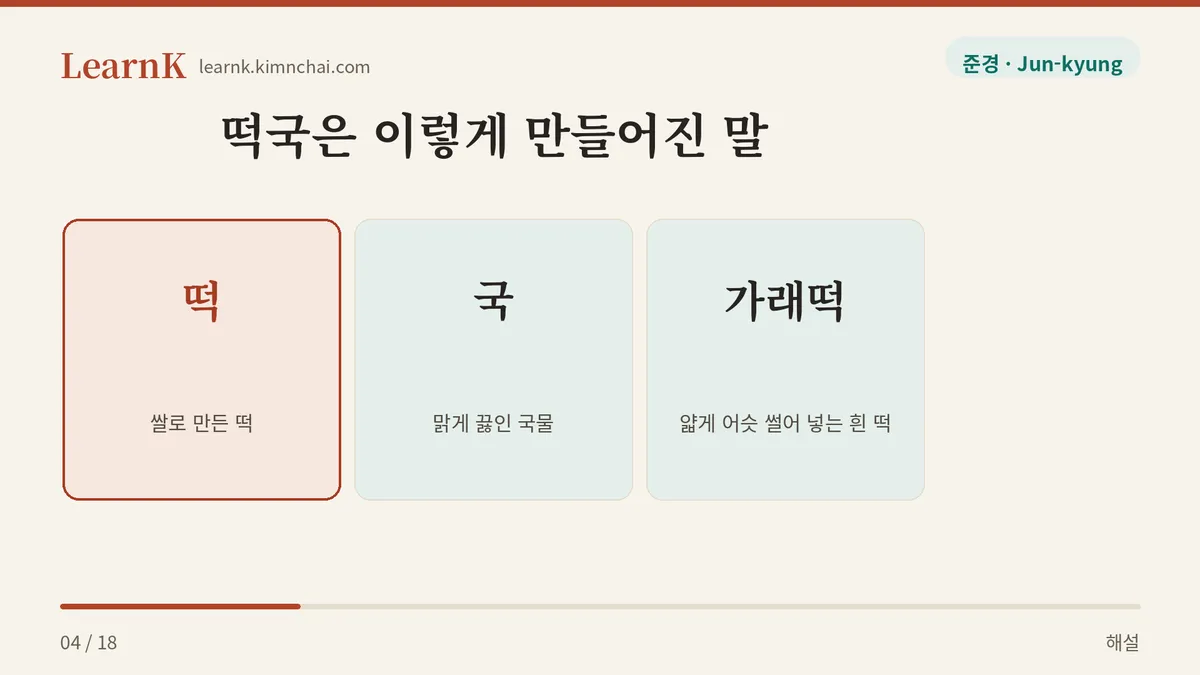
The name is honest. It’s 떡 (tteok) with 국 (guk) attached — “soup boiled with rice cake in it.” But not just any rice cake will do. 가래떡 (garaetteok) — a long, round white rice cake pulled out about as thick as your forearm — has to be cut into thin diagonal slices before it becomes the rice cake of tteokguk. The broth varies from house to house. Some families simmer beef brisket slowly for a clear broth; others use anchovies or beef bones. At the end, you add 고명 (gomyeong), the garnish — 지단 (jidan), egg whites and yolks fried separately and cut into strips, plus stir-fried beef, crumbled toasted seaweed, and finely chopped scallions.
There are two points of nuance worth flagging. First, tteokguk is not spicy. A lot of learners think “Korean food” and picture red broth, but tteokguk sits at the opposite end. It’s clear and mild — babies eat it, and so do grandparents. Second, this word doesn’t stop at being the name of a dish. In Korean, ‘떡국을 먹다’ (to eat tteokguk) also means to turn a year older. So the word tteokguk always carries a faint smell of time about it.
Checking It in the National Institute of Korean Language Dictionary
떡국 「명사」 가래떡을 얇게 썰어 맑은 국에 넣고 끓인 음식. [en] tteokguk; sliced rice cake soup — A dish made by cutting garaetteok, rice cake stick, into thin slices and boiling them in clear broth. [ja] トックク。ぞうに【雑煮】 — 細長い棒状の白餅の「カレトク」を薄く切って、スープに入れて煮込んだ料理。 [es] tteokguk, sopa con garaetteok — Caldo claro caliente que se prepara con trozos finos de garaetteok (barra de pastel de arroz). [zh] 年糕汤 — 将长条年糕切成薄片后放入清汤中煮制而成的食物。 — National Institute of Korean Language, Basic Korean Dictionary (krdict.korean.go.kr)
It’s worth resting your eye on the phrase ‘맑은 국’ (clear soup) in the definition. The dictionary bothered to specify the color of the broth because that’s exactly what separates this dish from other rice cake dishes. For reference, the Portuguese definition isn’t included in the dictionary, so we had nothing to translate. If we had to render it ourselves, it would be something like ‘sopa clara com fatias de bolinho de arroz’ — but that’s our own translation, not dictionary content.
Let’s look at a few of the actual usage examples listed in the dictionary.
한국에서는 설날에 가래떡으로 떡국을 끓여 먹는다. In Korea, people make tteokguk with garaetteok and eat it on Lunar New Year’s Day. — National Institute of Korean Language, Basic Korean Dictionary (krdict.korean.go.kr)
This is the most basic slot the word tteokguk sits in. 설날 (seollal) — the first day of the lunar new year — and this dish travel together almost as one body. It’s also worth noticing how the sentence marks the ingredient with ‘가래떡으로’ (with garaetteok).
우리는 설날 아침이면 친척들이 모두 교자상에 둘러앉아 떡국을 먹곤 했다. On Lunar New Year’s morning, all our relatives used to sit around the big table together and eat tteokguk. — National Institute of Korean Language, Basic Korean Dictionary (krdict.korean.go.kr)
A 교자상 (gyojasang) is a large table that many people can sit around. This one sentence contains the whole idea that tteokguk isn’t food you eat alone — it’s food that’s only complete when people gather. The ending ‘-곤 했다’ at the end of the sentence recalls a habit repeated in the past, so it also carries a trace of regret that things aren’t that way anymore.
어머니는 설날 떡국을 끓이기 위해 떡을 가래로 뽑으셨다. Mother pulled the rice cake dough into long sticks to make tteokguk for Lunar New Year’s Day. — National Institute of Korean Language, Basic Korean Dictionary (krdict.korean.go.kr)
This is a sentence from an era when people made their own rice cakes instead of buying them. ‘가래로 뽑다’ means to extrude the dough into a long stick shape — and that’s where the name garaetteok comes from.
네. 그리고 여기에 지단과 김 가루로 고명을 얹어 마무리하면 떡국이 완성됩니다. Yes. And if you finish it off by adding jidan and crumbled seaweed as garnish, the tteokguk is complete. — National Institute of Korean Language, Basic Korean Dictionary (krdict.korean.go.kr)
This is the kind of phrasing you’d hear on a cooking show or in a cooking class. Since gomyeong goes on at the very end for shape and color rather than flavor, it pairs with the verb ‘얹다’ (to place on top).
그녀는 떡국에 고명으로 올릴 지단을 부치기 위해 달걀의 흰자를 노른자와 따로 분리했다. She separated the egg whites from the yolks in order to fry the jidan she would put on the tteokguk as garnish. — National Institute of Korean Language, Basic Korean Dictionary (krdict.korean.go.kr)
The reason for separating whites from yolks is to make white jidan and yellow jidan separately, so you get two colors to work with. This sentence quietly tells you just how much work goes into a single bowl of tteokguk.
A Real Conversation
Setting: Lunar New Year’s morning, in the kitchen at Jun-kyung’s house. Emily, who has come to give New Year’s greetings, is helping set the table.
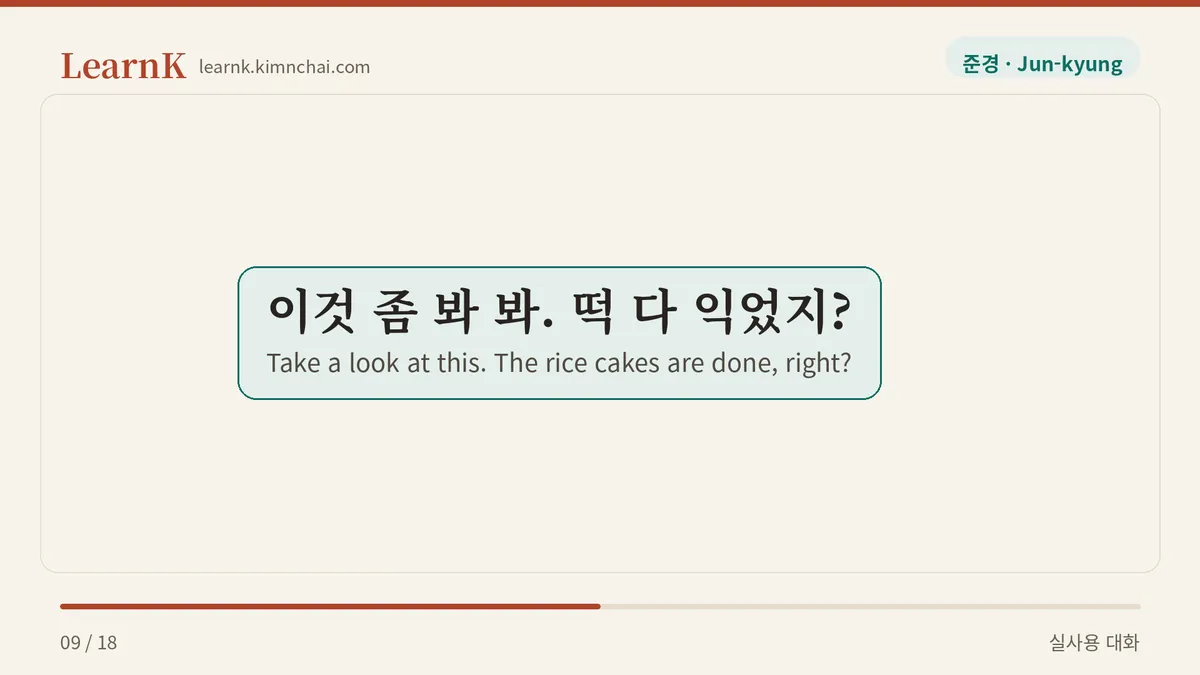
Jun-kyung: 에밀리, 이것 좀 봐 봐. 떡 다 익었지? Emily, take a look at this. The rice cakes are done, right?
Emily: 어, 다 떠올랐네. 근데 이 집 떡국은 국물이 왜 이렇게 뽀얘? Yeah, they’ve all floated up. But why is your family’s tteokguk broth so milky?
Jun-kyung: 우리 집은 사골로 끓이거든. 집집마다 달라. 자, 고명 얹자. We use beef bone broth. It’s different in every house. Okay, let’s put the toppings on.
Emily: 지단은 내가 부칠게. …근데 나 이거 먹으면 진짜 한 살 더 먹는 거야? I’ll fry the egg garnish. …By the way, do I really turn a year older if I eat this?
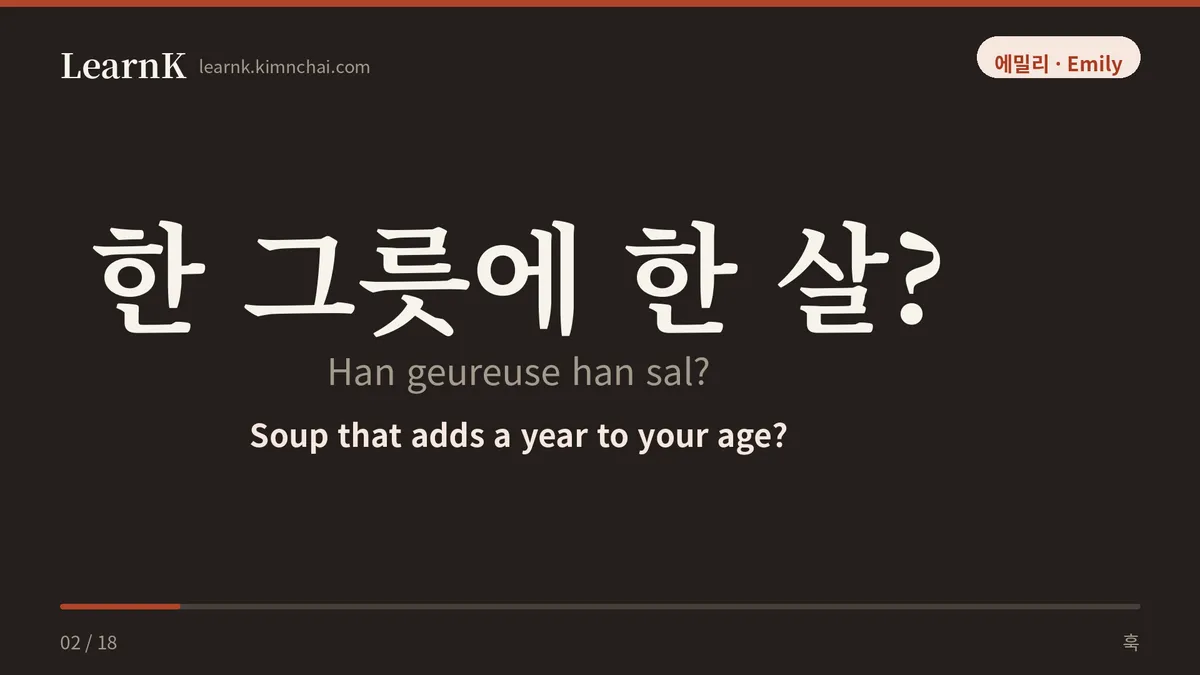
Jun-kyung: 당연하지. 떡국 한 그릇에 한 살. 두 그릇 먹으면 두 살이고. Obviously. One bowl of tteokguk, one year. Two bowls, two years.
Emily: 그럼 난 반 그릇만. 나이는 천천히 먹을래. Then just half a bowl for me. I’d rather get older slowly.
This Sounds Awkward
✗ (to an elderly person) 어르신, 떡국 참 많이 드셨겠어요. Sir/Ma’am, you must have eaten an awful lot of tteokguk. ✓ (to a friend your own age) 야, 너 그동안 떡국 몇 그릇 먹은 거야? Hey, how many bowls of tteokguk have you eaten by now? → Because ‘떡국을 먹다’ carries the meaning of ‘나이를 먹다’ (to get older), saying this to an older person doesn’t sound like you’re talking about food — it sounds like “Wow, you’ve gotten old.” Jokes about age stay between peers.
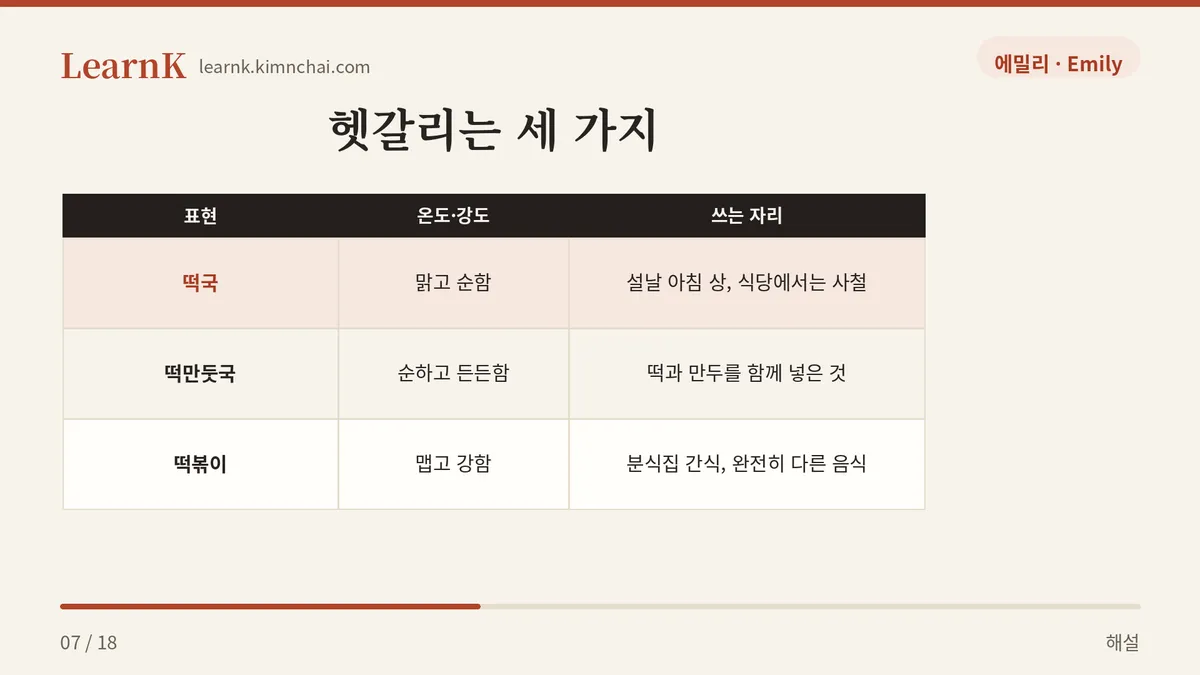
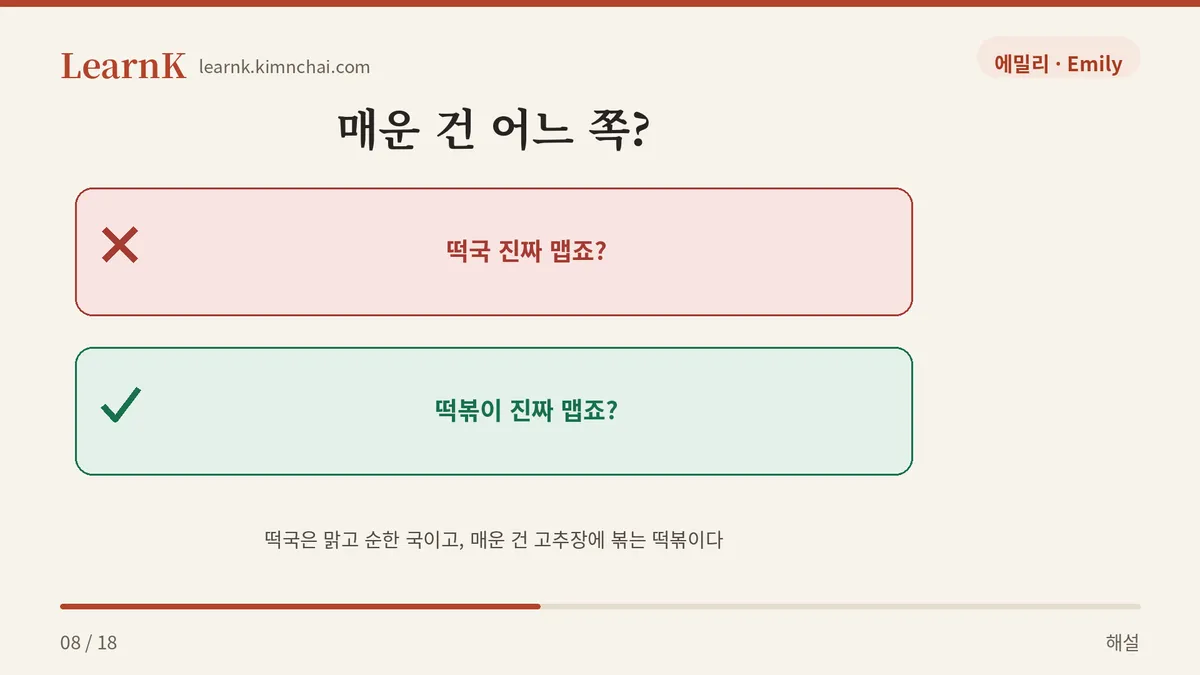
✗ 떡국 진짜 맵죠? 저는 매운 거 잘 먹어요. Tteokguk is really spicy, isn’t it? I’m good with spicy food. ✓ 떡볶이 (tteokbokki) 진짜 맵죠? 저는 매운 거 잘 먹어요. Tteokbokki is really spicy, isn’t it? I’m good with spicy food. → The names are similar, so this is the pair learners mix up most often. Both are made from rice cake, but tteokguk is a mild dish in clear broth, while the one stir-fried in spicy gochujang sauce is tteokbokki. The rice cakes are shaped differently too — tteokguk uses flat slices, tteokbokki uses short sticks.
Example Sentences by Situation
1. First day back at work in the new year, to a coworker
This is a greeting exchanged in Korea in early January or right after the Lunar New Year holidays. It’s a far more distinctly Korean way of asking how someone’s been than “잘 쉬었어요?” (Did you get some rest?).
떡국 드셨어요? 저는 어머니가 끓여 주신 거 두 그릇이나 먹었어요. (Tteokguk deusyeosseoyo? Jeoneun eomeoniga kkeuryeo jusin geo du geureusina meogeosseoyo.) 떡국 드셨어요? 저는 어머니가 끓여 주신 걸로 두 그릇이나 먹었어요. Did you have tteokguk? I had two whole bowls of the one my mom made.
The -이나 (-ina) in ‘두 그릇이나’ is a particle you attach when a quantity is more than expected. Just saying ‘두 그릇’ states a fact; saying ‘두 그릇이나’ turns it into a joke with a little bragging mixed in.
2. Ordering at a restaurant
Tteokguk isn’t only eaten on Lunar New Year’s Day. Korean restaurants and snack shops sell it all year round. In this context there’s no holiday connotation at all — it’s just a menu item.
떡국 하나 주세요. 만두도 같이 넣어 주실 수 있어요? (Tteokguk hana juseyo. Mandudo gachi neoeo jusil su isseoyo?) One tteokguk, please. Could you put dumplings in it too?
If you add dumplings, it becomes 떡만둣국 (tteokmandutguk). Most restaurant menus list 떡국 and 떡만둣국 side by side, so it’s handy to know both before you order.
3. When age comes up on a birthday or at New Year
Koreans toss out this line as a joke when they don’t feel like getting older. Use this expression and native speakers will light up.
나 올해는 떡국 안 먹을래. 나이 그만 먹고 싶어. (Na olhaeneun tteokguk an meogeullae. Nai geuman meokgo sipeo.) I’m not eating tteokguk this year. I want to stop getting older.
’-(으)ㄹ래’ is a casual ending that lightly states your own intention, so it’s right for friends. In front of someone older, you’d soften it to something like 떡국은 좀 줄여야겠어요 (Tteokgugeun jom juryeoyagesseoyo) — “I should probably cut back on tteokguk.”
Formal vs. Casual, and Similar Expressions
Tteokguk is a noun, so there’s no honorific level built into the word itself. What changes is the verb you use with it. To a friend, 떡국 먹었어? (Tteokguk meogeosseo?); to an older person or someone senior to you, 떡국 드셨어요? (Tteokguk deusyeosseoyo?); and in a very formal setting, 떡국 드셨습니까? (Tteokguk deusyeotseumnikka?). Using ‘먹었어요?’ with an elder is grammatically correct but sounds one notch short on politeness, so you’re better off memorizing ‘드시다’ as a whole.
Dishes that look similar break down like this.
| Expression | Flavor & intensity | Where it’s used |
|---|---|---|
| 떡국 (tteokguk) | Clear and mild; carries holiday weight | The Lunar New Year morning table. Sold year-round at restaurants |
| 떡만둣국 (tteokmandutguk) | Mild but heartier | Rice cake and dumplings together. The most common version on restaurant menus |
| 만둣국 (mandutguk) | Mild, no rice cake | The New Year spread in families with roots in the north |
| 떡볶이 (tteokbokki) | Spicy and strong; a light snack | Snack shops and street stalls. A completely different dish from tteokguk |
| 가래떡 (garaetteok) | Almost flavorless; an ingredient | The ingredient for tteokguk. Also grilled and dipped in honey |
Cultural Background — One Bowl, One Year
The word formation is simple, as we saw above: 떡 + 국. But as for why it’s this white soup that gets eaten at New Year, there’s an old explanation attached. It’s commonly said that the long-pulled garaetteok stands for a long life, and that the round slices resemble old coins and therefore signify wealth. The white color is talked about as meaning a clean start to the year. It’s an explanation widely used when introducing seasonal customs, so it’s good to know — but it’s hard to say definitively which of these was the original reason.
What is certain is that this dish is bound up with counting age. For a long time, Korea counted age in a way where everyone turned a year older together on New Year’s Day, and what you ate that morning was tteokguk. Even after the legal standard shifted to international age in June 2023, the joke has stuck around. To this day, once the Lunar New Year holiday passes, you’ll hear things like “떡국 먹었으니 이제 한 살 더 먹은 거네” (Well, you ate tteokguk, so you’re a year older now) around the office.
Regional variation is fun too. In the Kaesong area, people use 조랭이떡 — rice cakes pinched into a silkworm-cocoon shape. Families with roots in the north sometimes use dumplings instead of rice cake. Along the southern coast, they add oysters for a crisp, refreshing broth. So if you ask a Korean “떡국 어떻게 끓여 드세요?” (How does your family make tteokguk?), you’ll usually get a long story about their own home. It’s a very useful question for opening a conversation.
Whenever a Korean drama has a holiday scene, a bowl of tteokguk is almost never missing. In one popular family drama set in a 1980s neighborhood alley, there’s a scene on Lunar New Year’s morning where neighbors carry food back and forth between houses — and that white bowl steaming on the table sits right at the center of the frame. Without a line of dialogue, it says “today is New Year’s Day.”
Today’s Quiz
A Korean friend says this at the office after the Lunar New Year holiday:
“어제 떡국 두 그릇 먹었더니 갑자기 두 살 먹은 기분이야.” “I had two bowls of tteokguk yesterday, and now I suddenly feel two years older.”
Which is the best interpretation of this?
① They ate so much tteokguk that they got an upset stomach ② It’s a joke about really feeling that they’ve gotten older now that it’s a new year ③ The tteokguk was so spicy that it was rough on them ④ The price of tteokguk has doubled
Answer: ② — Since ‘떡국을 먹다’ carries the meaning of ‘나이를 한 살 먹다’ (to turn a year older), saying they ate two bowls becomes an exaggerated joke about feeling two years older. Tteokguk isn’t a spicy dish, so ③ doesn’t hold up in the first place.
Definitions and example sentences are from the National Institute of Korean Language’s Basic Korean Dictionary (krdict.korean.go.kr); that portion of this post, including our translations, is licensed under CC BY-SA 2.0 KR.