떡실신 (tteoksilsin) — The Word for Being Completely Wiped Out, and When Koreans Say It
The night you finally haul the last moving box inside. The dawn after a twelve-hour overtime shift. The moment right after you’ve watched your favorite singer perform live, right in front of your eyes — in all of these, Korean people blurt out the same thing, as if they’d agreed on it beforehand. That word is 떡실신 (tteoksilsin). 떡실신 describes the state of running completely out of energy and collapsing right there on the spot — “totally knocked out.” It doesn’t mean you actually lost consciousness. It’s the most exaggerated way possible to paint the fact that you don’t have the strength left to lift a single finger.
떡실신 (tteoksilsin)
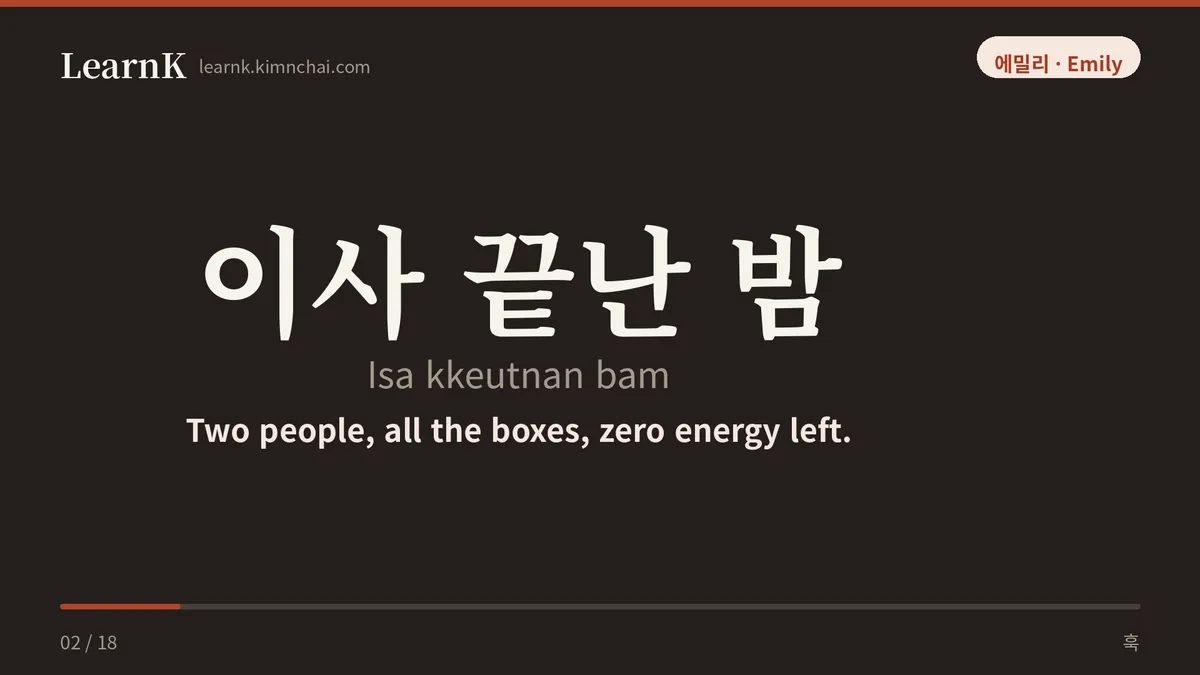
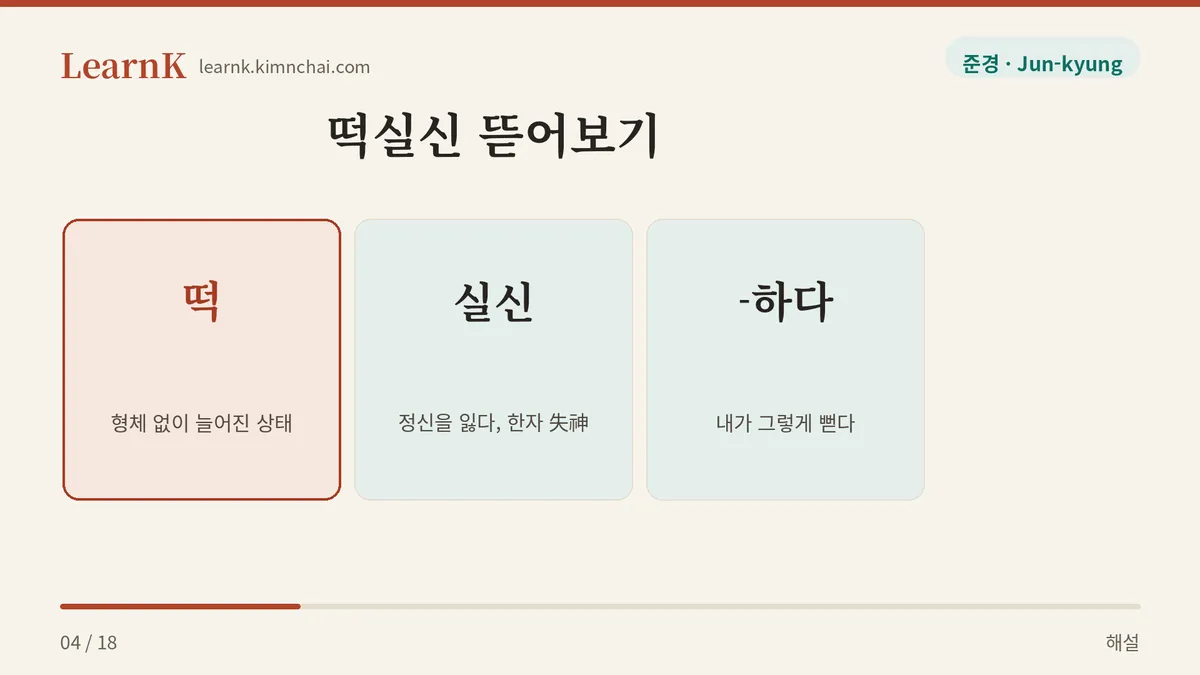
떡실신 is 실신 (silsin) with an intensifier attached to the front. 실신 is a Sino-Korean word, 失神 — to lose one’s senses. The 떡 stuck on the front has nothing to do with the taste of rice cake; it’s the 떡 from 떡이 되다 (tteogi doeda), a phrase Korean has used for ages to describe something that has gone limp and lost its shape. So 떡실신 is a coinage that squeezes “lost my senses so completely that I turned into 떡” into a single word.
There are two main branches of usage. The first is physical exhaustion. You use it for the scene where you push your body hard and then drop straight onto the bed or the sofa. The second is being overwhelmed. You use it when something is so good, so intense, or so funny that you can’t keep it together. Among fans of Korean culture, it’s this second one that shows up most often. When a performance is so good that it leaves you dazed, you say you 떡실신했다.
The conjugated forms are worth knowing too. 떡실신하다 (tteoksilsinhada) is when you collapse, and 떡실신시키다 (tteoksilsinsikida) is when you make someone else collapse. When you completely dominate an opponent in a game or a sport, you say 떡실신시켰다. And these days you’ll also hear 떡실신 각 (tteoksilsin gak) — a heads-up that you’re about to keel over any minute now.
The temperature of this word is definitely light and funny. It’s a complaint that makes the listener laugh, so it fits joking around with friends far better than genuinely asking for sympathy.
Seeing It in Real Conversation
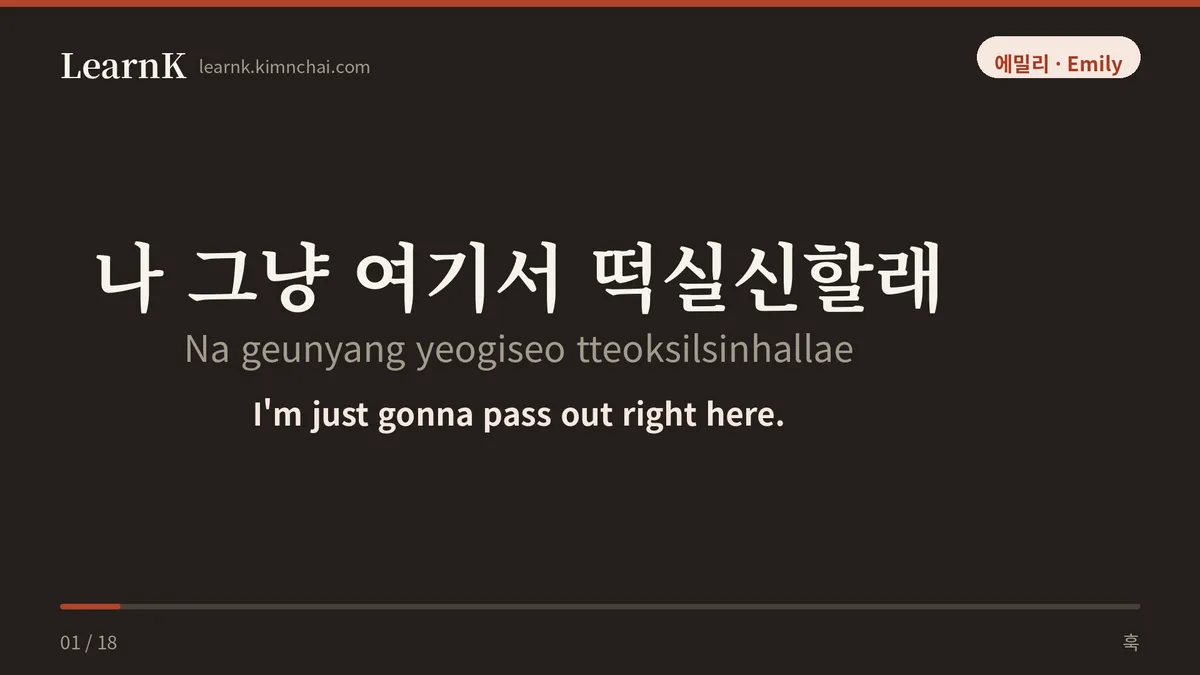
Setting: the night of moving day. All the boxes have made it inside, but not one has been unpacked. The two of them have sunk down onto the living room floor exactly where they were standing.
Jun-kyung: 야… 나 진짜 못 움직이겠다. 손가락도 안 펴져. Hey… I seriously can’t move. I can’t even straighten my fingers.
Emily: 나도. 아까 냉장고 옮길 때부터 떡실신 직전이었어. Same. I’ve been on the verge of collapsing ever since we moved the fridge.
Jun-kyung: 저녁 뭐 시킬까? 치킨 어때? What should we order for dinner? How about chicken?
Emily: 먹고는 싶은데 씹을 힘이 없어. 나 그냥 여기서 떡실신할래. I want to, but I don’t have the energy to chew. I’m just gonna pass out right here.
Jun-kyung: 박스 위에서 자면 내일 허리 나가. 이불부터 찾자. If you sleep on the boxes you’ll wreck your back tomorrow. Let’s find the blanket first.
Emily: 이불이 몇 번 박스더라… 아, 몰라. 내일의 내가 알아서 하겠지. Which box was the blanket in… ugh, whatever. Tomorrow-me will figure it out.
When It Sounds Off
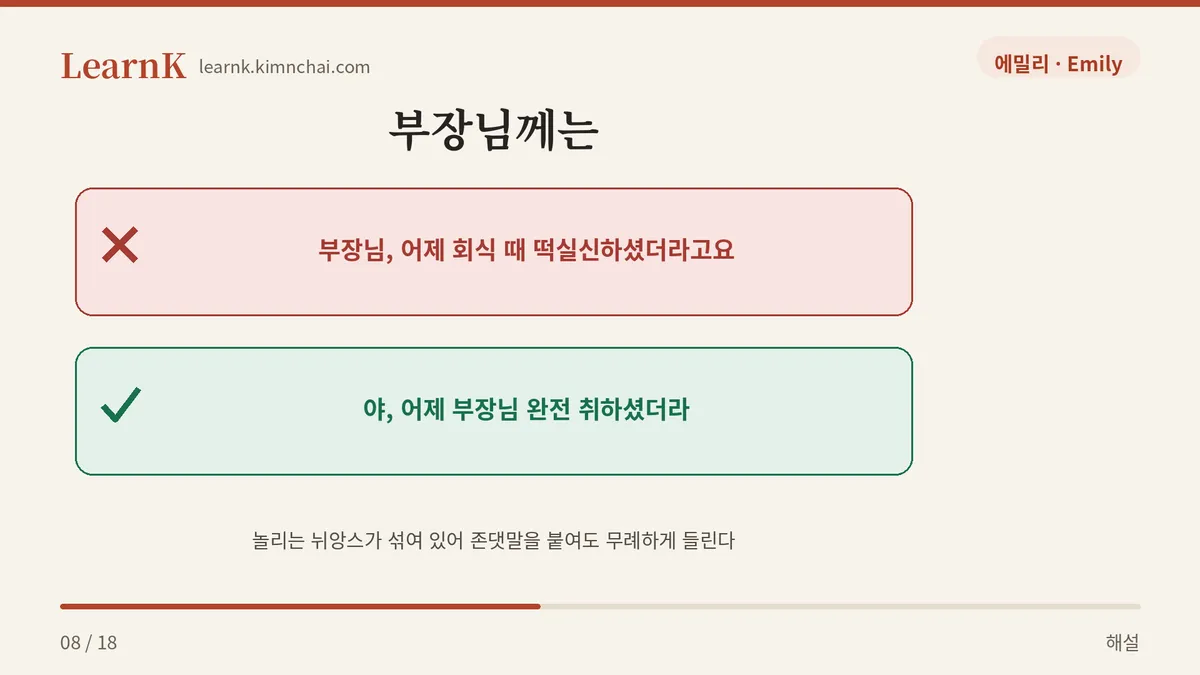
✗ (to your department head) 부장님, 어제 회식 때 떡실신하셨더라고요. Sir, you were totally knocked out at the company dinner yesterday. ✓ (to a coworker) 야, 어제 부장님 완전 취하셨더라. Hey, the boss was really drunk yesterday. → The grammar is perfectly fine. The problem is that you’ve described a senior person’s unraveled state with a jokey slang word. 떡실신 carries a teasing edge, so when the subject is someone above you, it sounds rude even with polite endings attached.
✗ (in the emergency room) 저기요, 이분 지금 떡실신하셨어요! Excuse me, this person has passed out cold! ✓ (in the emergency room) 저기요, 이분 지금 의식이 없어요! Excuse me, this person is unconscious! → 떡실신 doesn’t refer to actual loss of consciousness; it’s an exaggerated joke. Use it in a genuine emergency and you’ll come across as someone taking the situation lightly. In moments like this, use 의식이 없다 (uisigi eopda) or 쓰러지다 (sseureojida).
Example Sentences by Situation
① A fan talking to a friend after coming out of a concert (this is where fans of Korean culture use it most)
마지막 곡 무대 보고 나 완전 떡실신했잖아. Majimak gok mudae bogo na wanjeon tteoksilsinhaetjanha. That last performance completely wrecked me.
Here it doesn’t mean she’s tired — it means she was overwhelmed by emotion. What’s fun about this word is that it covers both a body that’s worn out and a heart that’s overflowing.
② On the way down after finishing a hike
정상까지는 갔는데, 내려와서 차 안에서 떡실신했어. Jeongsangkkajineun gatneunde, naeryeowaseo cha aneseo tteoksilsinhaesseo. I made it to the top, but I passed out cold in the car on the way back.
This is the classic “ran completely out of stamina” usage. Adding the place where you collapsed — 차 안에서 (in the car), 소파에서 (on the sofa) — makes it sound much more natural.
③ Talking to a friend after a game (the side that knocked someone else out)
어제 그 팀 우리가 떡실신시켰지. Eoje geu tim uriga tteoksilsinsikyeotji. We absolutely crushed that team yesterday.
Use this form only when the outcome was completely one-sided. Say it about a game you barely squeaked out and it sounds like bragging.
Formal vs. Casual Speech, and Similar Expressions
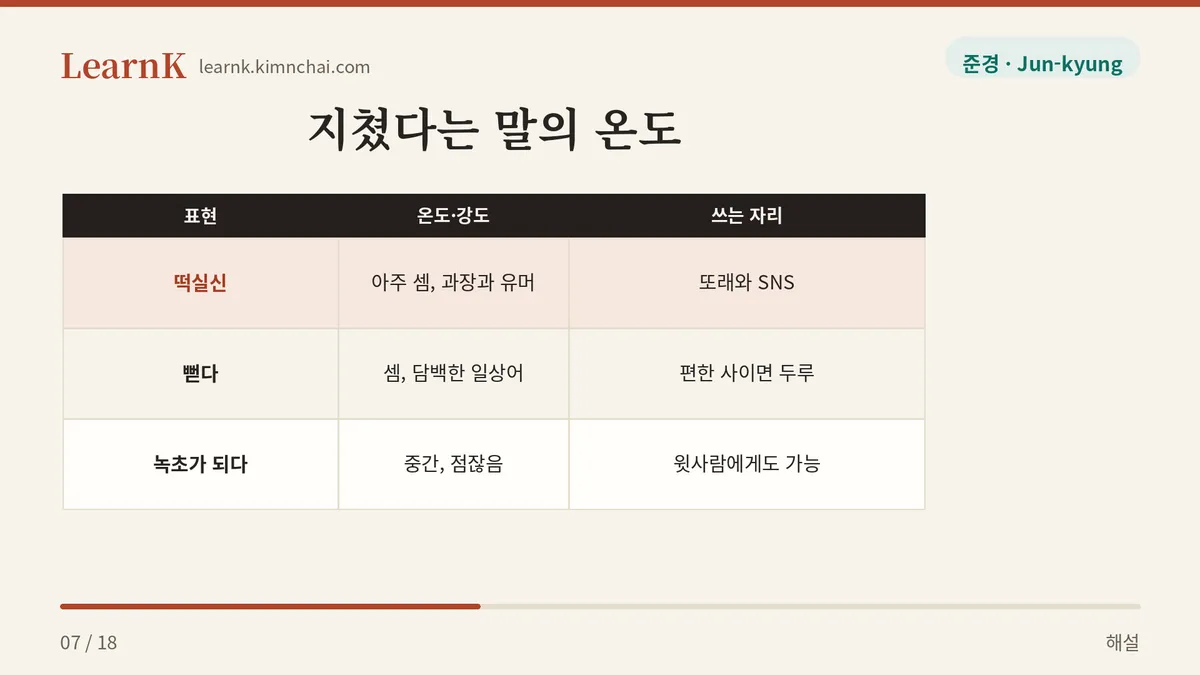
떡실신 doesn’t become polite just because you change the ending. You can say 떡실신했어요 (tteoksilsinhaesseoyo), but the vocabulary itself is casual, so the listener still needs to be a peer or someone you’re comfortable with. If you want to tell your boss at work or an adult you’ve just met that you’re exhausted, 많이 지쳤습니다 (mani jichyeotseumnida) or 녹초가 되었습니다 (nokchoga doeeotseumnida) is the safer route.
| Expression | Tone & Intensity | Where It Fits |
|---|---|---|
| 떡실신 (tteoksilsin) | Very strong. Exaggeration + humor | Peers and social media. Not for formal settings |
| 뻗다 (ppeotda) | Strong. Plain everyday word | Anywhere with people you’re comfortable with |
| 녹초가 되다 (nokchoga doeda) | Moderate. Well-mannered | Anywhere, including with people senior to you |
| 기절하다 (gijeolhada) | Depends on context | Actual loss of consciousness; also used as exaggeration |
Put all four in the same sentence and the difference is obvious. At the end of a long day, saying you 뻗었다 simply reports that you collapsed and slept; saying you 녹초가 됐다 is a grown-up way of describing your fatigue; and saying you 떡실신했다 makes whoever’s listening crack a smile.
Cultural Background — How Korean Paints a Body That’s Run Out of Battery
Korean has an unusual number of expressions that compare a worn-out body to an object. There’s 녹초, used to say your body has gone completely limp; 떡이 되다, meaning you’ve lost your shape; and even 파김치가 되다 (pagimchiga doeda), which likens you to wilted, moisture-drained vegetables. 떡실신 is a relatively young word, built by stacking the Sino-Korean 실신 (失神) on top of that old metaphor. It spread through internet communities and variety-show subtitles, and while it’s now used across generations, you still rarely see it in literary writing or official documents.
There’s one more reason this word is interesting from a Korean-culture fan’s perspective. In Korean fan culture, there’s a convention of expressing affection through the image of a body breaking down. 심장이 아프다 (my heart hurts), 정신을 못 차리겠다 (I can’t pull myself together), and 떡실신했다 — all of them are different faces of saying “I love this.” So when you spot 떡실신 in a Korean fan’s comment, read it not as “I’m exhausted” but as the highest compliment they can give.
Today’s Quiz
Which of the following is the most fitting situation for 떡실신?
- Explaining a patient’s condition to a doctor at the hospital
- Telling a boss you’re meeting for the first time that last night’s overtime was rough
- Sinking down onto the floor with a friend after twelve straight hours of moving
- Writing up a project status update in a company report
The answer is 3. 떡실신 is for comically exaggerating how wrecked you are among people you’re close to. Situation 1 deals with actual loss of consciousness, so a joking tone doesn’t belong; situations 2 and 4 call for formality, so you’d want 많이 지쳤습니다 or 업무 강도가 높았습니다 instead.
If you finish something tonight and collapse into bed, try leaving behind one sentence in Korean: 나 오늘 떡실신 (na oneul tteoksilsin).
Definitions and example sentences are from the National Institute of Korean Language’s Basic Korean Dictionary (krdict.korean.go.kr); that portion of this post, including our translations, is licensed under CC BY-SA 2.0 KR.