뜨아 (tteua) — The Two-Syllable Coffee Order You'll Hear All Day in Korea
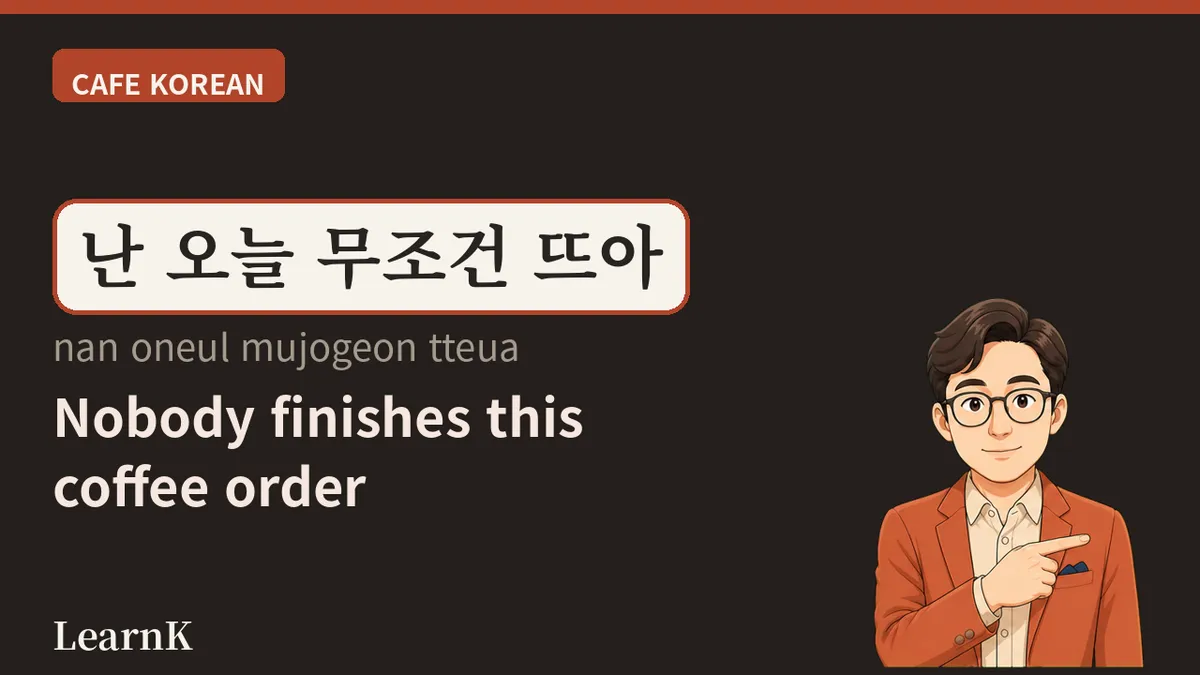
뜨아 (tteua)
뜨아 (tteua) is a two-syllable shortening of 뜨거운 아메리카노 (tteugeoun amerikano), a hot Americano. You’ll hear it at the café counter, in the office when someone is collecting everyone’s coffee order, and in a one-line text that just says 나 뜨아 (na tteua) — hot Americano for me. Anyone who has walked into a Korean café hears it several times a day, and yet it never shows up in a textbook.
The best-selling drink in Korean cafés is the Americano. It’s such a default that people stopped feeling the need to say the whole menu name out loud. That leaves exactly one decision — hot or cold? So a hot Americano became 뜨아 (tteua) and an iced Americano became 아아 (aa). These two-syllable words aren’t trendy slang that flares up and disappears; after well over a decade of use, they’re closer to ordinary everyday vocabulary.
The register is light and fast. It isn’t formal speech — it’s speech that gets the point across quickly. With friends, coworkers, and café staff it’s completely fine, but with an older person you’re meeting for the first time, or in a formal setting, it’s safer to say the full menu name. And one more thing: 뜨아 (tteua) itself carries no politeness level at all. Whatever you attach after it decides that.
A real conversation
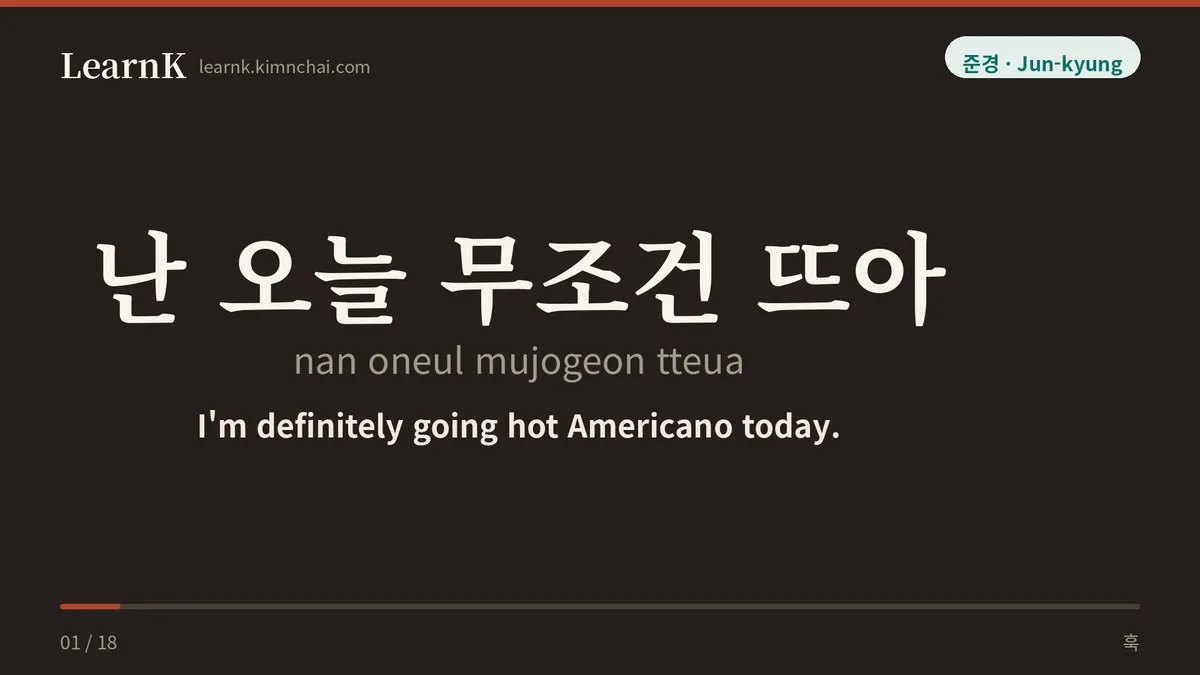
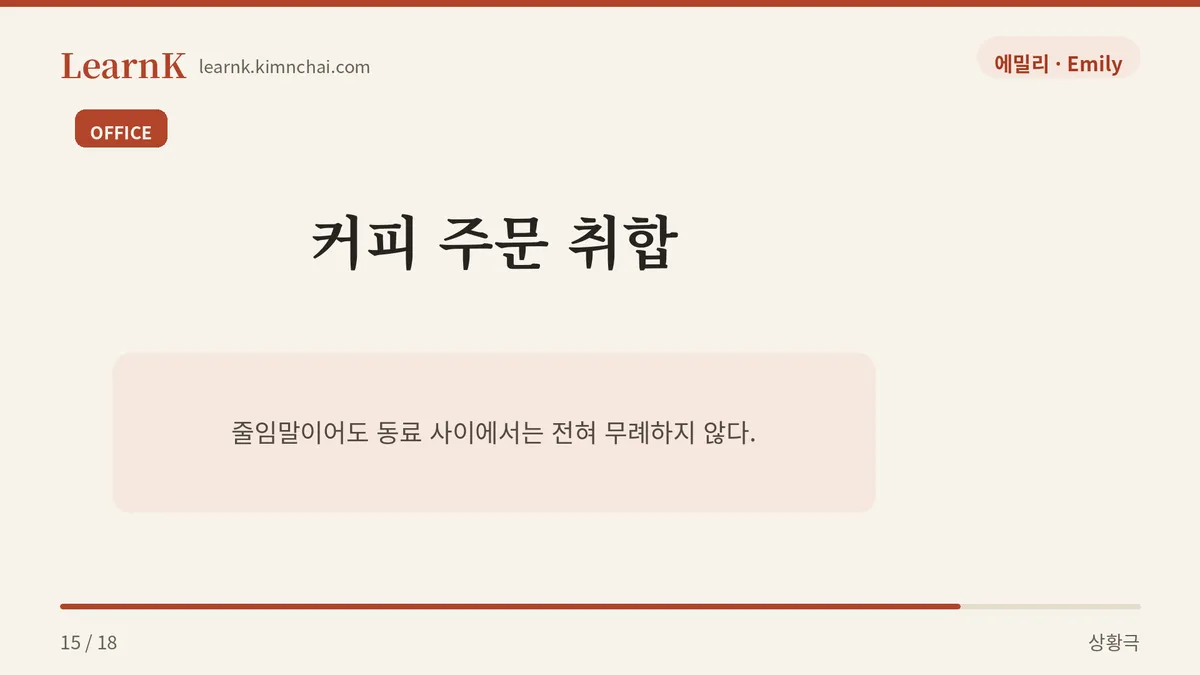
Scene: A December morning under a cold-wave warning. Two coworkers are standing side by side in the order line at the café in front of the office.
Jun-kyung: 에밀리, 뭐 마실 거야? 난 오늘 무조건 뜨아. Emily, what are you getting? I’m definitely going hot Americano today.
Emily: 난 아아. 손 시려워도 아아지. Iced for me. Even with freezing hands, it’s gotta be iced.
Jun-kyung: 야, 밖에 영하 12도야. 너 진짜 얼죽아다. Hey, it’s minus twelve out there. You’re a die-hard iced-coffee person.
Emily: 15년 살았으면 나도 한국 사람이지. 근데 오빠는 여름에도 뜨아 마시잖아. I’ve lived here fifteen years, so I count as Korean. But you drink hot Americano even in summer.
Jun-kyung: 나 위가 약해서 그래. 아, 저기요 — 뜨아 한 잔이랑 아아 한 잔이요. My stomach’s weak, that’s why. Oh, excuse me — one hot Americano and one iced Americano.
Emily: 얼음 많이요! 이건 꼭 말해야 돼. Extra ice, please! You have to say that part out loud.
When it sounds off
✗ (to a client’s department head you’re meeting for the first time) 부장님, 뜨아 드릴까요? ✓ (to a client’s department head you’re meeting for the first time) 부장님, 따뜻한 아메리카노 드릴까요? (bujangnim, ttatteutan amerikano deurilkkayo?) → 뜨아 (tteua) is a quick abbreviation traded between people who are comfortable with each other. Used on a senior you’ve just met, it makes your speech sound too casual — and depending on their generation, they may not even recognize the word. In this situation, say the full menu name.
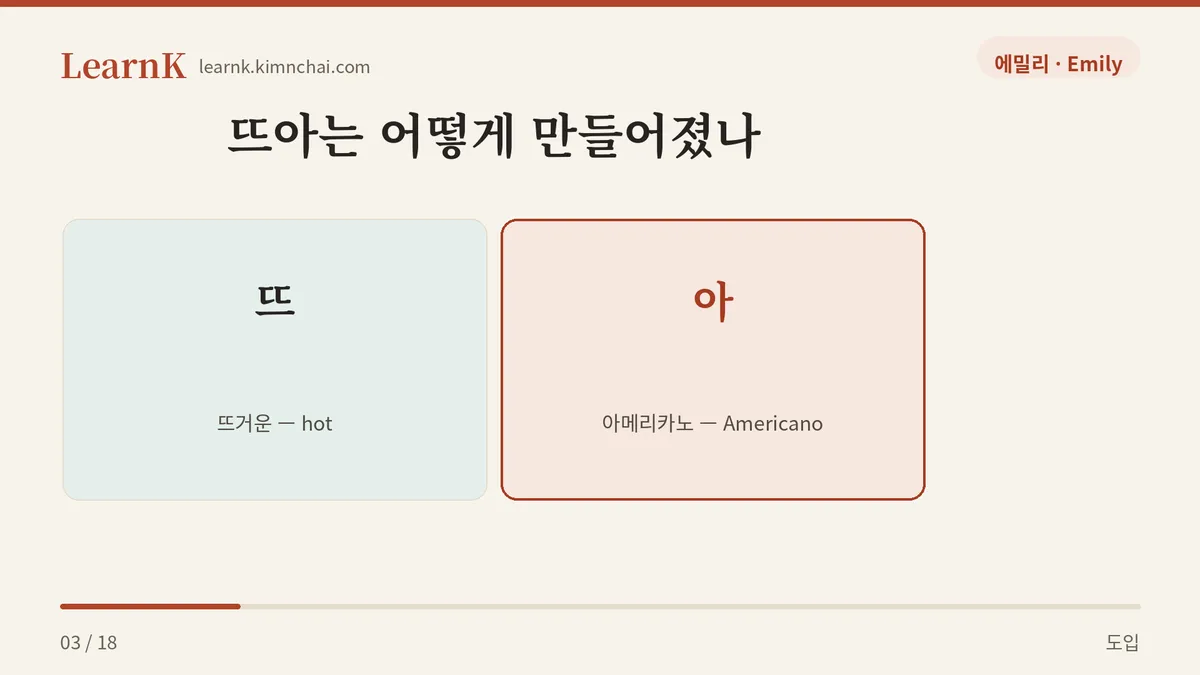
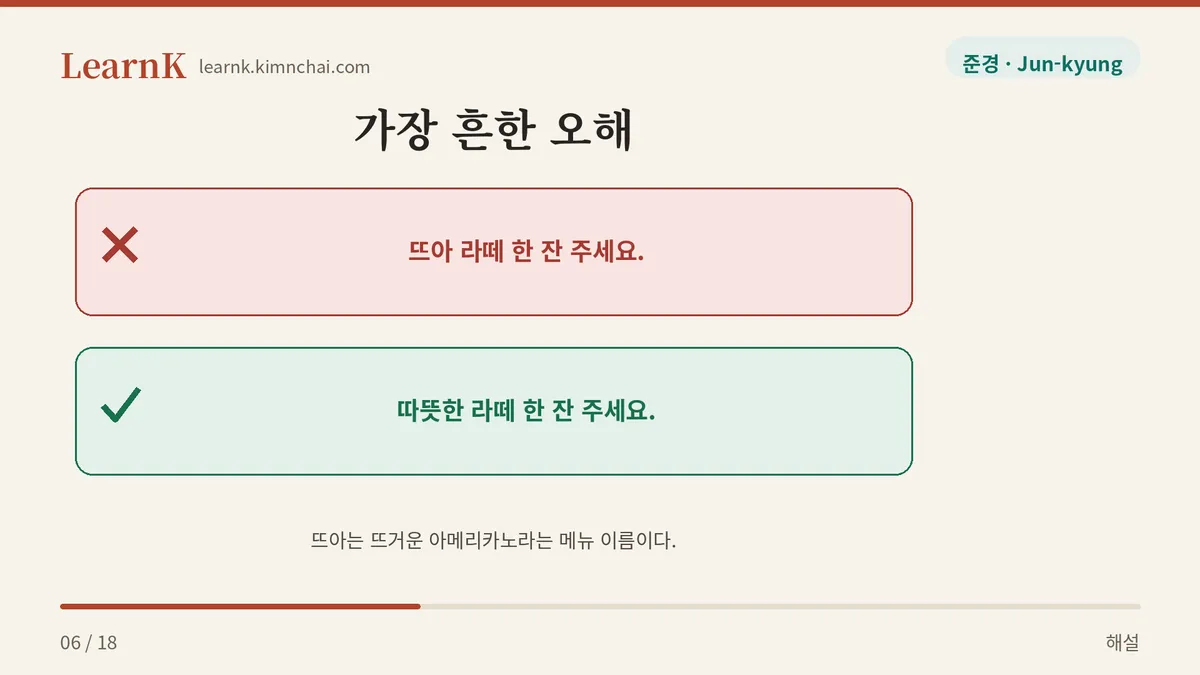
✗ 뜨아 라떼 한 잔 주세요. ✓ 따뜻한 라떼 한 잔 주세요. (ttatteutan latte han jan juseyo.) → The 아 in 뜨아 is the 아 of 아메리카노 (amerikano). In other words, 뜨아 doesn’t mean hot — it’s the name of one specific drink, a hot Americano. You can’t stick it onto a latte, a tea, or a 유자차 (yujacha, citron tea). This is the single most common misunderstanding learners have.
Example sentences by situation
1) Collecting coffee orders at the office The most junior staffer goes desk to desk asking what everyone wants. Here nobody says the full menu name — two syllables and you’re done.
저는 뜨아요. (jeoneun tteuayo.) — 저는 뜨거운 아메리카노로 할게요. (jeoneun tteugeoun amerikanoro halgeyo.) I’ll go with a hot Americano.
Just adding -요 (-yo) makes it polite speech. Even as an abbreviation, it’s not the least bit rude between coworkers.
2) Texting a friend who got there first You’re running a little late. Your friend already has a table, so you ask them to order ahead.
나 5분 늦어. 먼저 뜨아 하나 시켜 줘. (na o-bun neujeo. meonjeo tteua hana sikyeo jwo.) — 나 5분 늦어. 먼저 뜨거운 아메리카노 하나 시켜 줘. I’m five minutes late. Go ahead and order me a hot Americano.
In casual speech it drops straight into the object slot like this. Both 뜨아 하나 (tteua hana) and 뜨아 한 잔 (tteua han jan) sound natural.
3) Ordering at the café yourself This is the most common way to order for two people at once.
뜨아 한 잔이랑 아아 두 잔 주세요. (tteua han janirang aa du jan juseyo.) — 뜨거운 아메리카노 한 잔이랑 아이스 아메리카노 두 잔 주세요. One hot Americano and two iced Americanos, please.
Say this in an actual café and the staff will get it immediately. If anything, it sounds faster and more fluent than the long version.
Politeness levels and related expressions
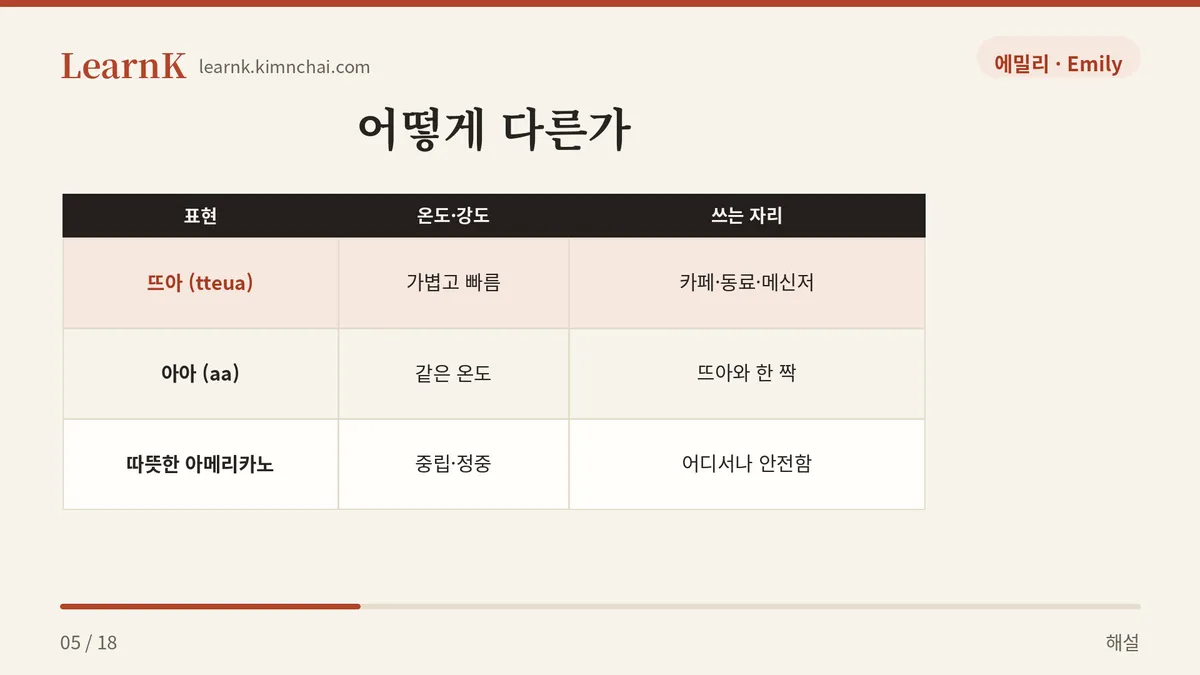
뜨아 (tteua) on its own is neither polite nor casual. What follows it is everything. 뜨아 줘 (tteua jwo) is casual, 뜨아 주세요 (tteua juseyo) is polite, and 뜨아 한 잔 부탁드립니다 (tteua han jan butakdeurimnida) is more formal still. That said, no amount of -습니다 (-seumnida) erases the fact that it’s an abbreviation, so in a genuinely formal setting you’re better off choosing a different expression from the start.
| Expression | Register / intensity | Where to use it |
|---|---|---|
| 뜨아 (tteua) | Light and quick; for people you’re at ease with | Café orders, coworkers, texting. Not with a senior you’ve just met |
| 아아 (aa) | Same register, opposite drink | The other half of the pair. Heard constantly even in midwinter |
| 따뜻한 아메리카노 (ttatteutan amerikano) | Neutral, polite | Safe anywhere. Elders, formal settings, a place you’re visiting for the first time |
| 얼죽아 (eoljuga) | Strong and playful | Peers, social media. It labels a person, like a nickname, not a drink |
Cultural background — why it had to shrink to two syllables
The word-formation is simple: take the first syllable of 뜨거운 (tteugeoun) and the first syllable of 아메리카노 (amerikano) and stick them together. The same method turns 아이스 아메리카노 (aiseu amerikano) into 아아 (aa). Korean has long had this habit of keeping only the first syllable of each word, and the more often a phrase gets repeated in a day — like a coffee order — the faster that compression happens.
A word worth learning alongside it is 얼죽아 (eoljuga). It’s short for 얼어 죽어도 아이스 아메리카노 (eoreo jugeodo aiseu amerikano), roughly “iced Americano even if I freeze to death,” and it refers to people who insist on cold coffee in below-freezing weather. The taste is common enough that Koreans joke about how iced-Americano sales barely dip in winter cafés. Which is why the person ordering 뜨아 (tteua) often ends up explaining themselves — weak stomach, coming down with a cold, hands too cold to hold anything else.
Office culture fed the word too. One person ordering coffee for eight teammates after lunch is a stock scene in Korean workplace dramas, and there’s no way to write down eight full menu names. 뜨아 셋, 아아 넷, 라떼 하나 (tteua set, aa net, latte hana) — three hot Americanos, four iced, one latte — that’s the only way your hand keeps up. The same goes for gathering orders in a KakaoTalk group chat. It’s a word that survived in a place where shorter always wins.
That’s what makes the expression both practical and symbolic for Korean learners. Two syllables show you at once how thoroughly Korean cafés revolve around the Americano and how aggressively people compress their speech. The moment you say 뜨아 (tteua) at a café counter, the person across the counter will feel that you’re not a tourist — you live here.
Today’s quiz
Which of the following uses 뜨아 (tteua) incorrectly?
- 저는 뜨아요. 얼음 빼고요.
- 부장님, 처음 뵙겠습니다. 뜨아 한 잔 드릴까요?
- 나 먼저 가 있을게. 뜨아 하나 시켜 놔.
Answer: 2. 뜨아 (tteua) is an abbreviation for people you’re comfortable with, so it sounds too casual directed at a senior you’re meeting for the first time. 따뜻한 아메리카노 한 잔 드릴까요? (ttatteutan amerikano han jan deurilkkayo?) is the safe choice. As a side note, sentence 1 may also strike you as odd — 뜨아 is a hot drink to begin with, so 얼음 빼고요 (eoreum ppaegoyo, “no ice, please”) is unnecessary. But that’s just redundancy, not rudeness.
The definitions, example sentences, and dialogue in this post are all original writing. 뜨아 (tteua) is not a headword in the National Institute of Korean Language’s Basic Korean Dictionary, so nothing here was quoted from a dictionary.